
Some cities are visited; others are inhabited. Quebec belongs to the second category. Founded by French explorer Samuel de Champlain in the early 17th century, the capital of the Canadian province of Quebec is the only city in North America to have preserved its ramparts, along with bastions, gates, and defensive works that still surround the old town. Walking its streets is not an exercise in archaeology: it is an immersion in a living city where heritage is not displayed but used.
The Historic District of Old Quebec, inscribed on UNESCO’s World Heritage List in 1985, covers about 135 hectares divided between the Upper Town, atop Cap Diamant, and the Lower Town, around Place Royale and the harbour. This geographical duality explains much of its character: a city that folds in on itself, that rises and falls, that forces you to look up and down without losing sight of the St. Lawrence River.
A citadel that orders the landscape
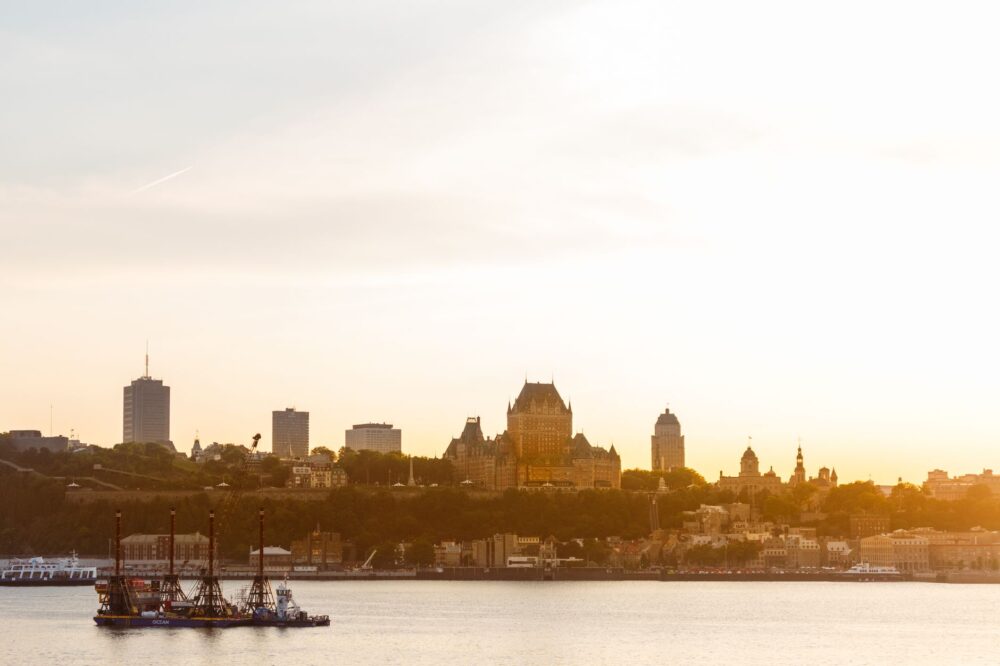
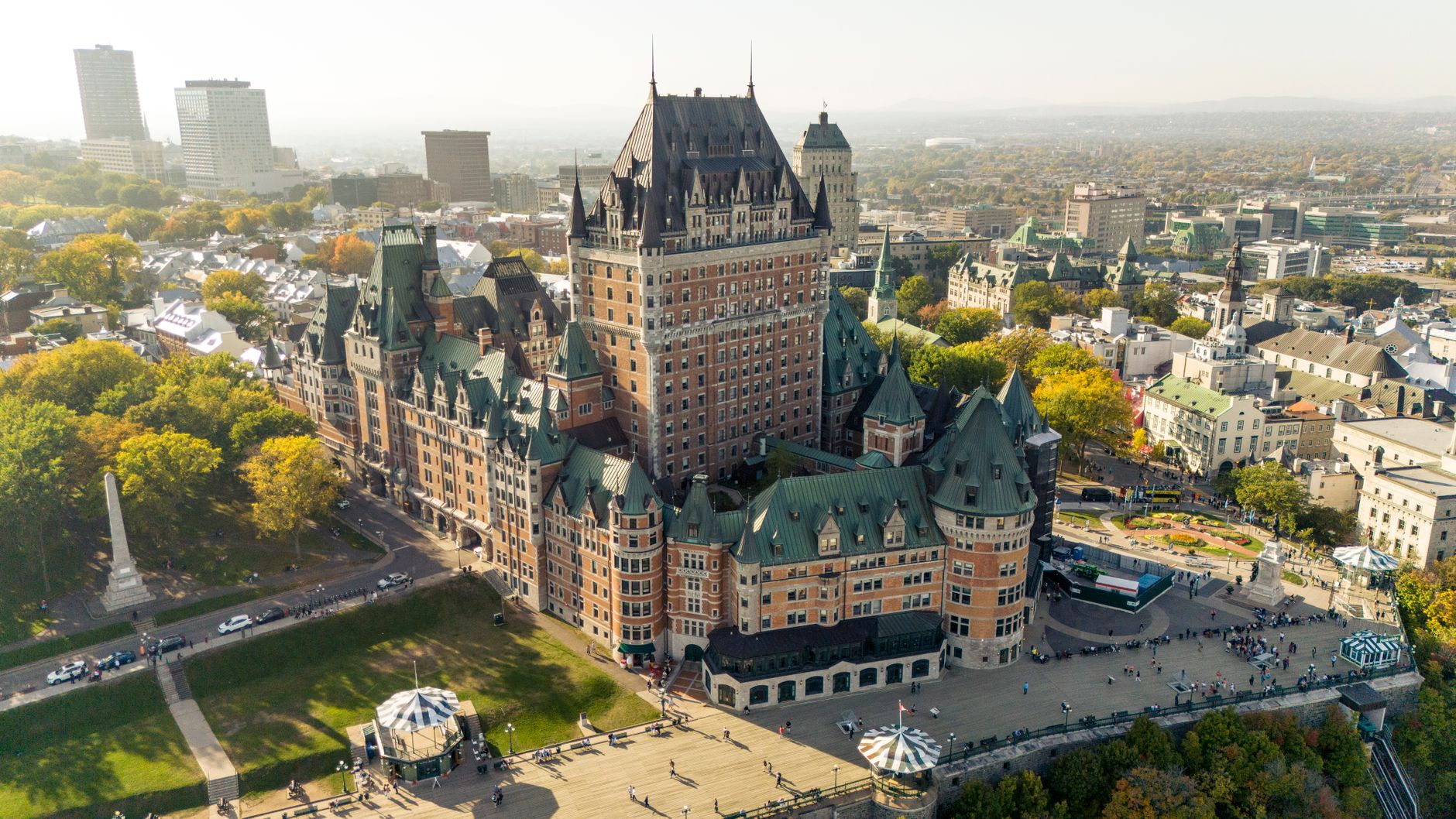
Quebec’s silhouette is best understood from the Citadel, the star-shaped fortress built by the British after the Seven Years’ War. It is not an isolated monument: it is the piece that closes the defensive system and remains an active space today, with a military presence and guided tours. From its walls, the city unfolds immediately: below, the river; above, copper and slate roofs; ahead, the Château Frontenac, that hotel that looks like a castle and has become the city’s unwitting symbol.
The Château Frontenac, opened in the late 19th century, is not a historic building in the strict sense, but its presence has shaped Quebec’s contemporary image. Visitors photograph it from the Dufferin Terrace, a landscaped promenade offering one of the most recognisable views on the continent. It is a good place to start, but also to understand that Quebec is not limited to that postcard.

The Upper Town: convents, churches, and administration
The Upper Town has been Quebec’s religious and administrative centre since its founding. Here you find Notre-Dame Cathedral, the Quebec Seminary—the oldest in North America—and the Ursuline Convent, founded in the 17th century and still active. These are not closed museums: they are institutions that have accompanied the city’s life for centuries.
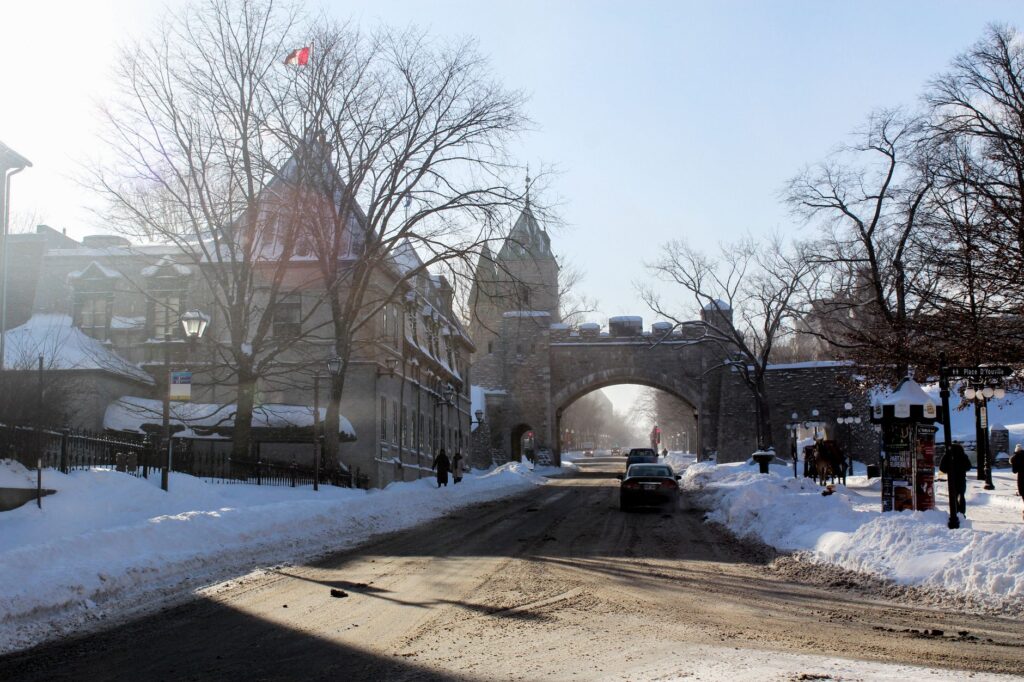
The Dauphine Redoubt, a small stone fortification, reminds us that the city was for a long time an outpost in a disputed territory. Walking along rue Saint-Louis or rue Sainte-Ursule means walking among grey stone houses, sloping roofs, and small windows designed for an unforgiving climate. Winter, with its heavy snowfall, transforms the city into an even quieter and more sheltered place.
Quebec’s heritage is not a backdrop for tourists: it is the material support of a community that lives, works, and organises itself within its walls.
The Lower Town: the harbour, Place Royale, and the old quarters
Descending to the Lower Town is a change of scale. Place Royale, the heart of the original French Quebec, preserves the layout and spirit of the 17th century. Here stands the Notre-Dame-des-Victoires church, built on the remains of Champlain’s first dwelling, and the Place Royale Interpretation Centre, which explains the history of trade and daily life in New France.
The Petit-Champlain quarter, with its narrow street and shops, is one of the most photographed, but also one of the most fragile. The influx of visitors has forced authorities to regulate traffic and protect the buildings. For travellers, the key is to explore without rushing, avoiding peak hours and respecting the fact that people live there.

The ramparts: a border that still stands
Quebec’s ramparts are not an archaeological remnant: they are urban infrastructure. They can be walked along a roughly four-kilometre route, from the Citadel to the Saint-Louis and Kent gates. The walk offers changing perspectives of the city and the river, and helps you understand how the defensive system adapted to the terrain.
The Saint-Louis Gate, the oldest, and the Kent Gate, from the 19th century, are the two main entrances to the old town. Crossing them is a daily gesture for residents and a symbolic moment for visitors. The ramparts are managed by Parks Canada, which handles their conservation and signs the routes.
Heritage as a shared responsibility
The protection of Old Quebec does not depend on a single institution. The Province of Quebec’s Cultural Property Act, adopted in 1963, and the 1964 decree that defined the heritage site, established the legal framework. Since then, any intervention in the old town—construction, renovation, restoration, or signage—requires prior authorisation from the City of Quebec’s Urbanism and Conservation Commission.
In addition, a Quebec Heritage Consultation Committee coordinates the different levels of government. The federal government, through Parks Canada, manages numerous historic buildings, including the Citadel. This protection network is not perfect, but it has allowed the ensemble to maintain its integrity and authenticity, as UNESCO recognised when inscribing it.
Quebec’s authenticity lies not only in its stones but in the continuity of its uses: churches remain churches, squares remain squares, and the ramparts still mark the city’s edge.
What it means to visit responsibly
Old Quebec receives millions of visitors each year, and that pressure has consequences. Residents have repeatedly expressed concern about overcrowding, noise, and the loss of local services. For travellers, simple decisions make a difference: staying in small, local establishments, shopping in neighbourhood stores, avoiding peak hours in narrow streets, and respecting residential areas.
It is also useful to understand that Quebec is not only a summer destination. Winter, with its carnival and snow, offers a different and less crowded experience. Spring and autumn are shoulder seasons, with fewer visitors and light that favours photography. In any case, the city invites you to walk, look up, and wonder how such an urban ensemble has been maintained for four centuries.
Beyond the old town
Although the Historic District is the heart of Quebec, the city continues beyond the walls. Saint-Roch, a former industrial area, has transformed into a space of galleries, cafés, and offices. Limoilou, with its residential feel, shows another side of Quebec life. And the Old Port Market, by the river, is a good stop to try local products.
The city is also a good starting point for exploring the province: Île d’Orléans, a few kilometres away, offers rural landscapes and farm products; the Beaupré coast and the Sainte-Anne-de-Beaupré sanctuary attract pilgrims and curious travellers; and Jacques-Cartier National Park, half an hour away, allows a quick contact with nature.
Practical guide
When to go: summer (June to September) is the busiest season, with pleasant temperatures. Winter (December to March) is cold but offers the Quebec Winter Carnival and a less crowded city. Spring and autumn are quiet and offer good light.
Getting around: the old town is best explored on foot. For longer distances, the RTC bus network covers the city. The funicular connects the Lower Town with the Upper Town and is a practical option to avoid steep climbs.
What to see: the Citadel, the ramparts, Place Royale, Petit-Champlain, Notre-Dame Cathedral, the Ursuline Convent, and the Château Frontenac (you can visit the lobby and some public areas).
Where to stay: there are options in the old town, but also in nearby neighbourhoods like Saint-Roch or Limoilou, with more moderate prices and a more local experience.
Tips: wear comfortable shoes, as the streets are steep and cobbled. In winter, warm clothing and appropriate footwear for snow are essential. Respect residential areas and avoid noise at night.
Language: French is the official language; English is spoken in tourist areas, but a greeting in French is well received.
A closing by the river
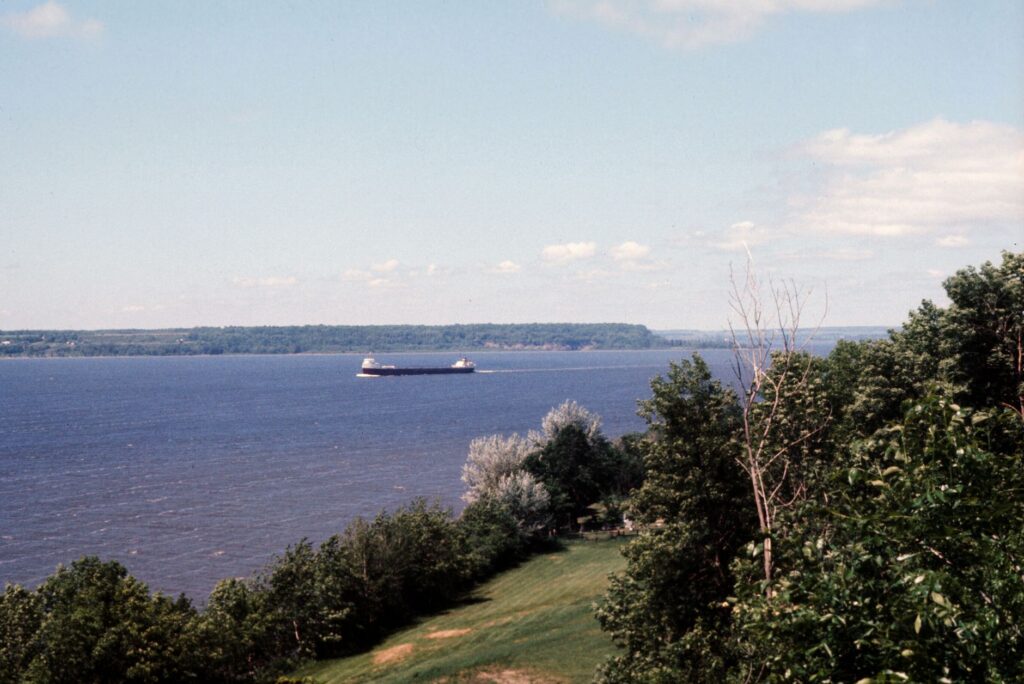
At the end of the day, when the tour groups leave and the streets recover their rhythm, Quebec shows its most serene face. From the Dufferin Terrace, with the St. Lawrence River stretching to the horizon, it is easy to understand why this city has resisted the passage of time without losing its character. It is not a museum: it is a place where history has become daily life, and where travellers have a responsibility not to break that balance.