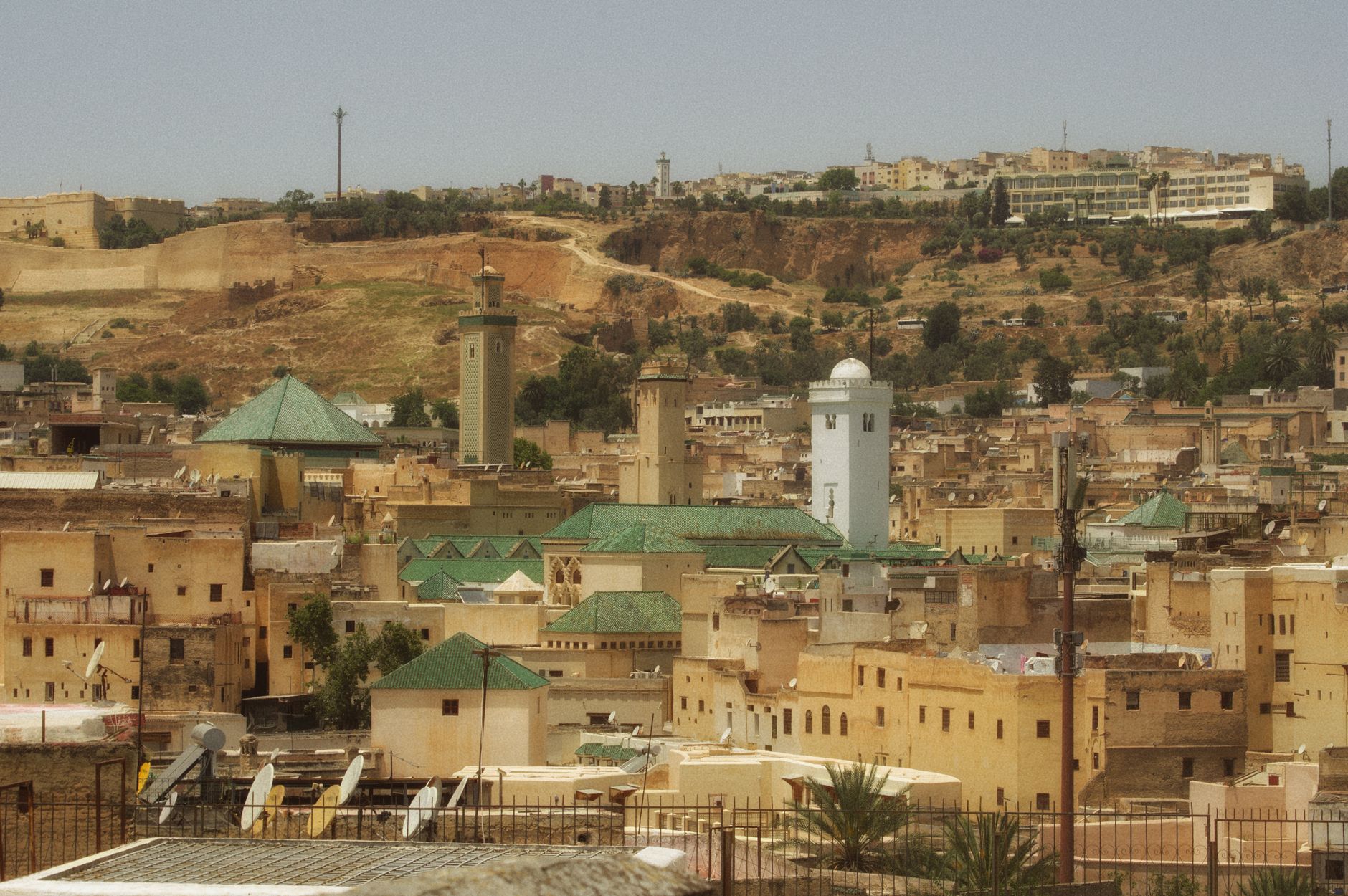

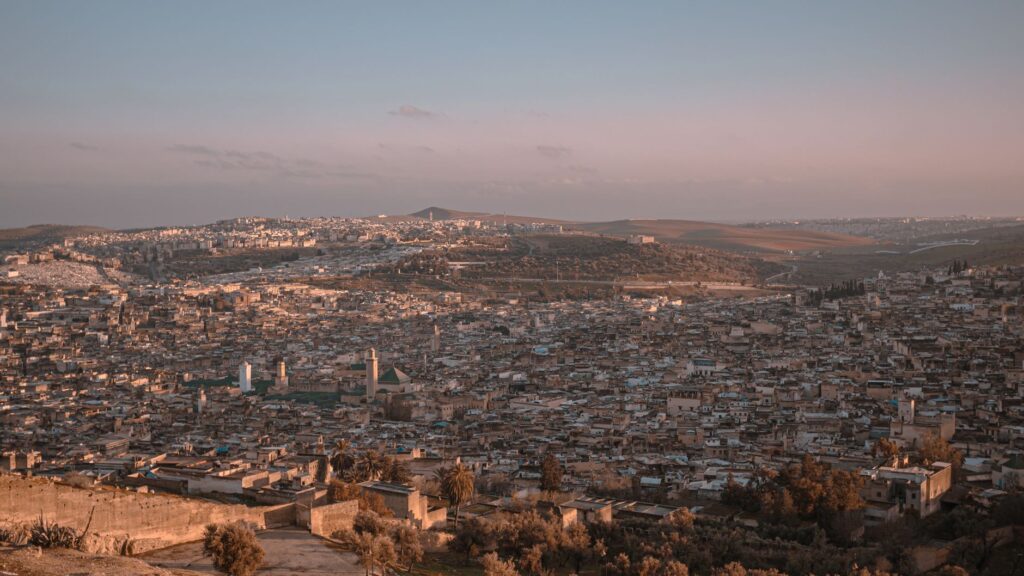
The medina of Fez, founded in the 9th century and flourishing under the Marinids in the 13th and 14th centuries, is a labyrinth of alleys where time seems to stand still. Inscribed as a UNESCO World Heritage site in 1981, it preserves an exceptional urban fabric and monuments: madrasas, fondouks, mosques, and fountains that testify to its past as Morocco’s cultural and spiritual capital. But beyond the stone, what truly keeps the medina alive are the crafts practiced in its workshops, often in the same rooms as centuries ago.
This report explores, based on documentary sources and testimonies gathered from archives and specialized publications, how Fez’s artisans preserve ancestral techniques while facing a changing world. It is not an on-site visit, but a journalistic reconstruction based on available documentation about an intangible heritage that endures.
A heritage you can touch
The medina of Fez is much more than a monumental ensemble. According to UNESCO, its architecture is characterized by construction and decorative techniques developed over more than ten centuries, interweaving local knowledge with Andalusian, Oriental, and African influences. This fusion is materialized in every arch, every tile, and every piece of carved wood. But also in the gestures of those who work leather, metal, or silk.

The site’s outstanding value lies in the fact that its unpaved urban space retains most of its original functions and attributes. It not only represents outstanding architectural, archaeological, and urban heritage but also transmits a lifestyle, crafts, and a culture that persist and renew themselves despite the effects of modern societies. The survival of traditional know-how, especially in building and decoration trades, is a major advantage for maintaining the property’s values.
The tanneries: the craft that dyes the medina
One of the most emblematic crafts of Fez is leather tanning. The tanneries, with their colored vats, are one of the most memorable visual and olfactory spectacles for those who approach the medina. Although up-to-date data on the exact number of workers is not available, historical documents and ethnographic studies agree that this activity dates back centuries and has been passed down from father to son.
The traditional process includes soaking, fleshing, tanning with vegetable substances such as sumac bark, and dyeing with natural pigments. Artisans work in harsh conditions, exposed to strong odors and chemicals. Modernization has introduced some changes, but many families still cling to inherited methods. The continuity of these techniques is a living testimony to the adaptability of Moroccan culture.
“Tanning is not just a job, it is an inheritance we carry on our skin,” recounts an ethnographic document collected by researchers at the University of Fez, underlining the artisans’ pride in a craft they consider part of their identity.
Weaving and embroidery: threads that tell stories
The medina of Fez houses workshops where carpets, djellabas, and silk fabrics are woven. The traditional loom, operated by hand, allows the creation of unique pieces with geometric and floral motifs that vary by family and region. Weavers, often women working from their homes, combine technique with creativity, introducing variations that make each piece irreplaceable.
Embroidery, meanwhile, reaches an extraordinary level of refinement. Gold and silver embroidery workshops, used to make caftans and ceremonial garments, require millimeter precision. Although demand for these products has declined in the face of industrial production, commissions for weddings and festivities continue. The transmission of this knowledge takes place mainly within the family, although some arts and crafts schools attempt to complement that training.
Wood and plaster: architecture as craftsmanship
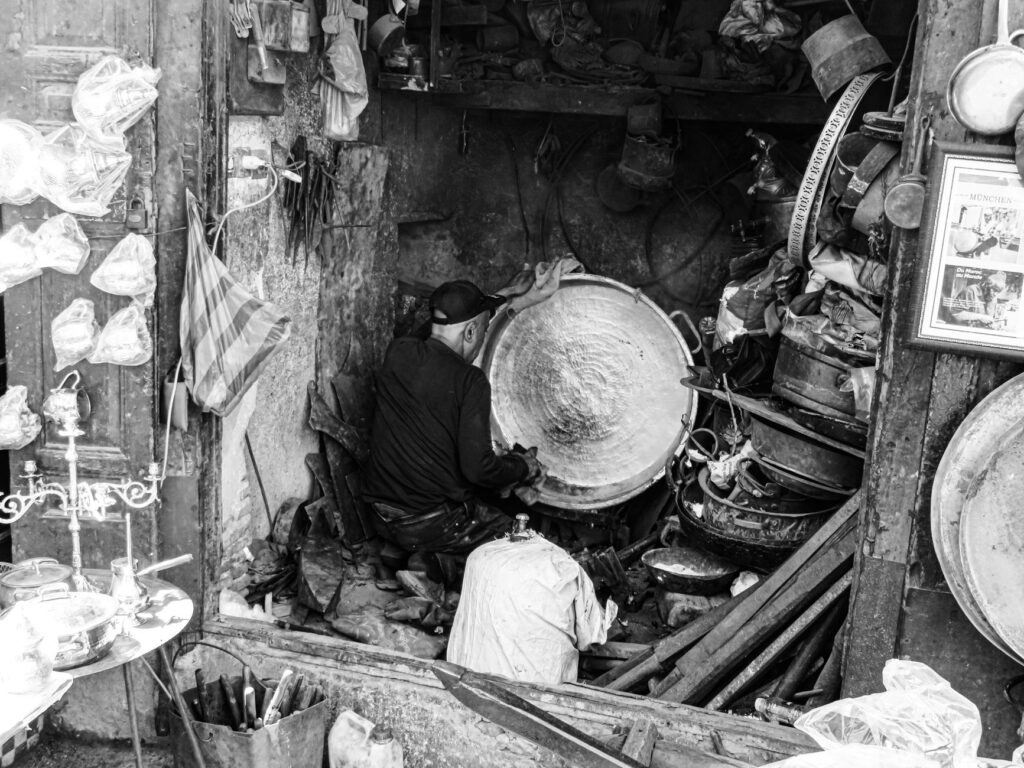
Carpentry and plasterwork are essential for maintaining the historic buildings of the medina. Artisans specialized in wood carving create doors, coffered ceilings, and latticework, while plasterers mold the stucco decorations that adorn courtyards and facades. These techniques, documented since the Marinid era, are still used in the restoration of monuments and homes.
The Agency for the De-densification and Rehabilitation of the Medina of Fez has promoted safeguard programs, but the continuity of these crafts depends on demand and on the ability of new generations to find a livelihood in them. According to UNESCO, the authenticity of the property is maintained thanks to the survival of this knowledge, although the Ministry of Culture works with difficulty to ensure that the different actors respect that authenticity.

The souk and the economy of crafts
The souk of Fez el-Bali is the commercial heart of the medina. Its narrow streets are lined with stalls selling spices, fabrics, carpets, brass lamps, and leather goods. Each guild occupies a specific area, an organization dating back to medieval times. Artisans sell directly or through intermediaries, and although tourism has introduced changes in prices and demand, the guild structure still carries weight.
Competition from industrial products, often imported, has affected some sectors. However, the quality and uniqueness of artisanal pieces allow them to maintain a niche market, especially among informed buyers and collectors. The challenge is to ensure that young people see these crafts as a viable opportunity and not just a relic of the past.
Transmission of knowledge: between family and school
Traditionally, crafts were learned within the family, from childhood. Children accompanied their parents to the workshop and assimilated techniques by imitation. Today, that model coexists with vocational training schools and programs promoted by cultural associations. The University of Fez and other institutions have documented the importance of this knowledge, but also warn about the loss of some minor crafts.

In 2021, UNESCO included Arabic calligraphy and other associated practices on the Representative List of the Intangible Cultural Heritage of Humanity, which has raised awareness of the need to protect this knowledge. In Fez, calligraphy and traditional bookbinding are venerable crafts still practiced in workshops near the Qarawiyyin Mosque, founded in the 9th century and considered one of the oldest universities in the world.
The challenges of conservation and tourism
The medina of Fez faces problems of building deterioration and overpopulation. The Medina Development Plan, adopted in 2001 and re-evaluated every ten years, incorporates provisions to rationalize urban interventions. Tourism pressure, while providing income, can also distort daily life and displace residents. Local authorities have undertaken safeguard actions, but the balance is delicate.
For visitors, it is essential to adopt a respectful attitude: buy directly from artisans when possible, avoid aggressive haggling, and value the time and work behind each piece. Responsible tourism can contribute to the sustainability of crafts, but only if managed with criteria of equity and conservation.
Practical guide
If you wish to learn about the crafts of the medina of Fez up close, keep the following recommendations in mind:
- Best time to visit: spring (March to May) and autumn (September to November) offer mild temperatures, ideal for exploring the alleys.
- Cultural respect: dress modestly, covering shoulders and knees. Ask permission before photographing artisans in their workshops.
- Responsible shopping: purchase products directly from workshops or cooperatives. Avoid excessive haggling; a fair price recognizes the value of artisanal work.
- Tours: hire accredited local guides who know the history of the guilds. Some routes include visits to tanneries, weaving workshops, and carpentry shops.
- Accessibility: the medina is pedestrian and its streets are narrow and often uneven. Wear comfortable shoes and be prepared to walk.
- Language: Arabic and French are the most useful languages; English is spoken in many tourist establishments.
- Currency: the Moroccan dirham. It is advisable to carry cash, although some shops accept cards.
“The medina is not a museum, it is a living organism. Every time we buy a handmade piece, we help that organism keep breathing,” states a report by the Agency for the De-densification and Rehabilitation of the Medina of Fez.
A future woven by hand
The medina of Fez has endured for more than a thousand years. Its artisans are the guardians of a legacy that belongs not only to Morocco but to humanity. The survival of their crafts will depend on their ability to adapt, recognition of their value, and the support of visitors and authorities. At the end of the day, when the sun sets over the minarets, the sound of hammers and looms continues to set the rhythm of a city that refuses to be just a memory.
That artisanal pulse is the true essence of Fez, a place where past and present intertwine in every stitch, every chisel stroke, every piece of tanned leather. A heritage that can be touched, smelled, and above all, respected.