In the heart of the Western Sahara, where the horizon dissolves into a perpetual mirage of sand and haze, beats an iron artery that defies the laws of geography and industrial logic. The Mauritanian Ore Train is not merely a means of transport; it is a feat of mechanical endurance that articulates the survival of an entire nation. With a length that often exceeds two and a half kilometers, this iron serpent carries thousands of tons of ore from the mines of Zouérat to the Atlantic port of Nouadhibou, traversing one of the most inhospitable territories on the planet.
To the outside observer, the train represents a relic of 20th-century engineering operating under extreme conditions. For Mauritanians, it is the umbilical cord connecting remote inland settlements with global trade. This report explores the technical complexity of maintaining a railway in an environment where sand dunes shift like slow waves, and the human dimension of those who, out of necessity or a spirit of adventure, choose to travel in the open atop the freight cars, shrouded in the reddish dust that permeates everything.
The Backbone of a Desert Nation
The history of this railway line is the story of Mauritania’s quest for autonomy. Inaugurated in 1963 by the company MIFERMA and later nationalized by the Société Nationale Industrielle et Minière (SNIM), the 704-kilometer track was designed for purely extractive purposes. However, over the decades, it has become an irreplaceable social infrastructure. In a country where roads are scarce and the terrain is unforgiving, the train functions as the only regular logistical service capable of moving not just iron, but also water, food, livestock, and people.
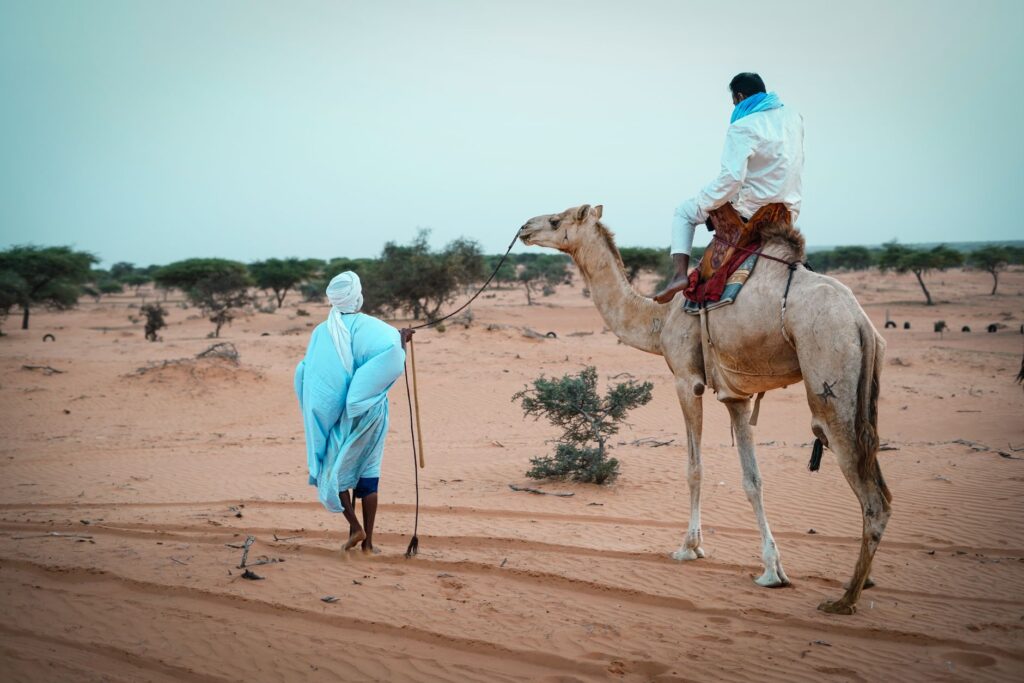
The route is an almost straight line that skirts the political borders of the Western Sahara, heading deep into the desert. The operation is a ballet of brute force: high-horsepower diesel locomotives pull up to 210 hopper cars, each loaded with 84 tons of ore. The pressure on the rails is constant, and the wear caused by sand abrasion demands maintenance that knows no rest. Keeping this track operational is a daily war against erosion and extreme heat, which can easily exceed 50 degrees Celsius during the day.
“The train waits for no one, but everyone waits for it. It is the only clock that works in the desert.”
SNIM’s logistics is one of the most efficient on the African continent, despite technological limitations. Engineers must anticipate the movement of dunes, which can bury entire sections of the track in a matter of hours after a sandstorm. Cleaning crews and surveillance patrols constantly roam the route, ensuring that the flow of ore—which represents nearly 50% of the country’s exports—never stops.
Resilience Engineering: 2.5 Kilometers of Steel
From a technical standpoint, the Mauritanian Train is a fascinating anomaly. Most freight trains in the world operate in controlled environments or with constant support infrastructure. Here, locomotives must be equipped with high-efficiency air filtration systems to prevent silica dust from destroying the engines. The total weight of the convoy can reach 22,000 tons, requiring masterful management of braking and acceleration to prevent tension forces from breaking the couplings between cars.
Traction is typically handled by three or four diesel-electric locomotives, often American models adapted to Saharan conditions. The roar of these engines is the only sound that breaks the absolute silence of the desert for miles around. The vibration generated by the passing train is felt in the ground long before the silhouette of the convoy appears on the horizon. It is a demonstration of industrial force applied to survival in an environment that rejects any form of human permanence.
In addition to the ore cars, the train usually includes a passenger car—often overcrowded and precarious—and platforms for transporting vehicles and supplies. However, the most iconic and raw image is that of the hundreds of locals who travel for free atop the iron ore. It is a 12-to-20-hour journey under a scorching sun or a bone-chilling night cold, where the only protection is a turban or *cheche* and one’s own physical resilience.
Life Atop the Ore: Passengers of the Void
Traveling on the SNIM train is an experience that redefines the concept of transport. There are no tickets, no seats, and no services. Traders carrying goods from the coast to the interior settle atop the mountains of iron dust, securing their bundles of tea, sacks of rice, and, occasionally, live goats. The dust is omnipresent; it gets into the eyes, the lungs, and stains the skin a metallic ochre tone that takes days to disappear.
Despite the hardship, there is a silent solidarity among the passengers. Embers are shared to heat tea on small stoves atop the moving ore, defying the wind and the jolts of the convoy. It is a space of transit where social hierarchies dissolve before the immensity of the landscape. For many, this journey is the only way to maintain commercial ties between the nomadic communities of the Adrar and the urban centers of the coast.

Night on the train offers one of the purest celestial spectacles in the world. With no light pollution for hundreds of kilometers, the sky unfolds with overwhelming clarity. However, the visual beauty clashes with physical reality: temperatures drop drastically, and the wind becomes biting. Survival on the train requires meticulous planning of clothing and water, as a breakdown in the middle of the desert can leave passengers isolated for hours under critical conditions.
Zouérat: The Iron Heart of the Adrar
The source of this constant flow of wealth and effort is Zouérat, a mining town born from iron. Here, the earth has been excavated to create monumental craters visible from space. Activity is incessant; massive mining trucks, whose wheels exceed the height of a man, feed the crushers that prepare the ore for its long journey to the sea. The city is an industrial enclave in the middle of nowhere, where life revolves exclusively around the rhythm of the mine.
SNIM not only manages the mine but is the main provider of services in the region, from electricity to medical care. This dependence creates a complex symbiosis between the company and the population. The logistics of maintaining thousands of workers in this environment requires a perfectly oiled supply chain, where the return train—the one coming back empty from Nouadhibou—plays a crucial role by bringing drinking water in tanker cars and fresh food.
“If the train stops, Mauritania stops. This is not a metaphor; it is our economic reality.”
The environmental impact of mining in Zouérat is evident, but in a country with limited resources, iron is the engine of development. Waste management, dust control, and occupational safety are constant challenges for a company that competes in a global raw materials market while operating under frontier conditions.
Logistics in the Void: Maintaining a Lonely Track
The maintenance of the railway track is perhaps the least visible but most heroic aspect of the entire operation. The rails are subject to extreme thermal expansion, expanding under the midday sun and contracting in the freezing desert nights. This can cause deformations in the steel that, if not detected in time, would cause catastrophic derailments. Since the train is so heavy, any incident on the track requires days of work to clear and repair.
There are intermediate technical stations, such as Choum or Fderik, where the train makes brief stops. At these points, logistical precision is vital. Choum, in particular, is a strategic node where many passengers board or disembark to head to the tourist region of Atar. The interaction between the freight train and local life at these stops is a reminder of how industrial technology adapts to the most basic human needs.
Digitalization has timidly reached SNIM’s management, with satellite tracking systems for locomotives, but physical inspection remains the gold standard. The human eye is the only thing capable of distinguishing an incipient dune from a mere shift in the sand’s shadow. Track crews live in isolated camps, rotating shifts to ensure that the 700 kilometers of steel remain passable 365 days a year.

Practical Guide
Traveling on the Mauritanian Ore Train is not a conventional tourist activity and carries significant risks. There are no official schedules published for the general public, as the train is governed by the needs of the mine, although there is usually a daily departure from Nouadhibou in the evening and another from Zouérat at the end of the day.
- Access Point: Most travelers opt for the Nouadhibou-Choum segment. Choum is the gateway to the dunes of Chinguetti and Ouadane.
- Essential Gear: It is mandatory to wear a *cheche* (long turban) to protect against iron dust, which is extremely fine and penetrating. Ski goggles or industrial safety glasses are highly recommended to prevent eye injuries from wind and sand.
- Clothing and Climate: Technical warm clothing is required for the night (temperatures can drop below 5 degrees Celsius) and full sun protection for the day. Iron ore absorbs and radiates heat.
- Supplies: You must carry all water (minimum 5 liters per person) and food needed for 24 hours, as there are no supplies on board.
- Safety: Traveling on top of the cars is legal but dangerous. Choose a car that is loaded (the ore is more stable than the bottom of an empty car) and stay away from the edges to avoid falling during the train’s sudden jolts.
The Echo of the Dunes and the Future of Iron
As the world moves toward an energy transition, the demand for high-quality iron, such as that extracted in Zouérat, remains fundamental for global infrastructure. Mauritania faces the challenge of modernizing its industry without losing the essence of this transport system that defines its identity. There is talk of new railway projects and the expansion of mines, but the Desert Train will remain, for a long time, the ultimate symbol of Mauritanian tenacity.
At the end of the journey, when the train enters the Nouadhibou peninsula and the smell of salt spray replaces the dry desert dust, a sense of deep respect for the scale of the operation remains. The train is a reminder that even in the emptiest places on Earth, human ingenuity and economic necessity are capable of tracing paths of steel that unite opposite worlds. The iron that travels across the Sahara today will end up converted into skyscrapers or bridges in some distant place, but its soul will always belong to the silence of the dunes.