
In the heart of Paris’s 13th arrondissement, behind the brick and stone walls flanking the Avenue des Gobelins, time seems to be governed by a rhythm far removed from the frantic pulse of the French capital. Here, silence is not an absence, but an atmosphere thick with concentration, interrupted only by the rhythmic tapping of wooden tools and the soft friction of wool against the warp. The Manufacture des Gobelins is not merely a living museum; it is the epicenter of an aesthetic resistance that has survived revolutions, regime changes, and the whirlwind of industrialization, keeping intact one of the most complex forms of human expression: the high-warp tapestry.
Entering these workshops means stepping into a sanctuary where constant, generous northern light bathes vertical looms that rise like giant harps toward the ceiling. The craft of the licier—the high-warp weaver—is a dance of extreme patience and absolute precision, a labor where progress is measured in mere square centimeters per day. In this feature, we delve into the universe of the Manufacture, exploring everything from the alchemy of its dyes to the symbiosis with contemporary artists who are currently redrawing the future of this millenary tradition.
The Sanctuary of Thread: Three Centuries of Excellence on the Bièvre
The history of this enclave dates back to the 15th century, when Jean Gobelin established a dyeing workshop on the banks of the Bièvre River, whose waters were famous for their purity and properties for fixing colors. However, it was in 1662 that Jean-Baptiste Colbert, under the reign of Louis XIV, transformed the site into the Manufacture Royale des Meubles de la Couronne. The goal was ambitious: to centralize the production of furniture, tapestries, and luxury objects to decorate royal palaces, especially Versailles, and to project France’s grandeur through its decorative arts.
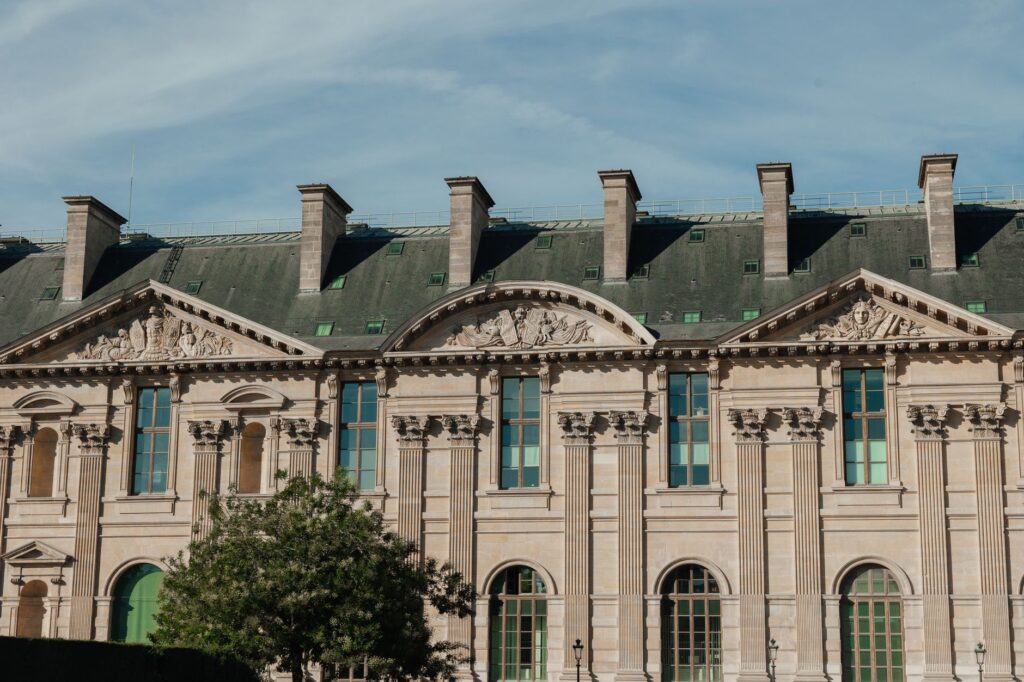
Throughout the centuries, the Manufacture has successfully adapted without losing its essence. What began as a tool for monarchical propaganda evolved into a laboratory for technical innovation. Today, under the tutelage of the Mobilier National, the Gobelins remain the global benchmark for tapestry. The current workshops do not just guard historical pieces; they function as active creative centers where cartoons—the original designs—by the most relevant artists of our time are interpreted, maintaining a chain of knowledge passed from master to apprentice with almost monastic rigor.
The High-Warp Technique: The Art of Weaving Blind
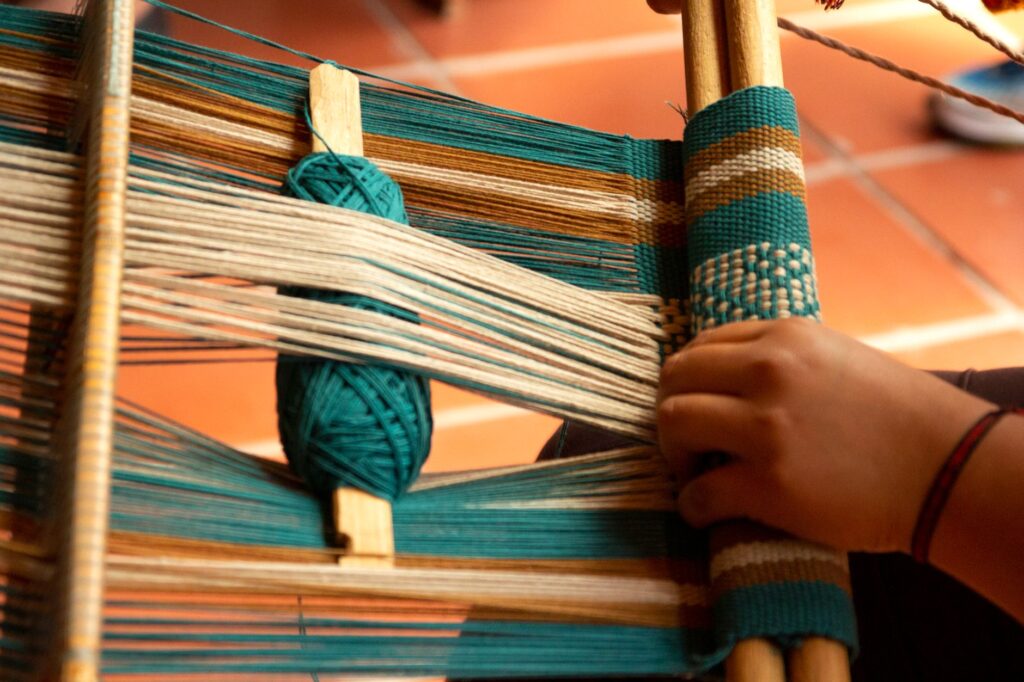
What distinguishes the Gobelins from other production centers is its mastery of haute-lisse, or high-warp. Unlike low-warp, where the loom is horizontal and operated with pedals, high-warp utilizes vertical looms. This arrangement forces the artisan to work from the back of the tapestry, observing progress through a mirror placed in front of the warp. It is a technique that demands an astonishing capacity for abstraction: the weaver must interpret the original design, situated behind them, and translate it into a structure of crossed threads without directly seeing the final result until the work is removed from the loom.
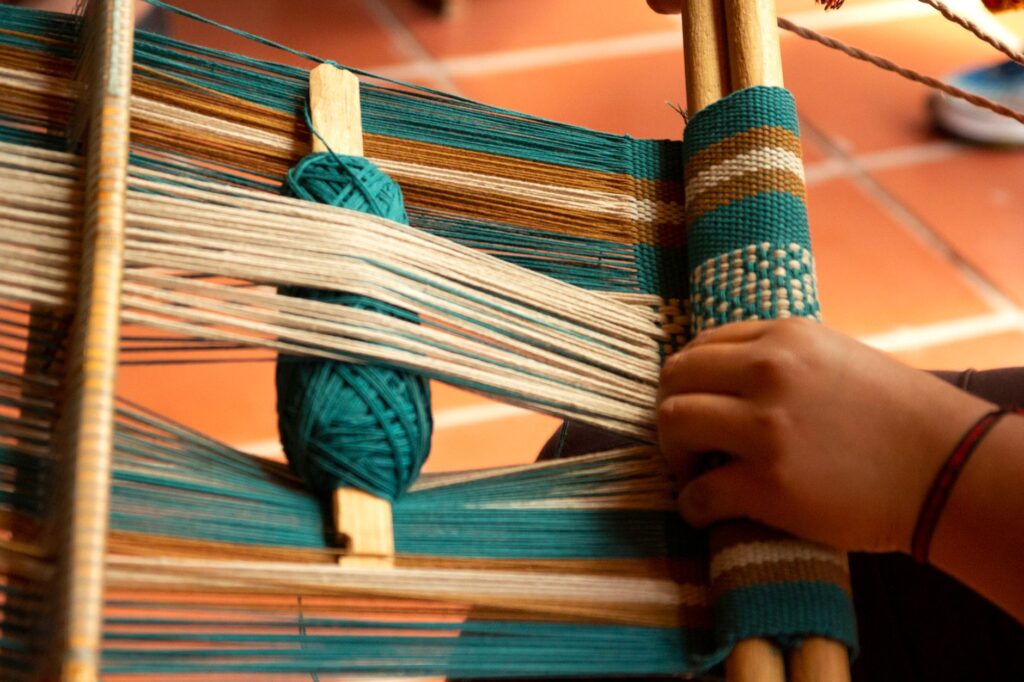
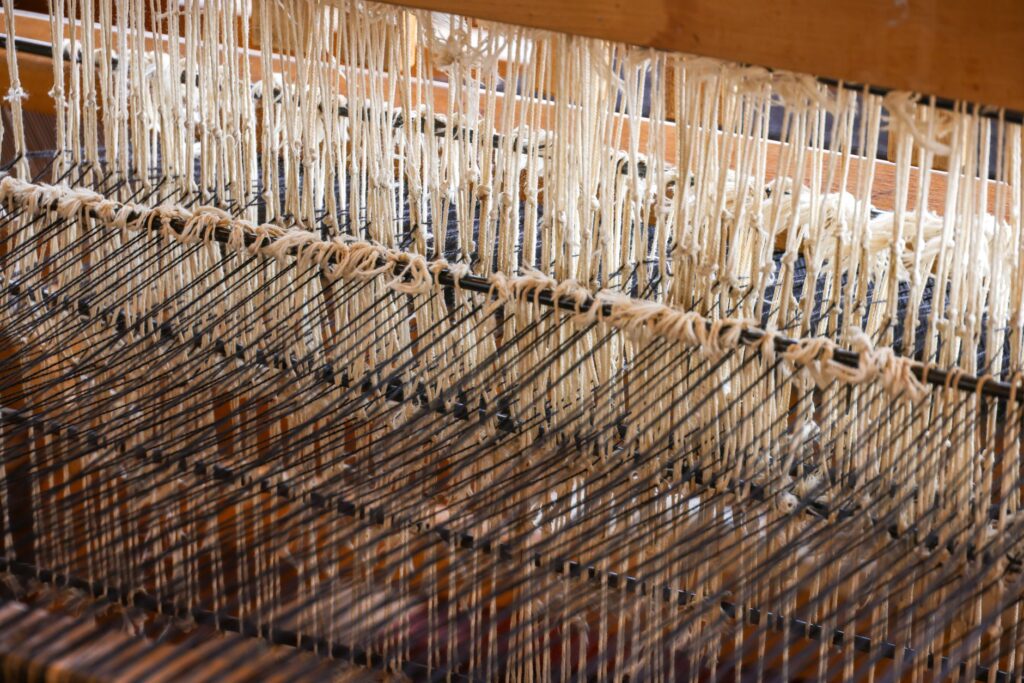
Each warp thread, generally made of wool or cotton, is manually manipulated using lissettes, small thread loops that allow the layers to be separated to introduce the weft. The licier’s tools are simple yet specialized: the broche (a wooden bobbin loaded with colored thread) and a comb made of ivory or wood to tighten the rows. The complexity lies in the blending of threads; to achieve a perfect color gradation, the artisan may combine up to six or seven strands of different shades on a single bobbin, creating a pictorial effect that rivals oil painting.
“A tapestry is not a copy of a painting, but a transmutation of matter where the thread acquires the depth of light and the permanence of stone.”
This labor is so meticulous that a medium-sized tapestry can require several years of uninterrupted work. The production rate is approximately one square meter per year per artisan. This temporality, radically opposed to contemporary immediacy, confers a metaphysical value upon each piece: the tapestry is, literally, solidified time.
The Language of Color: Alchemy in the Dye Workshop
The excellence of the Gobelins cannot be understood without visiting its dyeing workshop. This is where the chromatic magic begins. The Manufacture’s nuancier (color chart) boasts over 20,000 different shades, a palette that has been enriched since chemist Michel-Eugène Chevreul, director of dyes in the 19th century, developed his famous theory of the simultaneous contrast of colors. His discoveries did not only revolutionize tapestry but also profoundly influenced Impressionist and Pointillist painters.
In large copper vats, master dyers prepare baths using high-stability pigments. The process is a delicate balance between science and visual sensitivity. Each batch of wool or silk must be dyed with such precision that no imperceptible variations occur, which could ruin the uniformity of a background in the tapestry. Light is the supreme judge in this department; samples are compared under different lighting conditions to ensure the color will maintain its vibration for centuries.
Patience as a Metric: Time Suspended in the Loom
Daily life in the workshop is marked by a cadence that invites reflection. Artisans work in pairs or trios in front of the same loom, coordinating their movements in a silent choreography. There is no room for error; a poorly executed area can mean weeks of unweaving. This pressure, however, is met with enviable serenity. The licier develops an intimate relationship with the work, knowing every knot and every color transition as if they were part of their own biography.
Training a weaver at the Manufacture lasts a minimum of five years, but it is said that twenty are needed to reach total mastery. During this period, the apprentice not only learns manual technique but also educates their eye to understand composition, shadow, and volume. It is a comprehensive aesthetic education that ensures the artisan is not a mere executor but a sensitive interpreter of the artist’s thought.
From Cartoon to Textile: Collaborating with Contemporary Artists
Contrary to what one might think, the Manufacture des Gobelins is not anchored in the past. Its current mission is to collaborate with leading figures in contemporary art, design, and architecture. Artists like Louise Bourgeois, Sheila Hicks, and Matali Crasset have seen their visions transformed into wool and silk on these looms. The process begins with the cartoon, an original work that the licier must visually dismantle to map its translation into fabric.
This collaboration is often a technical challenge. Contemporary artists propose textures, reliefs, and chromatic plays that force master weavers to reinvent their methods. Sometimes, the resulting tapestry incorporates unusual materials or abandons traditional two-dimensionality to become a textile sculpture. This open-mindedness is what allows the Gobelins to remain relevant in the world’s most important galleries and museums, proving that tapestry is a medium as valid and potent as canvas or video art.
The Mobilier National: Guardians of State Heritage
The Manufacture des Gobelins is part of the Mobilier National, the institution responsible for furnishing the official residences of the French Republic, such as the Élysée Palace or French embassies abroad. This institutional role ensures that the works created in the workshops do not end up in forgotten warehouses but fulfill their original purpose of decorating and dignifying public spaces.
In addition to creating new pieces, the Gobelins complex houses world-class restoration workshops. Here, experts in conservation work on tapestries from the 17th and 18th centuries, restoring their structural and chromatic integrity. It is a work of textile surgery where original materials and techniques are scrupulously respected, allowing France’s historical heritage to remain accessible for future generations.
“Preserving a craft is not about worshipping the ashes, but about keeping the fire burning through innovation and respect for the material.”
The Transmission of the Gesture: Training the Next Generation
The future of the Manufacture lies in its training school, a space where young talents are selected each year to perpetuate the tradition. The selection process is rigorous, looking not only for manual skill but also for deep artistic sensitivity and patience that can withstand frustration. Students learn in a real workshop environment, surrounded by masters who generously share their secrets.
This transmission of the gesture is fundamental. In an increasingly digitized world, the value of the tactile and the handmade acquires an almost revolutionary dimension. Today’s young liciers are aware that they carry a torch that has illuminated European culture for centuries. Their challenge is to find the balance between respecting academic rules and the need to express 21st-century concerns through warp and weft.
Practical guide
For those interested in immersing themselves in this universe of threads and mirrors, the Manufacture des Gobelins offers various ways to visit. The complex is located at 42 Avenue des Gobelins, Paris. Guided tours are essential to understanding the magnitude of the work, as they provide access to the working workshops, which is not possible through general admission to temporary exhibitions.
- Location: 42 Avenue des Gobelins, 75013 Paris. Metro: Les Gobelins (Line 7).
- Workshop Tours: These are conducted exclusively by prior reservation and usually take place on Tuesdays, Wednesdays, and Thursdays. It is advisable to book several weeks in advance through the official Mobilier National website.
- Exhibition Gallery: The Galerie des Gobelins features temporary exhibitions linking historical collections with contemporary design. Open Tuesday to Sunday, 11:00 AM to 6:00 PM.
- Recommendation: Combine your visit with a walk through the nearby Square René-Le Gall, a garden occupying part of the former dyers’ grounds, offering a unique perspective on the complex’s industrial architecture.
- Cultural Context: Do not miss the nearby Manufacture de la Savonnerie (carpets) and Manufacture de Beauvais, which share the site and the philosophy of excellence.
Walking through the corridors of the Gobelins at dusk, as the light recedes from the looms and the weavers put away their bobbins, is an experience that reconciles the visitor with the human capacity to create beauty without haste. It is a reminder that some things, to be truly sublime, require the slow passage of years and the absolute dedication of a life committed to detail. The tapestry, in the end, is a mirror of our own history, woven with the rigor of memory and the hope of color.