
The Shadow Over the Wet Miami Tarmac
Dawn over Miami International Airport does not always bring clarity. In September 2026, the routine of international air traffic was abruptly interrupted when a cargo Boeing 767 operated by 21 Air overshot the runway during a landing maneuver. While no severe fatalities were reported, the material and symbolic impact shook the foundations of modern logistics. The aircraft was transporting goods managed under Amazon’s distribution network, a company that has built its empire on the promise of logistics immediacy and uninterrupted transcontinental connectivity.
Hours after the incident, the corporate response was swift. Far from minimizing the event or delegating responsibility entirely to subcontractors, the e-commerce giant issued a concise yet forceful statement: indefinitely pausing its business relationship with 21 Air. This measure directly impacts a fleet of cargo aircraft connecting key distribution hubs in North America and the Caribbean. The Miami accident transformed overnight into an uncomfortable mirror reflecting the operational and environmental risks of a global supply chain operating at the edge of its capacity.
The Invisible Backbone of E-Commerce
For the average consumer, the online shopping experience boils down to a couple of clicks and the punctual appearance of a brown box on the doorstep. Yet, behind that apparent simplicity operates a titanic machinery of air, land, and maritime transport. Amazon Air, the company’s dedicated freight division, was created precisely to reduce reliance on traditional carriers like FedEx or UPS by internalizing control over delivery timelines. Nevertheless, across secondary corridors and specialized operations, the company continues to rely on charter airlines and third parties like 21 Air to absorb demand spikes.
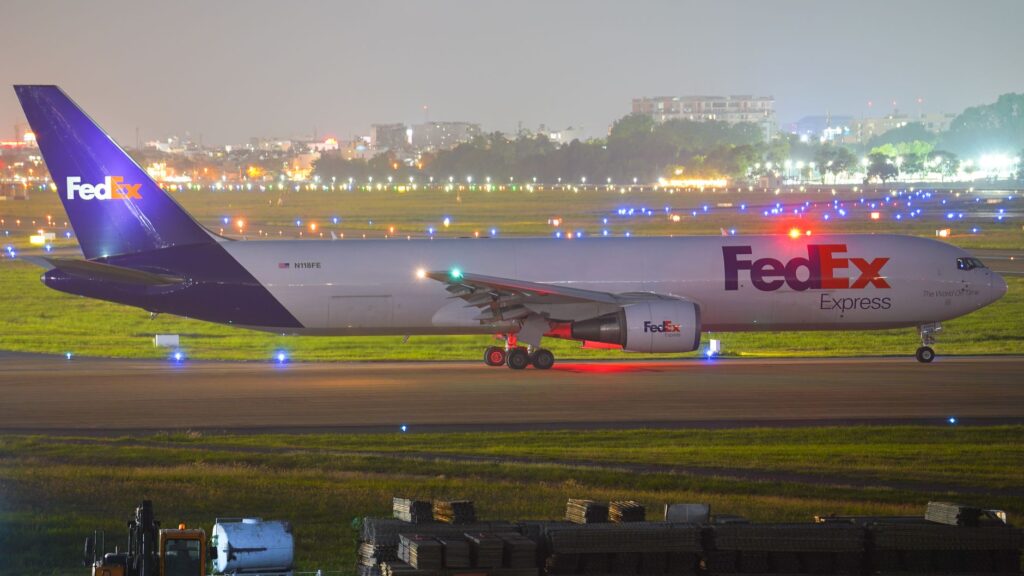
This fragmented outsourcing model has long been scrutinized by logistics industry analysts. On one hand, it allows for extreme flexibility; on the other, it dilutes direct supervision standards in crucial geographic zones. The aircraft utilized on these routes are often mature models—such as passenger-to-freighter converted Boeing 767s—accumulating decades of intensive service. The Miami runway accident raises an uncomfortable question: to what extent does the pressure to cut transit times compromise preventive maintenance and crew safety among smaller carriers?
Fast Freight Versus Ecological Limits
The commercial aviation sector accounts for approximately 2.5% of global carbon dioxide emissions, but the air cargo segment is proportionally one of the most carbon-intensive per ton transported. Unlike maritime shipping, which prioritizes volume over time, air transport prioritizes speed, exponentially multiplying its carbon footprint. Amazon’s corporate sustainability policies promise net-zero carbon emissions by 2040, an ambitious target that clashes head-on with the constant expansion of fast-freight air routes.

The suspension of flights with 21 Air responds not only to an operational safety crisis but also to a preventive management of corporate reputation. At a time when investors and consumers scrutinize every link of the value chain for genuine climate commitments, an accident hinting at negligence or mechanical failure can unleash a media storm difficult to weather. The paradox is evident: the company investing billions in renewable energy and electric delivery vans still relies on a fleet of mature cargo planes to uphold its same-day delivery promise.
Speed has become the most valuable asset in the global market, but the hidden costs of that urgency fall directly upon the physical infrastructure and the ecosystems sustaining it.
The Weakest Link in the Logistics Chain
Analyzing the operational structure of mid-sized carriers like 21 Air reveals a labor and technical ecosystem subjected to relentless pressure. Operating in congested airports like Miami under adverse weather conditions and minute-tight flight schedules demands flawless deployment of human and technical resources. However, profit margins in the cargo transport sector are notoriously thin, frequently resulting in lean staffing, extended work shifts, and maintenance schedules that skirt right along the minimum legal requirements set by regulatory agencies.
United States aviation authorities, led by the National Transportation Safety Board (NTSB) and the Federal Aviation Administration (FAA), launched an exhaustive investigation into the exact causes of the Miami incident. Preliminary reports point to a combination of factors including wet runway conditions, braking management, and potential deviations in approach protocols. For Amazon, cutting ties with this specific carrier is a precautionary measure, but also a reminder that outsourcing critical services carries risks that are difficult to mitigate entirely.

Toward a Redefinition of Freight Transport
The Miami incident could mark a turning point in how tech giants manage their transportation networks. Various sustainability experts suggest the future lies in partial relocalization of manufacturing and the mass adoption of sustainable aviation fuels (SAF). Nonetheless, SAF still accounts for a minuscule percentage of global fuel supply and commands a price multiple over conventional kerosene, which would drastically drive up shipping costs for the final consumer.
Another avenue being explored is algorithmic inventory optimization to reduce reliance on long-haul air freight. By predicting local demand with greater precision, companies can move goods via maritime and rail transport—far more energy-efficient methods—before the customer even places an order. The disruption of the 21 Air route demonstrates that relying exclusively on cargo aviation to patch inventory inefficiencies is a fragile model, vulnerable both to unforeseen accidents and tightening environmental regulations.
Impact on Airport Communities
Major air transport infrastructure rarely operates in a social vacuum. Airports like Miami’s are embedded in densely populated zones where constant noise, air pollution, and the latent risk of accidents generate permanent tensions with neighboring communities. Every severe incident reignites debate over the expansion of these facilities and the necessity of imposing nighttime curfews on cargo flights, which are typically the loudest and most numerous within e-commerce networks.

Neighborhood associations and environmental groups seized upon the Boeing 767 crash to demand a moratorium on the growth of air cargo traffic in South Florida. They argue that the economic benefits of rapid logistics concentrate within large corporations, while environmental and safety costs are disproportionately borne by local residents. Amazon’s decision to withdraw support from the involved airline is interpreted by some sectors as an implicit acknowledgment that the current model requires a profound overhaul regarding social acceptance and territorial viability.
Practical guide
How to audit the sustainability of your online purchases:
- Prioritize shipping consolidation: Select the option to receive all your items on a single delivery day to reduce individual trips and the use of expedited air freight.
- Research corporate policies: Consult the sustainability reports of the platforms you shop on to verify if they invest in electric delivery fleets and clean aviation fuels.
- Evaluate real necessity: Question whether a product genuinely requires 24-hour express shipping or if it can be transported via less polluting ground or maritime methods.
- Support local commerce: Reduce reliance on transcontinental supply chains by purchasing directly from neighborhood businesses whenever possible.
Official consultation resources:
- NTSB (National Transportation Safety Board): Public reports and investigation dockets on aviation accidents in the United States.
- FAA (Federal Aviation Administration): Operational safety regulations and airworthiness records for commercial fleets.
The Fragile Horizon of the Commercial Sky
Modern aviation history was written on the promise of connecting the world frictionlessly, shrinking distances and uniting markets within hours. Yet, the cargo plane crash in Miami and Amazon’s subsequent reaction reveal that the seams of this system are more fragile than they appear. Behind every touchscreen and successful delivery notification lies a dense web of contracts, complex machinery, and human beings exposed to tangible risks. The challenge for the coming decade consists not merely in making planes fly faster or burn less fuel, but in redesigning a logistics system that respects the physical limits of the planet and the safety of the people sustaining it. As the official investigation continues within NTSB offices, the e-commerce sector confronts a mirror reflecting an uncomfortable image: the urgency of the global market can no longer ignore the hidden costs of the air.
The sky is no longer an unbounded space for commercial expansion, but a finite, fragile resource demanding immediate accountability for every operational error.
Source in EN: The New York Times