The Boreal Seafarers’ Route to the Edge of the World
The Norwegian coastline, sculpted by millennia of glacial advance and retreat, constitutes one of the most complex and breathtaking marine landscapes on the planet. From the bustling docks of Bergen to the remote piers of Kirkenes near the Russian border, the shoreline fractures into a labyrinth of thousands of islands, submerged reefs, and vertical rock faces plunging straight into the dark waters of the Norwegian and Barents seas. For over a century, the coastal service historically known as the express route has served as an indispensable umbilical cord for the fishing communities populating these extreme latitudes. Comprehending this route means much more than embarking on a leisure voyage; it requires stepping into a sophisticated maritime logistics network where climate, tidal currents, and imposing geography dictate the rules of human transit.
Navigating these waters demands strict attunement to the rhythms of the North Atlantic. Unlike conventional cruise ships designed for open-sea recreation, the vessels operating this route combine passenger transport with the delivery of heavy cargo, vehicles, and fresh provisions to dozens of intermediate ports. This dual function infers a deeply authentic character onto the journey, where daily life on board unfolds in absolute synchronization with nighttime and daytime port operations. These port calls, often brief and executed with chronometric precision, offer a glimpse into the reality of settlements entirely dependent on the vessel’s punctual arrival to sustain their economic and social pulse during the harshest months of the boreal winter.
The sea within the Arctic Circle is never a static stage; it is a living organism demanding absolute respect, where every tide writes a fresh cartography upon the ancient stone of the fjords.
The Geography of Water and Western Coastal Architecture
The maritime route meanders through more than two thousand five hundred kilometers of indented coastline. For the navigator and inquisitive traveler, the territory divides into distinct geographical sections presenting vastly different technical and scenic challenges. The initial stretch, departing from the central western fjords, runs between hills draped in boreal forests and small aquaculture communities. As the ship gains latitude and crosses the invisible line of the Arctic Circle near Vikingen Island, the vegetation recedes to yield to alpine tundra, where the sharp peaks of the Sunnmøre Alps and the formations of the Lofoten Islands emerge from the water like fortified ramparts.

Navigation through these inner waters is largely sheltered by the natural reef wall known as the Skjærgård, a geological breakwater shielding the route from the worst assaults of the open ocean. Nevertheless, critical bottlenecks exist where the channel narrows or opens toward the open sea, as observed in the notoriously treacherous Stadhavet stretch—one of Norway’s most hazardous maritime zones due to the convergence of deep currents and gale-force winds originating in the North Sea. In these areas, the captains’ expertise and the vessels’ advanced stabilization technology prove decisive in guaranteeing a safe transit without disrupting the rigorous schedules of the postal route.
Managing the Light: Between Eternal Night and the Midnight Sun
The temporal factor absolutely conditions any expedition along the Norwegian coast. Depending on the chosen season, the traveler confronts two radically opposing lighting realities that transform the perception of the territory. During the summer months, the midnight sun floods the landscape with an endless golden clarity, permitting the observation of rock formations and seabird colonies at any hour of the night. This continuous illumination stimulates intense biological and port activity, facilitating deck operations and terrestrial excursions at the ports of call.

At the opposite extreme, the long polar night stretching from late November through January plunges the coastal communities into a bluish twilight, interrupted only by the crepuscular tones tinting the horizon for a few hours at midday. Far from being an inconvenience, this season offers one of the most coveted experiences for modern explorers: observing the northern lights. The absence of light pollution across much of the route and the northern latitude turn the ships’ observation decks into privileged platforms for witnessing this electromagnetic ballet in the upper atmosphere.
Life on Board and the Economy of Coastal Communities
Daily dynamics aboard a coastal liner differ markedly from the impersonal opulence of mega cruise ships. Here, space is shared among naturalists, photographers, local residents commuting between villages, and freight handlers supervising the unloading of refrigerated containers filled with fresh fish. This coexistence generates a unique atmosphere where seamanship rigor merges with the warmth of Norwegian hospitality. Panoramic lounges transform into reading and contemplation watchtowers, while outer decks receive the lash of the salty wind, serving as a permanent reminder of the harsh environment through which the vessel travels.
Port calls serve as open windows into northern Europe’s economic history. In ports such as Ålesund, rebuilt almost entirely in the characteristic Art Nouveau style following the devastating fire of 1904, urban architecture narrates its inhabitants’ resilience against natural catastrophes. Further north, in Trondheim, the imposing Nidaros Cathedral—the northernmost medieval sanctuary in the world—testifies to the region’s religious and commercial significance since the Viking age. Each dock tells a story of adaptation, ranging from the traditional dried cod industry in the Lofoten Islands to modern scientific research centers and marine technology based in Tromsø.
Marine Fauna and the Fragility of Boreal Ecosystems
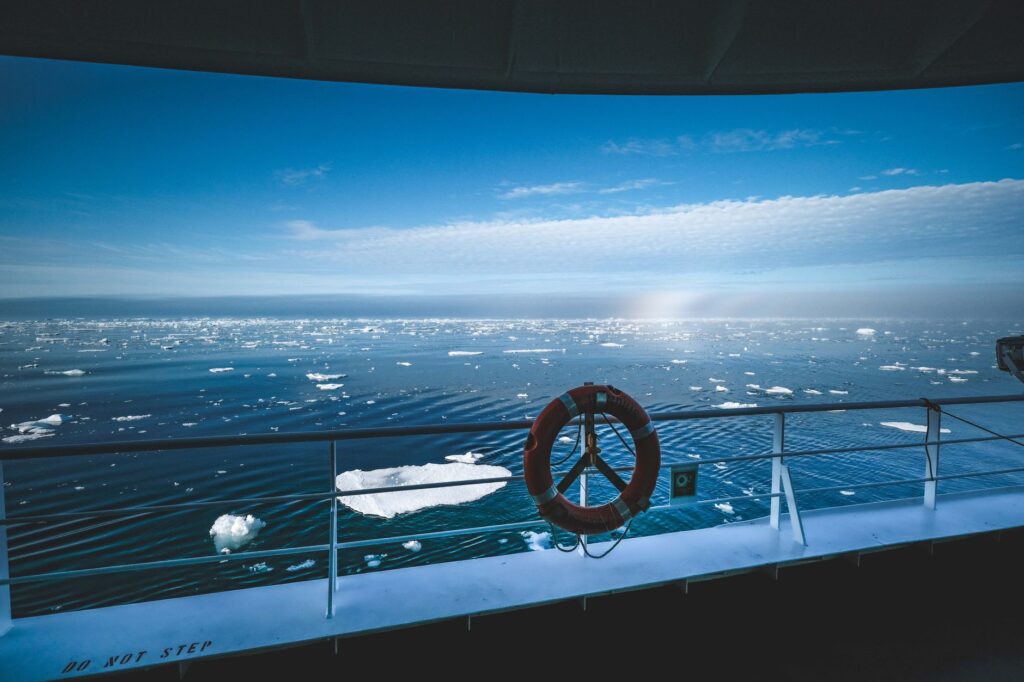
Navigating the waters of the Arctic Circle also means stepping into one of the richest biological sanctuaries in the North Atlantic. Nutrient-rich currents driven by the Gulf Stream create ideal conditions for vast populations of plankton, which in turn sustain a complex and fascinating food web. From the ship’s deck, frequent sightings include large cetaceans such as fin whales, humpback whales, and orcas navigating the fjords in search of herring schools. Likewise, the vertical rock faces serve as nesting grounds and sanctuaries for millions of seabirds, notably Atlantic puffins, shags, and majestic sea eagles.
Nevertheless, this delicate ecological balance faces mounting pressures stemming from climate change and the intensification of human activities in the arctic region. The retreat of coastal glaciers and rising surface water temperatures are altering migratory routes for marine species and modifying the chemical composition of fjord waters. Norwegian authorities and maritime transport operators implement increasingly stringent regulations regarding emissions and waste management, striving to balance the touristic opening of these remote settings with the strict preservation of their unique biodiversity.

The preservation of the arctic environment depends not solely on port legislation, but on the conscience of every traveler transiting these fragile marine ecosystems.
Practical guide
Planning a nautical expedition along the Norwegian coastline requires a rigorous understanding of maritime logistics, local climatology, and proper equipment to withstand changing weather conditions within hours.
Seasons and Travel Windows
Choosing the timing for the journey entirely defines the nature of the experience. Summer months, from June to August, guarantee milder temperatures, permanent daylight, and a higher frequency of guided land excursions. Conversely, winter, from November to February, prioritizes northern lights viewing and experiencing the polar night, though it requires greater tolerance for itinerary adjustments caused by open-sea storms.
Equipment and Technical Clothing
The layering principle is essential in the Arctic. A merino wool thermal base layer, a synthetic or fleece mid-layer, and a high-quality waterproof, windproof outer shell are strongly recommended. Footwear must be robust with slip-resistant soles for walking on wet decks or icy docks, and accessories such as windproof hats, tactical gloves, and polarized sunglasses are vital to counter glare from water and snow.

Port Logistics and Connectivity
The vessels feature basic medical facilities and satellite communication, yet terrestrial mobile network coverage is generally excellent across most of the Norwegian coast due to local network infrastructure. Travelers are advised to carry digital currency, as cash usage is virtually nonexistent in the country’s ports and commercial establishments.
The Silent Echo of Retreating Ice
As the vessel approaches its final destination on the northeastern tip of the peninsula, having crossed thousands of miles of aquatic labyrinths and dark stone walls, a lingering sensation remains of having touched the boundaries of the habitable world. The Arctic Circle voyage is not measured in map distance, but in the profoundness with which the landscape sculpts the traveler’s senses. In the silence of the deck at dusk, as the final northern lights brush the water’s surface and the ship’s engine rhythmically pushes against the current, one understands that the sea and land in these latitudes maintain an ancestral pact, untouched by the modern world’s haste, which only those who dare to navigate it with patience and respect can truly hear.