
The City That Eats Together
In Singapore, lunch is not improvised. At noon, a quiet tide leaves offices and construction sites to fill the hawker centres, the food markets that function as collective dining rooms. There are no tablecloths or reservations: there are orderly queues, plastic trays and a choreography repeated for decades. The city-state, with more than five million residents, has turned street food into a national institution, and its markets are the stage where that identity is cooked daily.
It is not only about eating well. It is about a system that blends Chinese, Malay, Indian and Eurasian heritage on a single tray. Wet markets, hawker centres and kopitiam —traditional coffee shops— form a network that sustains everyday life and that visitors can navigate with judgment, without becoming mere passers-by.
“In Singapore, eating out is neither a luxury nor an exception: it is the most common way to sit at a table.”
The geography of this system is not accidental. Singapore is a compact island, and its density has made shared eating spaces both practical and necessary. Housing estates, transport hubs and heritage districts each host their own centres, so that a resident rarely needs to travel far for a meal. That proximity is part of the design: it keeps prices competitive, sustains small operators and turns food into a daily civic ritual rather than a weekend outing.
For travellers, understanding this logic changes the way the city is read. A hawker centre is not a stop between monuments; it is itself a monument to how Singapore organises collective life. Arriving with curiosity rather than a checklist is the first responsible decision.
The Wet Market: A Pantry Without Display Cases
The wet market is the base of the system. Early in the morning, vegetable, fish and meat stalls open at the pace of wholesalers. There is no unnecessary packaging or design staging: produce is shown whole, on ice or in wicker baskets, and haggling is discreet. Tekka Market, in Little India, exemplifies this coexistence: spices, leafy greens, fresh fish and temple flowers share narrow aisles.
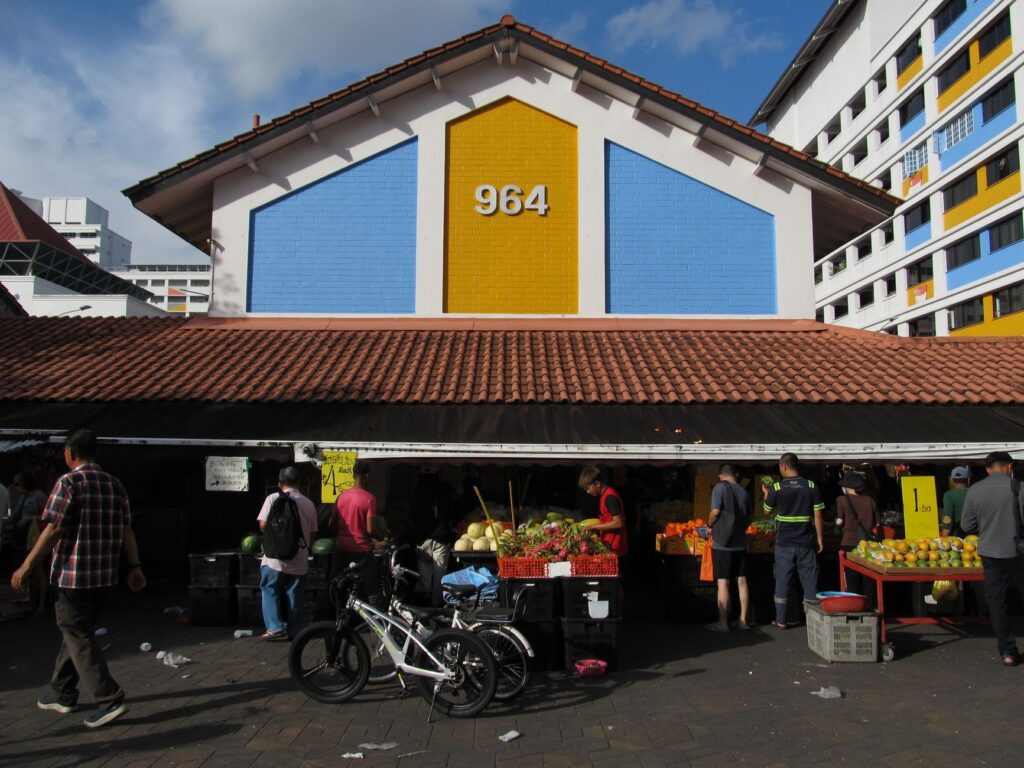
For visitors, the experience requires etiquette. Walk slowly, ask before taking photos and avoid touching goods unnecessarily. Vendors are not performers; they are working. The reward is a lesson in seasonality and provenance that no supermarket offers.
Wet markets also reveal the logistics of a city that imports most of its food yet insists on freshness. Stallholders judge fish by eye and touch, and customers trust that judgment. That relationship —between seller and buyer, between region of origin and plate— is a form of knowledge transmitted in person, not through labels. Watching it, even briefly, teaches more about Singapore’s food culture than any menu.
What to Look For and Ask About
- Fish: bright eyes, red gills, sea smell.
- Vegetables: firm stems, unblemished leaves, local varieties such as kangkong.
- Spices: sold by weight and sometimes ground on the spot.
- Fruit: durian has its own calendar and its own ritual.
Questions are welcome when they are respectful. Asking what is in season, how a vegetable is cooked or which fish is best that morning opens conversations and often yields practical advice. The market is a working environment, but it is also a place of exchange, and curiosity expressed politely is rarely unwelcome.
Hawker Centres: Cooking as Public Service
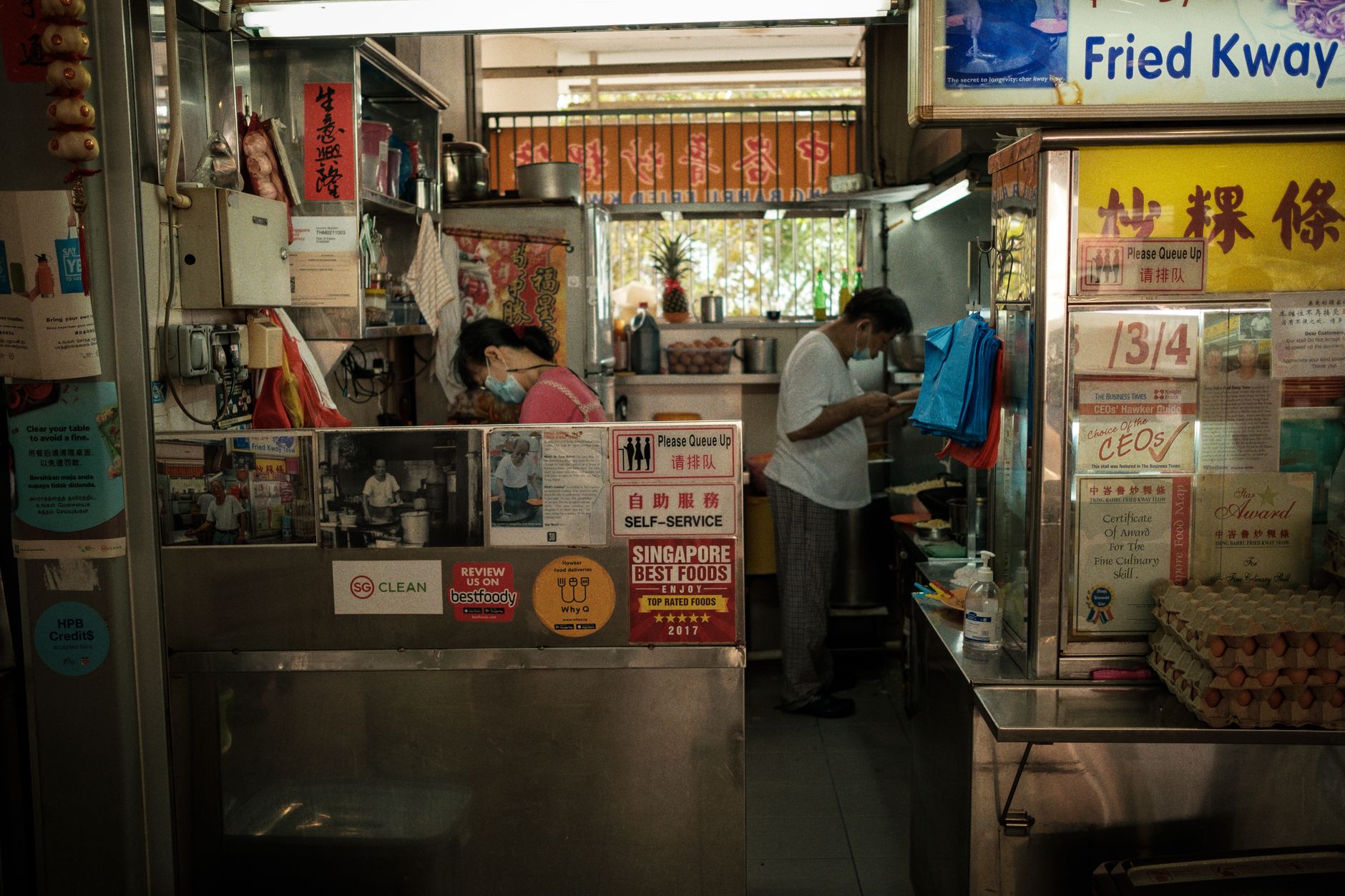
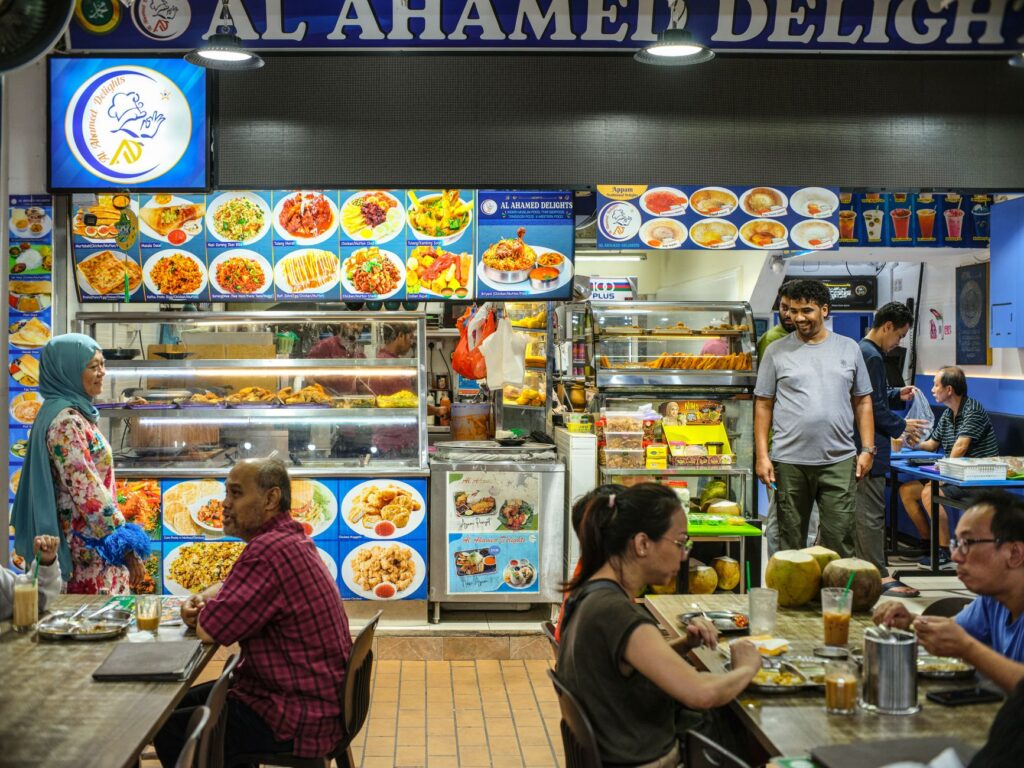
If the wet market is the pantry, the hawker centre is the dining room. These spaces, managed under strict hygiene rules and regulated prices, gather dozens of specialised stalls. Each one masters a recipe: char kway teow, hainanese chicken rice, laksa, rojak. Competition is fierce and quality is high. It is not unusual for a modest stall to earn international recognition.
The system has a deep social dimension. People from all income levels share long tables; anonymity is relative because faces recur. Elders occupy their usual seats, and young people discover flavours their grandparents already knew. It is a meritocracy of taste: those who cook well and charge fairly survive.
“The hawker centre is neither charity nor folklore: it is urban infrastructure, like the metro or the sewage system.”
This infrastructure is also remarkably efficient. A single centre can serve hundreds of meals in an hour, with each stall operating as an independent small business. The result is variety without chaos: dozens of cuisines coexist under one roof, and the customer assembles a meal from several stalls at once. That flexibility is one reason the model has endured while other cities struggle to preserve affordable everyday food.

It is worth noting that hawker centres are not frozen in time. New stalls open, old ones close, and tastes shift with each generation. What remains constant is the principle: good food should be accessible, and eating together should be ordinary. Visitors who grasp this see the city differently, not as a collection of attractions but as a community that eats in public.
Maxwell Food Centre: The Classroom of Flavour
In the heart of Chinatown, Maxwell Food Centre works as an informal school of Singaporean gastronomy. Its aisles concentrate canonical versions of dishes that visitors can compare in a single visit. Tian Tian’s chicken rice is the most cited, but not the only one: congee, popiah and fresh juice stalls complete a useful map for understanding the balance between tradition and tourism.
Maxwell is not a museum. By eleven in the morning there are queues, and by three in the afternoon some stalls close because they have sold out. That fleeting quality is part of its appeal: it forces you to eat when it is time, not when you feel like it.
The centre’s location also matters. Chinatown is a heritage district where shophouses, temples and clan associations sit alongside modern commerce. Eating at Maxwell places the visitor inside that layered history, where the food is both everyday necessity and living archive. The best approach is to arrive early, walk the aisles once without ordering, and then choose based on what is being cooked and who is eating.
How to Read a Hawker Centre
- Watch the local queue: it usually signals consistent quality.
- Look at award signs, but do not obsess: your palate rules.
- Carry tissues to reserve a table; it is an accepted custom.
- Return your tray: cleanliness is a shared responsibility.
Reading a centre well takes a few visits. Notice which stalls have regulars, which close early because they sell out, and which operate at a steady pace throughout the day. These signals reveal more than any guidebook ranking. They also encourage patience, which is the most useful quality a visitor can bring to a place designed for daily use rather than spectacle.
Tekka and Little India: Spices, Flowers and Memory
Tekka Centre, on Serangoon Road, is one of the city’s most vibrant markets. On its ground floor, a wet market coexists with clothing and fabric stalls; upstairs, a hawker centre serves biryani, dosai and teh tarik. The building, rebuilt several times, keeps its original function: supplying a community that arrived in Singapore generations ago and still celebrates its festivals with flowers, incense and sweets.
For travellers, Tekka is a lesson in context. It is not about “trying Indian food” in the abstract, but about understanding how the Tamil diaspora and colonial trade shaped the neighbourhood. Shrines, Tamil signage and conversations in several languages remind us that Singapore is a plural society, not a theme park.
The market also shows how religious and commercial life intertwine. Flower stalls supply garlands for temple offerings; spice vendors serve both home cooks and restaurants; textile shops cater to festive occasions. Buying a garland or a packet of spices is not a souvenir transaction but participation in a neighbourhood economy that has its own calendar and its own rhythms.
Kopitiam: The Coffee Shop That Orders the Day
The kopitiam is the link between market and office. These traditional cafés serve simple breakfasts: soft-boiled eggs, toast with kaya and coffee with condensed milk. Some have modernised their image, but they keep their function: being the first place where the city pauses and talks.
Etiquette is simple. Order at the counter, pay immediately and find a table. Kopi has its own vocabulary —kopi-o, kopi-c, kosong— reflecting a culture of precision. Learning it is a form of respect and a door to unexpected conversations.
The kopitiam is also a reminder that Singapore’s food culture is not limited to lunch and dinner. Breakfast here is a social institution, brief but deliberate. Regulars arrive at the same hour, order the same combination and exchange a few words before the day begins. For a visitor, sitting among them without rushing is one of the simplest ways to observe everyday life.
Minimum Vocabulary for Ordering Coffee
- Kopi: coffee with condensed milk.
- Kopi-o: black coffee, no milk.
- Kopi-c: coffee with evaporated milk and sugar.
- Kosong: no sugar.
- Peng: iced.
These terms are not trivia. They are a working language shared across generations and communities, and using them correctly signals that you have paid attention. Even a simple order placed with care can turn a routine transaction into a small, courteous exchange.
Heritage at Risk and Responsible Choices
UNESCO recognised Singapore’s hawker culture as intangible heritage in 2020. The gesture was symbolic and political: it protected an everyday practice against real-estate pressure and generational turnover. Many veteran cooks cannot find successors willing to endure long hours and thin margins. At the same time, rents in some centres have risen, and competition from chains and delivery apps alters the ecosystem.
Visitors can contribute with simple decisions: eat at local stalls, pay in cash when possible, avoid waste and respect the rules of each space. This is not romanticism, but an acknowledgement that a cheap and diverse system does not survive on goodwill alone.
Responsible behaviour also means avoiding the temptation to treat stalls as backdrops. Photographing a cook mid-service, blocking a queue or leaving a table dirty shifts the burden onto workers. Small courtesies —waiting your turn, clearing your tray, keeping voices low in crowded aisles— preserve the atmosphere that makes these places worth visiting in the first place.
There is also a broader point about consumption. Choosing a neighbourhood centre over a tourist-oriented food court keeps money circulating locally and supports operators who depend on daily regulars. It is a modest choice, but it aligns the visitor’s experience with the system’s survival.
Practical Guide
To explore Singapore’s markets with judgment, plan by neighbourhood and time. The city is safe and public transport is efficient, but heat and humidity demand a slow pace.
- Best time: wet markets open early; hawker centres run at midday and in the evening.
- Payment: many stalls accept cash and some mobile payments. Carry small notes.
- Etiquette: queue, do not reserve with valuables, return your tray and wipe the table.
- Language: English is useful, but basic words in Mandarin, Malay or Tamil improve the experience.
- Respect: ask before photographing people or stalls; avoid blocking aisles.
- Health: drink water, wear a hat and alternate spicy meals with mild options.
There is no single route. The best strategy is to choose two or three markets, sit, observe and return. Singapore reveals itself in repetition: the same stall, the same recipe, the same gesture. In that constancy lies its hospitality.
It also helps to travel light and unhurried. Markets are dense, noisy and warm; a small bag, comfortable shoes and a willingness to wait make the experience far more pleasant. And because many stalls close when their food runs out, flexibility matters more than a fixed schedule.
A Closing at Tea Time
Late in the afternoon, when the heat eases, hawker centres find a different rhythm. Families occupy tables, students share drinks and elders comment on the day. There is no spectacle, only life. Travellers who understand this stop looking for “the authentic” and accept the obvious: in Singapore, authenticity is a shared tray, a stall that closes when the food runs out and a city that, every day, sits down to eat again.