
Bari cannot be understood without the sea. The capital of Apulia, in southern Italy, grew facing the Adriatic and organising its life around a port that for centuries was a gateway to the eastern Mediterranean. Today it is a city of just over three hundred thousand people that combines a dense, labyrinthine old town with wide avenues, a long seafront and a university that renews its pulse every academic year.
Travellers in a hurry often stop at the silhouette of the Basilica of Saint Nicholas or a photo of the lungomare. Those who stay a few days discover something else: a city where heritage is not behind glass but in streets where laundry hangs, focaccia is kneaded and conversations happen at the doorstep. This report proposes exploring Bari through that daily life, with attention to what visitors can do to avoid disturbing it.
A city with two rhythms
Bari is organised into two large pieces that coexist naturally. On one side, Bari Vecchia, the historic core of narrow streets and pale stone, where churches, palaces and a human density that surprises first-time visitors are concentrated. On the other, the modern city, laid out in the nineteenth century with straight avenues, broad squares and a waterfront that works as a large urban living room.
That duality explains why Bari disconcerts those expecting a monumental city in the conventional sense. The interest here lies not only in individual buildings but in the way life unfolds among them: the market, the school, the café, the conversation on the corner. Heritage is the stage, but the plot is written by those who inhabit it.
The old town, stone and neighbourhood
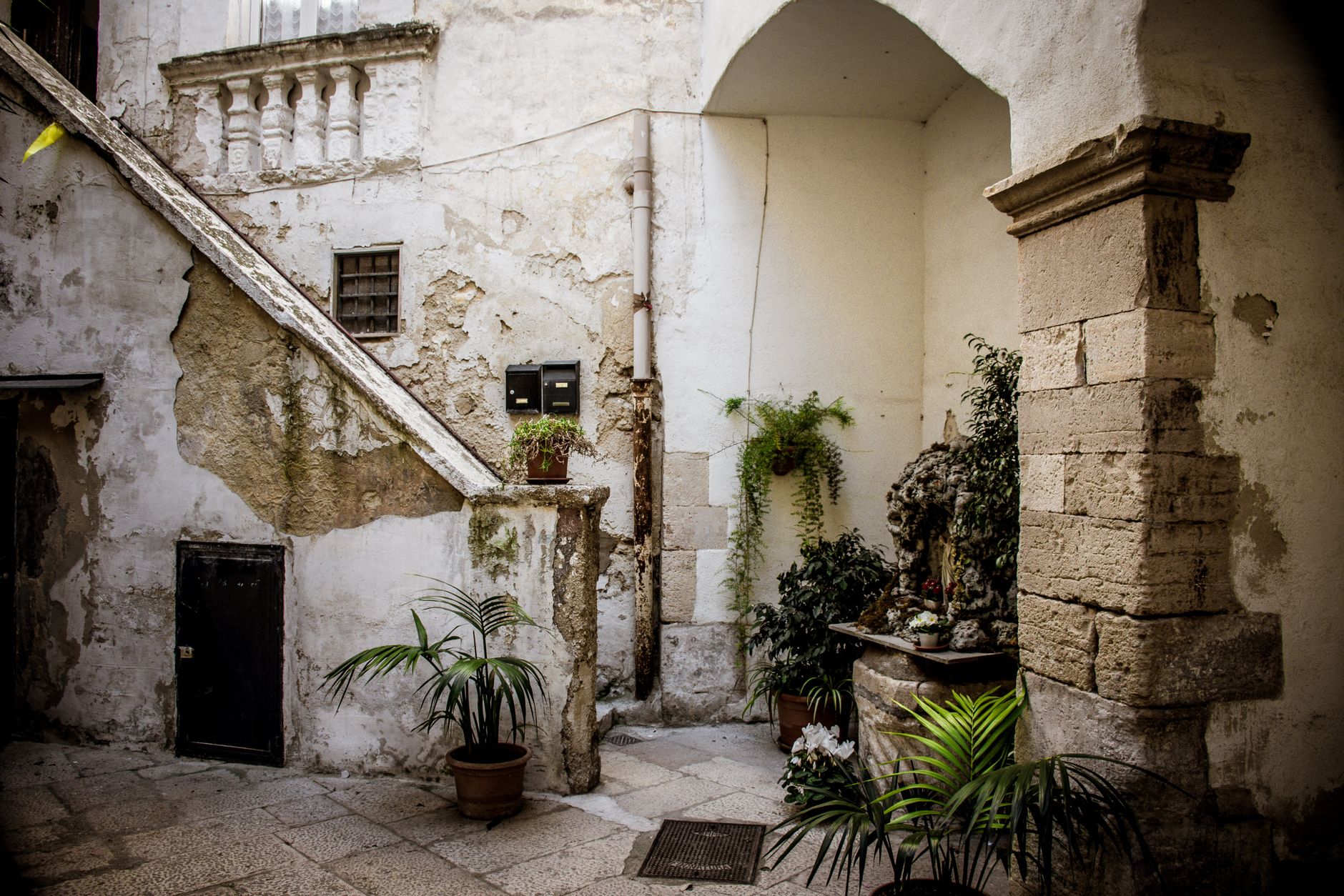
Entering Bari Vecchia means entering a space that is walked, not rushed. Its streets do not follow a grid and open onto inner courtyards where domestic life leans out. The Basilica of Saint Nicholas, one of the great pilgrimage churches of southern Italy, presides over the whole, but around it there is a fabric of smaller churches, arches and houses that deserve a slow look.
Visitors should remember that this is not a set. People live here. Open doors, chairs in the street and conversations are not an attraction: they are the life of a neighbourhood that has learned to live with tourism without ceasing to be what it was. Walking quietly, not intruding into private courtyards and buying from local shops are small gestures that change the experience a great deal.
In Bari Vecchia, heritage is not contemplated from outside: it is crossed, greeted and respected as one respects a neighbour’s home.
The seafront and the city facing the Adriatic
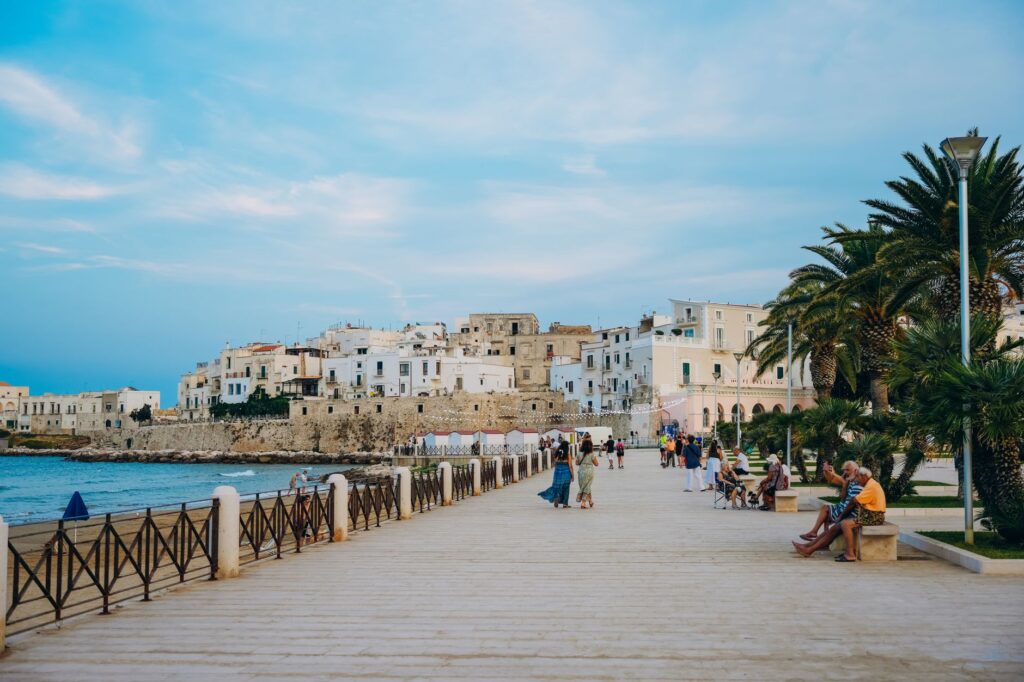
The lungomare of Bari is one of the most generous public spaces in southern Italy. Over several kilometres, the city leans out to the sea with a continuity that invites walking at sunset, when the light changes and the promenade fills with families, runners and groups of friends. It is not a place designed for tourists but for residents, and precisely for that reason it is so eloquent.

From the promenade one understands Bari’s relationship with water: commercial port, marina, urban beaches and a coastline that has been for centuries a border and a meeting point. The sea here is not scenery: it is economy, memory and routine.
The market and the kitchen as a local thermometer
If there is a place where Bari shows itself as it is, it is the market. Seafood, seasonal vegetables, regional olive oil and bread baked daily compose a scene repeated every morning. Focaccia barese, with tomato and oregano, is an everyday bite rather than a restaurant dish, and orecchiette, the pasta shaped like a small ear, is part of the area’s culinary identity.
Eating in Bari is a way of understanding the territory. Apulian cooking relies on what the nearby land and sea provide, with simple recipes and direct flavours. Visitors who sit in a neighbourhood trattoria, away from the busiest routes, will find honest cooking and conversation not designed for the photo.
Religious heritage and Mediterranean memory
The Basilica of Saint Nicholas is the great spiritual reference of the city and one of the most important churches in southern Italy. Its presence has marked the history of Bari and continues to attract pilgrims from different Christian traditions. Alongside it, the cathedral of San Sabino and other churches of the old town complete a religious route best done calmly and with respect for worship times.
Beyond the religious, Bari keeps the memory of its condition as a crossroads. Its port has been for centuries a departure point towards Greece, Albania and the eastern Mediterranean, and that condition has left its mark on architecture, gastronomy and the way its inhabitants carry themselves. The city is not a museum: it is a place of passage and encounter that still works as such.
What responsible visitors can do
Bari is a living city and, as such, appreciates curious and discreet visitors. A few guidelines help make the experience better for everyone. It is worth avoiding the busiest hours in the old town, respecting silence in residential areas and not treating public spaces as photographic sets.

- Buy in neighbourhood shops and at the market, not only in tourist-oriented stores.
- Respect worship times in churches and dress appropriately when entering.
- Do not intrude into private courtyards or entrances in the old town to take photographs.
- Move on foot or by public transport within the city.
- Choose small, local accommodation whenever possible.
None of these recommendations is a rigid rule, but all respond to a simple idea: Bari’s heritage is not a backdrop, it is the frame of a daily life that deserves to continue.
Getting there and when to travel
Bari has an international airport and rail connections with other Italian cities, as well as maritime links with the other side of the Adriatic. The city can be integrated into a route through Apulia, a region that combines coast, agricultural interior and pale-stone towns.
As for the climate, it is worth checking before travelling according to the chosen season. Spring and early autumn usually offer pleasant temperatures for walking, while summer concentrates more visitors and more heat. Specific information on opening hours, fares and services should always be checked in updated official sources.
A city to explore slowly
Bari is not a city exhausted by a list of monuments. Its interest lies in the way heritage and daily life intertwine: the market that opens early, the promenade that fills at sunset, the streets of the old town where stone and hanging laundry share space. Visitors who arrive with curiosity and leave with respect take away something more than photographs.

Perhaps that is why Bari is remembered with the body: for the sound of the sea on the lungomare, for the smell of freshly baked bread, for the feeling of walking through a city that poses for no one. That, in the end, is its best travel lesson.
Practical guide
Before travelling, check the documentation required according to your country of origin, the availability of flights and trains, and the conditions of access to religious spaces. Within the city, the old town is explored on foot and the seafront invites unhurried walking. For the market, the best time is the morning. For churches, respect worship times and dress appropriately. For eating, look for neighbourhood trattorias and seasonal dishes. For accommodation, consider small, local options. And for getting around, use public transport or walk, which is the best way to understand a city like Bari.