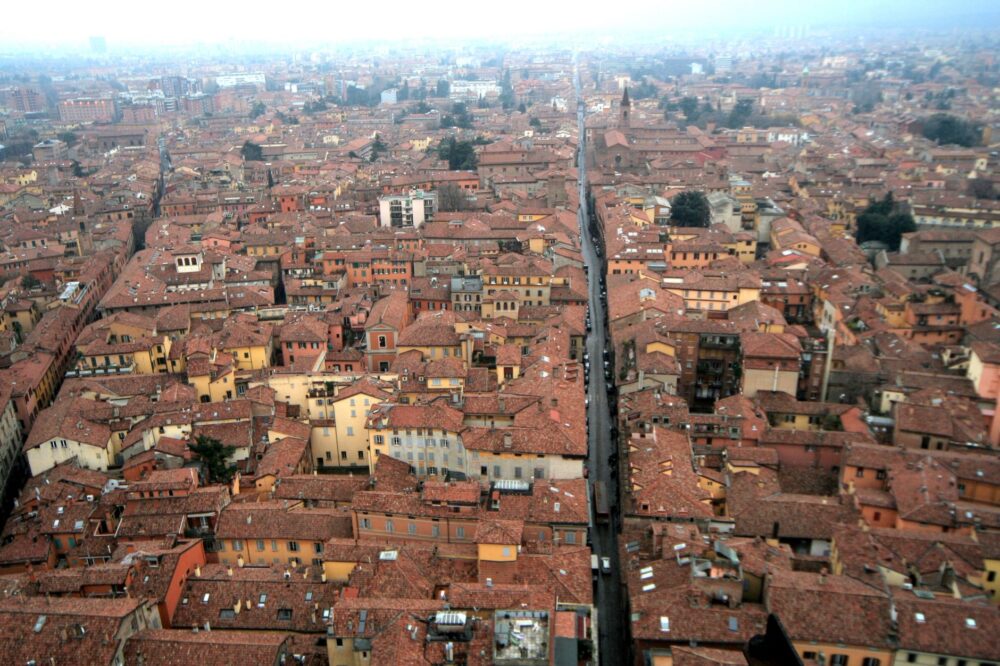
Some cities are explained by their river, others by their harbour or their cathedral. Bath, in southwest England, is explained by the hot water that rises from its subsoil. Since the Romans turned the springs into a thermal complex in the 1st century, the city has never stopped organising itself around that mineral upwelling. It is not an anecdotal detail: it is the axis that orders its topography, its architecture and much of its daily life.
To walk through Bath is to read a stratigraphy of two thousand years. Beneath the current streets lie the remains of Aquae Sulis; above them rise the Georgian terraces of oolitic stone, and around them, the green hills of Somerset frame a valley that seems designed to be contemplated. UNESCO inscribed the city in 1987, recognising the exceptional integration of architecture, urban design and landscape.
A valley that dictates the city’s form
Bath’s geography is not a backdrop. The city occupies a hollow between hills, and that condition has determined its growth. The thermal waters emerge at around 46 degrees in the heart of the valley, and around them the baths, the temple and, centuries later, public buildings and homes were arranged.
The local oolitic limestone, quarried nearby, gave the city a chromatic homogeneity that still surprises today. That stone, honey-toned, absorbs the damp light of the English west and returns a sense of warmth that contrasts with the climate. Walking its streets on a grey day is to discover how the built material dialogues with the sky.
The city does not impose itself on the landscape: it folds into it, takes advantage of its slopes, respects its views and turns geology into identity.
The result is an urban ensemble where perspectives matter. The streets do not seek the infinite straight line, but the break, the visual surprise, the appearance of a hill at the end of a facade. That picturesque sensibility, inherited from the 18th-century ideal, distinguishes Bath from other historic European cities.

From the spring to the social rite
The Romans did not invent the spring, but they did invent its systematic exploitation. The Great Baths complex, with its central pool and steam rooms, was for centuries a centre of sociability, health and worship. The city was called Aquae Sulis, in honour of the local deity associated with the water, and attracted travellers from across the empire.
After the Roman withdrawal, the place did not disappear. The medieval abbey rose beside the ruins, and the city was reborn as a wool centre. But it was in the 18th century that Bath recovered its thermal vocation with unprecedented intensity. The English aristocracy came to take the waters, and with them came the architects, entrepreneurs and masters of ceremonies who transformed the valley.
The Pump Room, the Assembly Rooms and the residential ensembles of Queen Square, The Circus and Royal Crescent are the expression of that collective project. There was no single master plan, but there was a shared ambition: to make Bath one of the most beautiful cities in Europe.
Stone as a common language
Bath’s Georgian architecture is distinguished by its scale and rhythm. Facades align in continuous terraces, with identical windows and cornices that repeat like a score. That uniformity is not monotony: it is an aesthetic agreement that allows buildings by different architects to dialogue with one another.
The Royal Crescent, by John Wood the Younger, is perhaps the best-known example. A curve of thirty terraced houses, with Ionic columns at the centre and a green meadow in front, sums up the idea of integrating architecture and landscape. It is not an isolated facade: it is an urban gesture that opens to the valley.

The Circus, designed by John Wood the Elder, proposes a circular form with three segments of facade. Doric, Ionic and Corinthian columns succeed one another on the different levels, and the central trees add an organic note to the ensemble. Walking there is to perceive how classical geometry adapts to the topography.
Bath is not an open-air museum: it is an inhabited city that still uses its public spaces, its baths and its streets with the same naturalness as three centuries ago.
The water that still flows
Today, Bath’s thermal waters cannot be drunk in the Pump Room as they once were, but they can be visited in the Roman complex and in the modern Thermae Bath Spa, which uses the same spring for its pools. The city has managed to keep alive its relationship with its founding resource without turning it into a theme park.
The Roman Baths Museum allows visitors to descend to the level of the original pools, see the columns, channels and inscriptions. The experience is not only archaeological: it is also sensory, because the steam still rises and the water is still hot. That material continuity is one of the values UNESCO highlighted when inscribing the site.
The relationship between landscape and daily life is perceived in smaller details. The Parade Gardens, beside the River Avon, offer a shaded walk with views of the abbey. The Kennet and Avon Canal crosses the city with its locks and barges, recalling that Bath was also a communications hub. And the hills surrounding the valley remain the daily horizon of its inhabitants.
A city to walk slowly
Bath is explored on foot. The historic centre is compact, and the distances between the abbey, the baths, the Pump Room and the Georgian ensembles are short. But the terrain is undulating, and the slopes are part of the experience. Climbing to Lansdown Crescent or Alexandra Park rewards with wide views over the city and the valley.
The urban landscape invites pause. Victoria Park and Royal Victoria Park offer green spaces beside the historic buildings. The pedestrian streets of the centre concentrate shops, cafes and bookshops. And the River Avon, with its bridges and landscaped banks, adds a tranquil dimension to the ensemble.

For the traveller interested in wellbeing, Bath proposes an experience that does not depend on medical promises or miracle treatments. It is rather a rhythm: walking, observing, stopping, breathing. The city invites that slowness because its own scale favours it.
Heritage as daily life
One of Bath’s most remarkable features is that its heritage is not separated from daily life. The houses of the Royal Crescent are still private residences. The Assembly Rooms host events. Churches such as St Michael’s Church and Bath Abbey maintain their religious and community functions.
That continuity has a price: the pressure of tourism and the need to balance conservation and development. The UNESCO site management plan addresses those tensions, and local authorities work with heritage bodies to maintain the integrity of the ensemble. It is not a closed debate, but it is a sustained effort.
The city has also managed to integrate new uses. The Thermae Bath Spa, opened in 2006, is an example of contemporary architecture that dialogues with the historic environment. Its rooftop pool, with views of the abbey, proposes a current reading of the ancient thermal rite.
Beyond the centre: hills and paths
The Bath valley does not end in the historic core. The Cotswolds, an area of outstanding natural beauty, begin a short distance away. Local paths such as the Cotswold Way allow walking between stone villages, fields and woods. It is a way of understanding the broader context in which the city is inserted.

To the north, the Kennet and Avon Canal offers walks beside the water and the chance to observe local wildlife. To the east, the Avon Valley preserves agricultural landscapes and small rural settlements. The relationship between the city and its surroundings is not only visual: it is also ecological and cultural.
For those seeking a wellbeing experience without rhetoric, Bath proposes something simple and verifiable: walking through a city that has managed to grow without betraying its geography, stopping in its gardens, looking at its facades and feeling the steam of the water that still flows.
Practical guide
The best way to reach Bath from London is by train, with frequent services from Paddington. Bath Spa station is in the centre, a few minutes’ walk from the main attractions. There are also bus and road connections, although parking in the centre is limited.
To visit the Roman Baths and the Thermae Bath Spa, it is advisable to book in advance, especially in high season. The Pump Room offers breakfasts and teas, and is a pleasant way to start the day. Bath Abbey deserves a visit, both for its architecture and for its views from the tower.
The historic centre is easily explored on foot, but there are slopes. Comfortable shoes are recommended. Parade Gardens and Royal Victoria Park are good places to rest. For a panoramic view, climb to Alexandra Park or Beechen Cliff.

The city has a wide range of cafes, pubs and restaurants. Sally Lunn’s, one of the oldest establishments, serves traditional buns. For a quieter experience, the residential neighbourhoods around Lansdown offer less crowded options.
If more time is available, the Cotswold Way and the Kennet and Avon Canal allow extending the visit to the surrounding landscape. The Bath Skyline, a circular route of about 10 kilometres, combines urban and rural views.
The best time to visit is spring and autumn, when the light is softer and the crowds smaller. Winter has its charm, with fewer visitors and a more intimate city. In summer, the gardens and terraces are at their best, but it is advisable to plan ahead.
A closing beside the water
At the end of the day, when the lights come on in the stone facades and the steam rises gently from the thermal pools, Bath reveals its most intimate character. It is not a city that gives itself immediately: it asks for time, slow steps and attention to detail. But when one stops beside the spring, listening to the water that has flowed for centuries, one understands that the true wealth of this place is not in its monuments, but in the continuity between water, stone and the life that keeps springing forth.