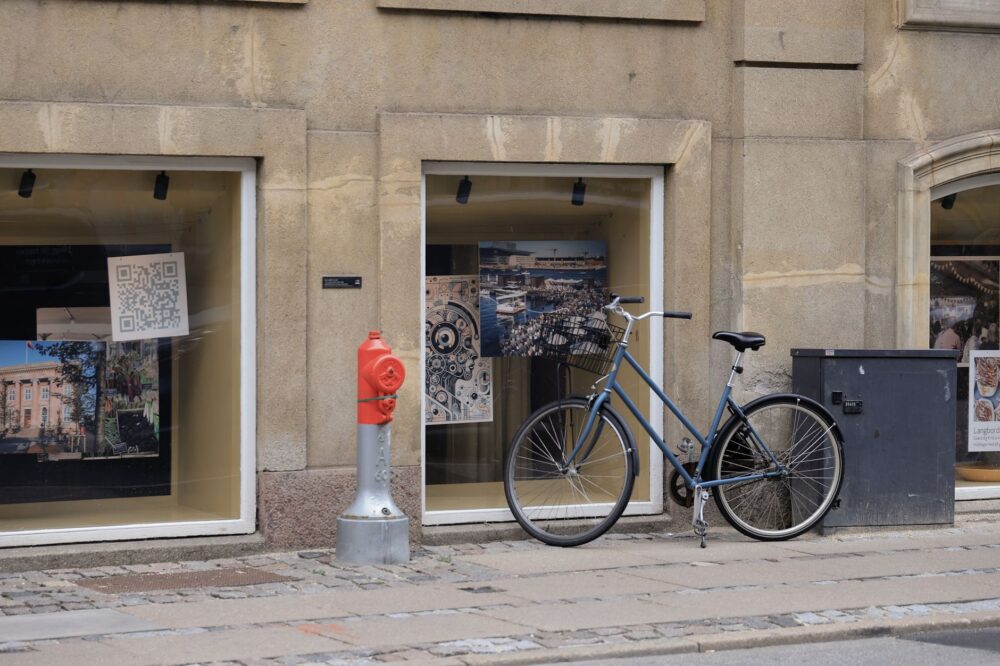
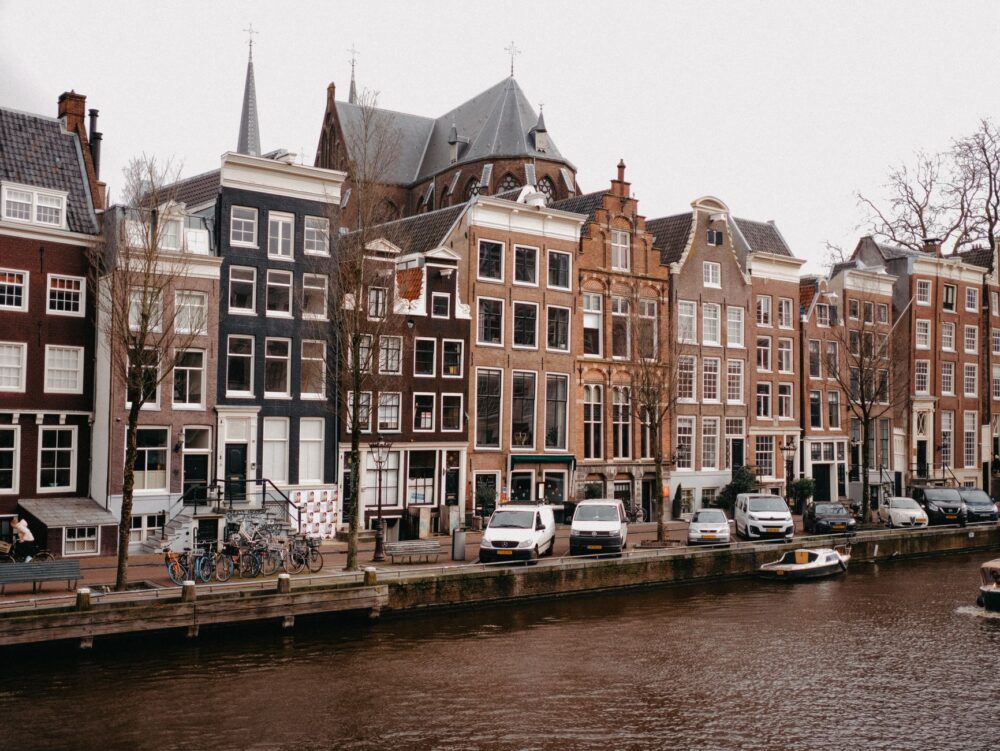
In Helsinki, design is not observed: it is inhabited. The capital of Finland has made the relationship between landscape and everyday life a guiding principle of its architecture. Here, buildings do not compete with their surroundings; they listen to them. The result is a city where granite, wood, and salt water intertwine with a naturalness few urban centers can match.
This report explores how Helsinki has woven an urban ecosystem where functionality and beauty dissolve into routine: from the tram that crosses neighborhoods of century-old stone to the library that invites you to stay, passing through public saunas facing the Baltic. It is not a guide to monuments, but an approach to a way of understanding the city as an extension of the Finnish landscape.
An urbanism that learns from granite and the sea
Helsinki rises on a granite peninsula surrounded by more than three hundred islets. That geography has conditioned its growth: streets adapt to the irregularities of the terrain, parks slip between blocks, and the sea appears unexpectedly at the end of an avenue. The city has not domesticated the landscape; it has negotiated with it.
The result is an urban fabric where local stone, extracted over centuries, serves both foundations and facades. The Art Nouveau buildings of the Katajanokka district, with their towers and arched windows, seem to emerge from the rock. It is not a metaphor: many of their walls rest directly on natural outcrops left visible.
“Finnish architecture does not seek to dominate nature, but to find its place within it,” wrote architect Alvar Aalto, whose work is present throughout the city.
That philosophy translates into everyday details: wooden benches that follow the topography of a square, railings that mimic the curve of branches, streetlights that do not glare. Design becomes discreet, almost invisible, but constant.

Trams, bicycles, and sidewalks that invite walking
Moving through Helsinki is experiencing design in motion. The tram network, with more than a century of history, remains the preferred means of crossing the center. Its modern carriages, with clean lines and soft colors, run on tracks that wind between parks and historic buildings. There is no stridency; the tram blends into the city’s soundscape.
Sidewalks are wide and free of obstacles. Bike lanes, separated from motor traffic, allow pedaling even in winter, when snow machines clear the routes before the streets. This infrastructure is not an add-on: it is part of a planning that prioritizes the human scale.
The result is a city that can be walked without fatigue. Distances between neighborhoods are short, and routes are dotted with squares with seating, fountains, and trees. Street furniture, designed by local studios, combines resistance and elegance: from trash bins to bus shelters, everything seems designed to last and not to disturb.
Oodi Library: a wooden living room for everyone
If there is a building that summarizes the relationship between design and everyday life in Helsinki, it is the Central Library Oodi. Inaugurated in 2018 opposite the central station, its spruce facade and large windows make it a luminous and welcoming space. It is not just a place to read: it is a living room for the city.

Inside, bookshelves coexist with play areas, sewing workshops, recording studios, and spaces to do homework. Users can have coffee, chat, or simply sit and look out the window. The library does not impose silence; it invites you to stay.
The building, by ALA Architects, is organized on three levels: a bustling ground floor, a middle floor for work, and an upper floor for reading with views of Parliament. Wood, glass, and steel combine in a balance that evokes Finnish forests. It is an example of how public architecture can be monumental without being intimidating.
Saunas by the Baltic: warmth in a cold landscape
The sauna is a Finnish institution, and in Helsinki it is integrated into the urban landscape in surprising ways. Sauna Löyly, in the Hernesaari district, is a wooden and glass building facing the sea. Its design, by Avanto Architects, creates a stepped terrace that allows you to go from the heat of the steam to the cold of the Baltic in a few steps.
It is not a tourist gesture: Helsinkians go to public saunas as part of their routine. There, neighbors, friends, and strangers gather in an atmosphere of respect and silence. The design of the space favors that intimacy: the light is dim, the materials are warm, and the views of the water remind you that the city is surrounded by nature.
Other saunas, such as the historic Kotiharjun Sauna, maintain a neighborhood character: small, familiar, and unpretentious. In both, design does not seek spectacle, but facilitates well-being. That is, perhaps, the key to the Finnish approach.
Katajanokka and Eira: stone, iron, and century-old trees
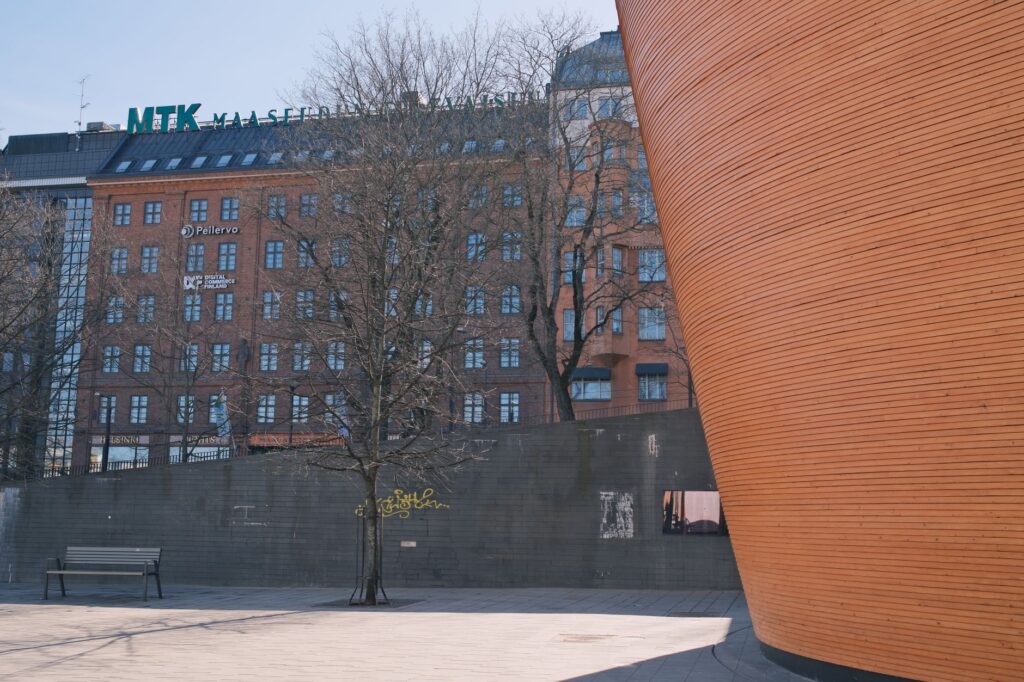
The districts of Katajanokka and Eira preserve the largest collection of Art Nouveau buildings in Northern Europe. Their facades, decorated with natural motifs and soft arched windows, line quiet streets where granite emerges between the pavement. It is not an open-air museum: these are inhabited homes, with shops on the ground floors and bicycles leaning on corners.
Walking through these streets is discovering details that reveal a sensitivity to the everyday: doorways with brass handles, wrought-iron balconies, interior gardens hidden behind facades. The scale is human, and the trees, planted more than a century ago, form green tunnels in summer.
Design here is not ostentatious, but integrated. Recent renovations have respected original materials and added contemporary elements without breaking the harmony. It is a lesson in how to conserve without petrifying.
The landscape as a building material
In Helsinki, the landscape is not a backdrop: it is another material. Architects use topography, light, and water as project elements. One example is Kaivopuisto Park, where paths follow the natural curves of the terrain and benches face the sea. Another is the Arabianranta district, where residential buildings are organized around interior courtyards that reproduce the density of a forest.
This approach has historical roots. As early as the 19th century, architect Carl Ludvig Engel designed Senate Square as a space that dialogued with the sky and stone. Today, that tradition continues in projects such as the Jätkäsaari district, where streets are named with maritime terms and parks recreate coastal ecosystems.
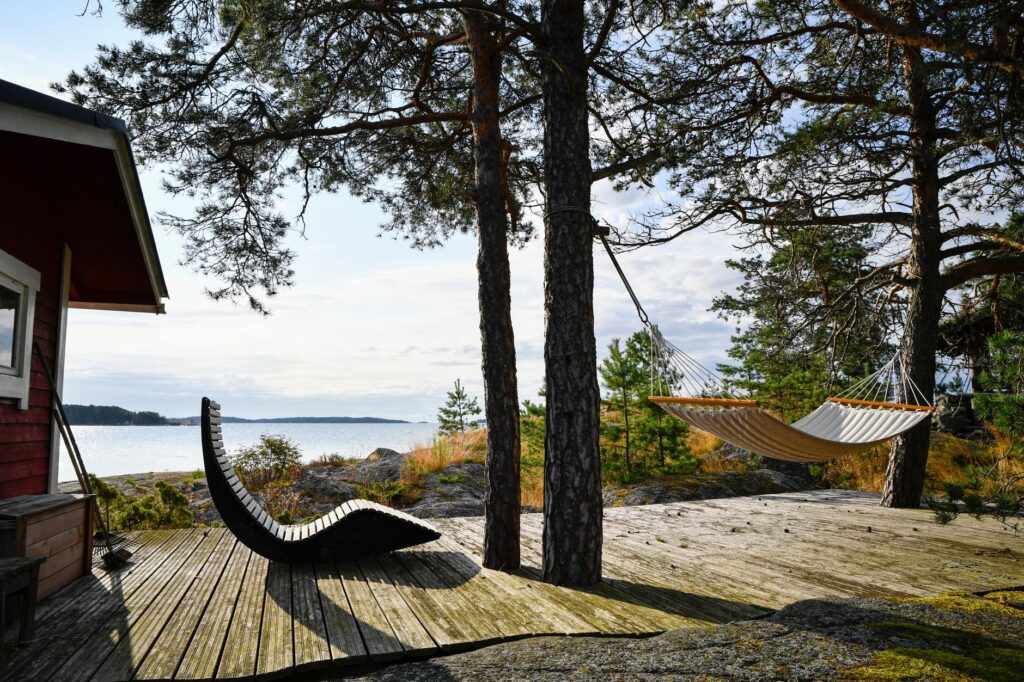
The result is a city that changes with the seasons. In winter, snow covers the roofs and ice forms on the shores; in summer, cafes set out their terraces and the islands fill with bathers. Design accompanies that rhythm, without imposing it.
Everyday design: objects that last and accompany
The culture of design in Helsinki is not limited to buildings. It is in the objects used daily: Arabia tableware, Marimekko textiles, Artek furniture. These brands were born in Finland and have maintained a philosophy of functionality and beauty that resists fashions.
In the city’s shops and markets, you find pieces that combine simplicity and resistance. They are not cheap, but they are made to last. That is another facet of the relationship between landscape and everyday life: the idea that objects are also part of the environment and must integrate into it with dignity.
Helsinkians value that durability. They repair, inherit, and reuse. In a world of fast consumption, the Finnish capital offers an alternative model: design as a life companion, not as a disposable commodity.

Practical guide
To experience Helsinki from this perspective, plan your visit calmly. The city is compact and easy to explore on foot or by tram. Public transport works with a rechargeable card that allows travel by tram, bus, metro, and ferry within the central zone.
- When to go: Summer (June to August) offers long days and mild temperatures, ideal for exploring islands and terraces. Winter (December to February) allows you to experience the sauna and snow, but requires appropriate clothing.
- What to bring: Comfortable, waterproof footwear, layers of warm clothing, and a raincoat. In winter, a hat, gloves, and scarf are essential.
- Where to stay: The districts of Punavuori, Kallio, and Katajanokka offer characterful accommodation with good connections to the center.
- What to visit: Oodi Library, Sauna Löyly, the Katajanokka district, Kaivopuisto Park, and the Kauppatori market. Ferries to Suomenlinna allow you to see the city from the sea.
- Tips: Reserve time to sit in a cafe and observe. Helsinki’s design is best appreciated without haste. Respect silence in saunas and public spaces.
The Helsinki tourist office offers updated maps and recommendations. There are also self-guided architecture routes that can be followed with mobile apps.
A closing by the water
At sunset, the Baltic light tints the stone buildings gray and gold. At the Hernesaari pier, next to Sauna Löyly, a group of people immerse themselves in the cold water after the steam. There is no fuss; only contained laughter and deep breaths. The city, in the distance, continues its rhythm of trams and bicycles.
That instant summarizes the spirit of Helsinki: a place where design does not seek to stand out, but to accompany. Architecture dissolves into the landscape, and the landscape filters into everyday life. It is not a city to visit with a list of monuments, but to inhabit with the senses. And in that experience, Finland offers a lesson that transcends borders: beauty can be functional, and functionality can be profoundly human.