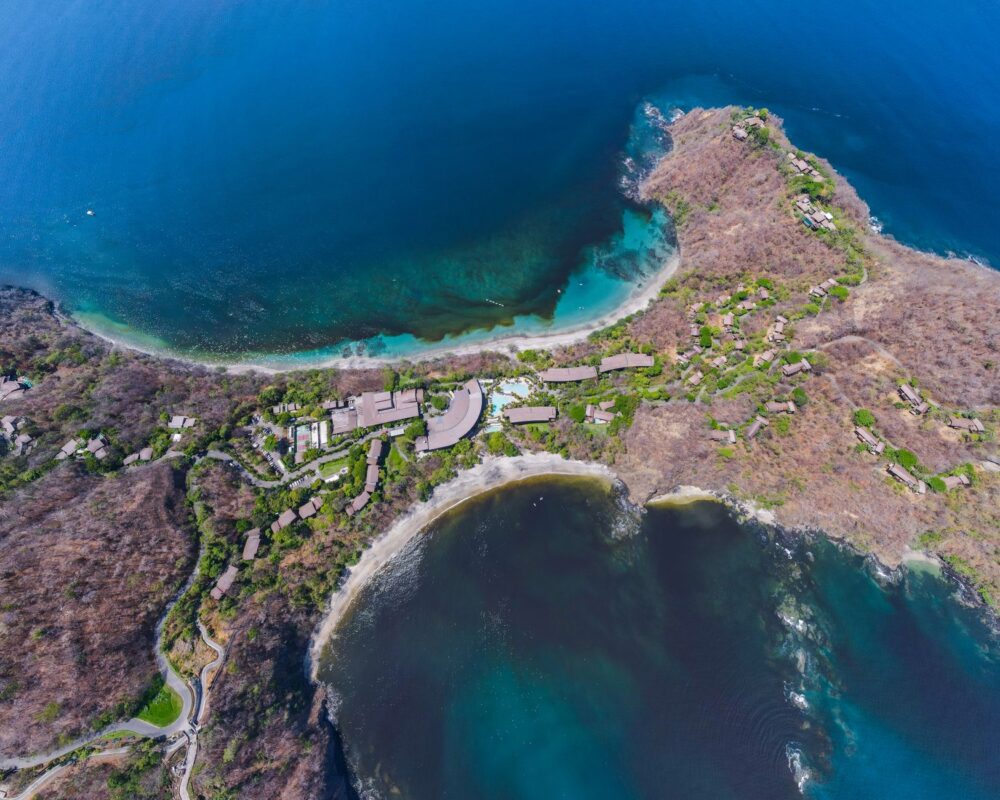
There is a landscape in Costa Rica that does not match the postcard of permanent green rainforest. In the country’s northwest, in Guanacaste province, a forest that sheds its leaves dominates much of the year, the ground cracks and the sun forces the day to be reorganized. That territory, largely protected within the Guanacaste Conservation Area, holds the best tropical dry forest habitats in the belt stretching from Central America to northern Mexico, according to the UNESCO documentation that inscribed it on the World Heritage List in 1999 and extended it in 2004 with the addition of 15,000 hectares from the Santa Elena property.
The question running through this landscape is not only how it is conserved, but how people live within it. Between volcanoes, coastal plains and a Pacific shoreline of islands and islets, Guanacaste’s population coexists with a marked seasonality: months of intense rain and months of prolonged drought. That alternation, far from being an obstacle, orders farming, cattle raising, tourism and even the way buildings are constructed.
A forest that was not always forest
The recent history of Guanacaste’s dry forest is also the story of a recovery. For centuries, the region was exploited opportunistically: trees were cleared for pasture, timber was extracted and hunting went unchecked. Yet poor soils, an erratic climate and geographic isolation set natural limits to that transformation. The site’s documentation notes that no conversion appears to have occurred beyond the ecosystem’s natural restoration capacity.
That circumstance allowed something rare in the tropics: a degraded dry forest to rise again. Today, within the protected area, the natural regeneration of a previously exploited ecosystem works as an indicator of intact ecological processes. Scale is key: the complex covers 147,000 hectares of land and sea, with 104,000 terrestrial hectares extending roughly 100 kilometres from the Pacific coast to the lowlands of the Caribbean basin.

Conserving dry forest does not depend only on fencing off a plot, but on maintaining a complete gradient between the ocean and the peaks.
The gradient linking sea and mountain
One of the features UNESCO highlights as exceptional is the continuity of the landscape. From the Pacific, the territory climbs the western slope of the Guanacaste Range up to Rincón de la Vieja volcano, which reaches 1,916 metres above sea level. Along the way appear mangroves, lowland rainforest, premontane and montane humid forest, cloud forest, oak forests and savannahs with gallery forests along the many watercourses.
That variety is not a decorative catalogue. It allows migration, genetic exchange and complex ecological processes at all levels of biodiversity, including land-sea interaction. On a continent where dry forests often survive as isolated fragments, the existence of a continuous, well-protected block changes the rules for the species that depend on it.
A diversity counted in thousands
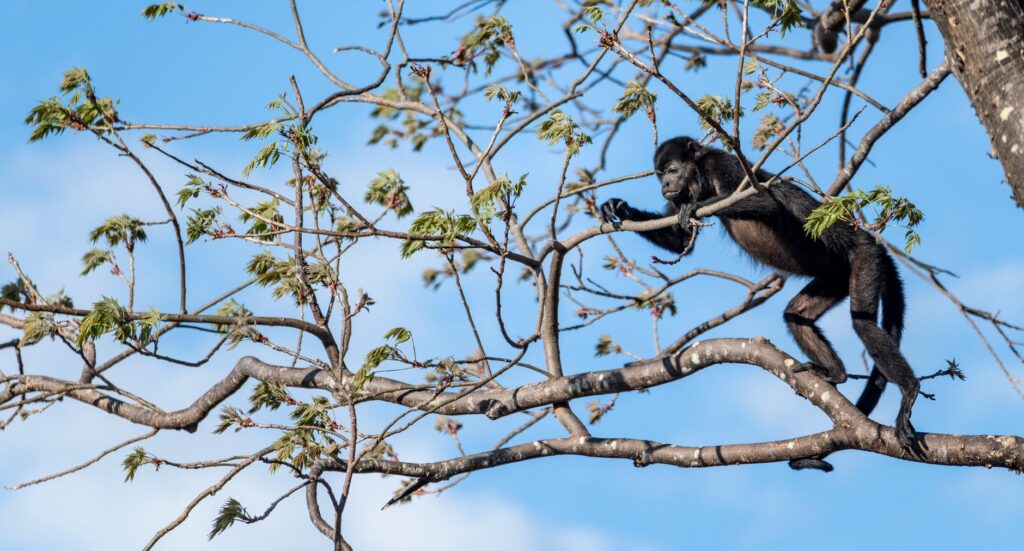
The figures attached to the site help gauge what is at stake. Around 7,000 plant species and more than 900 vertebrate species have been described. Notable mammals include the endangered Central American tapir, at least 40 bat species, jaguars, margays, jaguarundis and ocelots, as well as several primates. Among roughly 500 bird species are the endangered mangrove hummingbird and great green macaw, plus the vulnerable military macaw and great curassow.
Reptiles and amphibians are likewise numerous, with representatives such as the American crocodile and the spectacled caiman. Several sea turtle species occur in the area, including the critically endangered leatherback and a massive breeding population of the vulnerable olive ridley. Invertebrate diversity is equally extraordinary: an estimated 20,000 beetle species, 13,000 species of ants, bees and wasps, and 8,000 species of butterflies and moths.

The dry season as a teacher of life
For anyone visiting Guanacaste between December and April, the landscape can look austere. Many trees lose their leaves, grasses turn yellow and rivers shrink. But that apparent pause is part of how the dry forest works. Leaf drop reduces evaporation, and the flowering of many species syncs with the arrival of the first downpours.
Daily life in the province is organized around that rhythm. Outdoor activities cluster in the early morning. Farming and cattle work follow calendars that depend less on the clock than on the state of the soil. And the shade of a mature tree, such as the guanacaste that gives the province its name, acquires a value that is overlooked elsewhere.
In Guanacaste, shade is not an aesthetic detail: it is everyday infrastructure, shelter and a memory of the landscape.
Volcanoes, water and the pulse of rivers
Rincón de la Vieja, with its three craters and a lagoon, is a central piece of the system. At least 32 rivers and 16 intermittent streams originate in its surroundings and flow toward the Tempisque, a river of enormous importance for irrigating farmland in the province. That water network connects the mountain with the plains and the estuary, and explains why water management is one of the region’s most sensitive issues.
The protected area’s marine strip includes near-shore islands and islets, sandy and cobble beaches, rocky shores, estuaries, mangroves and wetlands. Cold upwelling currents offshore supply nutrients and sustain high marine productivity, the foundation of a diverse coastal ecosystem. UNESCO warns, however, that unregulated commercial and sport fishing, as well as coastal tourism, require stronger marine conservation efforts.
What threatens the forest from outside
The site’s integrity does not depend only on what happens within its boundaries. Official documentation identifies threats on farmland outside the protected area: pesticide pollution, water diversion for irrigation and introduced exotic grasses. It also mentions developments requiring a balance between impacts and benefits, such as growing tourism, road construction and hydropower generation.

In the marine environment, smaller fish sizes and increased effort per catch are clear signs of declining populations, according to the same source. They are indications that conserving a terrestrial landscape and its shoreline cannot be separated from fisheries management and tourism planning.
A mosaic with connected neighbours
Around the protected area there are other conservation zones that help avoid genetic isolation, buffer disturbances and facilitate natural restoration. Most of the territory is state-owned, except for a corridor managed by a parastatal foundation linked to national parks. Integrated management pursues a dual long-term objective: to conserve and to restore.
Its goals include incorporating neighbouring areas of conservation interest, applying payment for environmental services schemes and developing ecological research and outreach programmes. Funding combines governmental and non-governmental sources, plus a heritage fund established through a debt-for-nature swap. Even so, UNESCO itself notes that additional and sustainable funding schemes are needed to strengthen operational capacity in the face of mounting challenges.
The ranch that returned to the map
The 2004 extension, with the addition of 15,000 hectares of the Santa Elena property, is a relevant chapter. It was a private ranch that became part of the conservation complex. That kind of incorporation does not merely add surface area: it adds habitats and reinforces the continuity of the ecological gradient that makes the site unique.
The case shows that conservation in Guanacaste is neither a closed nor a final process. The property still has potential for further extension, and that possibility is explicitly listed among management objectives. Buying peripheral areas and adding them to the protected whole is a recurring practice aimed at consolidating the mosaic.
Researching in order to conserve
Ecological research holds a central place in management. Understanding how dry forest regenerates, how species move between mountain and coast, or how ecosystems respond to climate variations is essential for decision-making. Outreach, in turn, seeks to bring that knowledge closer to communities and visitors.
That link between science and local life is one of the traits that distinguish the site. It is not only about protecting emblematic species, but about maintaining the processes that sustain them: pollination, seed dispersal, migration, the water cycle and the connection between land and sea.
Practical guide
Planning a visit to Guanacaste requires understanding its climate. The dry season, roughly December to April, offers clear days and intense heat; the rainy season, May to November, brings the green back to the landscape and can complicate some roads. Light clothing, sun protection and hydration are essential at any time of year.
- Best time to see the dry forest at its clearest: the dry months, when many species lose their leaves and the landscape reveals its structure.
- To see the forest in its green, humid phase: the rainy season, with more water in rivers and streams.
- What to bring: enough water, a hat, sunscreen, closed shoes and insect repellent. Mountain areas can turn cool in the afternoon.
- What to avoid: feeding animals, leaving marked trails and leaving waste behind. Litter attracts wildlife and alters behaviour.
- Respect for local life: the province lives off cattle raising, farming and tourism. Buying from local producers and hiring accredited guides helps conservation return value to communities.
- Verifiable information: always check official sources from the conservation area and UNESCO before travelling, since hours, fees and access can change.
Visitors who arrive looking only for a green postcard may leave confused. Those who understand that the dry forest breathes in two tempos — drought and rain — discover a subtler, more honest landscape. The reward is not a lush jungle, but the certainty of standing before one of the last great well-conserved tropical dry forests on the continent.
A landscape cared for by walking it
At the end of the day, when the sun drops over the plains and the temperature eases, the dry forest comes back to life. Animals emerge, birds are heard and the air changes. In those moments, conservation stops being a technical concept and becomes a concrete experience: that of a territory that still functions as an ecosystem because many decisions, taken over decades, allowed it to.
Guanacaste is not an untouched landscape. It is a recovered, managed landscape shared with those who live in it. That is, perhaps, its most valuable lesson: conservation is not sustained only by lines on a map, but by communities that learn to read their own environment and to care for it.