In the Upper Engadin, the day does not begin with a rooster or the first bus, but with the distant whistle of a train climbing toward the Bernina Pass. In villages such as Pontresina or Bever, the narrow-gauge Rhaetian Railway is not a monument visited on Sundays: it is the clock that orders the day, the vehicle that takes children to school in Samedan, and the thread connecting scattered hamlets to the rest of Switzerland. Since 2008, the Albula and Bernina lines have been listed as UNESCO World Heritage, but that recognition coexists with a more down-to-earth reality: here, for many, the train remains the most sensible way to get around.
This report looks at that railway from below, from small platforms and fogged-up windows, to understand how a century-old infrastructure has become part of everyday life in a mountain region without losing either its practical function or its status as landscape.
A route born to break isolation
The Albula line opened in 1904 and the Bernina line followed a few years later, in 1910. Both were created with a clear purpose: to bring the settlements of the Central Alps out of isolation. The Albula route, 67 kilometres long, contains 42 tunnels and covered galleries and 144 viaducts and bridges, according to the site documentation. The Bernina line, 61 kilometres long, adds 13 tunnels and galleries and 52 viaducts and bridges.
Those figures are not a marketing boast: they explain why the train could reach places the road could not. In a geography of severe slopes and persistent snow, the narrow-gauge track offered a proportionate solution, able to adapt to the terrain without flattening it. The result is a technical and architectural ensemble that UNESCO describes as an outstanding example of harmony between human construction and the Alpine landscape.
The Engadin read from a window
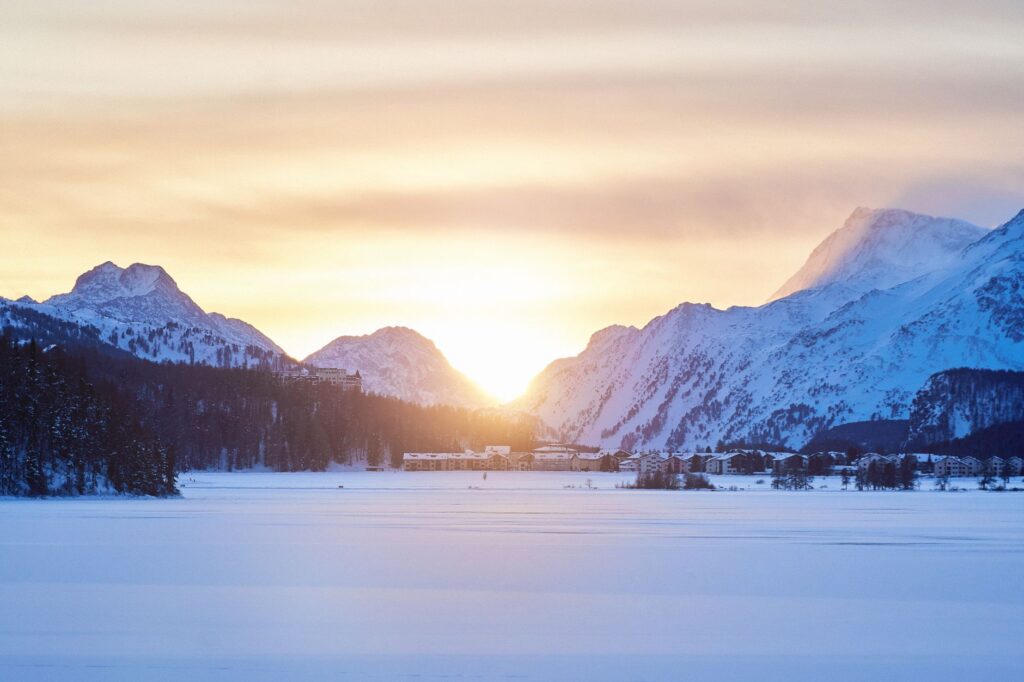
Travelling between Samedan, Pontresina and the Morteratsch valley reveals the logic of the route. The train does not seek the straight line: it negotiates with the mountain, slips through gorges, skirts slopes and suddenly appears on a stone viaduct that seems suspended in mid-air. In winter, when the valley is covered in snow, that choreography becomes almost domestic: locals recognise every curve, every tunnel, every point where the landscape opens up.
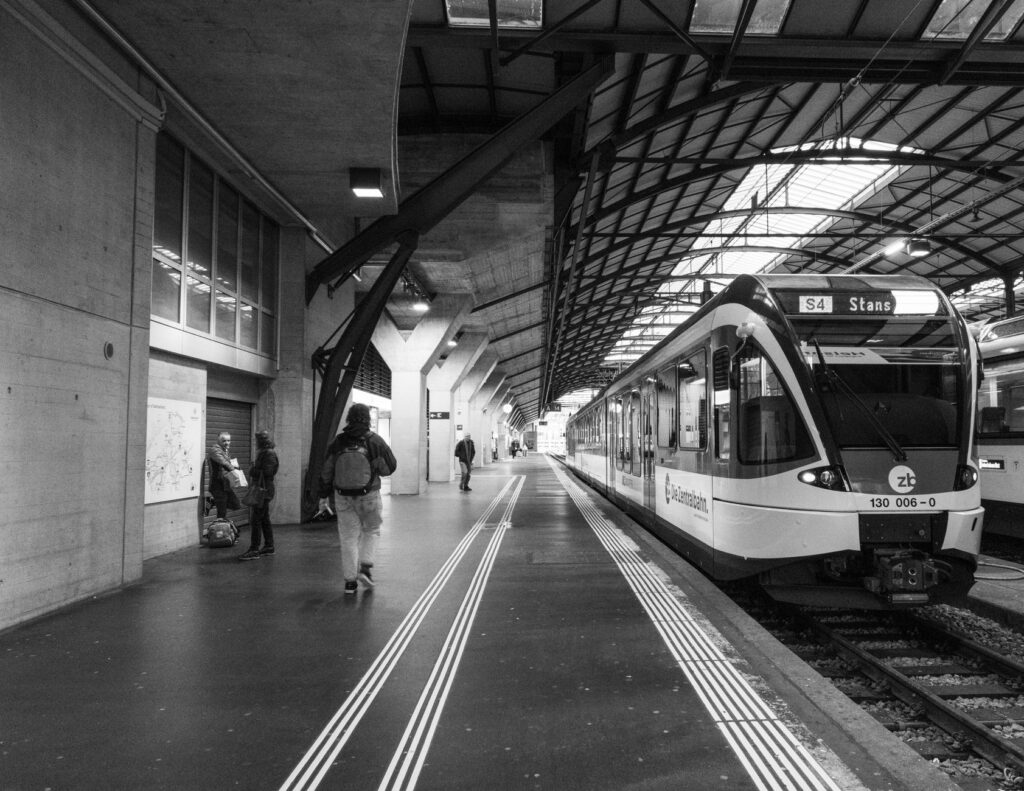
Pontresina station, with its wooden building and short platforms, works as a small covered square. Skiers, hospitality workers and students heading down to Samedan cross paths there. There are no large billboards or luminous screens: information arrives by loudspeaker and by habit.
The Bernina, a border crossed without noise
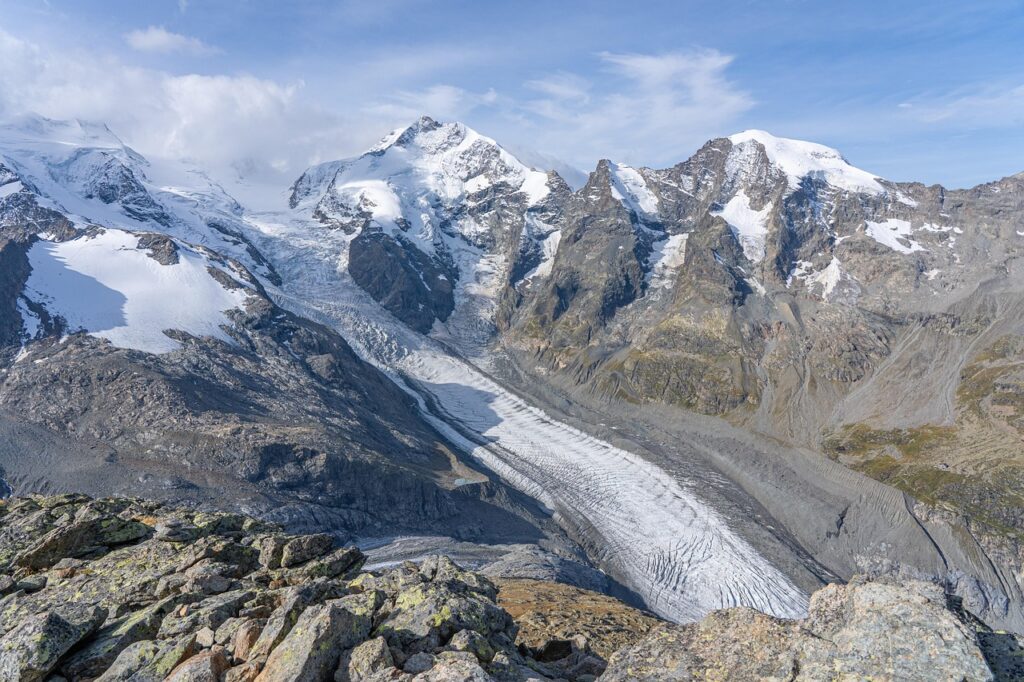
To the south, the Bernina line enters the Poschiavo valley and reaches Tirano, already in Italy. The Bernina Pass is one of the highest points a conventional adhesion train can cross in Europe, and that condition is felt in the landscape: vegetation changes, the air grows thinner and the language of passengers shifts too.
In Valposchiavo, the train coexists with an agricultural and tourism economy on a human scale. Intermediate stations such as Le Prese or Miralago keep a slow rhythm, almost that of a rural tram. The journey is not presented as a sporting feat, but as an everyday displacement that, along the way, offers some of the most celebrated views in the Swiss Alps.
The Rhaetian Railway does not merely cross the landscape: it is part of it. Its value lies not only in the engineering, but in the way it has allowed mountain life to remain possible.
Stone and iron architecture that ages well
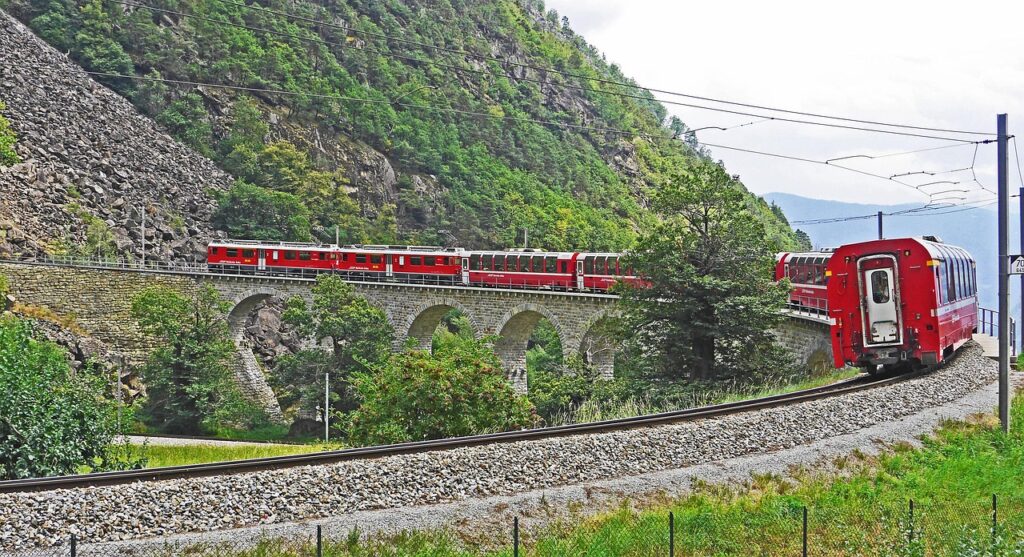
The Landwasser, Solís or Brusio viaducts are names that appear in any guidebook, but their interest goes beyond the photograph. They were built with a quality that has withstood more than a century of intensive use and extreme weather. The stylistic homogeneity of the ensemble, noted by UNESCO, is visible in the repetition of solutions: stone arches, retaining walls, helical tunnels.
That coherence is not an aesthetic whim. It responds to a way of building that understood infrastructure as part of the territory, not as an intrusion. Today, when adapting transport networks to climate change is under discussion, that lesson remains relevant.
Daily life on the rails
For the inhabitants of the Engadin and Valposchiavo, the train serves functions that go far beyond tourism. It is the means to reach a doctor in Samedan, to bring shopping from Poschiavo or to attend a concert in St. Moritz. In winter, when some roads close, the track becomes the only reliable connection.
That dependence explains why local communities defend the service so firmly. It is not only about preserving heritage: it is about maintaining a way of life. The train is, in a sense, the infrastructure that makes a territory habitable that would otherwise be reduced to a seasonal destination.
Landscape, snow and seasons
The calendar sets the rhythm of the railway. In summer, trains fill with hikers and cyclists; in autumn, with photographers chasing the colours of larches; in winter, with skiers and locals crossing between snow-covered villages. Each season has its own clientele and its own atmosphere.

That variety coexists with a remarkable continuity: the route, the stations and the timetables have kept a recognisable structure for decades. The experience of travelling on the Rhaetian Railway does not depend on spectacular novelties, but on the reliability of a system that has aged without losing its usefulness.
A heritage that is used, not just admired
Inscription on the World Heritage list in 2008 recognised the outstanding value of the ensemble, but it also posed a challenge: how to protect a property that remains in operation. The answer, according to official documents, involves maintaining operation and long-term conservation, introducing innovations compatible with the authenticity of the system.
That balance is not always easy. Modernising without betraying the essence requires careful technical decisions and attentive management. But the fact that the Rhaetian Railway remains, above all, a public service is perhaps its best guarantee for the future.
There are monuments you visit and infrastructures you inhabit. The Rhaetian Railway belongs to the second category: its value is measured in daily journeys, not in tickets sold.
Practical guide
To travel the Albula and Bernina lines, it is worth planning ahead, especially in high season. Trains run throughout the year, but timetables vary by season. It is advisable to check the official Rhaetian Railway website to confirm services and connections.
- Best time: June to September for hiking and green landscapes; December to March for snow and winter atmosphere.
- Recommended journeys: the stretch between Thusis and Tirano, combining the Albula and Bernina lines.
- What to bring: suitable footwear, warm clothing even in summer and a camera, because the views come without pause.
- Where to stay: Pontresina, Samedan or Poschiavo offer options for different budgets and good connections to the track.
- Tip: if travelling in winter, check connection status and allow enough margin between transfers.
A train that still tells the territory
At the end of the journey, when the train stops in Tirano and passengers step off calmly, the impression is of having crossed something more than a landscape. The Rhaetian Railway is not only a masterpiece of twentieth-century engineering: it is a living tool that continues to explain how life is organised in the Swiss Alps.
Its value lies not only in the viaducts or tunnels, but in the relationship it maintains with those who live near the track. That relationship, made of routines, shared landscapes and mutual dependence, is what turns a railway route into heritage. And it is also what ensures that, a hundred years from now, someone will still be looking out of the window as the train climbs, slowly, toward the Bernina Pass.