
Arriving at Changi is not landing at an ordinary airport. It is entering an ecosystem of four terminals, indoor gardens, a forty-metre waterfall, and an internal transport network that runs like clockwork. For the traveller with a layover, the question is not whether there is something to do, but how to organise the time so as not to get lost in the offer. In Singapore, the layover has become a travel decision.
This report offers a guide to understanding Changi for what it is: an infrastructure designed so that transit passengers do not feel they are waiting, but rather choosing. Without invented schedules or fares, with the logic of a traveller who needs clear criteria.
An airport you navigate like a city
Changi is organised into four main terminals connected to one another. Terminal 1, the oldest, retains the charm of the early years of commercial aviation in Singapore. Terminal 2, recently renovated, favours natural light and open spaces. Terminal 3, the largest, houses the famous butterfly garden and a rooftop pool. Terminal 4, opened in 2017, uses facial recognition to speed up controls.
For the transit traveller, the key is understanding that moving between terminals is straightforward but requires time. The automated train connecting Terminals 1, 2, and 3 runs around the clock. Terminal 4 is connected by a shuttle bus. Calculating connection times properly is the first responsible decision, especially if the onward flight has a tight margin.
At Changi, a layover is not improvised: it is planned with the same care as the main flight.
Jewel, the gem that changed the layover
Jewel Changi Airport is a complex attached to Terminal 1 that opened in 2019 and completely transformed the transit experience. Its centrepiece is the Rain Vortex, a forty-metre indoor waterfall that becomes a light and sound show at night. Around it, a multi-level indoor forest with more than two thousand trees and palms invites you to walk.
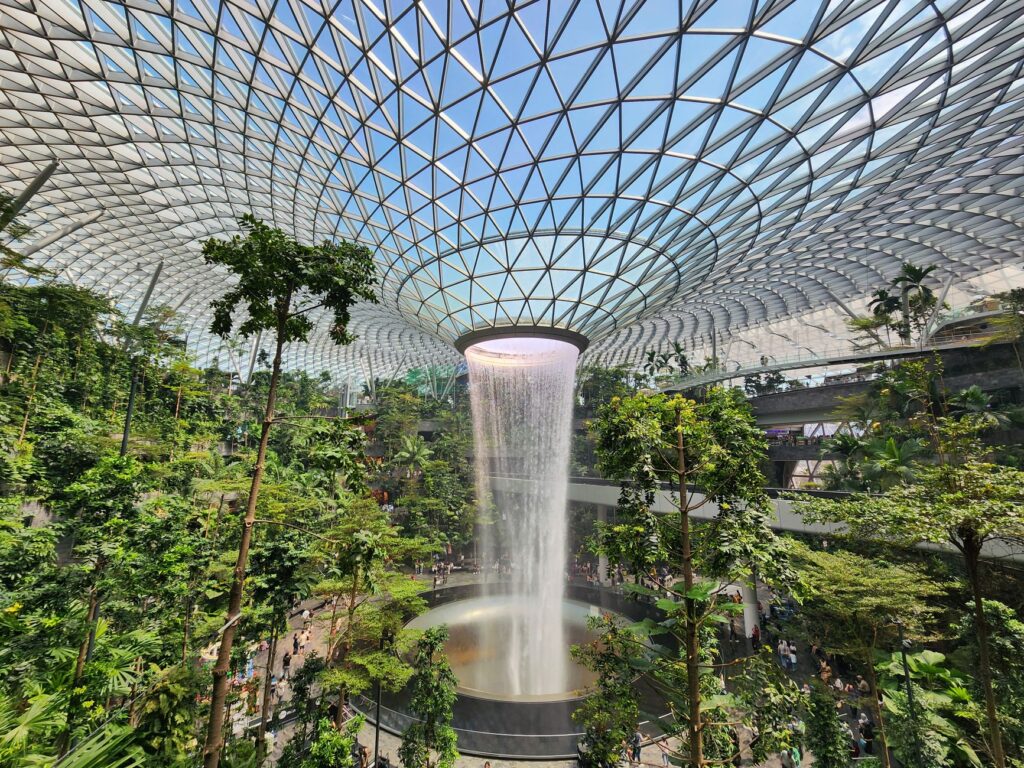
For transit passengers, Jewel is accessible from Terminals 1, 2, and 3 without passing through immigration, provided transit requirements are met. It is where many travellers decide to spend their waiting hours. But it is worth knowing that Jewel is not just a garden: it is also a shopping centre with more than three hundred shops and restaurants, and an entertainment space with cinemas and attractions for children.
The responsible decision here is to measure time. Jewel can absorb hours without you noticing. If the connection is short, it may be better to stay in the terminal and enjoy its own gardens, such as the Sunflower Garden in Terminal 2 or the Orchid Garden in Terminal 1.
Terminals as themed neighbourhoods
Each terminal has its own character. Terminal 1 stands out for the Orchid Garden, with more than a thousand specimens of this flower, Singapore’s national symbol. Terminal 2 offers the Sunflower Garden and a rest area with hammocks and reclining chairs. Terminal 3 has the Butterfly Garden, a space with more than a thousand butterflies of forty species, and an outdoor pool with runway views.
Terminal 4, more modern, embraces technology and digital art. Its interactive screens and art installations make it a different space, quieter and less crowded. For those seeking tranquillity, it may be the best option.
Choosing the right terminal for the type of layover is a decision that improves the journey. Not all terminals have the same amenities or the same atmosphere. If the traveller seeks rest, Terminal 3 offers rest areas and a transit hotel. If seeking entertainment, Jewel is the answer. If seeking silence, Terminal 4 can be the refuge.
Eating at Changi: from street food to fine dining
Changi’s food offering reflects Singapore: diverse, accessible, and high quality. In the public areas of the terminals there are food courts with local dishes such as chicken rice, fried rice noodles, or satay. At Jewel, the offer expands with international cuisine restaurants and some fine dining spaces.
For the transit traveller, the recommendation is simple: if time is limited, stay in the terminal and try local food at the food courts. If time is ample, cross to Jewel and explore. But remember that prices at Jewel are higher than in the terminals, and that the most popular restaurants may have waiting lists.
A practical detail: in Singapore, tap water is drinkable. Water fountains are available in all terminals, allowing bottles to be refilled at no extra cost. It is a responsible decision for the environment and the wallet.
Resting in transit: real options
Sleeping in an airport is an experience many travellers know. At Changi, options range from free rest areas to transit hotels. Terminal 3 has a hotel inside the transit area, with rooms by the hour. There are also reclining chairs in various zones, especially in Terminals 2 and 3.

For those seeking silence, Terminal 4 offers less crowded areas. And for those seeking a different experience, the YOTELAIR hotel at Jewel allows rest without leaving the complex. Booking in advance is advisable if travelling in high season, as places are limited.
The responsible decision here is to assess how much rest is needed and how much time is available. A four-hour layover is not the same as a twelve-hour one. In the first, a shower and a coffee may suffice. In the second, a transit hotel can make the difference.
Moving around Singapore on a long layover
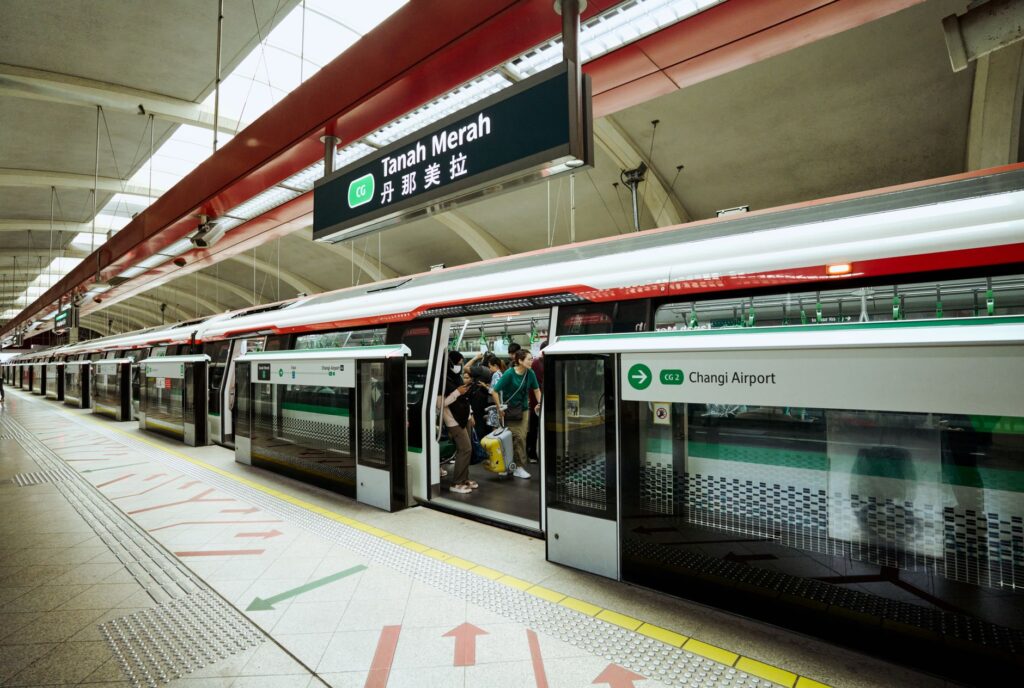
If the layover exceeds six hours and the traveller meets entry requirements, it is possible to leave the airport and visit Singapore. The city-state is small and efficient, and public transport connects the airport to the centre in less than an hour. The MRT has a station at Terminal 3, and buses connect to Terminals 1, 2, and 3.
For a quick visit, the most accessible destinations are Marina Bay, with its gardens and skyline, and Chinatown, with its market and street food. But calculate times carefully: the round trip, plus time in the city, can consume most of the layover. Leaving the airport is a decision that requires margin.
If the traveller decides to stay, Changi offers enough activities to fill a long layover. The free city tours organised by the airport, when available, are an interesting option, but require prior registration and meeting transit requirements.

Shopping and entertainment: what to know
Changi is also a shopping destination. The terminals and Jewel house everything from luxury stores to local product shops. For the transit traveller, the offer is broad, but remember that airport prices are not always lower than in the city. Comparing is a smart decision.
As for entertainment, options include free cinemas in Terminals 2 and 3, children’s play areas, and virtual reality spaces in Terminal 4. Jewel offers an amusement park with slides and a climbing net. For families, these options can turn a layover into a fun plan.
A cultural detail: in Singapore, tipping is not customary and service is included in the bill. This is an important difference for travellers from other regions. And another practical detail: English is an official language and is spoken in all terminals, although Mandarin, Malay, and Tamil are also heard.
Practical guide
To organise a layover at Changi, some basic criteria should be followed. First, verify transit and entry requirements, which vary by nationality and destination. Second, calculate available time: from flight arrival to the next departure, including security controls. Third, decide whether to stay in the terminal, explore Jewel, or go into the city.

- Minimum recommended time to move between terminals: one hour, considering controls and transfers.
- To visit Jewel: set aside at least two hours if you want to walk the forest and see the waterfall.
- To go into the city: allow at least six hours and verify entry requirements.
- To rest: consider a transit hotel if the layover exceeds five hours.
- To eat: terminal food courts offer local options at reasonable prices.
- For families: play areas and the Butterfly Garden are free and entertaining options.
Information on schedules, fares, and specific services should be checked through the airport’s official channels, as it may change. This report does not include real-time data or fares, precisely to avoid outdated information.
A layover that invites you to return
Changi is not just a place to pass through. It is a space where the traveller can decide how to live their layover: in a hurry or calmly, alone or accompanied, exploring or resting. The infrastructure is designed so that every option is possible, and the airport’s organisation makes it easy for transit not to become a waste of time.
For the traveller arriving in Singapore for the first time, Changi can be a perfect introduction to the city-state: orderly, diverse, efficient, and surprisingly green. And for those who already know Singapore, Changi remains a place that invites you to return, even if only to see the Jewel waterfall one more time.
The best layover is the one remembered not for the wait, but for what was done with it.
In a world where airports are often anonymous spaces, Changi proposes something else: a place where the traveller can choose, and where the layover becomes, if one wants it to, part of the journey.