There are places where time does not simply stop, but instead adopts its own steady cadence, far removed from contemporary urgency. At the southern tip of the Argentario promontory in Tuscany, Porto Ercole stands as a quiet refuge where the Mediterranean preserves its most noble memory. Far from the mass tourism choking other Italian coastal spots, this former fishing port maintains a rare balance between discreet elegance and maritime authenticity.
The town’s pulse is measured in everyday details: the rhythmic clinking of rigging against masts in the marina, the aroma of espresso and salt air drifting across morning terraces, and the imposing presence of sixteenth-century Spanish fortifications keeping watch over the horizon from the cliffs. It is no coincidence this corner captivated aristocrats, intellectuals, and image-makers like Slim Aarons for decades, immortalizing an aesthetic of the ‘dolce vita’ that still thrives today among ochre facades and Tyrrhenian sunsets.
The Old Port: Where the Sea Sets the Rhythm of the Hours
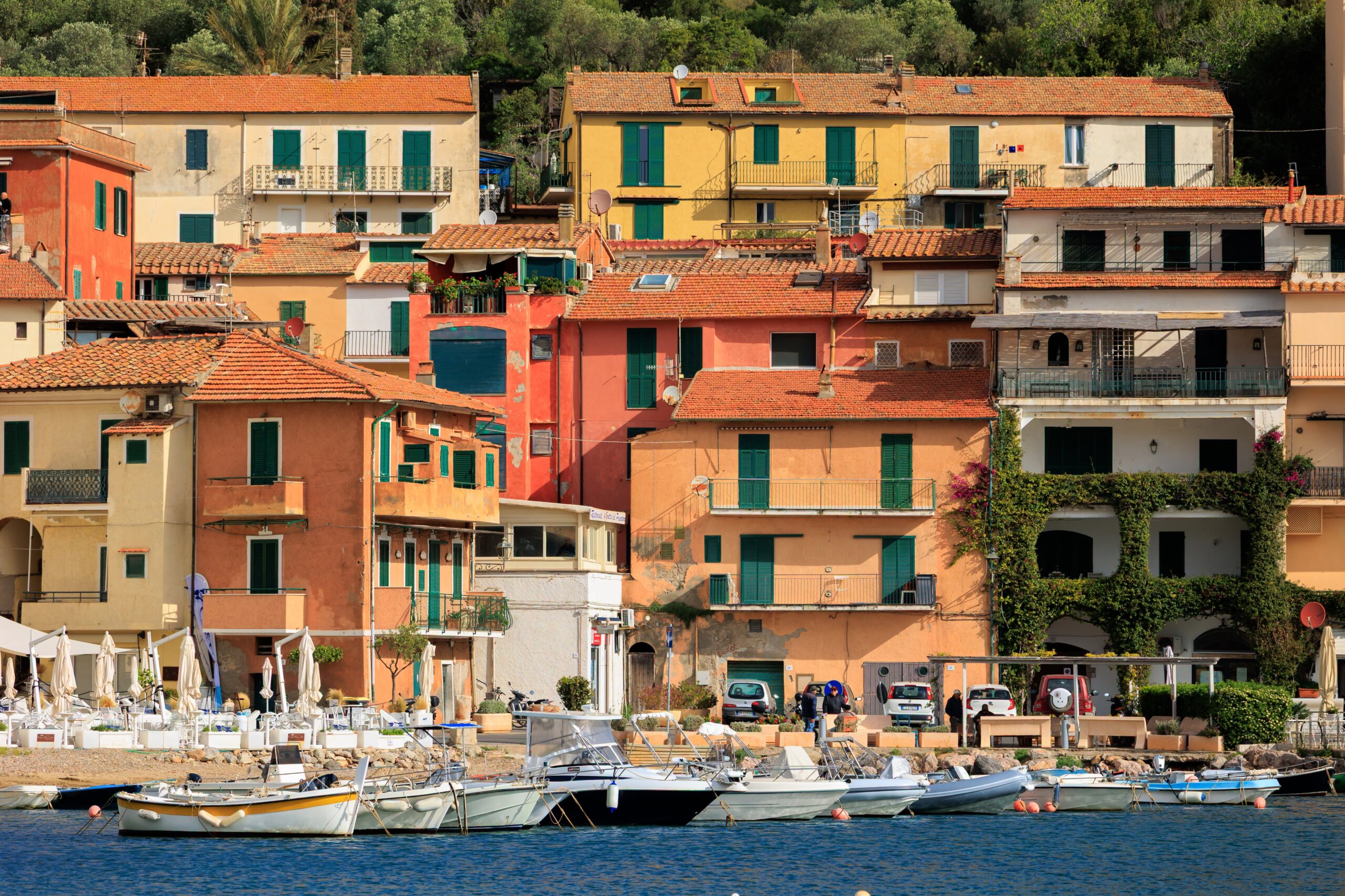
Life in Porto Ercole has always centered around the docks. The old port, sheltered by natural breakwaters and the stony bulk of Forte Stella, functions as the town’s main square. Traditional wooden fishing boats share space with leisure craft in a scene that has barely shifted in half a century. Local fishermen continue mending nets on the same stone benches where their grandfathers sat, maintaining an uninterrupted dialogue with the sea.
On misty mornings, the pier transforms into a stage of unhurried gestures. The morning catch is sold directly to family-run restaurants lining the waterfront. There is no flashiness or crowding; luxury here reveals itself in respectful silence and the quiet luxury of a conversation shared over a glass of local Ansonica wine from Monte Argentario.
Defensive Architecture and the Legacy of the Spanish Empire
Porto Ercole’s silhouette is dominated by its defensive network, a remnant of the era when this territory formed part of the State of the Presidios under the Spanish Crown. Forte Filippo, Forte Santa Caterina, and the striking Forte Stella—with its unmistakable six-pointed star layout—form a strategic web illustrating the geopolitical importance once held by this maritime enclave.
Walking up to Forte Stella at dusk offers one of the finest perspectives of the Tuscan coast. From its stone ramparts, the horizon opens toward the islands of Giglio and Giannutri, silhouetted against a sky shifting between mauve and fire. The preservation of these fortresses is not merely museological; it reflects the organic integration of historical monuments into the town’s urban and emotional geography.
The Historic Center: A Labyrinth of Stone and Memory
Crossing the medieval walls through the San Giovanni Gate means stepping into a vertical world of steep alleys, rounded arches, and facades draped in bougainvillea. Porto Ercole’s old town, locally known as Terra Vecchia, demands exploration on foot, without maps or haste, guided only by the murmur of neighborhood conversations spilling from open windows.
Within this car-free maze, every tiny square acts as a natural viewpoint over the harbor. Residents place chairs on their doorsteps as afternoon falls, keeping the ritual of the passeggiata alive. It is within these alleys that the town’s resistance to tourism standardization is most evident; shops remain neighborhood groceries, bakeries smell of sourdough, and artisan workshops keep their doors open to passersby.
Echoes of History: The Footprint of Caravaggio
Tucked within its folds of history, Porto Ercole holds one of the universal art world’s greatest enigmas: the death of Michelangelo Merisi da Caravaggio. Fleeing Rome under a cloud of debt and death sentences, the Baroque painter breathed his last in this port on July 18, 1610, under circumstances still debated today. Though his remains rested in an anonymous ossuary for centuries, recent archaeological and anthropological research finally identified his tomb in the cemetery of San Sebastián.
Today, a commemorative monument in the old town honors the master of chiaroscuro. Visitors who come to pay their respects find a direct bridge between seventeenth-century artistic brilliance and the serene melancholy of present-day Tuscany, recalling that beauty and tragedy often walk hand in hand across the Mediterranean.
The Aesthetics of an Eternal Summer: The Spirit of Slim Aarons
It is impossible to wander through Porto Ercole without evoking the photographs of Slim Aarons, the man who chronicled twentieth-century international high society. At iconic spots like Hotel Il Pellicano, perched on a sheer cliff surrounded by pine trees and Mediterranean scrub, elegance merged seamlessly with untouched nature.
Aarons turned this hotel and its surroundings into a symbol of carefree yet sophisticated living. Those swims in crystal-clear coves, lunches beneath white canvas umbrellas, and sunsets overlooking the Tuscan archipelago continue to define the area’s tourism identity. This is not about ostentation, but rather a refined appreciation for space, silence, and natural beauty over any artifice.
True luxury in Porto Ercole is not the accumulation of goods, but the capacity to stop time and enjoy the unwavering light of the Mediterranean upon ancient stone.
This atmosphere of relaxed exclusivity attracts those seeking a sanctuary where privacy is standard. Visitors share morning coffee with lifelong residents, and in harbor restaurants, the simplicity of a plate of sea urchin spaghetti elevates into a memorable experience thanks to the absolute authenticity of the ingredients.
The Natural Environment: Between Mountain and Deep Blue
The landscape surrounding Porto Ercole is a sanctuary of biodiversity. The Argentario promontory, once an island connected to the mainland by two sand tombolos and a central lagoon, offers a network of trails winding through forests of holm oaks, cork trees, and Mediterranean maquis.
Walking these paths leads to secluded coves like Cala Galera or tiny Spiaggia Lunga, where crystal waters reflect the deep green of pine trees grazing the shoreline. This coastal landscape, shielded from rampant real estate speculation, reveals both the fragility and strength of the Tuscan coast, a region that has successfully guarded its original physiognomy despite modern pressures.
Practical guide
How to get there: Rome-Fiumicino International Airport is roughly 150 kilometers south (about a one-and-a-half-hour drive via the A12 highway and Aurelia road). The nearest train station is Orbetello-Monte Argentario, connected to Rome and Pisa, with regular bus service onward to Porto Ercole.
When to go: May, June, September, and October offer the best combination of mild weather and tranquility. July and August see a significant surge in seasonal tourism, particularly on weekends.
Where to stay: Options range from the historic Hotel Il Pellicano, a benchmark of discreet cliffside luxury, to small boutique hotels and family-run guesthouses nestled in the historic center and along the harborfront.
Essential gastronomy: Sample Tuscan cacciucco (fish stew), fresh seafood risotto, and local Ansonica white wine at traditional taverns in the old port.
Etiquette tips: Discretion, respect for residential areas, and appropriate attire when visiting religious sites or dining at high-end establishments are greatly valued.
The Final Glimmer: The Invisible Pulse of Twilight
As the sun begins to dip into the Tyrrhenian Sea, Porto Ercole seems to hold its breath. Golden light washes over centuries-old walls, moored boats gently sway their hulls against gentle ripples, and gulls trace silent circles above water transformed into a sheet of polished copper.
On harbor terraces, locals and travelers share a quiet moment of tacit communion with the landscape. It is the hour when daytime bustle fades into the warm twilight of a Tuscan evening. In that threshold between day and darkness, the village reveals its deepest truth: a sanctuary where beauty is not a shop window, but a dignified way of inhabiting the world with memory and grace.
The true elegance of this port lies not in its yachts, but in the silent fidelity of its inhabitants to a way of life tied to the tides and the wind.
Remaining in Porto Ercole as dusk falls is understanding that the dolce vita was never a cinematic invention, but the simple art of knowing how to be present, watching the sea while history whispers from the stones.
Source in English: https://elpais.com/elviajero/escapadas/europa/2026-09-27/porto-ercole-el-pueblo-de-italia-donde-la-dolce-vita-sigue-mirando-al-mar.html