
Origins and Geography of an Ancient Craft
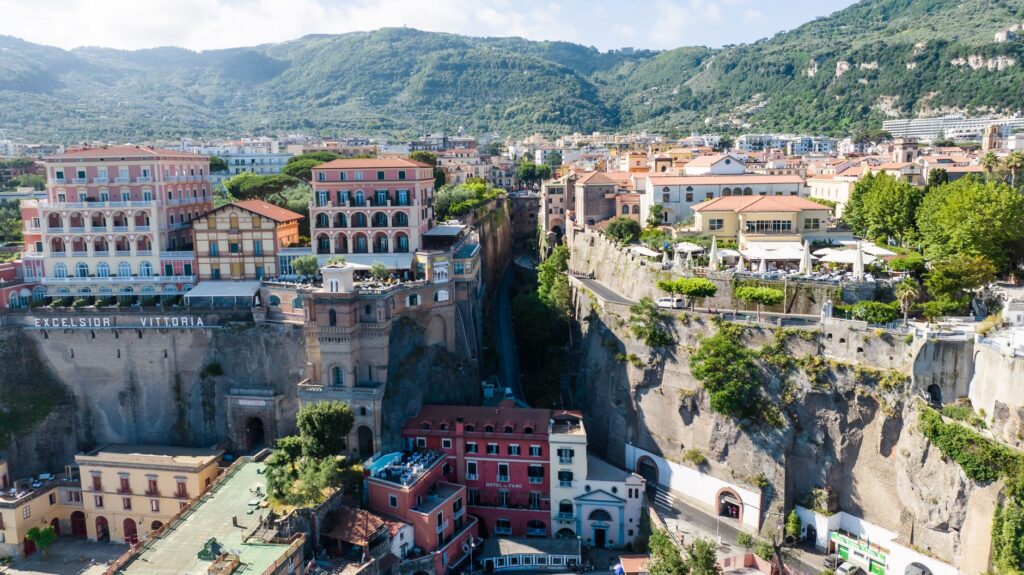
The Sorrentine Peninsula, suspended between the intense blue of the Tyrrhenian Sea and the sheer cliffs of limestone rock, has sheltered for centuries a silent tradition that defies the passage of time. Far from the summer bustle that crowds the viewpoints of the coast, in the steep alleys of Sorrento’s old town, the echoes of manual labor that demands infinite patience persist. Here, wood is not merely a constructive resource, but a living canvas where geometry, botany, and heritage passed down through generations converge.
The art of Sorrentine intarsia has its roots in antiquity, though it reached its aesthetic and technical maturity during the nineteenth century, driven by the fervor of the Grand Tour. European travelers descending to southern Italy in search of classical ruins and sublime landscapes found the perfect keepsake in these musical boxes, game tables, and decorative panels. Today, traditional workshops remain faithful to those construction methods, operating in the same spaces where their ancestors carved, cut, and assembled thousands of tiny pieces of noble wood.
The preservation of this intangible heritage is not a nostalgic exercise, but an active cultural resistance. Current masters combat digital obsolescence and mass industrial production by using the same rudimentary instruments: precision blades, animal-based glues, and a chromatic palette obtained exclusively through the natural tonal varieties of woods such as walnut, maple, cherry, and olive, entirely dispensing with artificial dyes.
The Alchemy of Veneer and Botanical Selection
The process begins long before the wood touches the workbench, in the meticulous moment of forest selection. Artisans look for specimens presenting whimsical grain patterns, dramatic knots, and natural color variations. Each plant species provides a specific tone: the warm yellow of boxwood, the deep dark brown of Italian walnut, the subtle reddish hue of wild apple, and the greenish or blackish nuances offered by woods subjected to traditional air-drying processes outdoors for years.
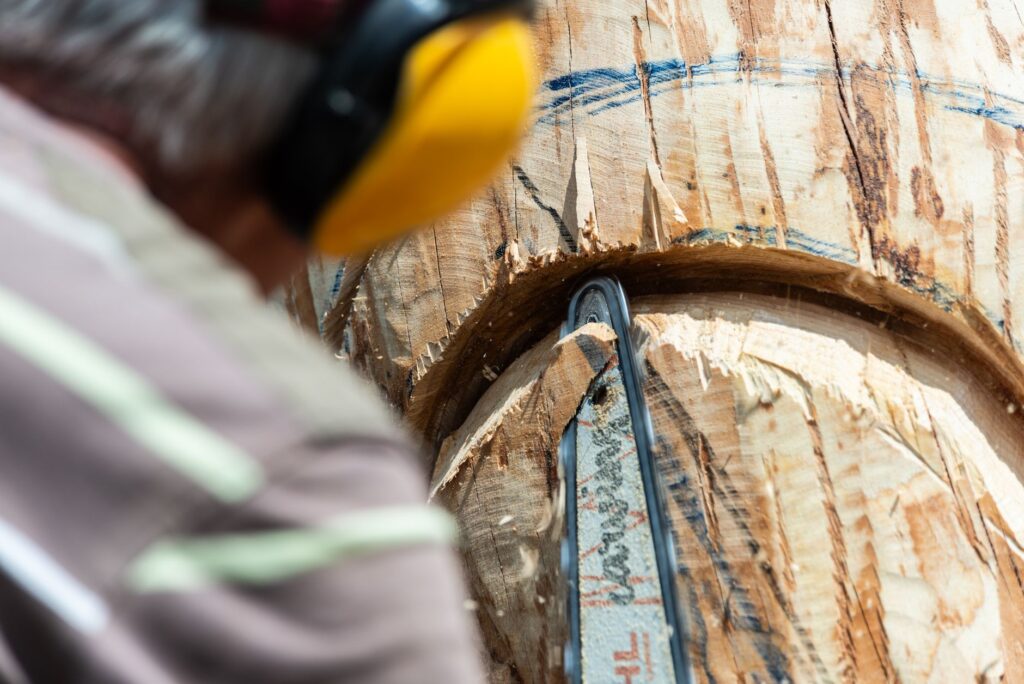
Once the logs are selected, they are cut into extremely thin sheets known as veneers, whose thickness rarely exceeds a millimeter. This millimeter-precise breakdown requires a steady hand and an encyclopedic knowledge of the organic behavior of the material. Wood is a hygroscopic material; it breathes, contracts, and expands according to environmental humidity. The marqueter must anticipate these invisible tensions to prevent the assembled pieces from suffering cracks or deformations decades later.
The true master does not dominate wood by forcing it, but by listening to the hidden tensions within the grain’s pattern before making the first cut.
In contemporary Sorrentine workshops, this respect for the raw material is combined with a constant pursuit of sustainability. Local studios work closely with foresters in the Campania region to guarantee the traceability of the wood, using pruning surplus and naturally fallen specimens, thus ensuring the ecological viability of a craft deeply rooted in its natural surroundings.
Geometry and Perspective: Miniature Drawing
Before cutting a single strand of wood, the design comes to life on paper through preparatory drawings of great geometric complexity. Traditional compositions range from coastal landscapes and floral still lifes to complex three-dimensional optical illusions that mimic architectural depth. Each line must be calculated with mathematical exactness, as the slightest drafting error will expand exponentially when assembling hundreds of adjacent pieces.
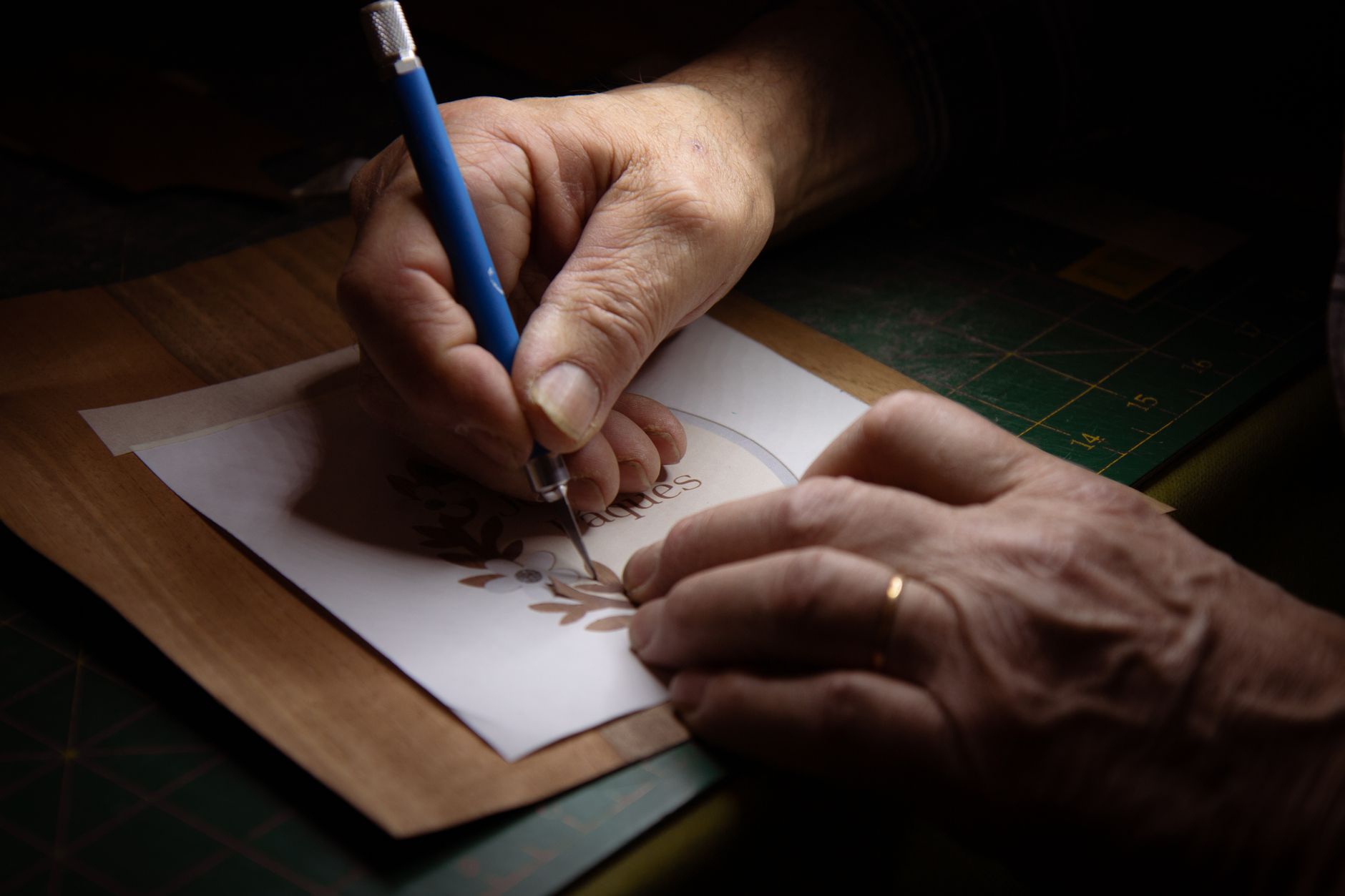
To transfer the design to the support, artisans employ manual tracing techniques onto the chosen veneer. Using a special short-bladed knife with an extreme edge, they simultaneously cut several superimposed layers of veneer, a method known as packet cutting. This allows the pieces to fit together with millimeter precision, leaving no empty spaces that would later need to be filled with artificial putties or waxes.
- Rigorous selection of native woods without added chemical dyes.
- Use of manual incision knives for sub-millimeter precision cuts.
- Compositional design based on conic perspective and geometric modulation.
- Cold assembly using reversible natural glues of organic origin.
This mastery of scale and perspective turns every flat surface into a visual trompe l’oeil. Those who observe a tray or tabletop signed by a Sorrentine workshop experience a subtle sensory confusion: volumes appear to protrude from the plane, cast shadows acquire physical consistency, and the Mediterranean light seems trapped between the plant fibers.
The Workshop: An Ecosystem of Secular Tools
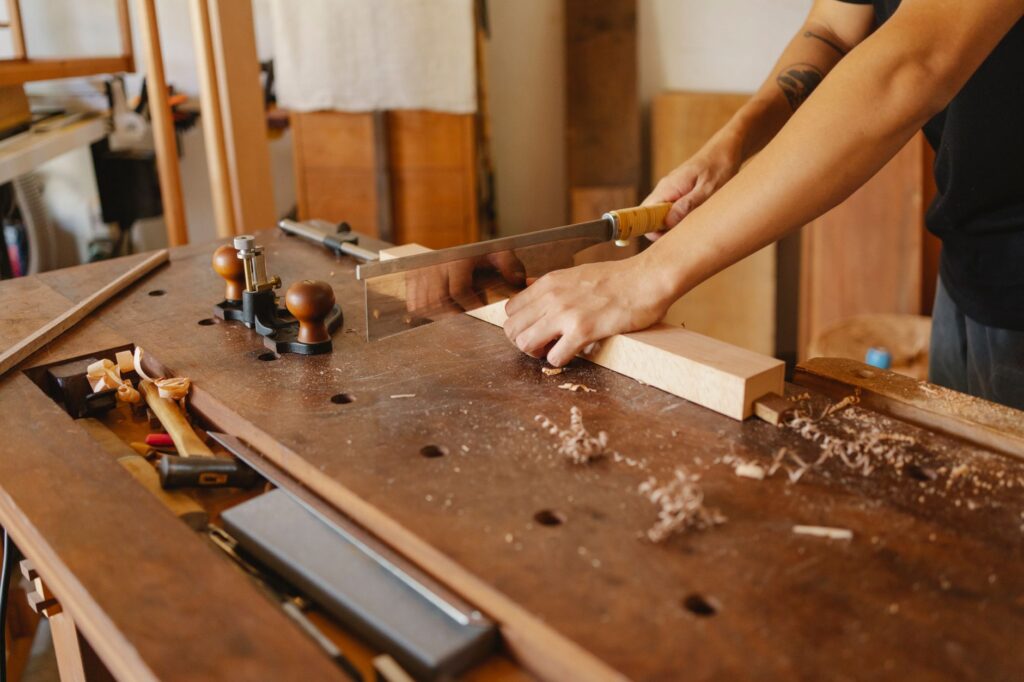
Crossing the threshold of a traditional workshop in Sorrento is stepping into a space where time seems to have slowed its pace. The walls are lined with shelves full of drawers labeled with faded calligraphy, storing tiny fragments of exotic and indigenous woods classified by density and color. On solid wood workbenches, polished by decades of continuous hand rubbing, rest the essential tools of the trade.
Among them stands out the characteristic marquetry horse, a foot-operated wooden frame that holds the veneer firmly while the artisan guides the blade with both hands. The synchronization between foot pressure and arm movement requires a physical coordination comparable to that of a musical instrumentalist. There is no noisy electrical machinery; the dominant sound is the faint crunch of wood being sectioned and the rhythmic whisper of fine-grained sandpaper.
Natural lighting is another determining factor in these spaces. The benches are strategically located next to high windows overlooking interior courtyards, taking advantage of the diffuse light of the Gulf of Naples to distinguish subtle tonal gradations between nearly identical woods. In this environment, apprentices spend years filing burrs and preparing glues before receiving authorization to assemble their first complex piece.
Generational Turnover and Design Vanguard
The great challenge facing Sorrento’s marquetry in the twenty-first century is the transmission of knowledge to younger generations. In an era dominated by laser cutting and three-dimensional digital printing, convincing youth of the merits of a craft requiring a decade of learning is complex. However, recent years have witnessed a renaissance driven by young designers who reinterpret tradition through a contemporary lens.
These emerging creators maintain the centuries-old technique of intarsia, but update the formal repertoire. They abandon traditional nineteenth-century floral motifs to embrace geometric abstraction, Scandinavian minimalism, and collaborations with international interior design firms. This hybridization allows Sorrentine pieces to step out of conventional tourist circuits and enter high-end private collections and exclusive architectural projects worldwide.

Tradition is not the worship of ashes, but the preservation of fire; renewing the language of intarsia is the only way to guarantee its future survival.
Local institutions and applied arts schools have begun offering scholarship-backed vocational training programs, attracting international talent interested in mastering an endangered craft. This cultural exchange revitalizes the workshops, injecting new aesthetic perspectives without compromising the technical integrity of the artisanal process.
Practical guide
Planning a trip focused on observing and acquiring fine marquetry in Sorrento requires understanding the codes of a highly fragmented artisanal sector. Unlike the mass commercial establishments on the waterfront that sell imported industrial souvenirs, authentic intarsia workshops are found in the side streets of the historic center, such as Via San Cesareo and its surroundings, or in the upper neighborhoods of the urban periphery.
The best time to visit the workshops and converse leisurely with the masters is during the low season, between November and March. In these months, tourist traffic drops considerably, allowing access to live demonstrations and custom commissions. To identify a genuine workshop, it is essential to look for actual wood shavings on the floor, the absence of automated cutting machinery, and the existence of certificates of authenticity detailing the wood species used in each piece.

- How to get there: Circumvesuviana train from Naples to the Sorrento terminal station (approximately a one-hour journey).
- Workshop locations: Explore the commercial fabric of Via San Cesareo, Via Fuoro, and the interior courtyards of Corso Italia.
- Conservation: Marquetry pieces must be protected from direct sunlight exposure and sudden humidity fluctuations.
- Documentation: Always request a detailed invoice and botanical origin certificate for international transport of noble woods.
>
Acquiring a piece of marquetry in Sorrento means understanding that one is not purchasing a conventional decorative object, but a fragment of the geological and cultural history of southern Italy. Each box, panel, or tabletop encapsulates the collective effort of a community that has turned physical space limitations into an infinite expansion of beauty through wood.
The Echo of the Forest at the Edge of the Sea
At dusk, when the last ferries leave the port of Marina Piccola and the golden evening light bathes the volcanic tuff facades, Sorrento’s workshops quietly close their heavy wooden doors. Inside, on workbenches covered in ultra-fine plant dust, unfinished pieces rest, ready to take shape at dawn. That nighttime silence is the true guardian of a craft that stands undaunted at the very edge of the marine abyss.
The wood, which once formed part of a secular tree on the forested slopes of inner Campania, finds here its second and definitive existence. Transformed by the expert hand of the artisan, it dialogues eternally with the sea washing the peninsula. In every grain assembled with millimeter precision, the memory of a landscape and the unalterable pulse of those who have dedicated their lives to turning geometric rigor into tactile poetry endure.