Beyond the Shadow of the Great Stones
The name Cambodia immediately evokes the carved towers of Angkor Wat in the traveler’s imagination, an architectural milestone that almost entirely absorbs international attention. However, reducing this Southeast Asian territory to its most photographed medieval jewel means ignoring a fascinating web of river landscapes, complex memories, natural reserves, and archaeological vestiges submerged in the thickets that rightfully claim their own space in the visitor’s memory.
Traveling beyond the classic circuit implies embracing a different rhythm, where dusty secondary roads lead toward rural communities where life flows to the rhythm of monsoons and the freshwater of the great Tonlé Sap lake. This chronicle traces the journey separating the vibrant and often turbulent capital, Phnom Penh, from the less traveled corners of the deep north, proving that Cambodia’s true depth lies in its capacity to surprise those who dare to look beyond the pre-established monumental horizon.
Phnom Penh: Contemporary Pulse on the Banks of the Mekong
The Cambodian capital unfolds with chaotic and magnetic energy at the confluence of the Mekong, Tonlé Sap, and Bassac rivers. Unlike the solemn stillness of the archaeological sanctuaries, Phnom Penh is a city that intensely lives the present, even though its recent past remains ever-latent in collective memory and in the testimonies dotting its urban fabric.
Between Colonial Boulevards and River Wharves
Strolling along Sisowath Quay at sunset reveals the river vocation of this metropolis. Fishing boats slowly set sail while locals practice open-air aerobics in the riverside parks, creating a scene of deeply human everyday normality. French colonial architecture buildings, worn by the tropical heat and the passage of decades, coexist with golden pagodas like Wat Phnom, the foundational temple that gives the city its name and remains an oasis of contemplation amid urban bustle.
The Cambodian capital is not merely a bridge to a monumental past, but a stage where human resilience manifests itself in every corner and in every improvised riverfront shop.
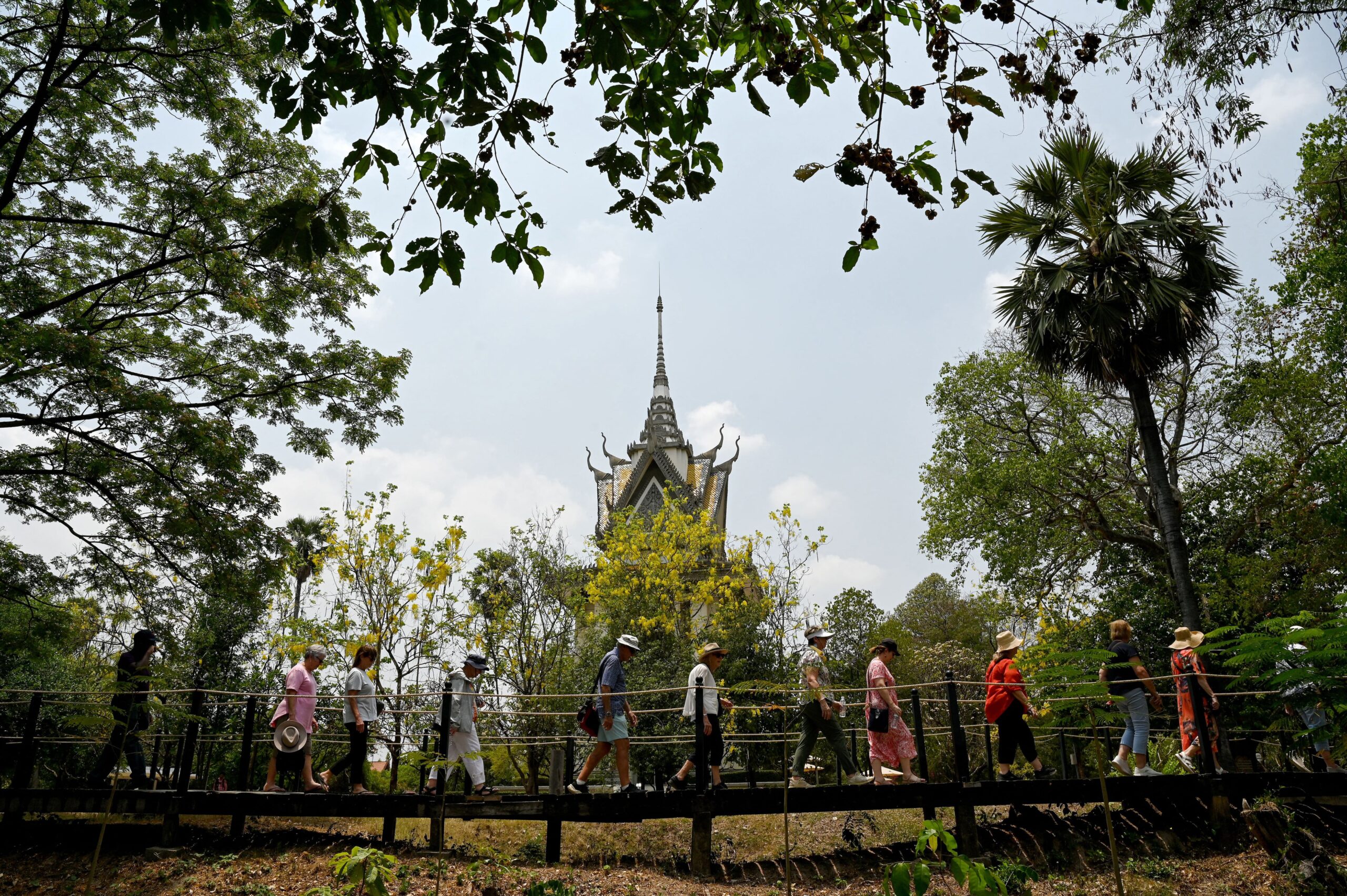
The Royal Palace and its Silver Pagoda offer a dazzling display of traditional Khmer craftsmanship, with pointed roofs and floors covered by thousands of pure silver tiles. Nevertheless, to understand the country’s complex identity, it is essential to step into the dark corridors of the Tuol Sleng Genocide Museum and the Killing Fields of Choeung Ek, spaces of historical memory where the visitor must confront the painful legacy of the Khmer Rouge regime with absolute respect and sobriety.
Heading North: The Transition of the Rural Landscape
Leaving Phnom Penh northward via National Highway 6 initiates a gradual metamorphosis of the landscape. Urban neighborhoods slowly yield ground to sprawling rice plantations, wetlands where fishermen cast nets from traditional boats, and small villages formed by wooden houses raised on stiles to protect against seasonal floodwaters.
Life Suspended on Water
In the vicinity of the lake system, human existence is entirely organized around water fluctuation. Floating communities are not merely a visual attraction, but secular adaptations to a dynamic ecosystem where schools, markets, and temples float and shift according to the dry or rainy season. Here, the traveler witnesses how local family hospitality remains intact despite the material precarity often accompanying these aquatic geographies.
As the road progresses toward provinces like Kampong Thom or Siem Reap, the density of the jungle becomes palpable. Local roadside markets offer an overwhelming sensory palette, blending the aromas of local spices, fermented fish (prahok), and tropical fruits like rambutan and durian, inviting a pause to observe leisurely commercial activity.
Battambang and the Crepuscular Spectacle of Phnom Sampov
Situated to the west, Battambang preserves one of the best-preserved collections of colonial architecture in the country alongside a lively contemporary art scene. However, one of the greatest natural attractions of its surroundings hides within the karst hills of Phnom Sampov, a sacred site embodying both profound natural beauty and painful historical memory.
The Nocturnal Exodus of Two Million Bats
At dusk, when the golden sunlight begins to dye the surrounding savannah, thousands of visitors and locals gather at the foot of the Phnom Sampov cave. What follows is a natural phenomenon of overwhelming magnitude: for over an hour, a dense, winding column composed of approximately two million emerging bats leaves the cavity in search of food across the region’s rice fields and wetlands.
This living river in the sky traces sinuous, whimsical shapes against the twilight firmament, accompanied by the constant hum of millions of wings and the occasional presence of birds of prey capitalizing on the feast. It is an eloquent reminder of the ecological vitality still surviving in the least intervened recesses of Cambodian territory, far removed from purely monumental circuits.
Koh Ker: The Enigmatic Pyramid in the Thicket
While the vast majority of travelers concentrate their steps within the Angkor archaeological park, the deep north conceals treasures whose solitude magnifies their aura of mystery. Among them stands the Koh Ker site, which during the 10th century briefly served as the capital of the Khmer Empire under the reign of Jayavarman IV before the court decided to return to the Siem Reap region.
Monumental Architecture Far from Crowds
The most fascinating element of Koh Ker is Prasat Thom, a seven-tiered stepped pyramid temple rising imposingly with a structure unmistakably reminiscent of Mesoamerican constructions, despite belonging entirely to Khmer aesthetics and worldview. Built with massive sandstone blocks and surrounded by dense secondary vegetation that has slowly reclaimed the terrain over centuries, this pyramid conveys a sense of isolation and wonder very difficult to experience in more crowded temples.
Ascending the enabled walkways to the top platform reveals a green sea of virgin jungle stretching to the horizon, dotted here and there by the half-ruined silhouettes of lesser shrines and giant lingas hidden among the brush. Here, silence is broken only by the songs of tropical birds and the rustling of branches, offering visitors an intimate communion with archaeology and landscape.
Living Memory and Heritage Conservation
Tourism in Cambodia finds itself at a delicate crossroads. While visitor arrivals provide essential economic sustenance for thousands of families, pressure on monuments and natural ecosystems demands increasingly strict management policies respectful of the surroundings.
The Balance Between Development and Sustainability
Local and international institutions work hand in hand to restore temples using traditional techniques that prevent irreversible sandstone degradation. Simultaneously, community tourism initiatives in provinces like Preah Vihear or Pursat seek to diversify visitor flows, allowing economic benefits to reach rural communities directly without altering their traditional lifestyles.
The true future of tourism in this country involves decentralizing the gaze, shifting spotlights away from saturated enclaves to distribute wealth and wonder across a territory replete with unexplored nuances.
This respectful approach is indispensable to ensure future generations can continue admiring not only the magnificence of grand imperial constructions, but also the fragile harmony of the natural environments sustaining them.
Practical guide
How to get there: Phnom Penh International Airport (PNH) and Angkor Siem Reap International Airport (SAI) receive regular international flights from major Southeast Asian hubs such as Bangkok, Singapore, or Kuala Lumpur.
Best time to visit: The dry season runs from November to April, with November and December being the most pleasant regarding temperatures and humidity. The rainy season (May to October) radically transforms the landscape, flooding fields and making the jungle lusher.
Documentation and visas: Citizens of most countries require a visa to enter Cambodia, which can be processed online (e-Visa) prior to departure or directly upon arrival at enabled international airports.
Currency and payments: The official currency is the Cambodian riel, though the US dollar is widely accepted for everyday transactions. Carrying cash in small denominations is recommended for rural areas.
Internal transport: For long journeys between cities, express buses and private taxis are the most reliable options. In archaeological and rural areas, renting tuk-tuks or motorbikes with drivers facilitates local mobility.
Health and safety: Travelers are advised to obtain comprehensive medical travel insurance and consult an international vaccination center before embarking on the route, especially if planning extended stays in rural or jungle areas.
The Distant Echo of an Empire in the Mist
When morning mist begins to clear over the forgotten ruins of Koh Ker and the last bats return to their sanctuary deep within Phnom Sampov, Cambodia reveals its true dimension. It is not merely a postcard destination or an archaeological yearbook frozen in time, but a vibrant, complex, and deeply human country that dignidad withstands the blows of its own history.
Venturing along its secondary roads, listening to the accounts of its inhabitants in the shade of a rural pagoda, and contemplating the immensity of its river and forest landscapes allows travelers to understand that true travel is not about accumulating visits to celebrated monuments, but about letting oneself be transformed by the subtle, dazzling authenticity of a territory that always keeps one more secret hidden in the thicket.
Source in EN: El País (El Viajero) – Cambodia is Much More Than Angkor: From a Cave with Two Million Bats to an Enigmatic Pyramid.