
The Arctic Circle is not merely a line drawn on school maps; it is a biogeographical boundary that imposes its own rules on those who dare to walk it. In the northernmost reaches of Europe, the Swedish tundra holds one of the best-kept secrets for long-distance hiking enthusiasts: the Kungsleden, or the King’s Trail. Stretching over four hundred kilometers between Abisko and Hemavan, this route represents the quintessence of Scandinavian trekking, combining the vastness of the Abisko, Sarek, Stora Sjöpället, and Pieljekaise national parks with a network of shelters that balances wild isolation with the indispensable technical safety required in extreme latitudes.
Planning a self-supported traverse in this environment demands shedding any romantic notions of temperate climates. Unlike the alpine ranges of southern Europe, where meteorological shifts often relent at dusk, Swedish Lapland operates under the tyranny of volatile weather that can transform a mild summer day into a freezing gale within hours. This guide rigorously addresses the logistical, technical, and cultural aspects necessary to successfully complete this itinerary, breaking down each section from the perspective of the experienced traveler seeking to understand the territory in its deepest and most respectful dimension.
The Anatomy of the Polar Circle: Geography and Climatology of the Swedish Tundra
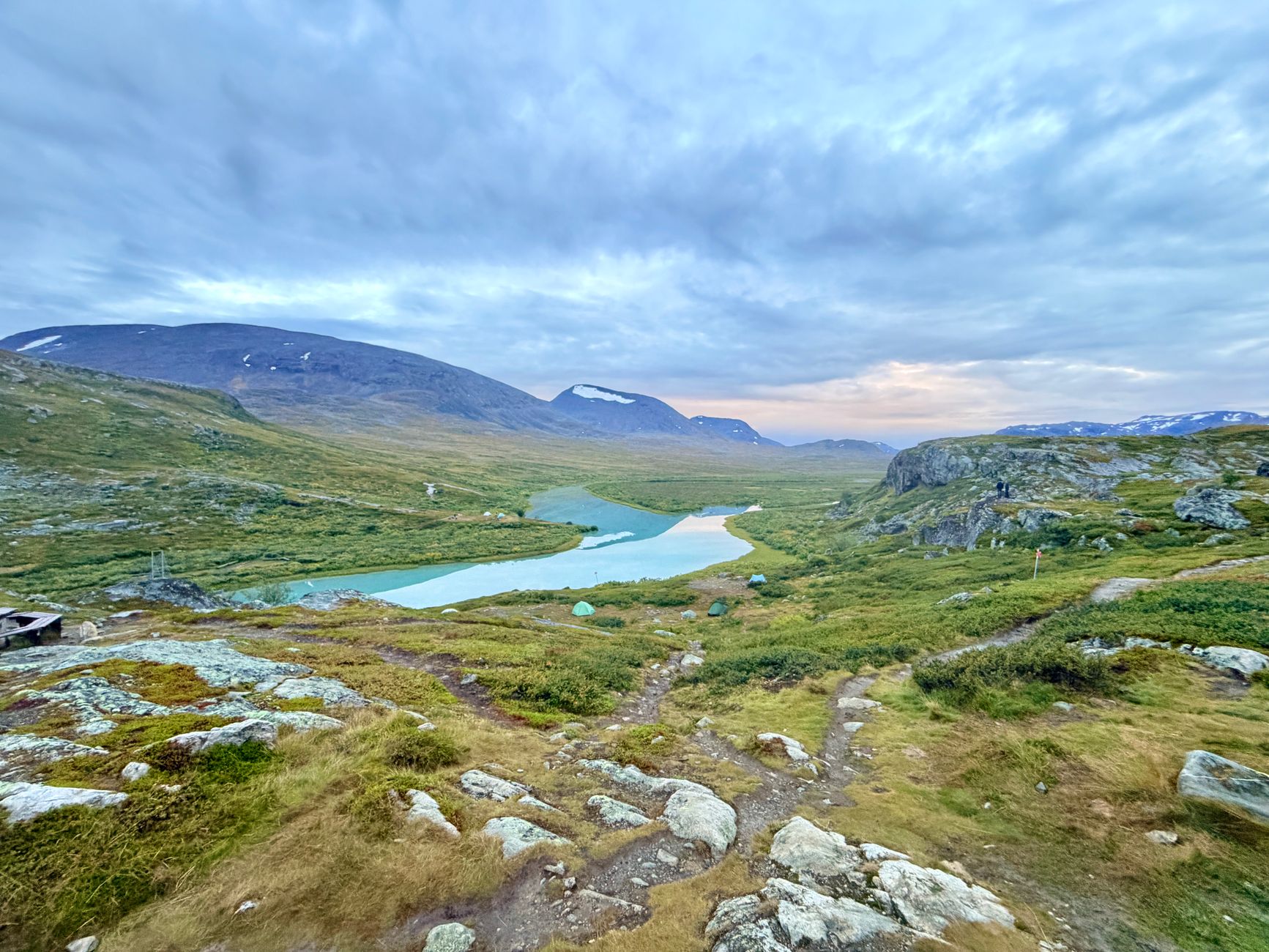
Understanding the geography of the Kungsleden means delving into a landscape shaped by glacial erosion over millennia. The U-shaped valleys that characterize northern Sweden are flanked by basaltic plateaus and rounded peaks that rarely exceed two thousand meters in altitude, yet whose climatic severity equals that of much higher alpine summits. The absence of trees above the arctic tree line exposes the walker to the direct action of katabatic winds descending from the perpetual snows of the western massifs.
Thermal conditions during the short summer season, stretching from late June to early September, range between zero and fifteen degrees Celsius. However, the wind chill factor can drive apparent temperatures well below freezing even in July. Added to this is the phenomenon of the midnight sun during the opening weeks of the season—a psychological and biological conditioning factor that alters the hiker’s circadian rhythms and demands rigorous discipline in rest and marching schedules.
Logistics of Access and Northern Railway Networks
The traditional starting point of the trail is located at the Abisko Turiststation railway depot, accessible via the iron ore railway line connecting the mining city of Kiruna with Narvik on the Norwegian coast. This connection represents a major logistical advantage of the Kungsleden over other remote routes globally: the ability to reach the expedition trailhead directly by train, reducing carbon footprint and avoiding dependence on costly charter flights or road transfers.

Planning the arrival requires synchronizing itineraries with overnight sleeper trains operated by the state railway company SJ from Stockholm Central. These trains carry both international hikers and local workers, serving as the first filter of mountain socialization before setting foot on the ground. At the southern terminus, Hemavan features a small regional airport connected to Stockholm via regular flights operated by local airlines, allowing for linear traverses without the need to return to the origin via the same route.
The Hut System and the Management of Food Autonomy
Along the main sections of the Kungsleden, the Swedish Tourist Association (STF) maintains an exemplary network of cabins and shelters. These establishments range from fully equipped facilities with resident wardens and small provision stores to self-managed emergency shelters where the traveler is responsible for firing up the wood stove, hauling water from the river, and logging their stay through established payment mechanisms.
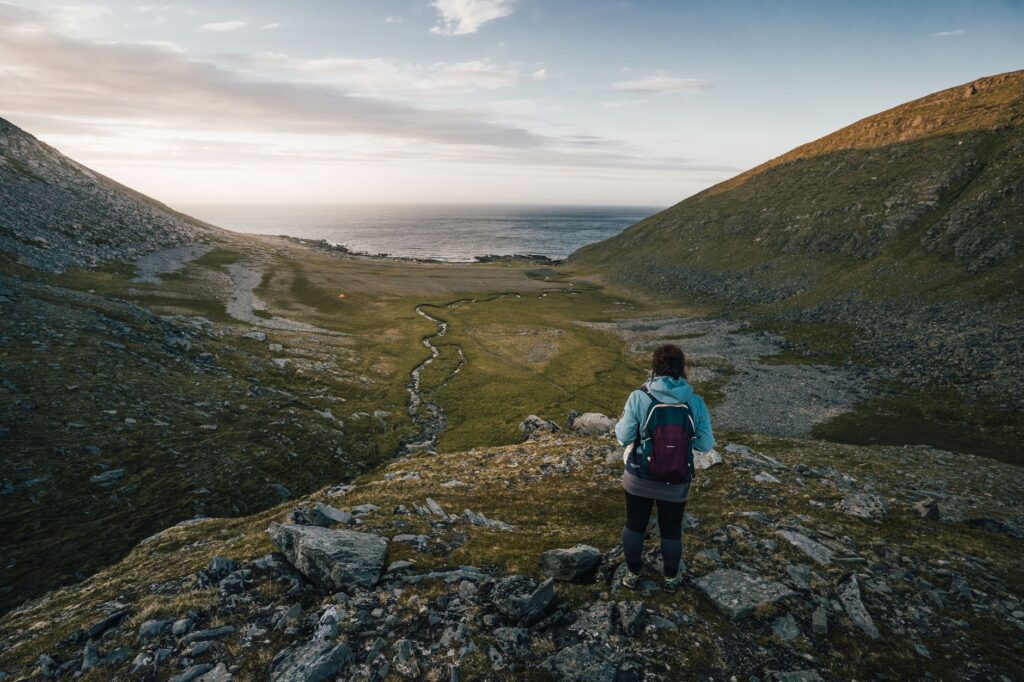
Nevertheless, reliance on these huts does not exempt the expedition member from carrying a complete self-supported camping kit. Stages between cabins can range from fifteen to twenty-two kilometers, crossing marshy terrain and unstable wooden boardwalks that slow down progression rates. Swedish public access legislation, known as Allemansrätten, permits wild camping for one night in the same location, provided that leave-no-trace principles are respected and a prudent distance is maintained from settlements and inhabited dwellings.
Culture and the Ancestral Territory of the Sami People
Walking the Kungsleden means traveling through Sápmi, the historical homeland of the indigenous Sami people, spanning northern Norway, Sweden, Finland, and the Kola Peninsula in Russia. Traditional Sami economy, based on nomadic reindeer herding, defines land use and conservation regulations within the national parks traversed by the trail.

During the summer months, herds are driven toward elevated mountain pastures. It is essential that hikers maintain a respectful distance from the animals, avoid approaching mothers with calves, and meticulously close all gates and fences designated for livestock management. Respect for sacred Sami sites, known as sieidi—unique rock formations with spiritual significance—constitutes an elementary ethical standard for any visitor aspiring to understand the socio-ecological complexity of the region.
Technical Equipment and Footwear in Boggy and Riverine Terrain
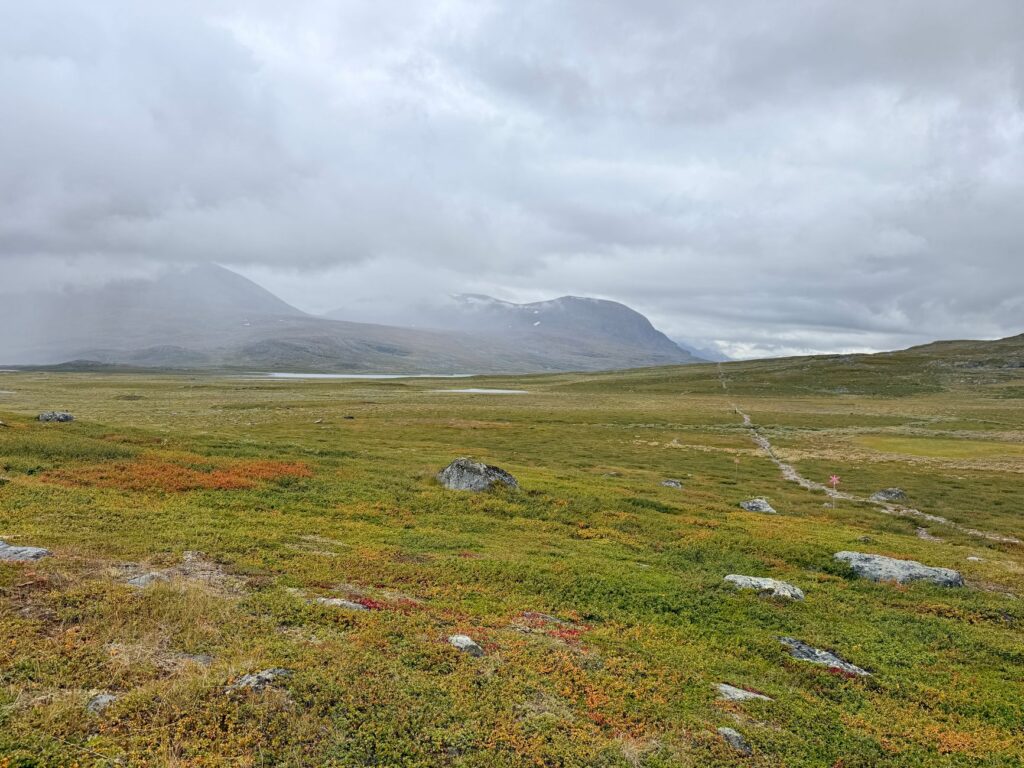
The nature of the terrain on the Kungsleden differs substantially from southern European dry stone or Andean granitic rock. Much of the route runs over fens, peat bogs, and permanently damp soils where footwear management and waterproofing determine the expedition’s success. Traditional high-end leather boots with hydrophobic treatments, combined with breathable technical gaiters, remain the preferred choice among local guides over lightweight trail running shoes.
Crossing unbridged rivers and streams constitutes another critical technical moment on the itinerary. Although more complex stretches feature rowboat systems—where the user rows across the channel and then returns a boat to leave it available for the following traveler—sudden surges in water levels due to heavy rains or accelerated snowmelt may force route modifications. Robust trekking poles and specific wading sandals are mandatory pieces in any serious expedition inventory.

The Arctic does not punish error with immediate defeat, but rather with the silent accumulation of minor negligences until cold becomes the sole certainty.
Practical guide
Planning an expedition to the Kungsleden requires meticulous attention to operational details, from seasonality to safety protocols in remote areas devoid of mobile phone coverage.
- Best time to visit: From July 1st to August 31st, when most serviced huts are open and seasonal river footbridges are installed.
- Permits and regulations: No entry permit is required for national parks, but compliance with Allemansrätten conservation guidelines and camping restrictions in ecologically fragile zones such as Sarek National Park is strictly mandatory.
- Connectivity and safety: Mobile phone coverage is practically nonexistent in deep valleys. Carrying a satellite communication device or an emergency GPS locator beacon (PLB) is highly advisable.
- Provisions: STF hut shops allow replenishment of basic food items (pasta, rice, canned goods, chocolate), but variety is limited. It is strongly advised to carry the bulk of dehydrated rations from Stockholm or Kiruna.
- Waste management: All waste materials, including packaging and toilet paper, must be packed out in the backpack to authorized collection points at the main mountain stations.
The White Silence: The Last Frontier of Contemplation
As the arctic sun begins to dip toward the horizon in the final weeks of August, tinting the tundra in ochre, red, and golden hues, the trail recovers an almost mystical stillness. It is at that moment that the traverse ceases to be a mere exercise in physical endurance and transforms into an experience of profound introspection. The wind whistling through the dwarf birches and the reflection of the summits in the glacial lakes remind the traveler of the insignificance of humankind before the immensity of the north, closing a cycle of learning where every step taken is also a step toward self-knowledge in the heart of Europe’s last great wilderness.