
The Island of a Thousand Fires and Green Water
In the Venetian lagoon, where morning mist dissolves the outlines of bell towers and brackish water laps against exposed brick foundations, time is measured not in hours, but in degrees Celsius. Ever since the decree issued by the Most Serene Republic in 1291, which ordered the relocation of furnaces from the main island to Murano for fire-safety reasons, this minor archipelago has served as the global epicenter of a discipline where material physics constantly dialogues with artistic intuition. Today, crossing the San Donato canal is not merely a tourist excursion, but an immersion into a unique productive ecosystem where raw materials—a precise mixture of silica, soda, and lime—are transformed at temperatures exceeding one thousand degrees on the ends of iron blowpipes.
The contemporary challenge for these masters lies not only in commercial survival against industrial counterfeiting or the mass import of 3D-printed glass from Asia, but in the ability to keep alive an oral and gestural transmission chain that leaves virtually no margin for error. In the workshops scattered along the secondary alleyways, far from the souvenir shops crowding the basilica of Santa Maria e San Donato, the silence of the street is broken solely by the muffled roar of gas furnaces operating continuously day and night. Here, craftsmanship ceases to be a nostalgic gimmick and becomes an active laboratory of material design.
The Alchemy of the Crucible: When Sand Becomes Light
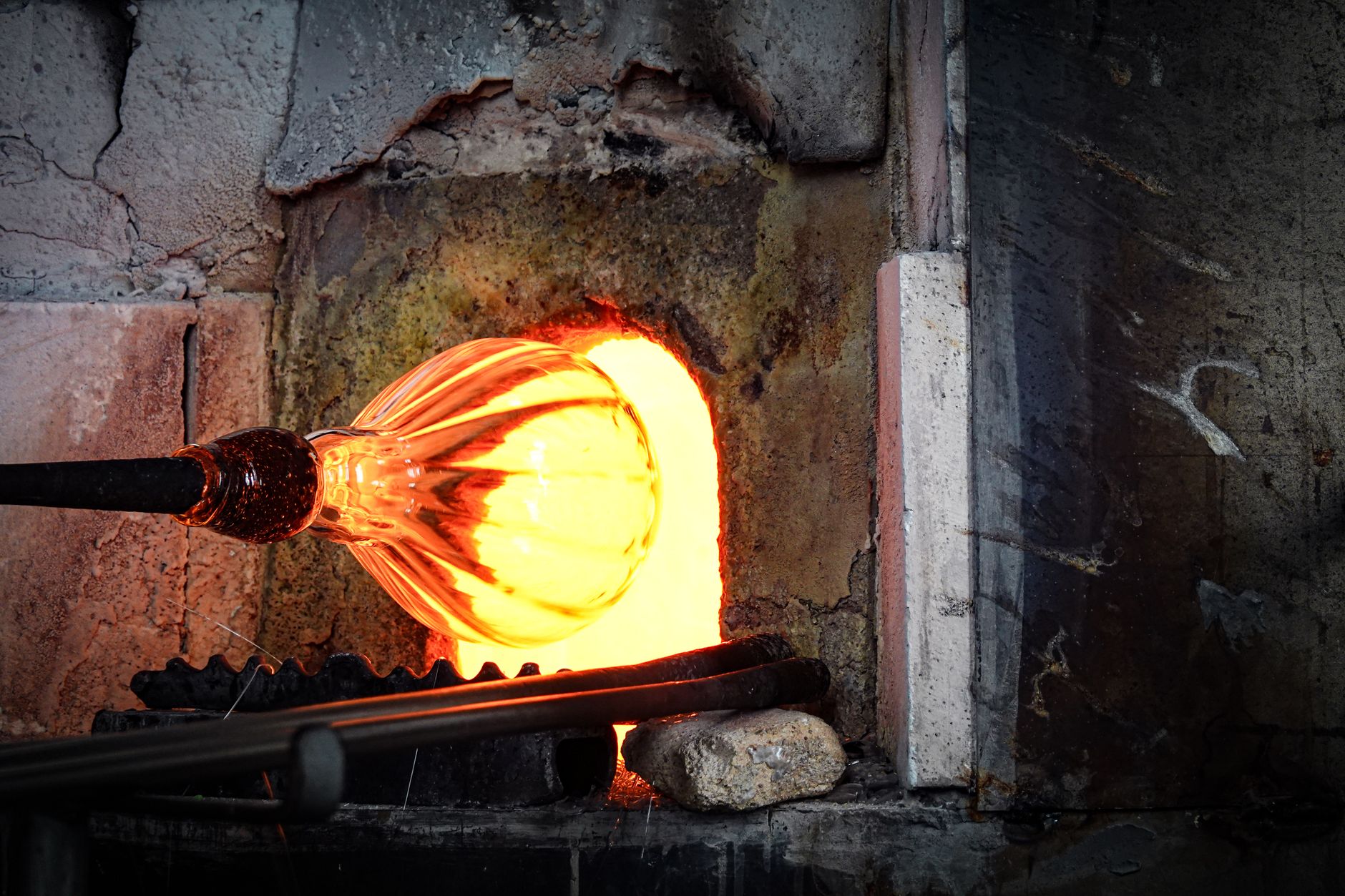
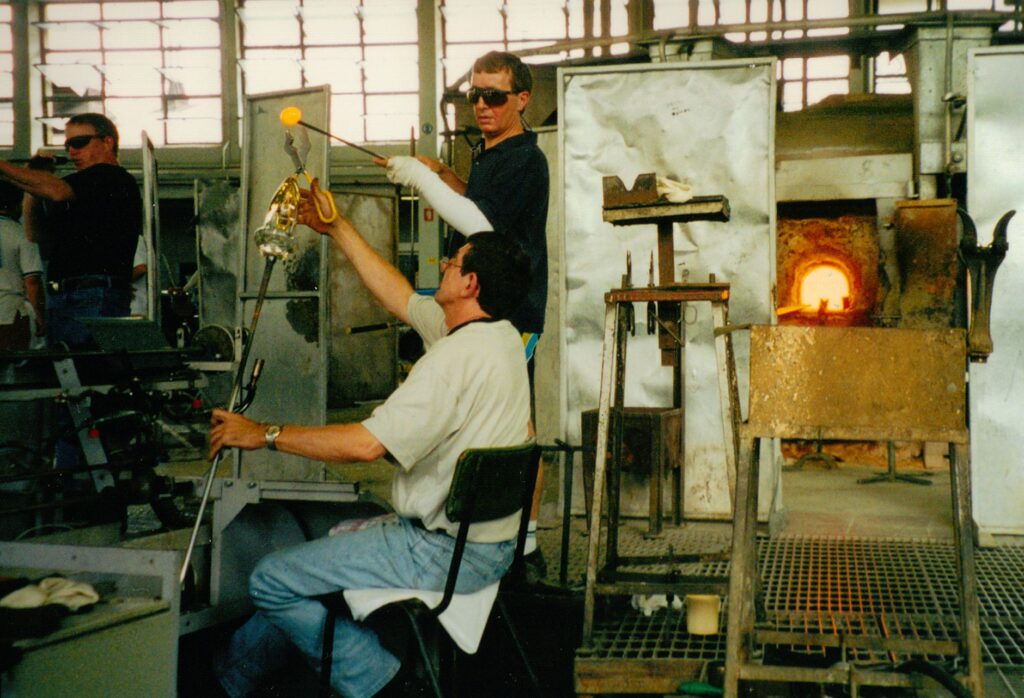
The process begins long before the master touches the metal. In the heart of the workshop, the chemical selection of components determines the viscosity and refractive index of the final piece. Pure silica, sourced from quartz quarries, melts with fluxes at temperatures surpassing 1,400 degrees Celsius inside refractory clay crucibles. This incandescent mass, known as vetro pasta, requires millimetric thermodynamic control; any unforeseen thermal fluctuation destroys the internal tension of the material before blowing even begins.
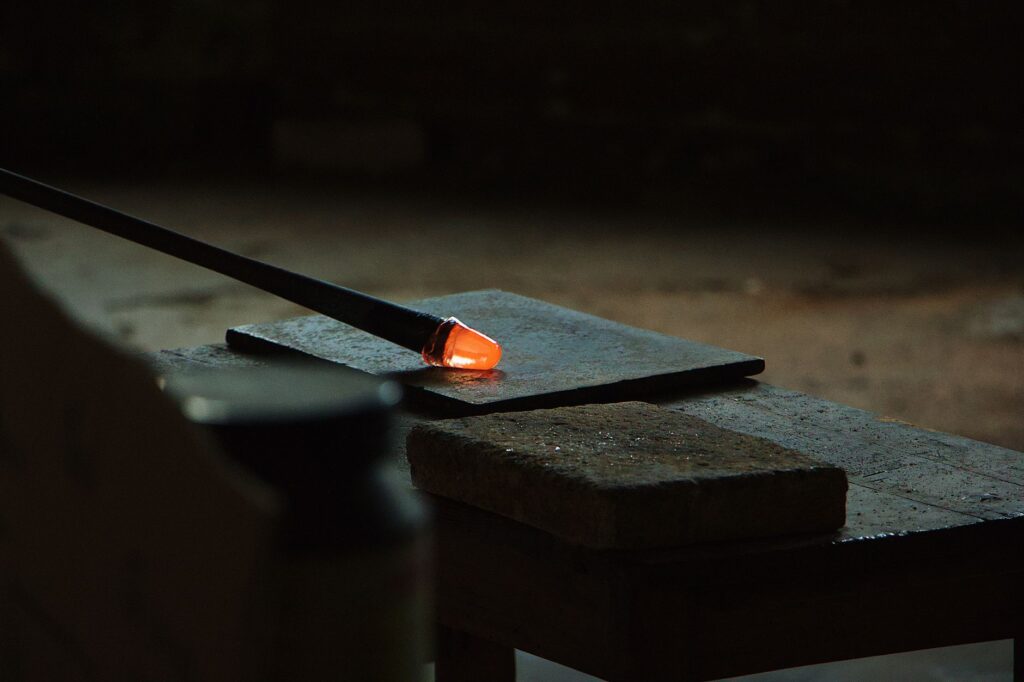
The master glassmaker, flanked by a team of assistants or serventi, operates with a choreography honed over decades. The blowpipe, a hollow iron tube a meter and a half long, is dipped with a sharp motion into the furnace mouth to gather the initial gather of molten glass, the bolo. From that moment on, gravity, breath pressure, and rotation speed on the workbench determine the symmetry and thickness of the object.
Glass is neither a conventional solid nor a liquid; it is a state of matter suspended in the memory of fire, demanding absolute and unyielding attention from the artisan.
This dual nature turns every working day into an exercise in physical precision where the artisan’s body absorbs the radiant heat and muscular fatigue accumulated over years of craft.
Tools and Gestures: The Persistence of the Manual Archive
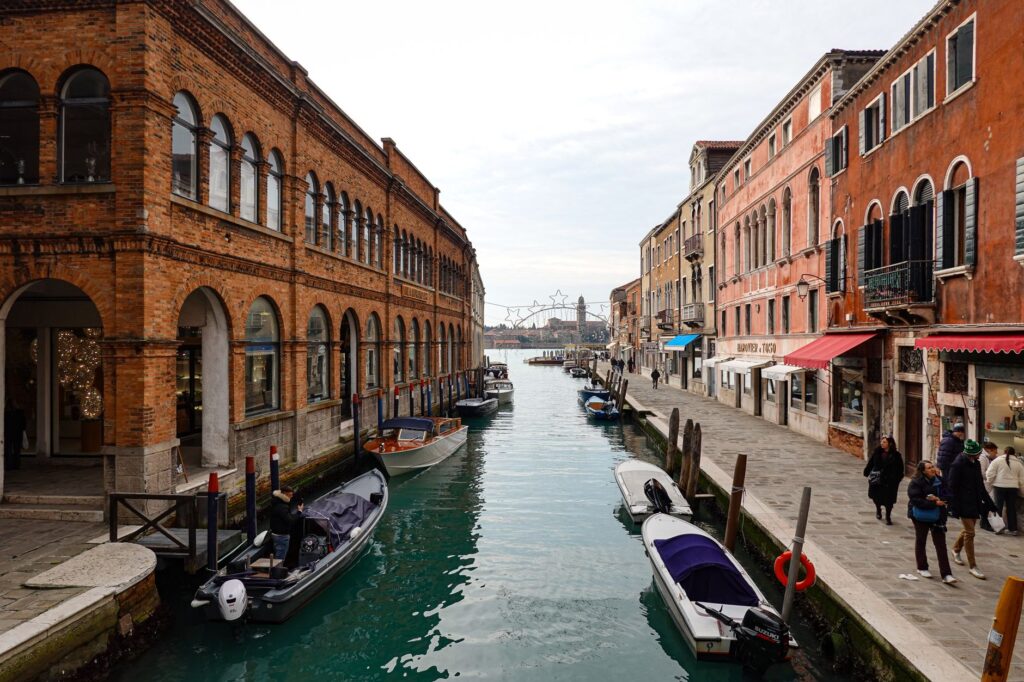
The tools used in Murano workshops have changed remarkably little since the Renaissance. Stainless steel tongs called borselle, front-cutting shears known as manganella, and dampened pearwood forming blocks, the scagno, form part of an intimate toolkit that each artisan adapts to the ergonomics of their own hands. No printed manuals record the exact pressure required on a piece during annealing to prevent structural collapse; everything resides in the master’s kinesthetic memory.
This generational transmission currently finds itself at a critical crossroads. While historic foundries close their doors due to rising energy costs and a shortage of generational succession, independent studios and international art residencies are injecting fresh life into the ancient furnaces. Industrial designers from Milan, Stockholm, or Tokyo travel to Murano to collaborate side by side with traditional blowers, fusing the rigor of contemporary geometry with the organic fluidity of Venetian glass.
Formal Evolution: From Renaissance Goblet to Kinetic Art
Murano’s formal history is a catalog of aesthetic ruptures. While during the 15th and 16th centuries the technical obsession centered on achieving maximum purity—the crystal clear cristallo emulating diamond—and the intricate filigree of vetro a fili, the 20th century brought a conceptual revolution driven by architects and visual artists. Creators like Carlo Scarpa and Gio Ponti collaborated closely with masters like Paolo Venini to endow glass with a rigorous architectural language, stripping away baroque ornamentation.
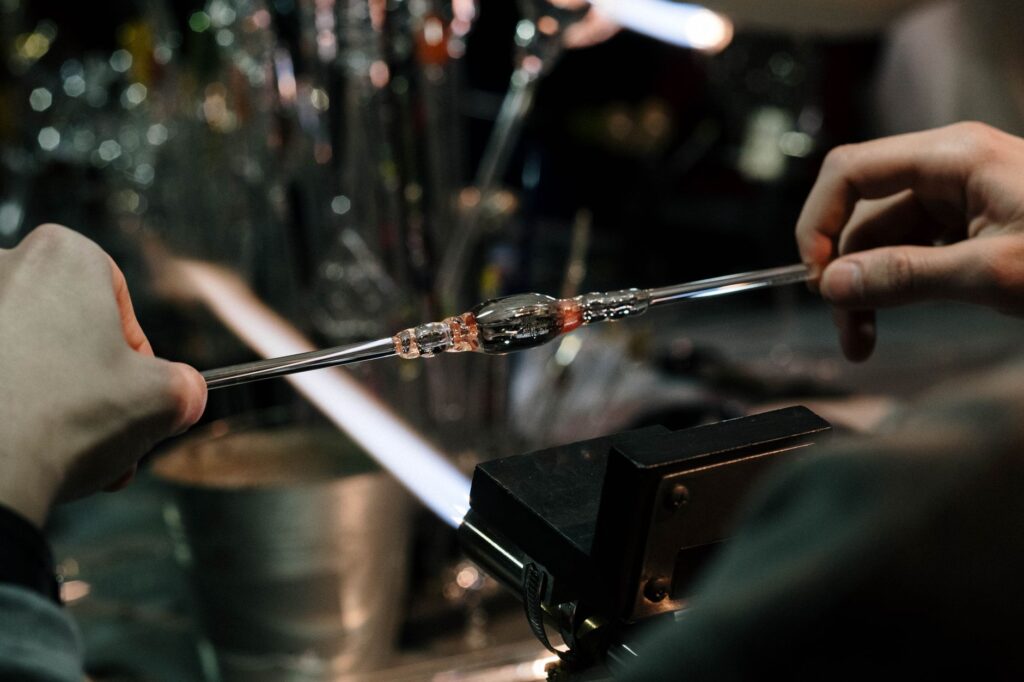
Today, experimental galleries and furnaces explore the optical properties of massive glass through cold-working techniques, acid etching, and the layering of dense chromatic strata. The results are sculptural objects that challenge the viewer’s visual perception, playing with the refraction of natural and artificial light. Purity of lines and the rejection of perfect symmetry have become the new hallmarks of an avant-garde that respects, without subordinating itself to, the island’s classical heritage.
Architecture of Fire: The Urban Landscape of Chimneys
Murano’s urban silhouette is inextricably linked to its industrial infrastructure. The slender red-brick chimneys, cutting against the gray sky of the lagoon or reflecting in the dark waters of the canals, function as silent monuments of an industrial archaeology still in active operation. These evacuation flues are not merely aesthetic elements, but the physical testimony of a combustion system that transformed the insular landscape and shaped its urban layout, characterized by narrow streets facilitating the rapid transit of incandescent materials between furnaces and cooling chambers.
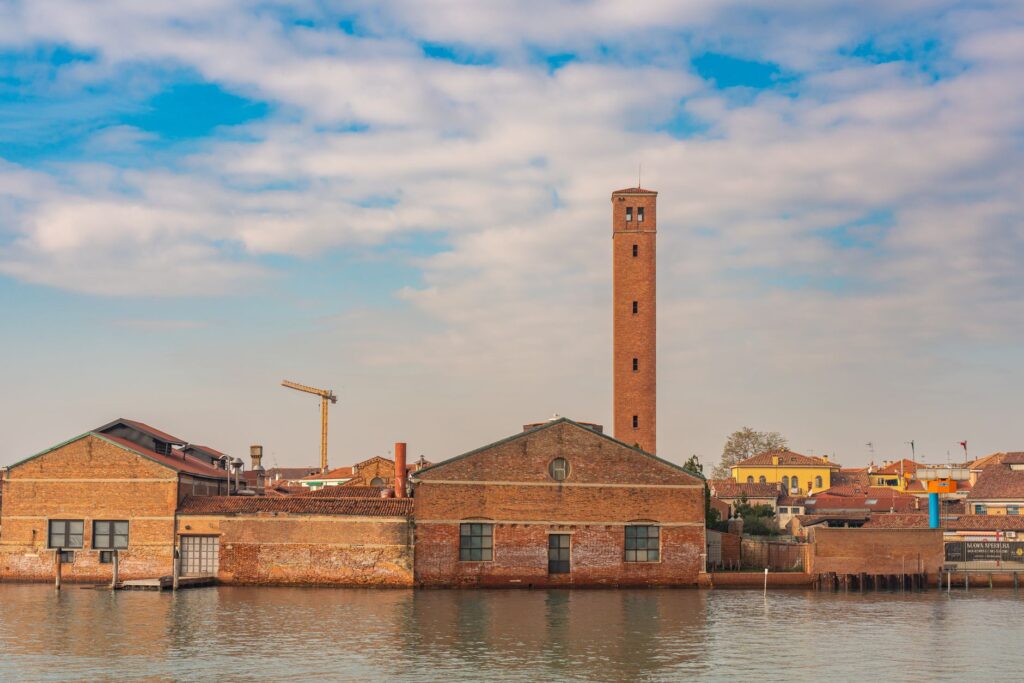
The transport of raw materials and finished works still relies heavily on navigable canals. Barges powered by electric motors or traditional oars navigate the internal waterway network, carrying sacks of sand and large wooden crates protected with straw. This logistical anchor in the aquatic environment gives Murano an anachronistic atmosphere, where the silent modernity of vaporettos coexists with the heavy floating machinery of raw material suppliers.
Practical guide
Planning a rigorous visit to the workshops of Murano requires abandoning overcrowded commercial routes and booking prior appointments directly with artisanal studios. Autumn and winter months offer the most conducive context for tranquil observation, when visitor numbers drop and furnace activity recovers its genuine technical rhythm.
- How to get there: Main access is via ACTV vaporetto services (lines 3, 4.1, or 4.2) from Venice (stations at Fondamenta Nuove or Ferrovia). The journey takes approximately 20 to 30 minutes.
- Workshop access: Most historic furnaces allow entry to the blowing areas by prior reservation or via specialized guided tours that respect the masters’ working rhythm. Touching metal structures and cooling zones is strictly prohibited.
- Etiquette and safety rules: Due to high temperatures and risks from handling cutting tools and incandescent glass, visitors must follow instructions from safety personnel at all times and maintain a safe distance from the workbench.
- Documentation and purchases: When acquiring art pieces, ensure you request a certificate of origin guaranteeing the authenticity of Murano production against foreign industrial imitations. High-prestige studios handle insured international shipping.
Silences of Silica: The Suspended Memory of the Workshop
When night finally descends over the canals of Murano and the large furnace burners dial down to their minimum maintenance setting, the island experiences an exceptional lull in light and sound. Inside the empty workshops, small fragments of waste glass covering the stone floors reflect the last glimmers of moonlight filtered through barred windows. It is in this moment of absolute stillness that the true dimension of the craft reveals its profound depth.
There, atop burnished wooden workbenches and alongside blowpipes aligned with military precision, inert matter seems to hold its breath awaiting the coming dawn. The masters who each morning restore life to the crucible know their task is not merely to manufacture decorative objects, but to guard a fragile link in European material civilization. As long as fire continues to burn beneath the brick vaults of the lagoon, the memory of blown glass will continue to defy the fleeting nature of modern time.