
Origins and Geography of an Insular Art
The narrow alleys of the island of Murano guard an ancient secret that defies both time and water. In this archipelago located at the northern edge of the Venetian lagoon, the heat of the fire never ceases, not even during the coldest months of the Adriatic winter. The history of Muranese glassmaking has its roots deep in the 13th century, when the Most Serene Republic ordered the systematic relocation of all furnaces from the historic center of Venice to the insular periphery. This measure, formally dictated by safety concerns regarding devastating fires that threatened the wooden structures of the era, ultimately consolidated an industrial secret closely guarded under penalty of death.
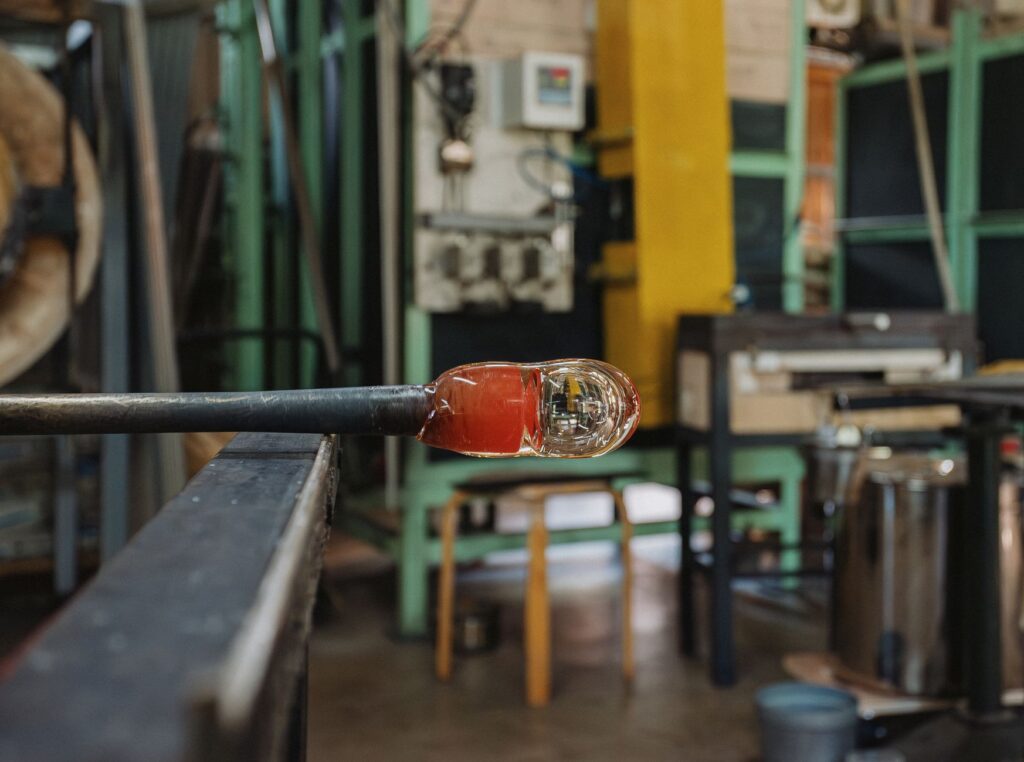
Walking through the canals of Murano today is akin to moving through a living museum where industrial architecture coexists with the daily lives of its residents. The old raw material warehouses and exposed brick chimneys preserve the memory of generations of artisans who turned silica sand and metallic oxides into collector’s items coveted by royal courts worldwide. Unlike other centers of mass production, the true value of Murano lies in the preservation of unaltered technical gestures, where mastery of the geographical environment and historical resource scarcity spurred creativity unparalleled in the European continent.
Insular isolation fostered a strong sense of guild community among the masters. Ancient statutes regulated not only manufacturing processes but also the residence and marriages of the artisans, safeguarding knowledge that formed the economic backbone of the maritime power. Today, traditional workshops stand side by side with contemporary art galleries experimenting with new textures, proving that tradition is not a static fossil, but an ever-evolving language capable of engaging with twenty-first-century global design.
The Alchemy of the Crucible and the Chemistry of Color
At the heart of every workshop, the crucible serves as an altar where the transformation of matter takes place. The vitreous mass, melted at temperatures exceeding one thousand degrees Celsius, demands titanic physical effort and millimeter-precise synchronization between the master glassmaker and assistants. Silica sand, historically sourced from the quarries of Fontainebleau or local riverbeds, melts alongside natural fluxes to create glass of exceptional purity. Mastering viscosity while hot allows artisans to sculpt the material before ambient temperature initiates cooling and fracturing.
Color is undoubtedly the hallmark of the Muranese school. Through the addition of specific metallic oxides during the melting phase, artisans achieve hues that defy the physics of light. Copper oxide contributes intense turquoise blues and deep reds, while powdered gold and silver generate iridescent effects impossible to replicate through automated industrial processes. Each formula results from decades of empirical testing passed down from parents to children, a compendium of applied chemistry memorized through daily practice before the open jaws of the furnace.
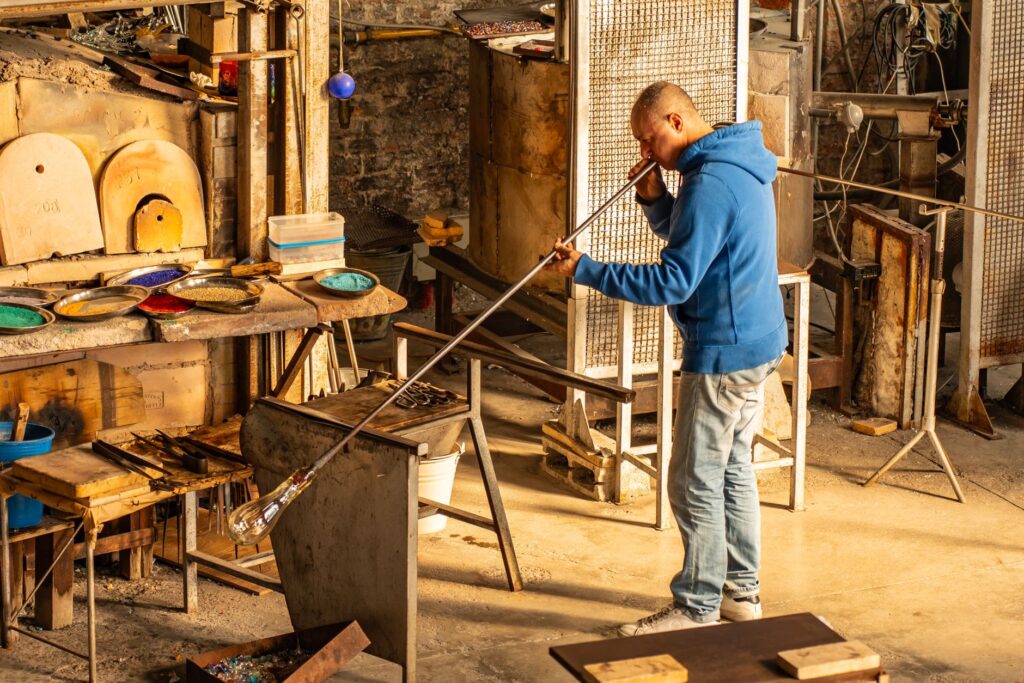
Glass never forgives doubt; every breath is a definitive decision etched forever into the geometry of the piece.
The manipulation of oxides requires absolute precision. An excess of just a few microns of cobalt can irreparably darken crystal transparency, turning a delicate project into a useless opaque block. For this reason, the colorist’s role within the workshop remains one of the most respected. They work with precision scales and centurial notebooks recording thermal reactions to environmental humidity variations in the Venetian lagoon—a factor decisively influencing the final behavior of the molten mixture.
Ancient Tools and Timeless Gestures
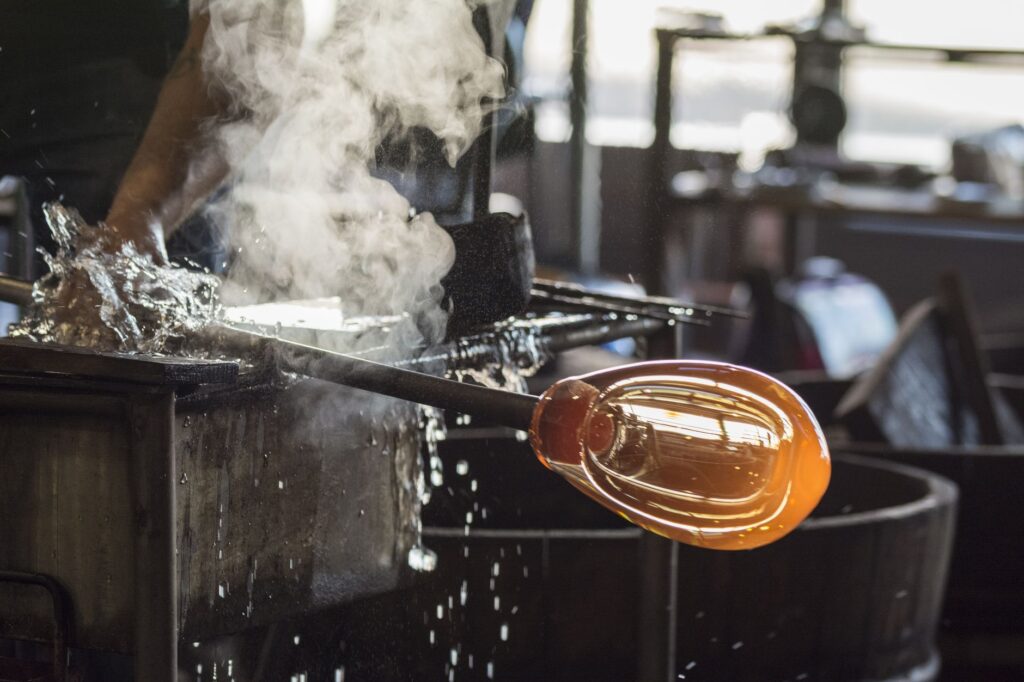
The Muranese glassblower’s toolkit has remained virtually unchanged since the Renaissance. The blowpipe, a hollow iron tube slightly over a meter in length, acts as a natural extension of the artisan’s body. With it, the first drop of incandescent glass—known as the initial gather—is extracted from the crucible. Alongside it, hot-cutting shears, precision tongs, and damp cherry wood paddles allow artisans to shape the soft mass without leaving unwanted marks on the translucent surface.
The use of wet wood represents one of the most fascinating aspects of the trade. Upon contacting glass at over one thousand degrees, the tool’s moisture generates a thin steam cushion acting as a thermal buffer, enabling the artisan to rotate and round the piece with bare hands protected by specialized gloves without extreme heat burning the wood or destroying the object’s molecular structure. This precarious balance among water, fire, and wood defines the tactile mastery distinguishing a true artist from a mere industrial operator.
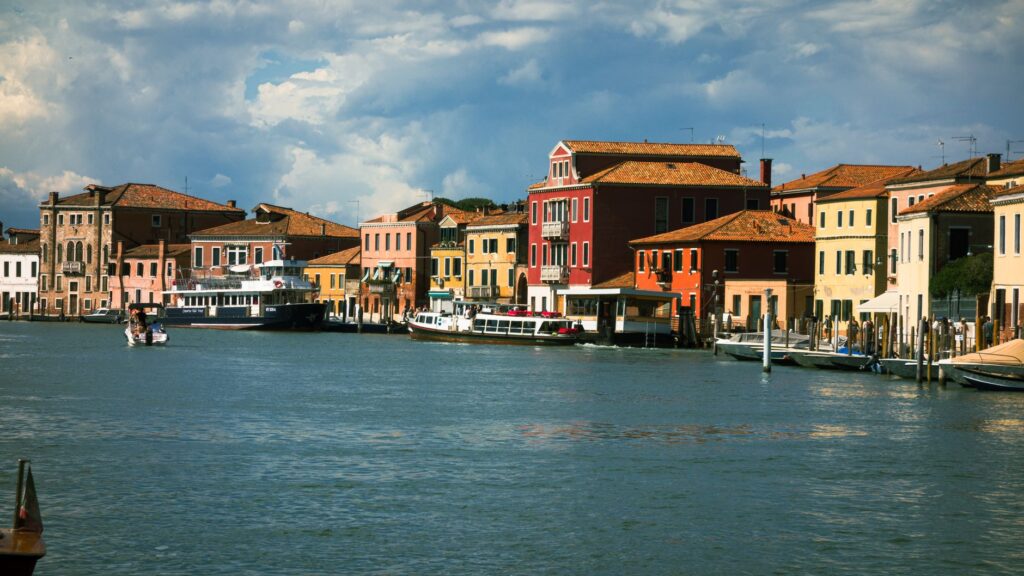
The tool is not a mere instrument of labor, but the indispensable mediator between human intuition and the capricious malleability of fire.
Besides the blowpipe, the pontil—a solid iron rod attached to the base of the piece to free it from the main blowpipe and work the mouth or upper rim—demands flawless choreographic skill. Assistants and the master move around the workshop in a silent ballet where glances replace words. A false step or a half-second delay in rotation causes the piece to lose its symmetrical axis and collapse under its own weight, forcing the entire creative cycle to restart from scratch.
From Utilitarian Bottles to Contemporary Fine Sculpture
For centuries, Murano’s output focused on tableware, large mirrors, and pharmaceutical jars of high aesthetic quality. However, the 20th century marked a radical turning point thanks to collaborations between master glassmakers and renowned international designers. Architects and visual artists found in the island’s furnaces an unlimited medium of expression, shifting focus from mere decorative functionality toward large-scale contemporary sculpture.
Figures like Carlo Scarpa and Ercole Barovier revolutionized traditional forms by introducing complex geometric techniques and textured surfaces playing with natural light refraction. These collaborations proved that blown glass was neither a minor nor purely ornamental art, but a discipline capable of housing profound conceptual discourse. Pieces from this golden era are exhibited today in design museums worldwide, revaluing the material and immaterial heritage of the insular community.
Today, new generations of creators combine historical techniques with computer-aided design and advanced thermal analysis technologies. Despite these innovations, the core process remains dependent on manual skill. Modern furnaces are more energy-efficient and reduce polluting emissions in the fragile lagoon, but the physical demands and creative tension before boiling glass remain identical to those experienced by artisans in medieval Venice.
The Ecological Challenge and Sustainability of the Continuous Furnace
Keeping Murano’s furnaces burning in the 21st century poses economic and environmental challenges of immense scale. Traditionally fueled by natural gas or petroleum derivatives, these refractory giants consume energy uninterruptedly, since extinguishing a crucible means ruining the internal ceramic structure and losing weeks of thermal preparation. Faced with European regulatory pressure and constantly rising energy costs, workshops have had to reinvent operational processes to guarantee the long-term viability of the sector.
Recent research projects driven by local consortia explore integrating alternative fuels, recovering residual heat for community space heating, and utilizing high-purity recycled glass to lower melting temperatures in crucibles. This ecological transition is not without resistance, as many masters fear any alteration in chemical composition or traditional thermal curves could jeopardize the unique chromatic quality and texture characteristic of authentic Murano glass.
Concurrently, international counterfeiting and the sale of industrial products imported from Asia under the fraudulent label of Murano pose an existential threat to the island’s economy. To counter this phenomenon, local institutions promoted a protected origin trademark certifying that each work was effectively blown and sculpted in authorized workshops within the insular territory. Defending authenticity has thus become an indispensable cultural front to protect the survival of the last masters of fire.
Knowledge Transmission: Schools and Generational Turnover
The greatest challenge facing Murano’s glassmaking community is neither technical nor energy-related, but human. A shortage of young vocations willing to endure the harsh physical conditions of the workshops—high temperatures, demanding shifts, and years of unpaid apprenticeship—threatens the survival of knowledge accumulated over seven hundred years. Working before the mouth of the furnace demands an almost monastic vocation and renunciation of modern comfort few young people are willing to undertake today.
To prevent the extinction of this intangible heritage, the Abate Zanetti School, the island’s historic glass school, has restructured educational programs combining traditional master-to-pupil teaching with official degrees in industrial design and materials chemistry. These courses attract students from five continents, injecting fresh vitality into an ecosystem at risk of becoming a sterile theme park. Blending classical discipline with fresh international perspectives ensures workshops remain alive and open to experimentation.
Family workshops, meanwhile, continue operating as the primary core of trade transmission. Within them, apprentices start by sweeping floors, preparing tools, and assisting in secondary tasks before touching the blowpipe with a small amount of glass. This rite of passage, based on patience and silent observation, ensures the subtlest secrets—such as the exact moment when the mass acquires perfect plasticity—continue to be learned through the senses rather than theoretical manuals.
Practical guide
How to get there: Access to Murano is exclusively maritime. Public water buses (known as vaporetti) operated by ACTV regularly connect the Venetian stations of Fondamenta Nuove and Piazzale Roma with the island’s various stops (Murano Faro, Colonna, and Museo) in journeys ranging from 20 to 40 minutes.
When to visit: Spring (April to June) and autumn (September to November) offer ideal climatic conditions and lower mass tourism influx. It is advisable to plan morning visits, when furnaces operate at full capacity following technical ignition and artisans perform complex tasks.
Workshop etiquette: Most historic workshops permit visitors to observe work live for free or with a small purchase, but safety perimeters marked on the floor must be strictly respected. Touching tools, interrupting masters during critical blowing phases, and using flash photography without explicit authorization are strictly forbidden.
Accommodation and gastronomy: Although most travelers choose to stay in Venice’s historic center, the island features small boutique hotels and family-run guesthouses of great historic charm. Local gastronomy highlights traditional maritime lagoon dishes, featuring fresh fish risottos and Venetian specialties paired with regional white wines.
Shopping and authenticity: To avoid purchasing industrial counterfeits imported from abroad, always look for the official trademark seal *Vetro Artistico® Murano*, certifying handcrafted manufacture on the island. Requesting a certificate of guarantee signed by the origin workshop at the time of purchase is strongly recommended.
The Liquid Memory of the Lagoon
When the sun sets behind Venice’s bell towers and the lagoon waters adopt a leaden hue, Murano recovers an ancient silence broken only by the dull hum of burners that never turn off. In the twilight of the workshops, the last embers of the furnaces cast elongated shadows over floors covered in silica dust and fragments of forgotten colors. It is in this moment of pause that the island’s past and future seem to merge into a single incandescent mass, reminding us that the purest beauty is always the result of patient resistance against fire.
Visitors leaving the island on the last night *vaporetto* carry away not only the ephemeral sparkle of sculptures displayed in galleries, but the certainty of having witnessed a daily miracle. A marvel where useless beach sand transforms, through human effort and mastery of the flame, into an enduring testimony of European culture. As long as there are hands willing to hold the iron pipe and breathe their own life into the heart of the crucible, Murano’s beat will continue to resonate powerfully in the depths of the Adriatic.