
The Vertical Conquest of Frozen Valleys
The Alpine territory of the Grisons in Switzerland is not merely a geographical accident of unattainable peaks and fathomless gorges, but a permanent challenge to the laws of physics and mobility. At the turn of the twentieth century, the necessity to connect communities isolated by snow for three seasons of the year drove one of the most daring engineering feats in modern history: the expansion of the Rhaetian Railway (Rhätische Bahn) network. This system did not conceive the tracks as a scar upon the landscape, but as a sinuous extension of the rock itself, adapting to impossible gradients without resorting to the visual spoliation of the valleys.
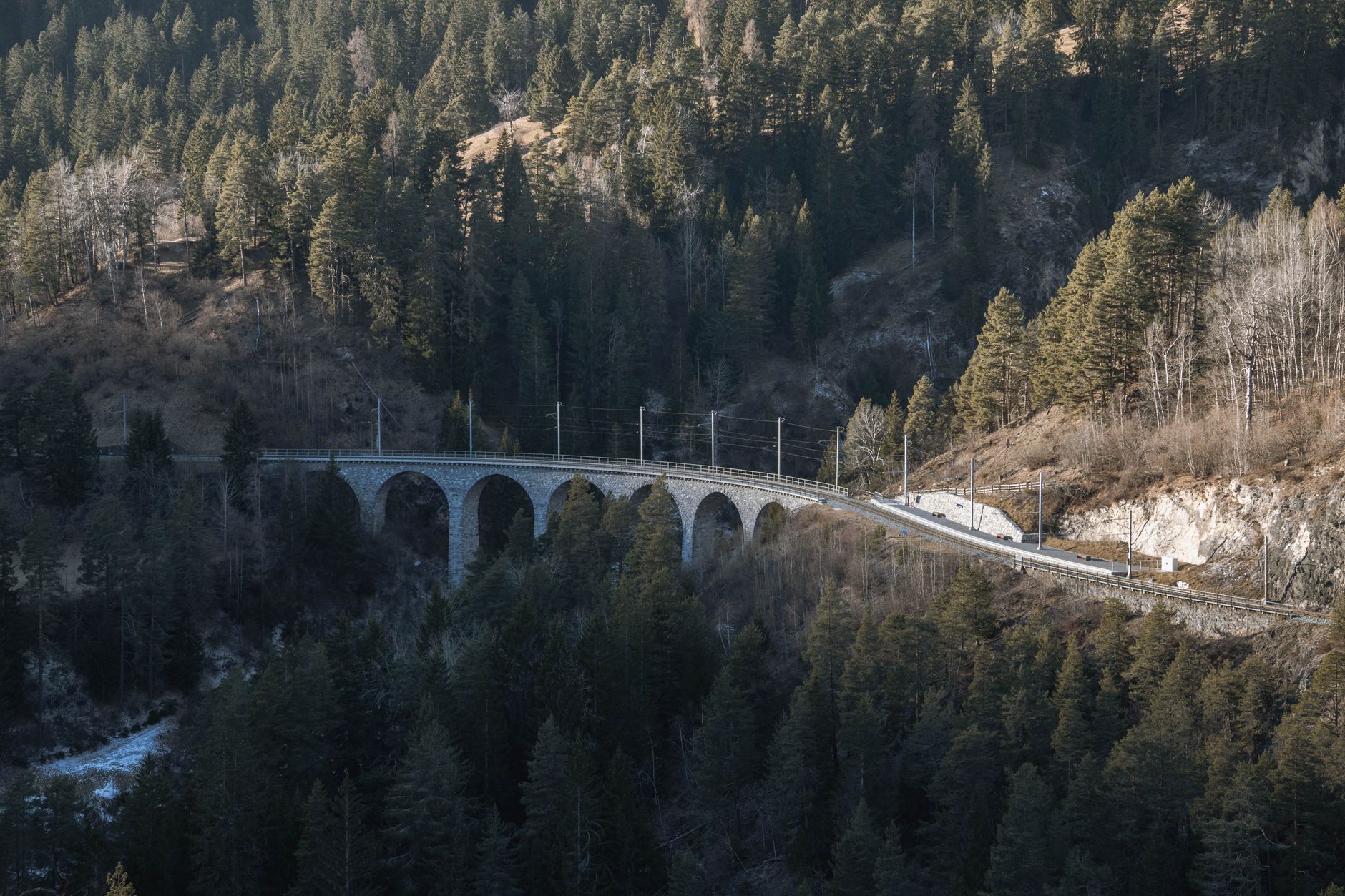
Today, traveling along this UNESCO World Heritage-designated network allows one to comprehend how civil engineering can converse with nature rather than subjugate it. Dry-stone bridges and multi-arch viaducts rise over raging torrents as silent witnesses to an era where every block of granite was laid by hand, defying vertiginous abysses. The meditative slowness of its carriages is not a technical shortcoming, but an aesthetic and functional decision: offering the traveler an absolute immersion in the monumental scale of the Alpine landscape.
The Architecture of Stone and Iron
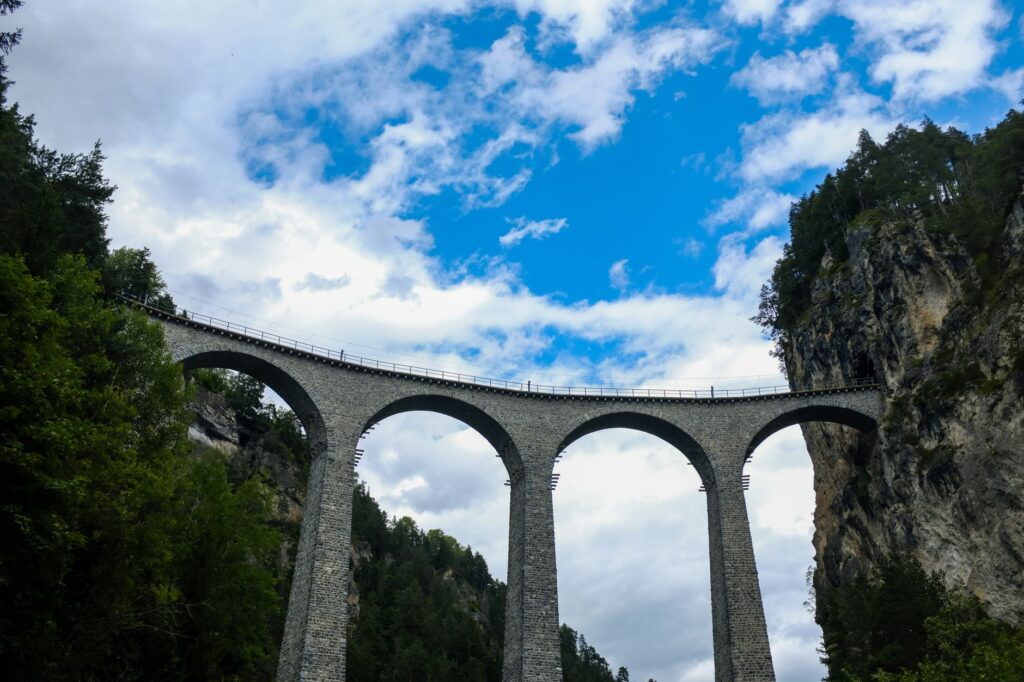
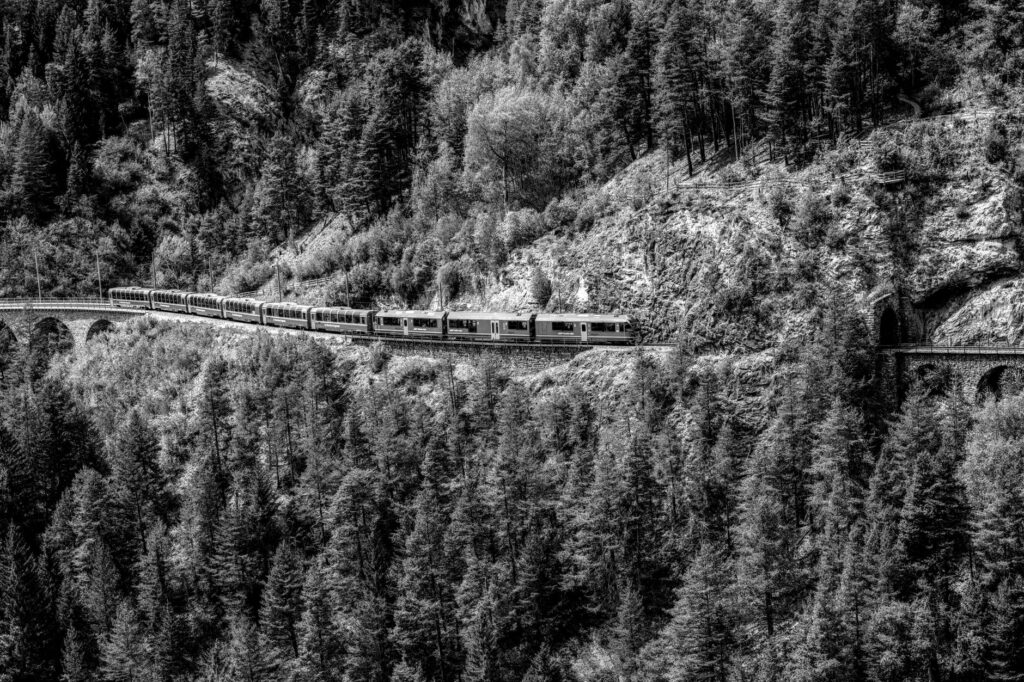
The most eloquent symbol of this communion between human ingenuity and geology is the celebrated Landwasser Viaduct, near Filisur. Its six dark masonry arches plunge directly into the face of a vertical cliff, culminating in a tunnel excavated within the bowels of the mountain. Observing the train emerge from the darkness to glide over the void, sixty-five meters above the Landwasser River, constitutes one of the most striking visual experiences in European transport. Every beam, every support, and every curve responds to millimeter calculations devised to withstand the extreme pressures of avalanches and winter ice.
Throughout the route, the granite-stone stations maintain a coherent architectural typology that reflects the solidity of the Swiss Confederation. Far from the industrial standardization of large metropolises, these halts act as thermal and cultural thresholds. Their gable slate roofs and wooden shutters protect passengers from the freezing wind descending from the glaciers, while station masters continue to operate with the precision of a Swiss watch, keeping alive a railway ritual that has barely mutated in over a century.
The Alpine railway does not seek to shorten distances at any cost; its true mastery lies in turning the journey into an exercise in geological contemplation.
The Crossing of the Albula and Bernina Passes
The layout of the Albula and Bernina lines represents the pinnacle of mountain engineering. To overcome elevation changes that would have rendered any conventional line unviable, engineers resorted to ingenious solutions such as helical tunnels and tight-radius curved bridges. Trains gain altitude by winding back and forth upon themselves inside the rock, crossing valleys on curved viaducts that allow travelers to glimpse the locomotive they have just left behind, now situated dozens of meters below. It is a perfect geometric choreography where topography dictates every meter of advancement.
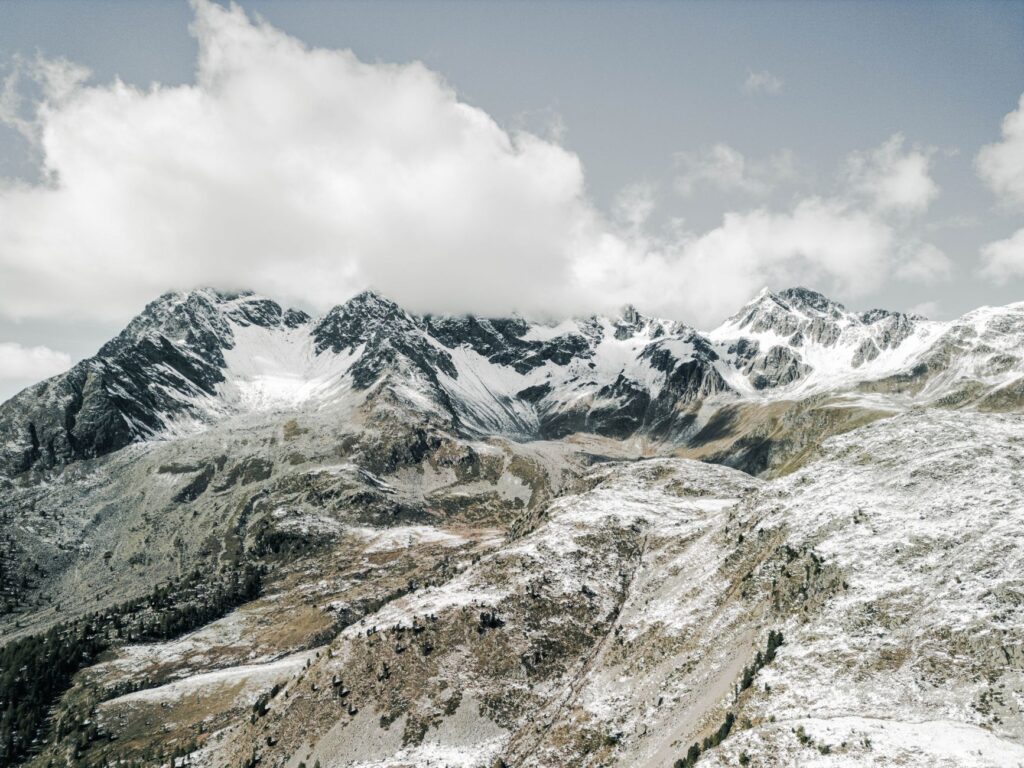
The crossing of the Bernina pushes this experience to its climatic limit, reaching 2,253 meters of altitude at the Ospizio Bernina station, the highest adhesion point in Europe without a rack system. Here, high-mountain lakes such as Lago Bianco remain frozen for much of the year, reflecting an intense blue sky that contrasts with the bright red of the carriages. The ecological transition is drastic: in just a few hours, the convoy moves from the temperate larch forests of the Poschiavo Valley, with its clear Italian influence, to the perpetual glaciers of the Bernina massif, offering a seamless synthesis of Alpine biodiversity.
Invisible Engineering: Maintenance in Extreme Conditions
What few passengers perceive when contemplating the landscape from the comfort of the panoramic window is the titanic logistical and human effort required to keep these tracks operational three hundred and sixty-five days a year. Maintenance crews face Arctic blizzards, rockfalls caused by summer thaws, and temperatures plummeting below minus twenty degrees Celsius. They deploy powerful rotary snowplows equipped with cutting-edge technology to clear meters of compacted snow blocking mountain passes before dawn.
Likewise, the geotechnical monitoring of slopes and centenary bridges is carried out using high-precision sensors that detect any minor vibration or millimeter displacement in the rock structure. This combination of artisanal stonemasonry craft and technological vanguard in safety ensures that the railway legacy of the Grisons continues to operate with proverbial punctuality. It is a reminder that the most sustainable infrastructure is one that integrates into the environment and is tended to with generational rigor.
The Leisurely Rhythm of the Poschiavo Valley
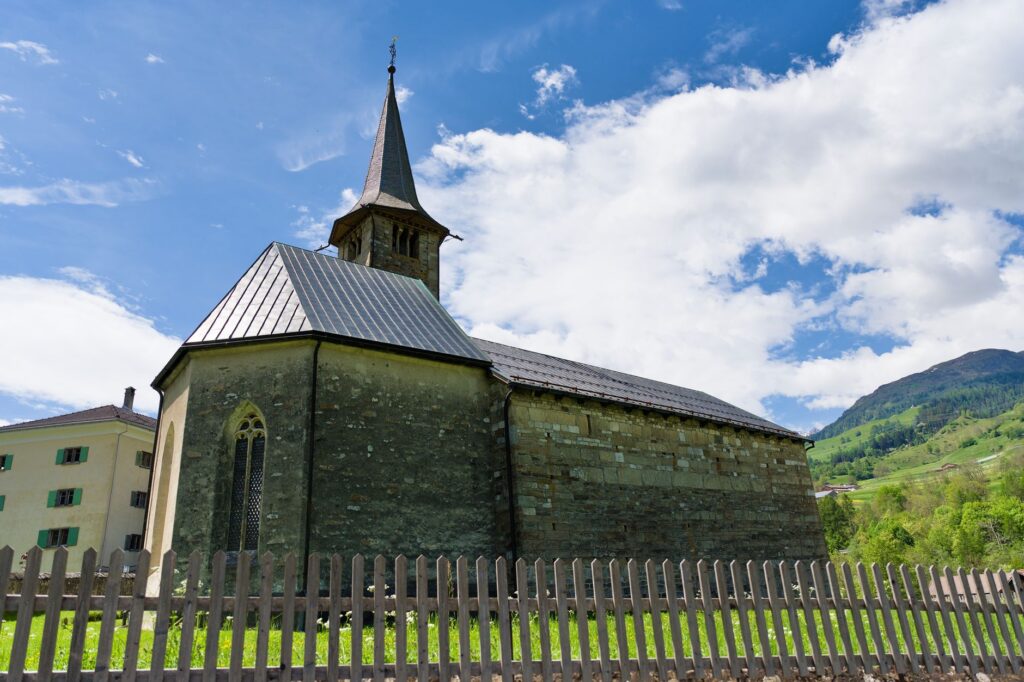
Descending southwards along the Italian slope of the Grisons, the landscape undergoes a radical metamorphosis affecting both vegetation and the architectural pulse of the localities. In the Poschiavo Valley, stately Lombard-influenced houses with arcaded courtyards and terracotta roofs replace the wooden chalets of the high mountains. The train literally winds through the streets of villages like Campocologno, passing mere centimeters from house facades and sharing road space with local traffic in an unusual display of urban coexistence.
This section of the line demonstrates that the railway is not merely a tourist transport medium, but the economic and social backbone of the valleys. Local farmers, students, and artisans routinely use these carriages to commute between villages that would otherwise remain cut off during winter months. The region’s economy gravitates around the stations, consolidating a rural development model where modernity and heritage preservation walk hand in hand.
Railway Gastronomy and High-Altitude Produce
The journey across the Grisons is also tasted. In the small canteens flanking the stations and aboard select special services, local gastronomy reflects the harshness and richness of an isolated Alpine environment. Mountain cheeses made from the raw milk of cows grazing on high-altitude pastures during summer, bacon cured in conifer wood smoke, and the famous Engadine walnut tart (Engadiner Nusstorte) compose a robust recipe book designed to combat the cold.
The restaurants in the railway villages have reinterpreted this ancestral pantry under contemporary criteria, attracting travelers seeking culinary authenticity without artifice. Eating a plate of capuns—chard leaves stuffed with flour dough and cured meat—while watching snow fall over the tracks through the window adds a comprehensive sensory dimension to the travel experience, where the territory is savored as much as it is contemplated.
True exclusivity in contemporary travel lies in the ability to stop time and connect with the intelligent slowness of historical infrastructures.
Practical guide
How to get there: The ideal starting point for the Rhaetian Railway network is the city of Chur, directly accessible via Swiss Federal Railways (SBB) from Zurich in approximately one and a half hours. Chur is Switzerland’s oldest city and boasts excellent hotel infrastructure.
Route planning: The complete Bernina Express journey connects Chur or St. Moritz with Tirano (Italy) across 55 tunnels and 196 viaducts. While panoramic cars require mandatory seat reservations, regular regional trains run the exact same route, allow windows to be opened for photography, and require no reservation supplements.
Fares and tickets: The Swiss Travel Pass covers the entirety of the Rhaetian Railway network (excluding seat reservation fees on special panoramic trains). It is highly recommended for multi-day stays due to its flexibility across trains, postal buses, and boats.
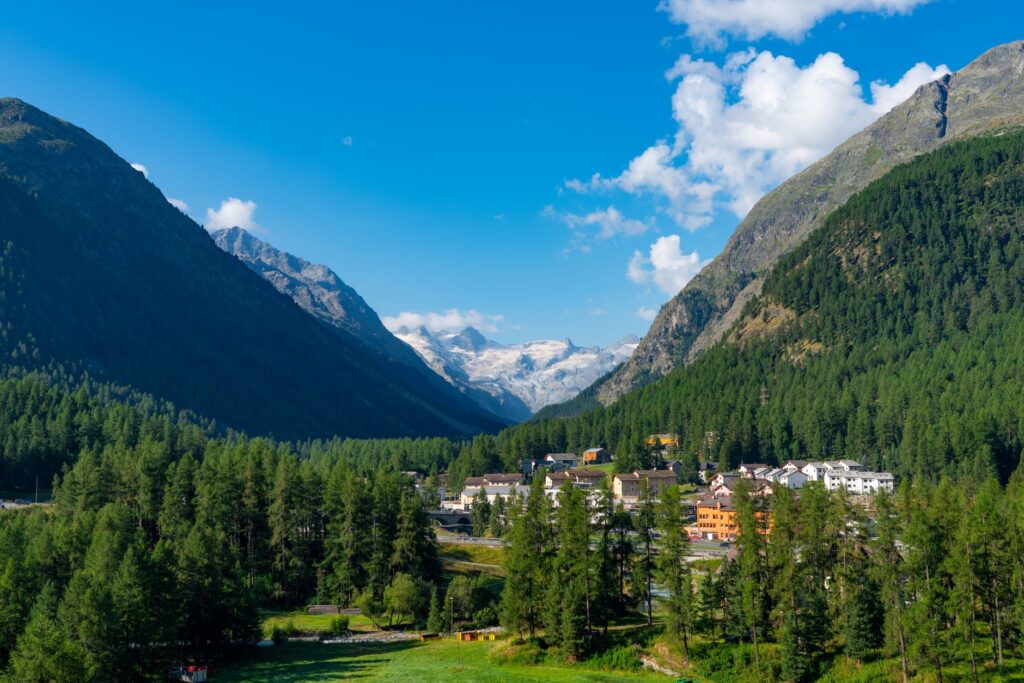
Best time to visit: May to June to enjoy flowering meadows and swollen meltwater streams; September to October for the golden foliage of larch forests; and January to February for a fully snow-covered winter landscape.
The Eternal Return to the White Track
As evening begins to fade over the peaks of the Grisons and the golden light of dusk sets the snowy ridges ablaze, the final convoy of the day traces its red silhouette against the stone horizon. In that instant of absolute silence, interrupted only by the faint hum of wheels on steel, the true essence of this journey is revealed. It is not simply about moving from one point to another on the Alpine map, but about participating in a millimeter choreography where human ingenuity pays tribute to the majesty of the mountain.
Sitting by the window, watching the vertical landscape unfold with the elegance of a classical score, and feeling the solidity of a centenary bridge beneath one’s feet returns a fundamental perspective on time and space to the traveler. The Grisons railway network proves that the most sophisticated modernity does not consist of supersonic speed, but in the capacity to preserve the human rhythm, respecting the colossal scale of nature and turning every kilometer of track into a living monument to intelligence and memory.