
In the heart of an emirate accustomed to dazzling the world with dizzying skyscrapers, artificial islands, and insurmountable architectural records, an underground current has emerged in recent times, seeking to turn our gaze toward the past. This is not an exercise in sterile nostalgia, but rather a meticulously designed strategy for cultural survival. In this context, the presentation of Heritage Express at the Arabian Travel Market (ATM) in Dubai marks a milestone in how global destinations manage the fine line between commercialization and authenticity. Recent data compiled by sector analysis agencies such as IndexBox puts figures to a phenomenon that was already palpable on the streets: cultural tourism in the United Arab Emirates is no longer a marginal alternative, but the new engine of economic diversification.
While macroeconomic indicators continue to reflect sustained growth in international visitor arrivals drawn by sun and luxury, local tourism ministries and heritage entities have identified an unsatisfied demand. The contemporary traveler seeks more than bright postcards; they demand context, depth, and a verifiable human narrative. It is here that the concept of Emirati heritage tourism ceases to be an advertising slogan and becomes an infrastructure of experiences. Heritage Express stands as the mobile standard-bearer of this transformation, proposing a physical and conceptual journey that challenges the most common stereotypes about the region and returns prominence to local communities.
The Paradox of Development: The Contrast Between the Global Metropolis and Bedouin Roots
To understand the magnitude of initiatives like the one promoted at ATM 2026, it is imperative to analyze Dubai’s urban and social landscape from a critical perspective. The city was built at breakneck speed on the foundations of an economy traditionally based on fishing, pearl diving, and small-scale maritime trade. This metamorphosis, although globally admired, carried the risk for decades of burying collective memory under layers of concrete and glass. The urgency to rescue material and intangible heritage thus became a matter of cultural sovereignty.
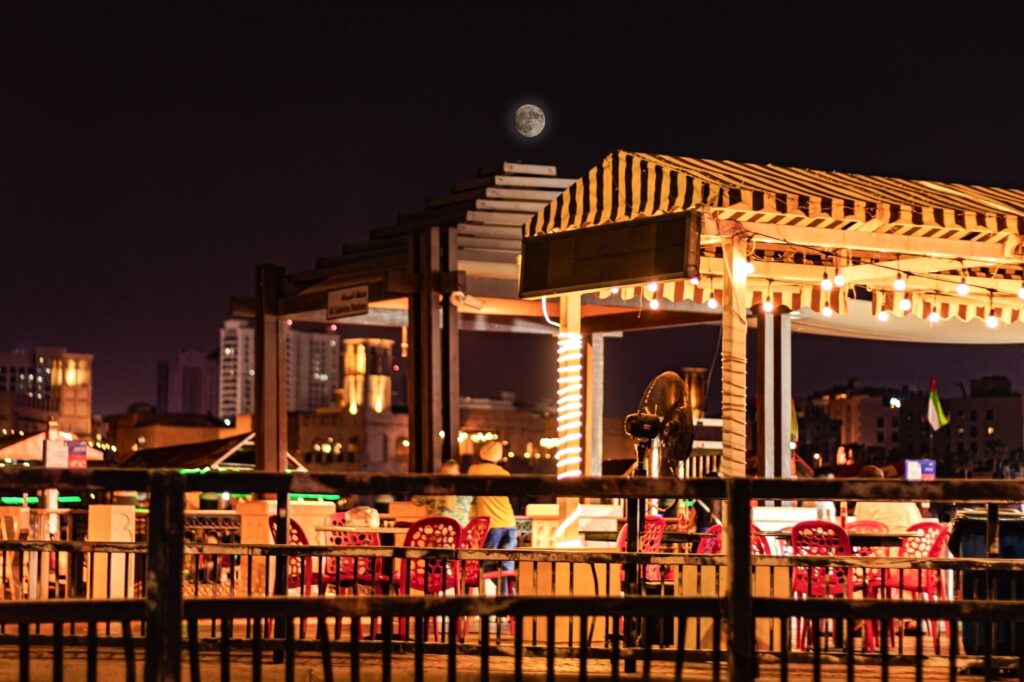
Economic reports presented in international forums such as IndexBox reveal that tourist spending on cultural experiences has experienced exponential growth superior to that of other traditional segments. This trend shift responds to an evolution in the visitor profile: a more mature, educated traveler with a clear inclination toward sustainability and intercultural respect. In this scenario, the contrast between the financial bustle of the commercial district and the meditative quiet of the interior’s historical settlements acquires incalculable pedagogical value.
The Vehicle of Memory: Anatomy and Philosophy of Heritage Express
Far from conventional tour buses that travel the main arteries of the metropolis offering superficial panoramas, Heritage Express operates under a radically different premise. Its design and operation are conceived to function as a living bridge between past and present. Aboard these adapted units, the journey is not mere spatial displacement, but a temporal immersion carefully paced by local guides who are, at the same time, custodians of the region’s oral traditions.
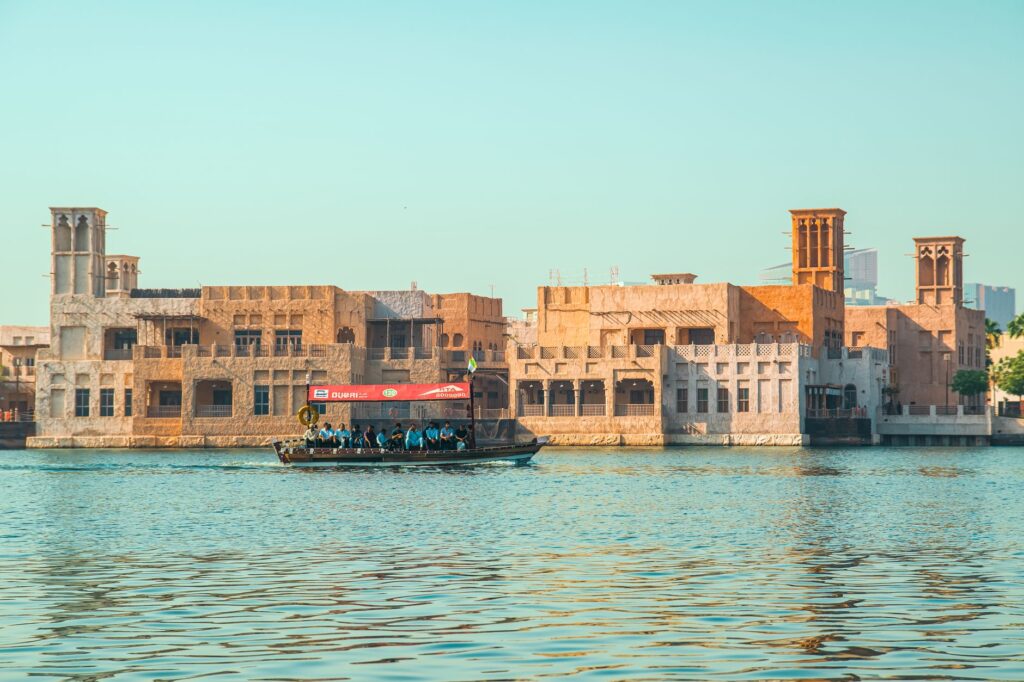
The methodological proposal of this project is based on direct interaction without artificial intermediaries. Passengers have the opportunity to delve into historic neighborhoods like Al Fahidi, interact with local artisans, and understand the complexities of traditional wind-tower architecture, known as Barjeel. This natural ventilation structure is just one example of how ancient inhabitants dialogued with an extreme climatic environment long before the arrival of air conditioning, offering lessons in sustainability that gain tremendous relevance today.
True luxury in 21st-century tourism is not material exclusivity, but the authenticity of shared knowledge and respect for the memory of peoples.
Architecture, Mobility, and the Rediscovery of the Urban Space
The impact of cultural tourism is not limited to museums or closed interpretation centers; it radically transforms the visitor’s relationship with urban mobility and the territory’s architecture. Heritage Express routes are designed to disconnect the traveler from the closed circuits of large hotel complexes and immerse them in the pre-existing urban fabric. This strategy of tourist decentralization relieves pressure on the city’s neuralgic points and distributes economic benefits to local communities and small businesses.
The integration of transport with historical narrative allows us to observe Dubai’s evolution not as a spontaneous miracle arising from nowhere, but as the result of resilient historical continuity. The strategic stops on the tour invite visitors to examine the transformation of ancient souks, where the scent of spices and the flicker of artisanal textiles coexist with the modern logistical systems of contemporary trade. It is a constant reminder that Emirati modernity does not disown its origins, but subsidizes and protects them as its most valuable asset.
Community Voices: Oral Transmission as Living Heritage
One of the greatest methodological achievements highlighted in recent sector evaluations is the centrality of local voices in the experience. Instead of resorting to externalized academic discourses or automated recordings, the project entrusts the narration to Emiratis who share their own family stories, childhood memories, and tales passed down from generation to generation. This ethnographic approach turns every journey into a space for genuine intercultural dialogue.

Visitors learn about traditional Al-Ayyala poetry, recognized by UNESCO, falconry as an ancestral art of survival and diplomacy, and the fundamental role of women in domestic economy and the preservation of desert medicinal knowledge. These direct testimonies dismantle prejudices and simplifications about Emirati society, offering a human radiograph rich in nuances, resolved contradictions, and aspirations for the future.
Gastronomy and Rituals: The Flavor of Encounter
The cultural immersion proposed by the model analyzed at ATM 2026 would be incomplete without the gastronomic dimension. Food in the United Arab Emirates is much more than nutrition; it is a codified language of hospitality, a ritual of welcome rooted in the unwritten laws of the desert. Through selected gastronomic stops and onboard culinary experiences, travelers discover native ingredients such as dates, cardamom, Gulf fish, and spiced meats prepared according to centuries-old methods.
This sensory approach provides an understanding of how the local diet responded to the demands of an arid ecosystem and the trade routes connecting the Arabian Peninsula with Persia, India, and East Africa. Food thus acts as an invisible map of geopolitical and cultural influences that explain Dubai’s current cosmopolitan condition from a deeply rooted foundation in historical exchange.
Future Challenges: Sustainability and Overcrowding in the Balance
Despite the enthusiasm generated by IndexBox statistics and the positive reception of initiatives like Heritage Express at international fairs, the sector faces complex formal challenges. The main dilemma lies in how to scale this type of high cultural intensity tourism without compromising the fragile integrity of historical enclaves and without falling into commercial folklorization. The preservation of authenticity demands strict limits on visitor volume per group and constant monitoring of the environmental impact of mobility.
Likewise, there is the challenge of continuing to train new generations of Emiratis to assume leadership in managing their own heritage, preventing narratives from falling into the hands of intermediaries outside local culture. Sustainability is therefore redefined not only in ecological or carbon footprint terms, but as a people’s capacity to maintain control over the narrative of their own identity in a globalized market.

Preserving culture does not mean freezing it in time, but equipping it with the necessary tools to dialogue with dignity and rigor with future generations.
Practical guide
Planning an immersion into Dubai’s cultural tourism requires a different perspective from the usual leisure or shopping visit. Below are the essential guidelines to enjoy the experience with rigor and respect.
- How to get there: Dubai has one of the best-connected international airports in the world (DXB). From there, access to the historic Al Fahidi district and the Heritage Express departure points is perfectly integrated into the metro and public transport network.
- When to go: The months between November and February offer the most favorable weather conditions for outdoor activities and extended tours without the thermal fatigue of summer.
- Reservations and advance booking: Due to reduced capacity policies to ensure the quality and closeness of guided experiences, booking heritage tours several weeks in advance through official platforms is essential.
- Code of conduct and dress: Although Dubai is a cosmopolitan metropolis, modest dress —covering shoulders and knees— is recommended when visiting historical enclaves, traditional neighborhoods, and community cultural centers.
- Responsible photography: Always ask permission before photographing local residents, especially women and the elderly, scrupulously respecting their privacy and personal spaces.
Epilogue: The Echo of the Desert in Tomorrow’s Pulse
As evening falls, when the sun merges with the glass and steel horizon of the great city, echoes of the past resonate with unexpected clarity. The success of proposals like Heritage Express demonstrates that the future of tourism does not consist of inventing increasingly colossal attractions, but in knowing how to look attentively at what was always there, waiting to be told. In that attentive gaze lies the true wealth of a destination that, by embracing its memory, secures the depth of its future.
Source in EN: IndexBox – Heritage Express at ATM 2026: Emirati Cultural Tourism in Dubai (https://news.google.com/rss/articles/CBMitgFBVV95cUxPQVFGN3dHU2wxWFo2QW96ZVhrOFFhTHdNOFBEbTVvaEo2ZnpVYTNOQi1fdE5wVkRudkw2VXdrUndoaEZ0QXYyX0dkcmw5alpHdEVpODJfcWVESGY5U0hrV05RUUxUWTZDN2hXekxkaGYtdUVkVkl4OFUzSlpWUlhjblJYZEh0Ul9ocERJYVUycXlaMUYwclAtWEF5aUlMNnc0YUMwWmFqaEZHbG9lLXNNaWlHTFVsUQ?oc=5)