
The contemporary map of long-distance travel is typically measured in flight hours and impersonal airport connections. Yet, a steel scar traverses the Eurasian heartland, defying the very notions of geography and time: the Trans-Mongolian Railway. This line, acting as the boldest and most fascinating branch of the great Trans-Siberian network, is not merely a means of transport. It is a civil engineering masterpiece adapted to the planet’s most unforgiving wilderness, an invaluable geopolitical corridor, and a travel experience where territory ceases to be an obstacle and becomes the central argument of the voyage.
From an infrastructure perspective, the route represents a monumental exercise in topographic and climatic mastery. The tracks meander from the Siberian taiga, cross the vast and desolate plateau of Mongolia —where thermometers swing dramatically between the rigors of the boreal winter and summer isolation— and finally descend into the dense rail network of northern China. Understanding this route requires examining the meticulous logistics necessary to maintain an umbilical cord thousands of kilometers long, where track gauge alterations, complex border operations, and train self-sufficiency are components of a mechanism as fragile as it is resilient.
Geopolitical Genesis and Steppe Engineering
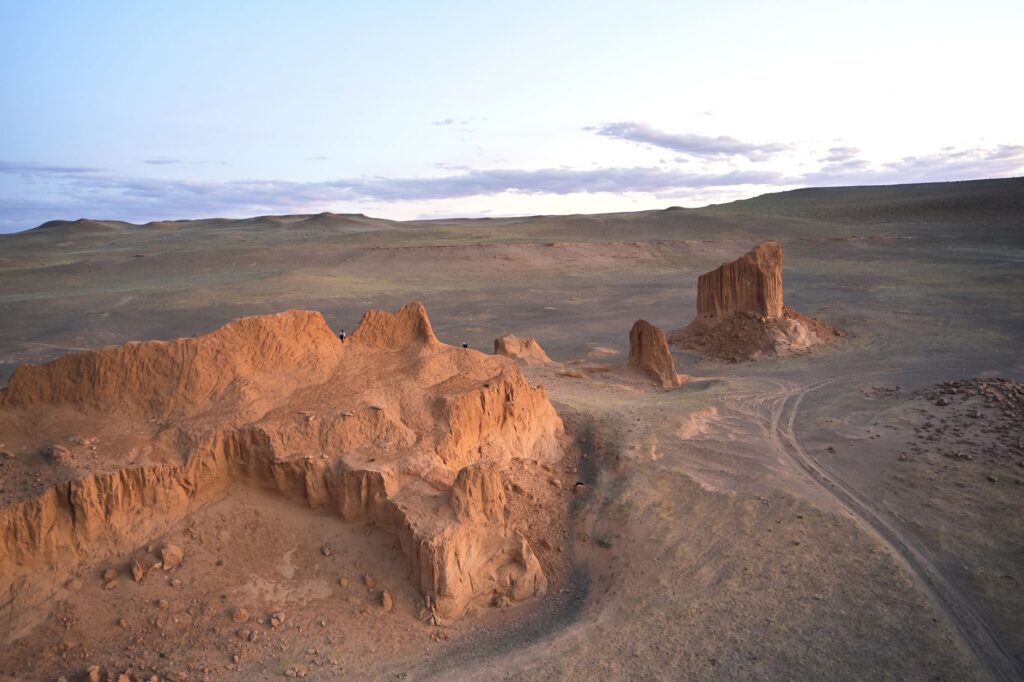
The construction of the Trans-Mongolian Railway was driven not only by commercial demands but also by a complex 20th-century geopolitical strategy aimed at linking the Soviet bloc with the People’s Republic of China through Mongolian territory. Unlike other railways laid over stable terrain, engineers had to contend with permafrost soils in northern sections and unstable sands and clays in the desert plateaus of the Gobi. The placement of ties and ballast required innovative technical solutions to prevent extreme thermal fluctuations from warping the steel or fracturing the structural base.
The route harnesses natural river depressions and valleys to gain altitude gradually, avoiding excessive gradients that would compromise heavy locomotive traction. Across the Mongolian section, the track extends over infinite plains where the horizon curves, and the railway line remains the sole geometric reference for hundreds of kilometers. Topographic precision across these expanses demanded an unprecedented cartographic effort, executed under weather conditions where the metal of surveying instruments froze upon contact with human skin.
Border Logistics and the Track Gauge Challenge
One of the most fascinating aspects of traveling the Trans-Mongolian is the logistical management of technical discontinuities between rail systems. While Russia and Mongolia employ the Russian broad gauge of 1,520 millimeters, China operates on the standard international gauge of 1,435 millimeters. This historical divergence is not merely a technical detail; it constitutes an inescapable physical border requiring complex operations at border towns such as Naushki and Erlian.
At these stations, passengers experience one of the most unique rituals in global transport: the lifting of railcars via massive hydraulic jacks while bogies —the wheel assemblies— are replaced beneath the chassis. This process, executed by teams of mechanics with millimeter synchronization, transforms the border into a technical interlude where railway diplomacy is put to the test. Operational efficiency at these transfer points determines the economic and temporal viability of the entire trade corridor between Europe and the Far East.
Life On Board: Autonomy and Train Rhythms
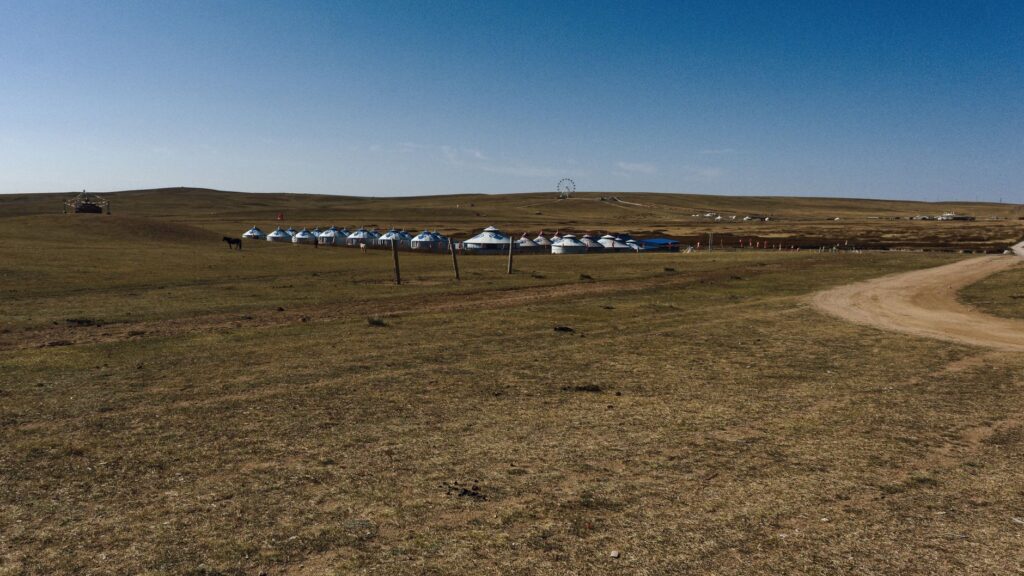
Traveling the Trans-Mongolian for the duration of the full journey between Moscow and Beijing demands a psychological transformation in the traveler. The train car becomes a self-managed community where time discards urban conventions. The supply of coal for traditional Russian stoves —the samovars providing continuous boiling water— marks an ancestral domestic rhythm contrasting with the external landscape of taiga, alpine Siberian lakes, and scattered nomadic yurts.

The convoys combine sleeper cars of various classes, ranging from compartmentalized first-class cabins to open third-class spaces where intercultural coexistence is total. The dining car’s menu evolves subtly according to the jurisdiction of the traversed section, adapting provisions and recipes as the train crosses successive cultural boundaries.
The train is not merely a vehicle to move from point A to point B, but a mobile observatory where the immensity of the Eurasian landscape reveals itself in all its complex solitude.
This logistical autonomy compels both crew and passengers to maintain rigorous planning, as prolonged stops are scarce and replenishment opportunities in small Siberian enclaves are dictated by strict operational schedules.
The Passage Through Ulaanbaatar and Urban Transformation
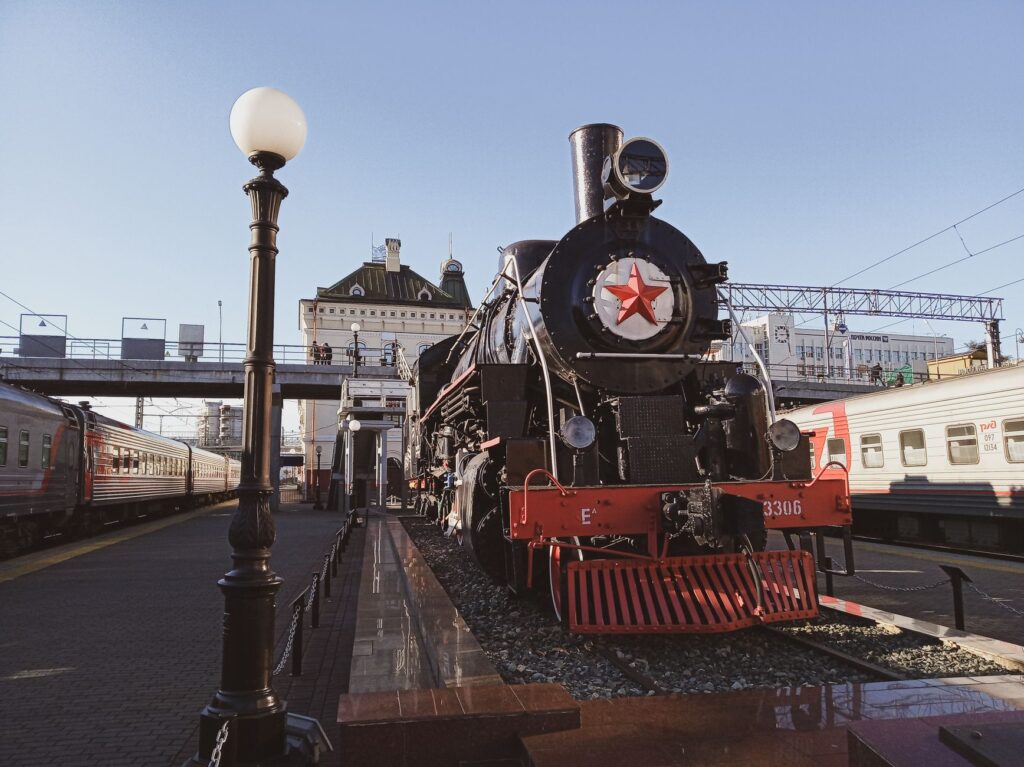
The geographical heart of the route is located in Ulaanbaatar, Mongolia’s capital, a metropolis that has grown vertiginously around railway activity. The arrival of the line in the 1950s anchored the country definitively to global supply routes. Today, Ulaanbaatar’s central station functions as a neuralgic hub where mineral freight flows and long-distance passenger traffic converge.
The urban impact of the railway in Mongolia is undeniable. Industrial zones and residential districts historically developed parallel to the tracks, leveraging heavy freight capacity for coal and construction materials. For the traveler, stepping off at this station represents an abrupt transition between the isolation of the steppe and the bustling activity of a city blending nomadic tradition with accelerated, dusty modernity.
The Descent Toward the Gobi and the Approach to the Wall
As the convoy advances southward from Ulaanbaatar, the vegetative landscape of taiga and grassland yields to the severe aridity of the Gobi Desert. This ecological transition poses new engineering challenges, such as sand accumulation over tracks and fierce winds lashing the desert plains. Local maintenance teams operate continuously to clear the corridor and ensure ballast stability in zones prone to relentless wind erosion.
After clearing the Erlian border crossing, the train enters China’s Inner Mongolia Autonomous Region, initiating the final descent toward Beijing. The visual contrast is striking: open plains gradually transform into mountain ranges carved by tunnels and viaducts, culminating in the Chinese megalopolis. This landscape metamorphosis summarizes the integrative ambition of the Trans-Mongolian, capable of connecting the most remote boreal forests with East Asian urban dynamics.
Practical guide
Planning a journey aboard the Trans-Mongolian Railway requires a comprehensive understanding of bureaucratic, logistical, and seasonal requirements. Below are the fundamental keys to approaching this journey with rigor:
- Visas and Documentation: Transit or tourist visas for Russia, Mongolia, and China must be arranged in advance, ensuring entry and exit dates strictly match train tickets.
- Choosing the Season: Summer months (June to August) offer moderate temperatures and extended daylight, while winter (November to February) presents extreme snowy landscapes but demands greater preparation against Siberian cold.
- Ticket Reservations: Tickets must be purchased several months ahead through specialized agencies or official platforms, carefully selecting cabin classes (Kupe for four-berth compartments or Spalnya for two).
- Provisions On Board: Although trains feature dining cars, it is advisable to board with basic supplies of non-perishable food, nuts, and bottled water for stretches between major stations.
- Connectivity and Power: Mobile phone coverage is non-existent across vast areas of Siberia and the Gobi. Bringing high-capacity external power banks and pre-downloaded media is strongly recommended.
Epilogue on the Infinite Steppe
At journey’s end, when the metallic rumble of bogies subsides in major urban terminals, the indelible imprint remains of having crossed the world’s confines at a locomotive’s steady pace. The Trans-Mongolian is not an escape route, but a deep immersion in Eurasia’s outsized scale.
In the silence of the night, when the train pauses at a forgotten siding beneath the celestial vault of the Mongolian steppe, the true dimension of travel is understood: an uninterrupted dialogue between human beings, machinery, and the immensity of the horizon.
It is this capacity to suspend time and space that consecrates the route as one of the most extraordinary and rigorous experiences in contemporary travel geography.