
The Genesis of an Enlightened Utopia on the Lucense Coast
In the heart of A Mariña lucense, where the mountains slope down toward the Cantábrico Sea covered in lush eucalyptus and chestnut forests, stands the historic-artistic complex of Sargadelos. This is not merely a ceramics factory, but the monumental vestige of an 18th-century enlightened dream conceived by Antonio Raimundo Ibáñez, the Marquis of Sargadelos. In this secluded enclave, the convergence of the Xunco river’s hydraulic power, an abundance of timber for the kilns, and proximity to pure kaolin deposits laid the groundwork for what would become the most advanced iron foundry and royal earthenware factory in the Iberian Peninsula.
The traveler who ventures into this green valley today immediately perceives a solemn silence, broken only by the murmur of water and the distant echo of crashing waves. The ashlar stone buildings, designed with a sober neoclassical aesthetic, guard the memory of a pioneering industrialization that successfully fused metallurgical science with the subtle art of fire. The contemporary recovery of these spaces has transformed the complex into an inescapable reference point for European industrial heritage, where archaeology and living creation converse without friction.
The weight of industrial history in Galicia continues to define the character of its most remote river valleys.
The Alchemical Process of Kaolin and Cobalt
Stepping into the active workshops of Sargadelos today is akin to witnessing a ritual where chemistry and patience dictate the rhythm of every workday. The soul of this pottery lies in its raw material: kaolin, a high-purity white clay historically extracted from the Galician mountains, which gives the ceramic body its immaculate whiteness and resilience after high-temperature firing. The workers, direct heirs to a lineage of throwers and molders, manipulate the paste with a sensitivity acquired through decades of hands-on artisanal practice.
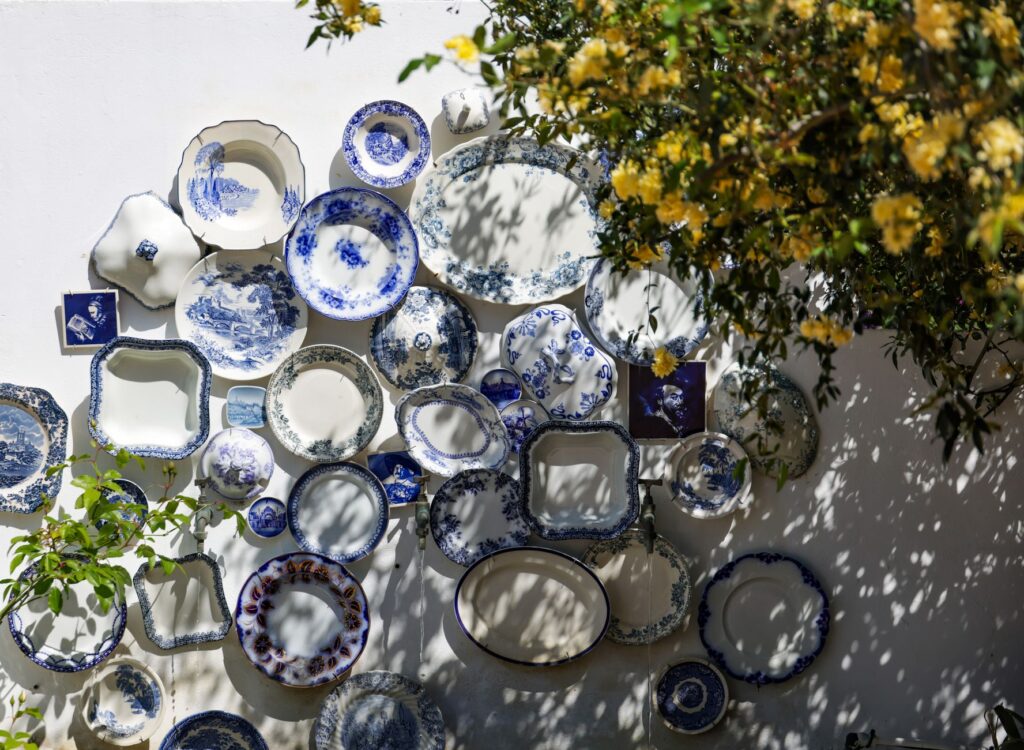
Once the pieces are demolded and subjected to an initial bisque firing, the house’s most iconic chromatic element comes into play: cobalt blue. Applied freehand using marten-hair brushes by expert decorators, this mineral pigment undergoes a radical transformation inside the kiln. The oxide, initially grayish and muted, fuses with the glassy glaze at over twelve hundred degrees to emerge with that characteristically intense, deep, and clean cobalt hue that evokes the stormy skies and marine breakers of northern Galicia.
The true work of art in ceramics lies not in the symmetric perfection of the form, but in the invisible trace of the human pulse running through it.
Geometry, Avant-Garde, and the Legacy of Seoane
The aesthetic trajectory of Sargadelos underwent a Copernican shift in the 20th century thanks to the intervention of key figures of the Galician avant-garde, most notably intellectual and artist Luis Seoane. Alongside Isaac Díaz Pardo, Seoane redefined the factory’s formal repertoire in the mid-sixties, moving away from 19th-century costumbrism to embrace an abstract language deeply tied to the ancient forms of Castro culture, Atlantic petroglyphs, and popular art.
This syncretism between Celtic archaeology and modern design gave rise to tableware, zoomorphic figures, and mural panels where circles, interlaced crosses, and schematic profiles compose a unique visual grammar. In today’s workshops, creators continue to draw from this historical catalog, reinterpreting original matrices without losing technical rigor. Each geometric piece is the result of a precise mathematical calculation where industrial design yields to the unpredictable demands of clay and thermal contraction.
The Silent Workshop: Hands, Wheels, and Kilns
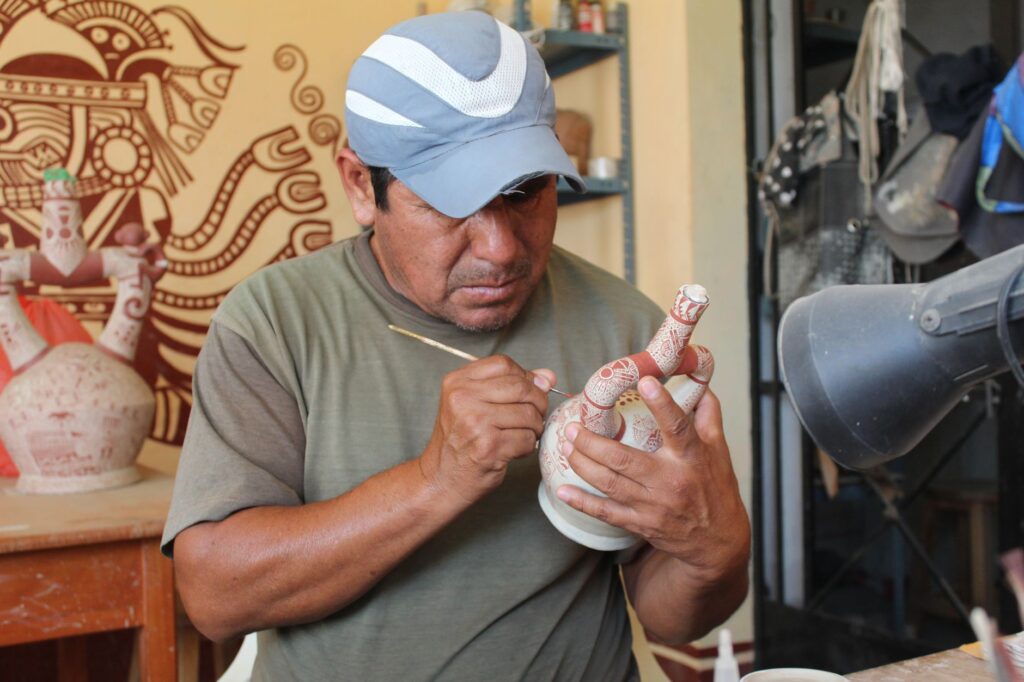
The pace of the contemporary workshop contrasts sharply with the speed of the outside world. At their workbenches, master throwers work the damp clay with absolute concentration, guided by the tactile memory of their fingertips. Here, there are no automated assembly lines; every vessel, platter, and decorative element passes through the hands of half a dozen artisans before receiving final approval. The quality control is relentless: the slightest air bubble in the paste or imperfection in the glaze condemns the piece to destruction in pursuit of excellence.
Current gas kilns, equipped with advanced digital thermal control technology, allow artisans to replicate the exact firing curves that guarantee the perfect vitrification of the glaze. Nevertheless, workshop veterans nostalgically recall the old wood-fired kilns, where human skill and intuition in the face of erratic flames were the sole guarantors of success. This constant tension between technical modernity and absolute respect for the manual gesture defines the daily heartbeat of the factory today.
The Impact on the Landscape and Cultural Tourism
The survival of Sargadelos has radically transformed the economy and tourist profile of the region. Cervo has ceased to be merely a transit point on the coast, becoming a pilgrimage destination for design lovers, art historians, and curious travelers seeking to understand the identity keys of Galicia beyond summer clichés. The industrial complex, with its tree-lined paths along the river and rehabilitated historic warehouses, offers a museological tour that scientifically explains the production process and the social epic of its founders.
Sustainable cultural tourism finds in these manufacturing enclaves an exemplary model of territorial revitalization without overcrowding.
Furthermore, the opening of official shops and interpretation centers in major Galician and Spanish cities has brought this heritage closer to the general public, consolidating a loyal market that values durability, timeless design, and the ethical traceability of everyday objects. Buying a Sargadelos piece today is not an act of decorative consumption, but an active form of cultural patronage that sustains traditional workshops and endangered ancient crafts.
Contemporary Challenges of Autorial Porcelain
Despite its international prestige, the Sargadelos workshops face profound economic and generational challenges today. Generational turnover remains the primary concern of veteran masters; training a thrower or ceramic painter requires years of intensive learning and a vocation capable of sacrifices that is increasingly scarce among younger generations. Local and regional institutions currently collaborate on specific training programs to ensure that techniques of slip casting, glazing, and manual decoration are not lost to oblivion.
On the other hand, unfair competition from mass industrial production and the constant rise in raw material and energy costs force the brand to recalibrate its commercial strategy, firmly committing to exclusivity, limited editions, and collaborations with internationally acclaimed contemporary artists. This delicate balance between guarding historical tradition and maintaining creative audacity is the only thing keeping the flame alive in one of the most fascinating industrial adventures in Atlantic Europe.
Protecting artisanal heritage requires understanding that a lost craft is a fragment of collective memory extinguished forever.
Practical guide
How to get there: The historical complex of Sargadelos is located in the municipality of Cervo, in the province of Lugo. The most efficient way to arrive is by private vehicle via the N-642 road or the A-8 highway, taking the exit toward Cervo/San Cibrao. The nearest railway station with regular connections is Viveiro, located just twenty kilometers away.
When to go: Spring and early autumn months offer ideal weather to walk the river trails of the Xunco river and enjoy the facilities without crowds. The factory and historic site are open Monday through Saturday, though checking specific schedules for guided tours of the production workshops in advance is recommended.
What to see and do: Walking the lovers’ path (paseo de los enamorados), a tree-lined trail running alongside the river to the remains of the old iron foundry, is an absolute must. Additionally, the Sargadelos Historical Museum houses an exceptional collection of original pieces from the 18th and 19th centuries. Booking limited spots in advance to watch the live work of throwers and painters in the active workshops is strongly advised.
Accommodation and gastronomy: The A Mariña lucense region boasts an excellent rural tourism network featuring restored historic manor houses and charming small hotels in coastal towns like San Cibrao or Burela. Gastronomically, local produce stands out for the freshness of Cantabrian fish and seafood, paired with white wines from the Rías Baixas denomination of origin or local Ribeiro.
Visual Epilogue Between Kaolin and Memory
عندما When the late afternoon light filters through the tall windows of the old workshops and reflects upon the piles of white clay arranged for drying, time seems to suspend itself in Cervo. In this northern nook, the collective effort of generations of men and women has successfully shielded an essential fragment of Galician aesthetic identity against global homogenization. Born of fire and patience, these kaolin and cobalt pieces continue to guard the secret heartbeat of mountains that once dared to dream of industrial modernity without ever renouncing the beauty of the handmade.