
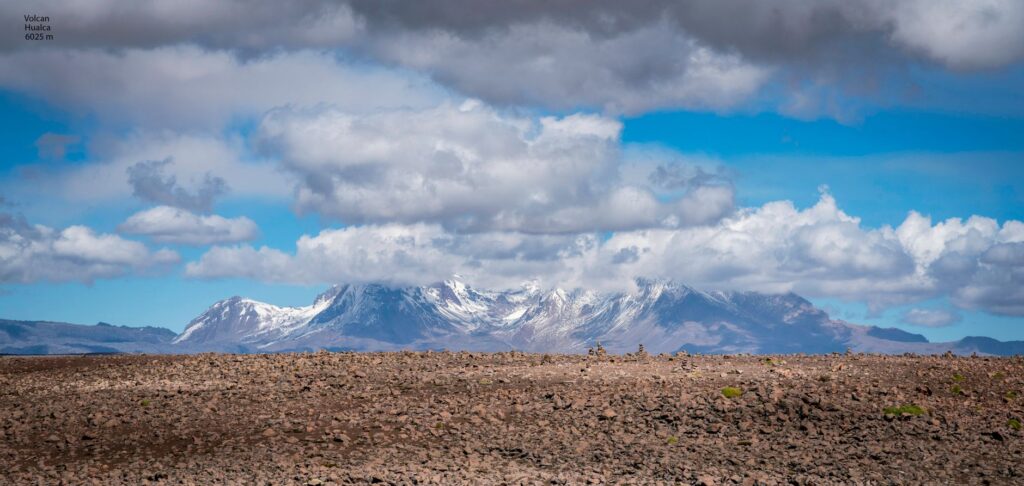
In the heart of the Peruvian Andes, where the mountain range displays a rugged geography of volcanic rock and pristine skies above 4,000 meters of altitude, the survival of ecosystems relies not on massive technological infrastructure, but on the subtle architecture of water. The Salinas y Aguada Blanca National Reserve, flanked by the snow-capped colossi Misti, Chachani, and Pichu Pichu, constitutes a vast territory where ecological balance has historically hung by a fragile thread. Here, local communities—heir to a millennial herding tradition—have taken the helm of a radical shift: the transition from traditional extensive land use toward a regenerative management model that prioritizes the health of bofedales, the high-Andean wetlands essential for hydrological regulation and carbon sequestration.
This report examines how the convergence of ancestral shepherd knowledge and contemporary scientific research is redrawing the future of the reserve. Facing the advance of desertification, historical overgrazing, and climatic variability that disrupts glacial melting cycles, the Andean territory stands as a living laboratory for socio-environmental resilience. This is not merely about protecting a scenic landscape, but about understanding that the viability of the water descending toward coastal metropolises is inextricably linked to the health of these humid grasslands and the sovereignty of those who inhabit them.
The Geography of Altitude and the Hydrological Challenge
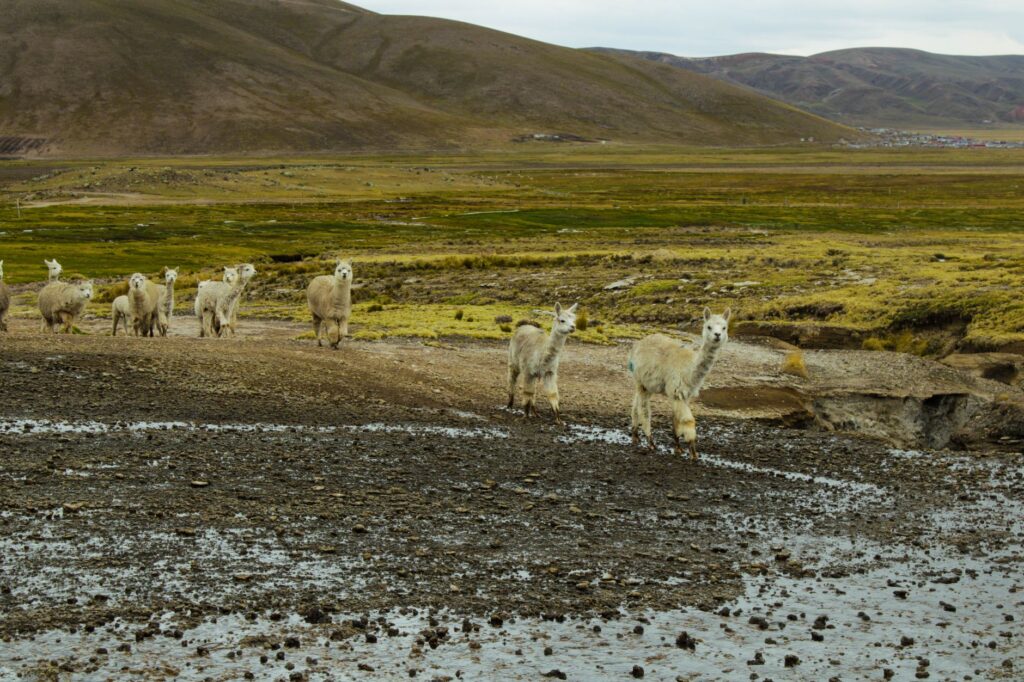
The Salinas y Aguada Blanca National Reserve spans over 360,000 hectares distributed across the regions of Arequipa and Moquegua. This setting, characterized by extreme thermal amplitude and seasonal precipitation concentrated within a few months, harbors a highly specialized biodiversity. Vicuñas, a national symbol that recovered its populations after decades of poaching, share these plateaus with domestic camelids such as alpacas and llamas, alongside high-Andean avifauna including Chilean flamingos and Andean geese. However, the most precious resource of this ecosystem is the bofedal: peat-forming wetland formations that act as natural sponges, retaining rainwater and glacial runoff to release it in a regulated manner during the dry season.
Over recent decades, pressure on these wetlands intensified due to unmanaged livestock increases and altered rainfall patterns. The partial desiccation of the bofedales not only reduced the availability of quality forage for alpaca herds but also accelerated the release of carbon accumulated in the soil for millennia. Facing this diagnosis, conservation institutions and peasant communities understood that the answer did not lie in banning land use, but in optimizing management through participatory science.
The Rebirth of Wetlands: Stone Dikes and Community Science
The core of environmental transformation in Salinas y Aguada Blanca lies in hydrological recovery techniques applied directly to degraded bofedales. Far from requiring heavy machinery or invasive interventions, community members—organized in shepherd associations and backed by biologists and hydrologists—have revived the ancestral technique of amunas and low-retention check dams built with local stone and turf sods.
These small barriers, arranged transversely in the headwaters of minor streams and seepages, slow down runoff water, allowing it to deeply infiltrate the soil and expand the area of hydrophilous vegetation. Hydrological monitoring conducted in pilot sectors shows a marked increase in soil moisture and a visible recovery of plant biomass in less than three seasonal cycles. This alliance between the empirical intuition of the Andean inhabitant—who knows every spring and wetland by name—and scientific measuring instruments has equipped communities with technical tools to demonstrate the effectiveness of their stewardship to the State and international cooperation agencies.
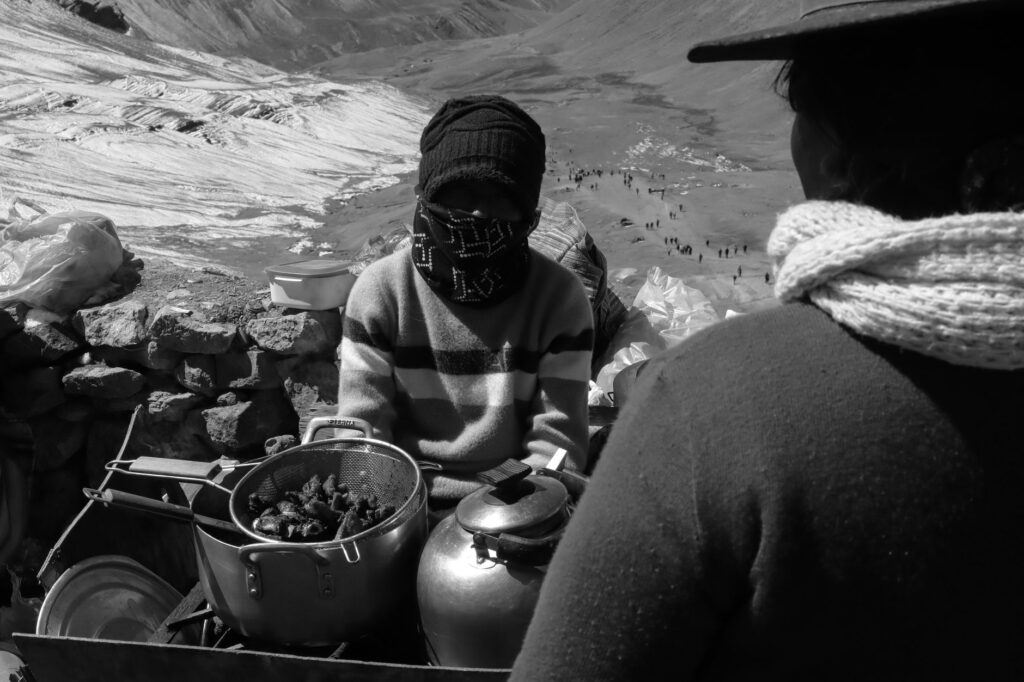
The restoration of a bofedal is not a static engineering feat, but a daily pact between the water descending from glaciers and the hands tending the earth.
Rotational Grazing and South American Camelid Conservation
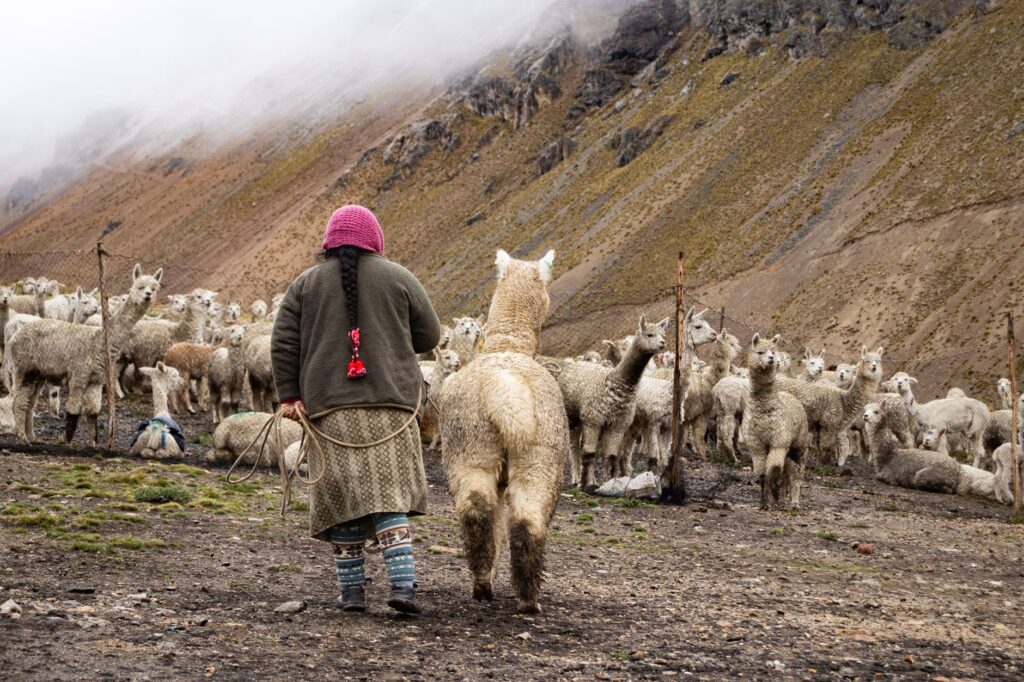
Water management is inseparable from livestock husbandry. Historically, the free and continuous access of alpaca herds to the bofedales caused excessive trampling of saturated soils, compacting the earth and destroying the roots of native quenua trees and aquatic plants. The community solution has been to implement a rigorous system of rotational grazing and seasonal resting periods for the bofedales.
Through the temporary delimitation of parcels using low-impact mobile fencing and planned herd rotation, the bofedal is allowed to rest, recover its vegetation cover, and strengthen its root system before welcoming livestock once again. This practice not only improves the nutritional quality of alpaca fiber—increasing its value in sustainable textile markets—but drastically decreases wind and water erosion. Shepherd families have verified that more orderly spatial management results in healthier animals, lower kid mortality during severe frost events, and greater economic stability for rural households.
The Role of Andean Women in Natural Heritage Custody
It is impossible to understand the success of conservation initiatives in Salinas y Aguada Blanca without highlighting the daily leadership of Andean women. Traditionally relegated in formal communal decision-making spaces, women have assumed a central role in water management committees, fiber selection, and the transmission of ethnobotanical knowledge to younger generations.
They lead community wildlife censuses, recording the presence of flamingos, viscachas, and Andean foxes, and spearhead environmental education workshops in rural schools across high-Andean hamlets. Their participation has transformed family dynamics, turning environmental conservation into an intergenerational project where collective memory merges with social innovation. This revaluation of the female role strengthens social cohesion and anchors youth to the territory, mitigating migration toward coastal urban centers.
Scientific and Community Tourism: An Alternative to the Extractive Model
Facing historical pressure from extractive economic activities on the reserve’s periphery, communities have fostered a specialized form of ecotourism: scientific and community-based tourism. This modality does not seek visitor massification, but rather welcomes conscious travelers, researchers, and university students interested in understanding high-mountain processes.
Visitors participate in experiential workshops on alpaca management, traverse interpretation trails guided by locals explaining volcanic geology and endemic flora, and stay in family-run rural lodging networks equipped with solar energy technologies. The revenues generated by this activity are directly reinvested into community funds dedicated to health, education, and the maintenance of ancestral irrigation infrastructures, consolidating a diversified local economy that reduces exclusive dependence on traditional livestock raising.
True regenerative tourism in the high mountains does not consume landscapes; it finances the continuity of the cultures that make those landscapes remain alive.
Practical guide
How to get there: The primary access point to the Salinas y Aguada Blanca National Reserve is the city of Arequipa. From there, entry to the protected area is made via 4×4 vehicles hired through authorized agencies or through organized community routes. The journey to central sectors, such as the Salinas zone or the Aguada Blanca wetlands, takes between two and three hours along unpaved gravel roads.
Best time to visit: The dry season, spanning from May to November, offers clear skies and better road conditions, though with nighttime temperatures frequently dropping below freezing. The rainy season (December to April) presents landscapes dyed in intense green and higher avifaunal activity, but requires caution due to road conditions.
Acclimatization recommendations: The reserve lies entirely above 3,800 meters above sea level, reaching heights exceeding 4,800 meters. It is essential to spend at least two days acclimatizing in the city of Arequipa (2,325 masl) before ascending, maintain constant hydration, and avoid heavy meals.
Gear and clothing: Essential items include thermal layering systems, windproof outerwear, sturdy trekking boots, high-UV-protection sunglasses, mineral sunscreen, and a reusable water bottle.
Environmental conduct rules: It is strictly prohibited to litter, disturb wildlife through excessive approach, light campfires, or drive vehicles off authorized routes designated by the protected area’s management office.
The Horizon of Climate Sovereignty in the High Andes
The process underway in the Salinas y Aguada Blanca National Reserve transcends the strictly local sphere. On a planet struck by recurring climate crises, the community bofedal management model demonstrates that the most efficient solutions often stem from restoring bonds between human societies and their ecosystems. Science and ancestral tradition do not oppose each other in these highlands; on the contrary, they complement one another to offer a robust response against environmental uncertainty.
As glacial meltwater continues its descent toward valleys and cities, the silent effort of high-Andean communities ensures that the cycle of life does not stop. Sustaining the bofedal is, ultimately, sustaining the future of an entire region dependent on the generosity of the heights. And in that daily endeavor, Arequipa’s herders have proven that the future of conservation is written with hands weathered by the cold, shared science, and the unwavering conviction to protect the land that sustains them.