
Introduction to the Green Murmur of Kyoto
In the northwestern reaches of Kyoto, where the city yields its urban pulse to the wooded foothills of the Arashiyama mountain range, lies a landscape that defies standard paradigms of wellness tourism. This is neither a enclosed spa nor a high-altitude mountain sanctuary, but a millennial green corridor where the architecture of giant bamboo—specifically the Phyllostachys edulis species, introduced from China during the Heian period—defines both visual aesthetics and soundscape. This report examines how this plant environment has transformed into a global benchmark for preventive medicine and contemplative immersion, moving away from mass-market postcards to analyze its ecological structure and its real impact on the human nervous system.
The urgency of this analysis lies in the redefining of experiential travel in the 21st century. While contemporary travelers constantly seek refuges from hyper-connectivity, the Sagano groves offer something more radical: a protocol of silence regulated by the very physics of the foliage. Through the interaction between culm density, valley wind speed, and the acoustic absorption of leaf-covered soils, this ecosystem operates as a natural anechoic chamber—a phenomenon formally recognized by Japan’s Ministry of Environment when it included the sound of wind in Sagano among the One Hundred Soundscapes of Japan.
The Invisible Geography of Arashiyama and the Oigawa River Valley
To comprehend the wellness emanating from Sagano, it is imperative to analyze its geographic setting. The district sits at the confluence of the Hozu and Oigawa rivers, a position that historically served as a fluvial transport route for timber and supplies destined for the imperial capital. The constant humidity generated by these waterways, combined with the acidic, well-drained soils of the Arashiyama slopes, created the ideal microclimate for the massive propagation of moso bamboo. Unlike deciduous broadleaf forests, this ecosystem maintains year-round canopy cover that strictly regulates local temperature and air saturation.
Human intervention in this landscape is not recent. For centuries, the aristocracy of the imperial court used these valleys as private summer retreats, constructing Buddhist temples and rest pavilions whose architecture was deliberately designed to frame the bamboo. Tenryu-ji temple, founded in 1339 by the shogun Ashikaga Takauji, incorporated the surrounding forest into its chisen-kaiyushiki garden style (a strolling pond garden), establishing an architectural precedent where boundaries between building and forest entirely dissolve. This spatial integration foreshadows modern concepts of biophilic design.
Botanical Engineering: Culm Physics and Vertical Rhythm
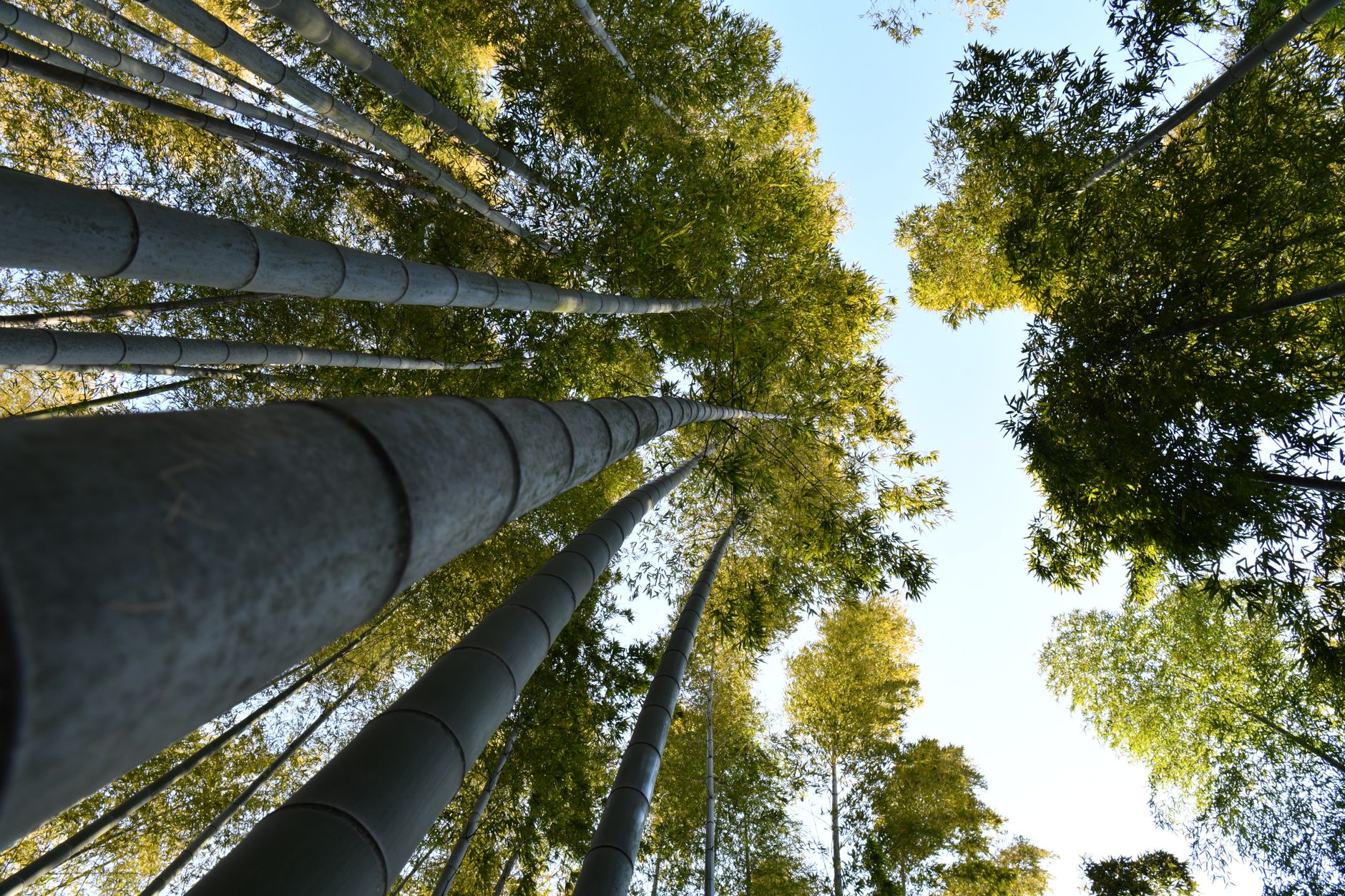
The visual and psychological impact of the Sagano forest lies in its rigorous vertical geometry. Unlike traditional trees, which develop branched and irregular crowns, the stalks or culmos of Phyllostachys edulis grow completely straight, reaching heights of up to twenty-five meters with diameters exceeding fifteen centimeters. This dizzying growth—which can record increases of nearly a meter in a single day during spring—generates a sense of absolute order that sharply contrasts with the visual chaos of modern metropolises.
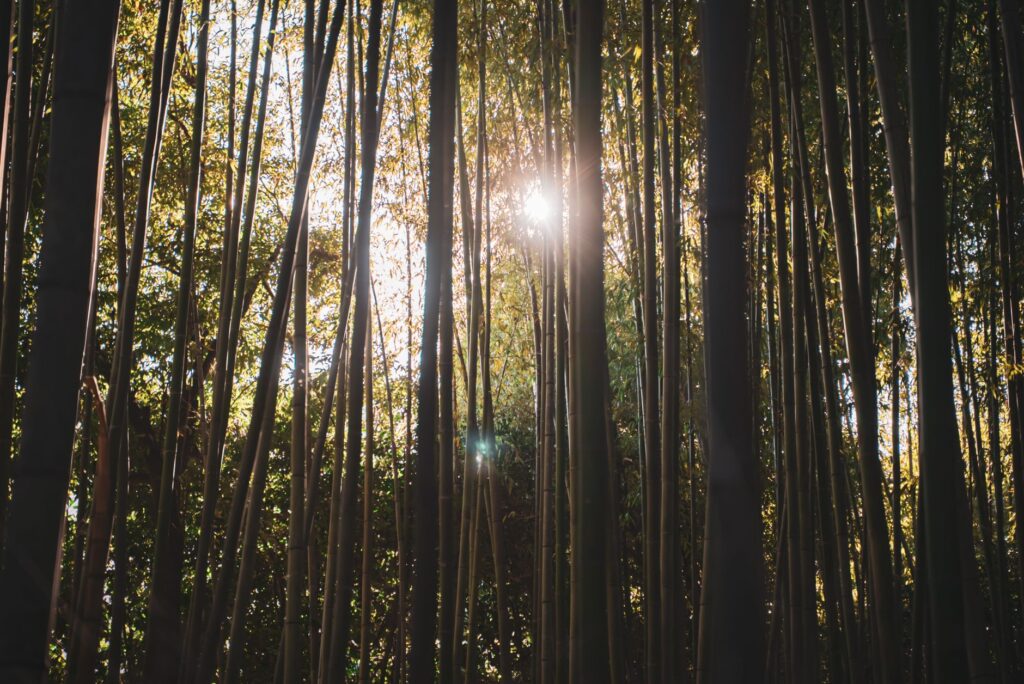
From the standpoint of botanical engineering, the internal structure of bamboo is a marvel of evolution. Its cross-section reveals a network of densely packed cellulose fibers on the periphery, granting superior bending strength compared to many hardwoods. This structural flexibility allows the forest to withstand typhoons and gale-force winds without fracturing; rather than offering rigid resistance, the culms oscillate and communicate through a controlled mechanical friction system that produces their characteristic rustling sound.
Environmental Acoustics and the Neuroscience of the Soundscape
The true therapeutic value of Sagano resides in its acoustics. Recent research in psychoacoustics and applied neurophysiology has shown that exposure to low-frequency natural sounds, such as the rhythmic friction between bamboo stalks and the whispering wind through lanceolate leaves, immediately induces a transition in human brain waves from the beta state (associated with stress and analytical alertness) to the alpha state, characterized by vigilant relaxation and reduced blood cortisol levels.
The sound of bamboo is not mere ambient noise; it is a constant modulation of frequencies acting as a natural pacemaker for the autonomic nervous system.
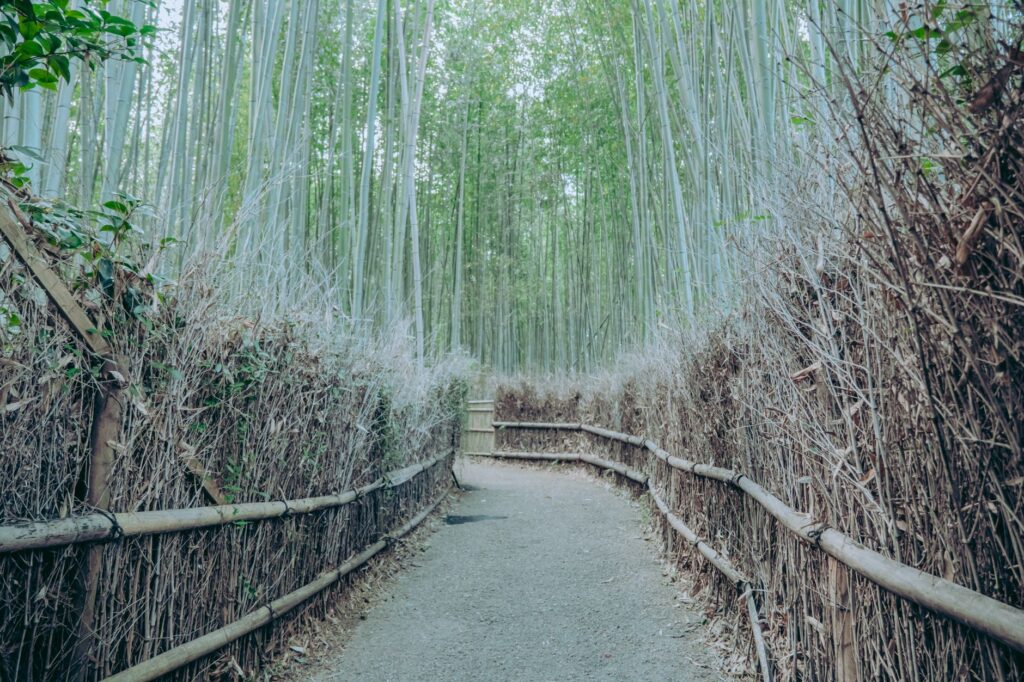
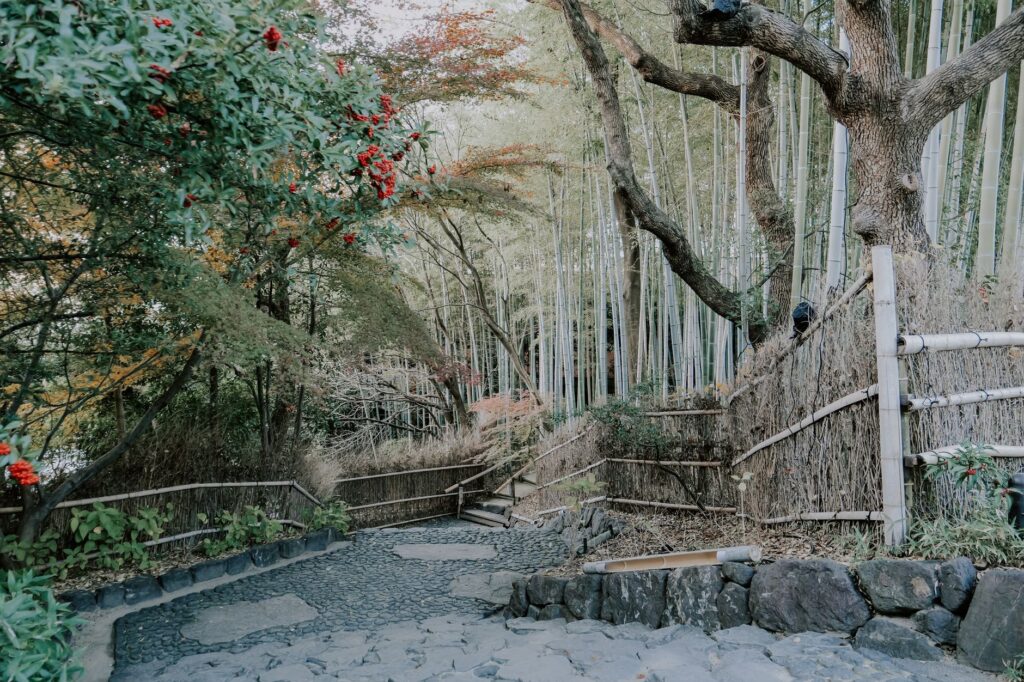
This phenomenon is enhanced by the spatial layout of the trails. The main pathway, discreetly paved to allow respectful transit, is flanked by traditional fences woven from interlaced bamboo branches known as *sodegaki*. These structures not only demarcate visitor flow but act as secondary acoustic diffusers, preventing excessive reverberation and ensuring the wind’s murmur retains its harmonic purity even on days of peak tourist influx.
The Immersion Protocol: Beyond Mass Tourism
In recent years, the critical challenge for Sagano’s management has been balancing the conservation of the fragile ecosystem with global tourism pressure. Mass tourism, particularly during seasonal peaks in autumn (*koyo*) and spring (*sakura*), represents a direct threat to the forest floor, whose shallow root system (*rhizomes*) is highly vulnerable to compaction caused by constant foot traffic outside designated trails.
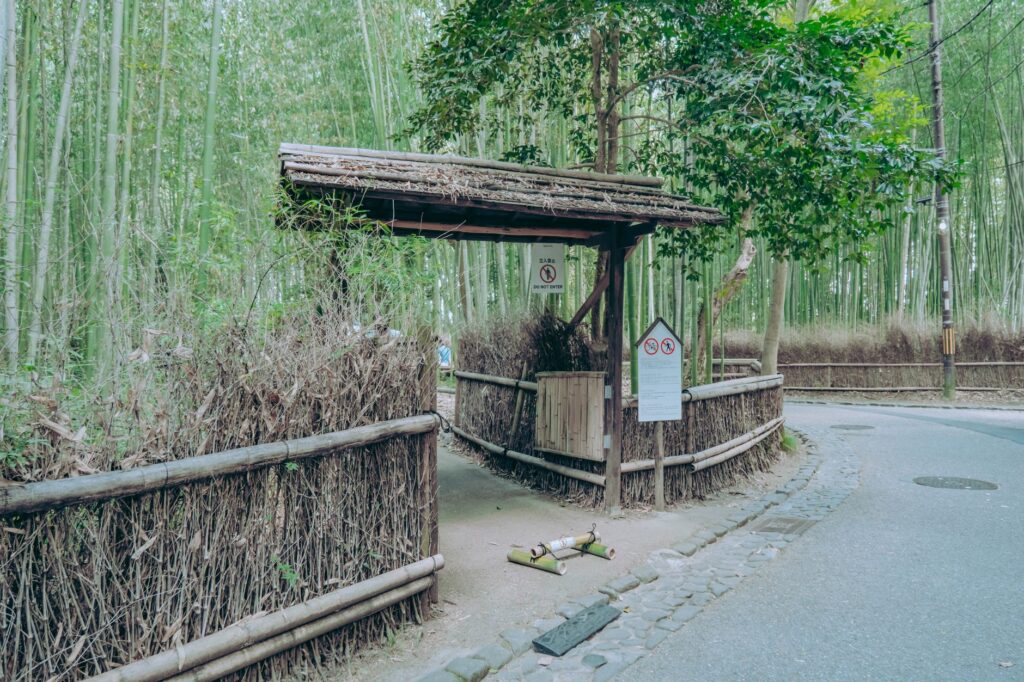
In response, local authorities in Kyoto, in collaboration with preservation associations in the Arashiyama district, have implemented strict sustainable management guidelines. These measures include drone prohibitions, access hour limits in sensitive zones, and the active promotion of morning immersion programs inspired by the concept of *shinrin-yoku* (forest bathing). These programs eschew rapid consumption of the landscape in favor of conscious deceleration through guided breathing exercises and silent meditative walks along secondary trails winding into the mountain foothills.
Cultural Symbiosis: Local Craftsmanship and the Circular Bamboo Economy
The wellness associated with Sagano is not confined to contemplative experience; it is underpinned by a circular economy deeply rooted in traditional Japanese craftsmanship (*takenoko* and *takezaiku*). Sustainable forest management requires the annual selective harvesting of mature culms to ensure regeneration and sunlight penetration to the understory. This extracted timber is utilized by Kyoto master craftsmen to manufacture tea utensils, fans, baskets, and high-precision architectural elements.
This symbiotic relationship between landscape maintenance and artisanal production brings an ethical dimension to travel. When visitors explore the traditional workshops located near the Togetsukyo Bridge, they realize the forest’s beauty is not a static backdrop, but the result of continuous silvicultural labor across generations. Preserving this environment directly depends on the economic viability of these traditional trades, closing a virtuous circle among ecology, culture, and human health.

Practical guide
How to get there: From Kyoto Station, take the JR Sagano (San-in) Line to Saga-Arashiyama Station (approximately 15 minutes). Alternatively, the Keifuku Electric Railroad (Randen) tram connects central Kyoto to Arashiyama Station in about 22 minutes.
Best time to visit: Early morning hours, between 06:00 and 08:00, offer optimal silence conditions and zenith light filtered through the culms without tourist congestion.
Behavioral rules: Touching bamboo culms is strictly prohibited to avoid damaging the protective waxy layer, and visitors must remain on marked paths to safeguard the shallow root system.
Recommended accommodation: Traditional ryokans in the Arashiyama district offering private zen garden access and vegetarian *shojin ryori* Buddhist cuisine.
Connection with other wellness spaces: Combining a morning visit to the Sagano grove with a tour of Tenryu-ji temple and a return ride on the historic Sagano Scenic Train along the Hozu River gorge is strongly recommended.
Epilogue: The Permanent Echo in the Traveler’s Memory
Upon leaving the Sagano bamboo forest and descending into the bustle of Kyoto’s commercial streets, travelers experience a sensory persistence that transcends the moment of the visit. That strict geometry of vertical green and the persistent whisper of the wind over lanceolate leaves act as a lasting psychological anchor. In an era marked by digital urgency and informational saturation, the true lesson of this botanical sanctuary lies not in the spectacle of its scale, but in its capacity to remind us that deepest human wellness always springs from nature’s silent order.