
The Pyrenees have never been merely a geographical border; they have historically acted as an imposing physical and psychological barrier between the Iberian Peninsula and the rest of Europe. Overcoming this colossus of limestone rock and snow-capped peaks demanded titanic audacity from engineers and states alike during the late nineteenth and early twentieth centuries. Born out of this ambition for geopolitical and industrial expansion was the central Trans-Pyrenean Railway project, an artery designed to connect Zaragoza with Pau via the international Somport tunnel, placing the small Aragonese town of Canfranc at the epicenter of a European dream of unification and cross-border trade that pushed the limits of contemporary engineering.
The conception of this line responded not only to criteria of immediate economic viability but also to a complex geopolitical chess match between Spain and France. Following the ratification of international treaties, construction stretched over decades due to the extreme harshness of the Pyrenean terrain. Engineers had to lay tracks in zones where glacial erosion and rockfalls constantly threatened to bury the alignment. Today, exploring the vestiges of this infrastructure provides a deep understanding of the scale of human effort poured into every meter of standard and broad gauge, standing as a testament to an era when the train was the ultimate symbol of modernity and material progress.
The Topography of Challenge: Civil Engineering in High-Altitude Terrain
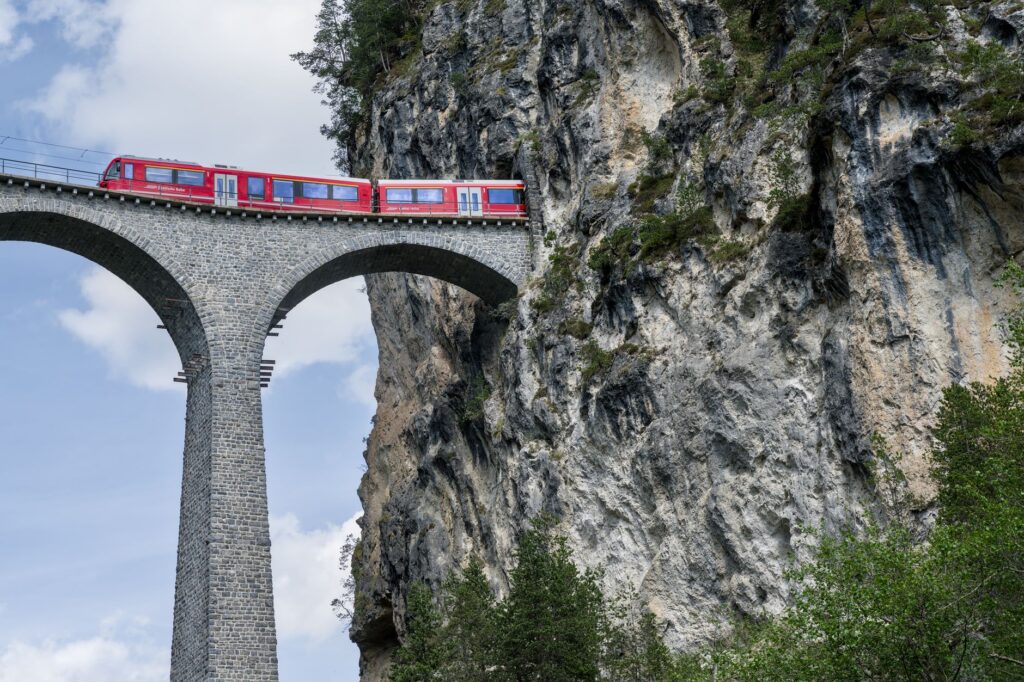
The railway alignment between the Aragón and Aspe valleys forced engineers to devise technical solutions unprecedented for the era. The rugged orography required overcoming vertiginous elevation gains within short distances, resulting in the construction of numerous metallic viaducts and helical tunnels designed to gain altitude in a controlled manner. The massive use of reinforced concrete and stone masonry under extremely adverse weather conditions posed a monumental logistical challenge for material transport in the heart of the Pyrenean winter.
One of the most complex elements throughout the route was conquering the maximum gradient ramps. To prevent locomotives from losing adhesion on the rails, millimeter-precise super-elevations and underground drainage systems were calculated to prevent ice accumulation and subsequent service interruptions. The precision with which the tunnels were excavated from both sides of the border, meeting deep inside the mountain with minimal deviation, continues to be studied in engineering schools today as a milestone of topography applied to alpine environments.
The Colossus of Canfranc: Monumental Architecture in Isolation
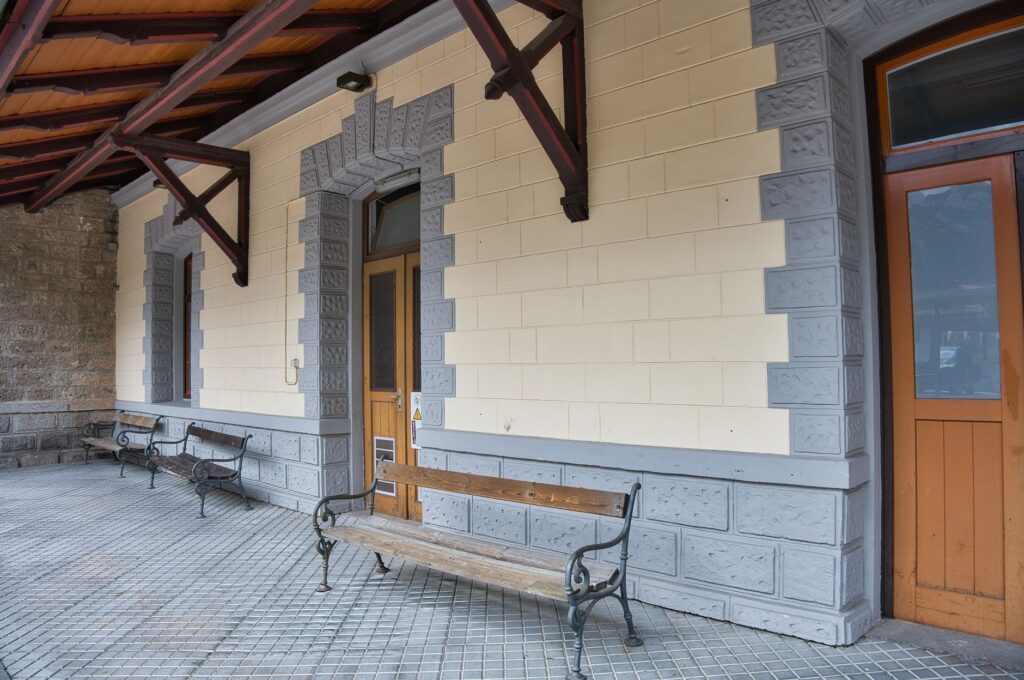
At the heart of this route stands the legendary Canfranc International Station, inaugurated in 1928 before royal and governmental authorities. Its design, inspired by nineteenth-century French grand railway palace architecture, contrasts sharply with the surrounding high-mountain natural environment. Spanning over two hundred meters in length, the façade combined concrete, glass, and slate, symbolizing the wealth and industrial might of an era that placed unwavering confidence in continental rail integration.
The interior of this complex housed not only passenger services and customs facilities but also a luxury hotel, post offices, and police quarters to manage the transfer between the Spanish and French railway networks, which were penalized by different track gauges. The station operated as an autonomous city amidst geographic isolation, a meeting point where travelers experienced the cultural and administrative transition between two worlds that had spent centuries turning their backs on one another.

The train did not merely connect valleys and nations; it rewrote the laws of gravity and distance, transforming the mountain range into a bridge of iron rather than a wall.
Geopolitics and Logistics: The Truncated Dream of the International Route
The operation of the Trans-Pyrenean line was marked from its inception by geopolitical turbulence. Although it experienced moments of notable freight and passenger activity during the 1930s, European armed conflicts and subsequent border instability drastically altered its performance. The route functioned as a delicate gear dependent on bilateral diplomatic agreements and constant investment in maintaining infrastructure exposed to harsh mountain weather.
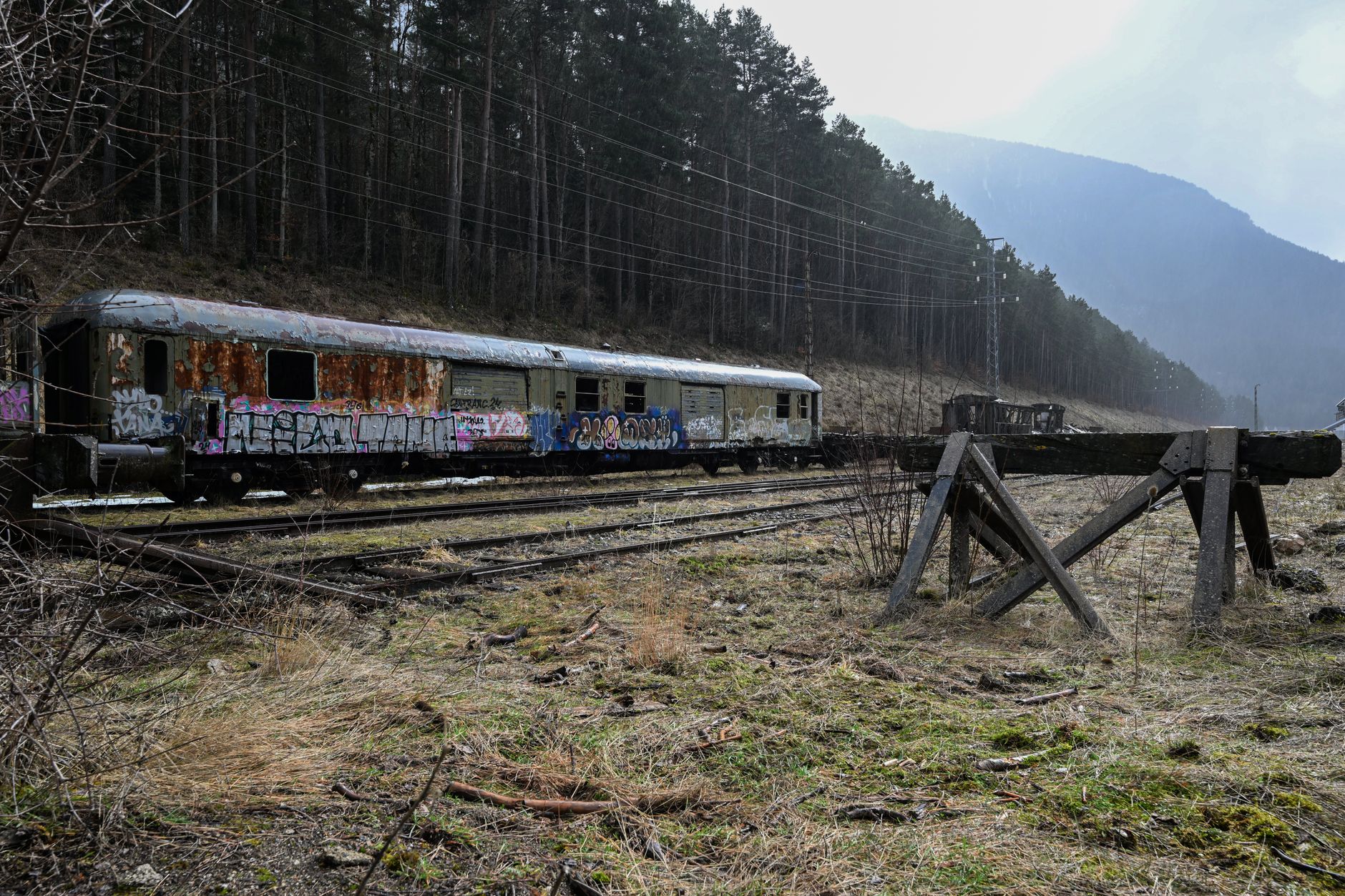
The definitive decline of the international connection arrived in the 1970s, when an accident at the L’Estanguet bridge on French territory caused the indefinite suspension of international rail traffic. From that moment on, Canfranc was reduced to a terminal station, a gigantic architectural monolith plunged into silence and oblivion, while the tracks heading north were gradually swallowed by vegetation and institutional neglect.
Subterranean Memory: The Somport Tunnel and Underground Laboratories
Beneath the rocky mass of the Somport pass, the international railway tunnel—nearly eight kilometers long—has experienced an unexpected second life. After decades of darkness, a portion of the subterranean facilities and adjacent spaces have been repurposed into the Canfranc Underground Laboratory, a world-class research center dedicated to dark matter detection and astroparticle physics.
This scientific reconversion exemplifies how past civil infrastructure can find new avenues of utility in the present. The thick layer of rock isolating the tunnel from the surface acts as a natural shield against cosmic radiation, creating the ideal environment for high-sensitivity scientific experiments. Thus, the space once conceived for speed and international commerce now serves to probe the deepest mysteries of the universe.
The Rail Renaissance: Current Challenges of Reopening
In recent decades, social, institutional, and technical pressure has driven determined projects to reopen the international line and restore rail traffic between Aragon and Aquitaine. Current European regulations on sustainable mobility and the need to decongest high-mountain roads by shifting freight transport to rail have lent renewed relevance to this historic corridor.
Nevertheless, the comprehensive rehabilitation of the alignment demands multi-million-euro investments and complex environmental mitigation measures to bring the track up to twenty-first-century standards. Debates surrounding European track gauge compatibility, historical tunnel safety, and the protection of fragile Pyrenean ecosystems dominate the technical agenda of governments on both sides of the border as they weigh the costs and benefits of restoring railway momentum to this historic pass.
Reviving the tracks of Canfranc is not an exercise in archaeological nostalgia, but an unequivocal commitment to the connected and ecological future of the European continent.
Practical guide
Planning a visit to the surroundings of the Trans-Pyrenean Railway requires an understanding of its alpine geography and current access options.
How to get there
Canfranc International Station is located at the northernmost tip of the Huesca province, accessible by road via the N-330 from Jaca. By train, Renfe’s regional line connects Zaragoza and Huesca with Canfranc following a winding and extraordinarily scenic route parallel to the Aragón River.
When to go
The summer months and early autumn offer optimal conditions for exploring the surrounding area and touring the interior of the station. Winter brings an impressive snowy landscape, though it requires road caution and limits high-mountain hiking routes.
What to see
Guided tours of the Canfranc International Station are essential to understanding its architectural history. Additionally, the surrounding area offers hiking trails following the old railway alignments, defensive bunkers from the Pyrenean Line, and approaches to the southern portal of the Somport tunnel.
Accommodation and gastronomy
The Aragón region offers everything from refurbished historic hotels to mountain refuges and rural lodgings in Canfranc Pueblo and Villanúa. Local gastronomy features roasted lamb, traditional Pyrenean stews, and artisanal cheeses from the high valleys.
The metallic echo of old trains still seems to resonate between Canfranc’s concrete walls when mist descends the valley to wrap around the imposing silhouette of its station. This frontier of stone and steel, which once dreamed of uniting continents through steam and engineering precision, stands today as a monument to human audacity. As travelers contemplate its silent platforms and the tracks fading into the mountain’s darkness, they realize that great works of modernity never truly die; they simply wait patiently for history to bring them back to life.