
Silence in the Higashiyama Hills: The Heartbeat of the Wood
In the heart of Kyoto, where the narrow alleys of Higashiyama preserve the aroma of cypress wood and rice paper, time is measured not in seconds, but in the resilience of plant fiber. While major metropolises accelerate their production processes toward digital immediacy, a small group of master carvers, printers, and papermakers keeps alive one of humanity’s most sophisticated artistic traditions: traditional Japanese woodblock printing, historically known as the art of floating world prints. This is not a mere exercise in tourist nostalgia, but an act of cultural and technical resistance that demands decades of silent apprenticeship in workshops where natural light filters every imperfection of wild cherry wood.
The survival of these workshops relies on an artisanal value chain nearly extinct in the rest of the industrialized world. From selecting mountain cherry logs—which must season for years to prevent millimeter-level warping when exposed to water-based inks—to the handmade production of kozo fiber washi paper, every stage of the process demands absolute physical precision. There are no technological shortcuts or screens to correct the stroke of a gouge; a half-millimeter error in the key block means discarding weeks of continuous work. It is this unwavering rigor that attracts a new generation of international creators and discerning collectors today.

The Alchemy of the Workshop: Tools That Defy Time
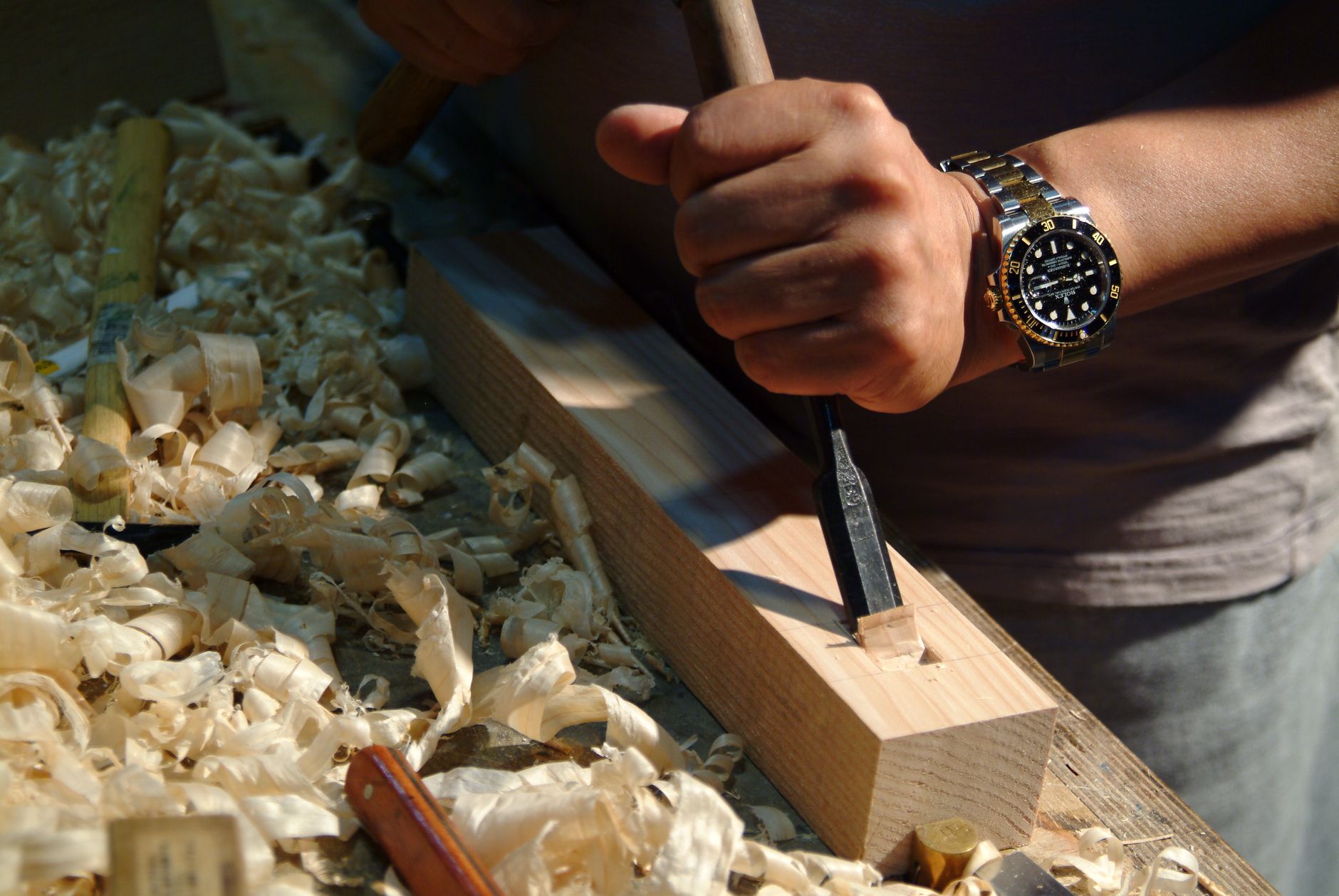
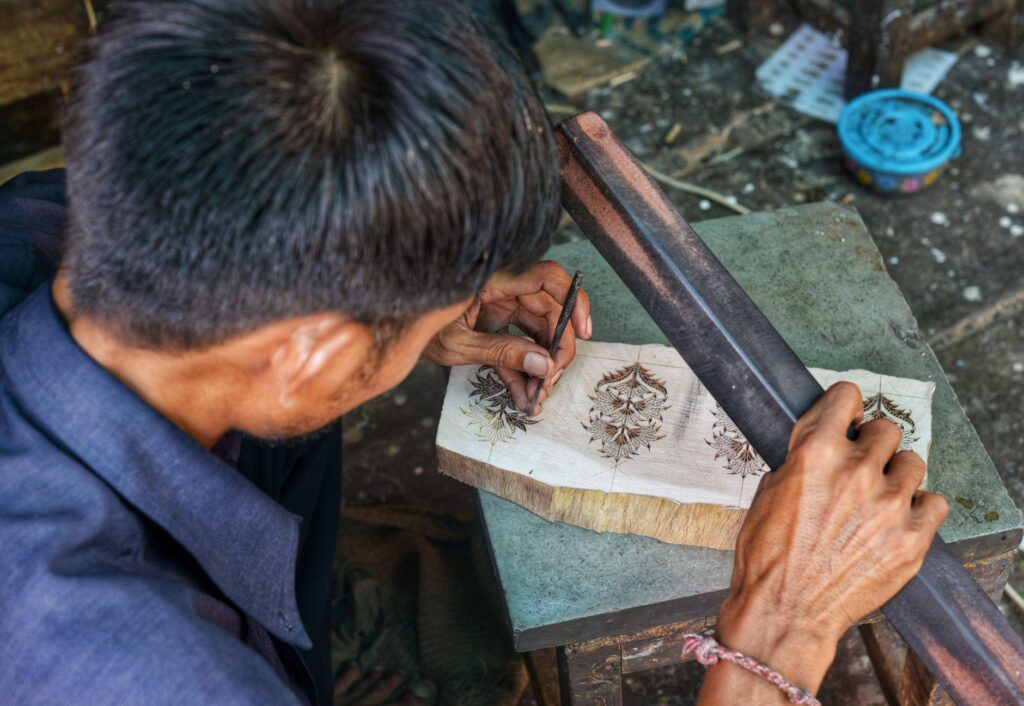
Crossing the threshold of a traditional workshop in the Nakagyo district, the dense air smells of mineral pigments and rice starch glue. Here, cutting tools are not mere utensils, but extensions of the artisan’s body. The gouges, forged by third-generation blacksmiths using water-quenched high-grade steel, are sharpened multiple times a day on waterstones sourced from local quarries. The master carver holds the wooden block with one hand while gliding the blade at a millimeter angle, peeling away shavings so fine they resemble silk threads. Each cut aims to release the pure line originally designed on thin paper, respecting the direction of the grain so the relief can withstand the subsequent pressure of manual printing.
A few meters from the cutting tables, the color-mixing area operates under chemical principles as ancient as they are precise. Unlike synthetic oil-based inks, those used in Kyoto’s woodblock printing are composed of natural pigments extracted from minerals, crushed shells, and plants, dissolved in water and bound with a starch paste called nori. This combination allows color to penetrate the fibers of damp paper rather than forming a glossy surface layer. Mastering tonal gradation, known as baren-sabaki, requires a steady pulse and extreme sensitivity to calculate the exact amount of moisture the paper must retain before receiving the friction of the traditional bamboo disc.
The Paper of Time: Kozo Fiber and the Perfect Support
No high-quality print can be conceived without the proper support. In the foothills of Kyoto Prefecture, small family workshops continue to produce washi paper using the traditional nago-nagashi method. Kozo shrub branches are harvested during winter when sap concentrates in the roots, and boiled in iron cauldrons with wood ash to soften the bark. The resulting fibers are washed in crystal-clear mountain spring water and beaten by hand on wooden boards before being dispersed in a vat with plant mucilage. This viscous liquid, obtained from the root of the tororo-aoi shrub, ensures fibers interlock in all possible directions, granting the paper exceptional mechanical strength and flexibility.

The drying process is equally rigorous. Damp sheets are carefully adhered to large cedar wood boards exposed to the sun and the valley’s warm breeze, or pressed using traditional methods that avoid industrial rigidity. This paper not only withstands multiple passes of damp blocks without tearing, but ages with an aesthetic dignity unattainable for commercial cellulosic supports. Collectors value this temporal patina as an indivisible part of the work of art, a physical testimony of the natural elements that converged in its creation.
Generational Transition: Veteran Masters and New Apprentices
The greatest challenge facing these centuries-old workshops is not a lack of international demand, but a critical shortage of generational renewal. Learning traditional Japanese woodblock printing requires a commitment of exclusive dedication that can span a decade before an apprentice is permitted to sign their own work. During the initial years, tasks are limited to sweeping the floor, sharpening the masters’ tools, and preparing starch paste. However, recent years have witnessed a hopeful phenomenon: young artists from Europe, North America, and other Asian regions arrive in Kyoto willing to submit to this monastic discipline to apply ancestral techniques to contemporary visual languages.
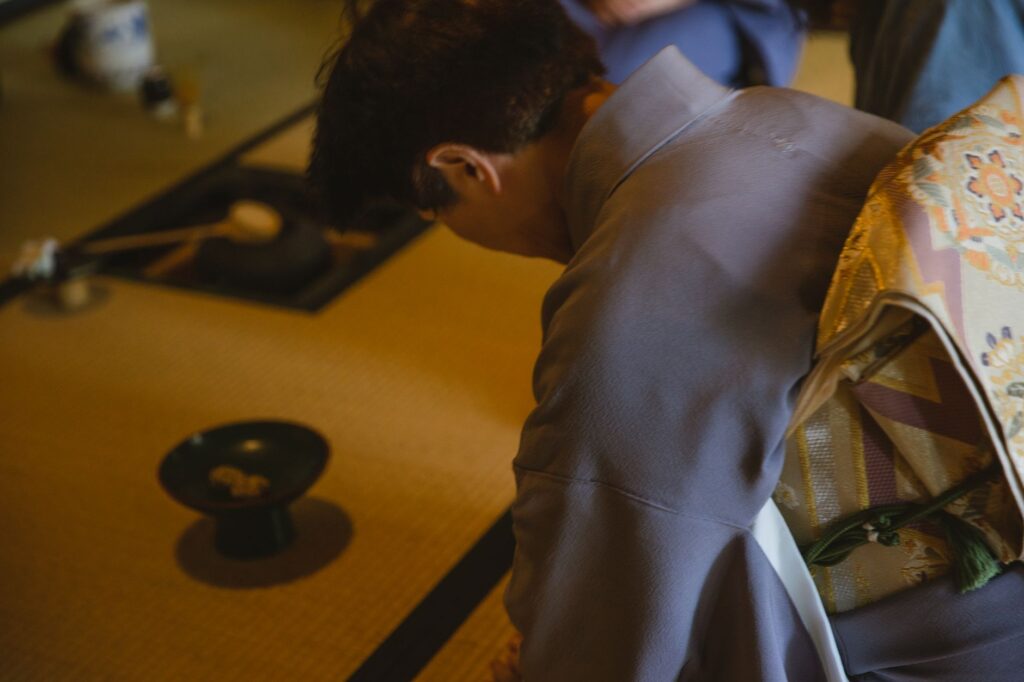
This cultural hybridization is revitalizing the sector without compromising its technical integrity. While local masters guarantee the purity of classical procedures in reproducing historical works, new residents introduce abstract themes, modern graphic narratives, and experimental formats that challenge the limits of the two-dimensional plane. This synergy demonstrates that the craft is not a mummified museum piece, but a living language capable of engaging with 21st-century aesthetic concerns without losing an ounce of its foundational rigor.
Wood does not lie; every knot, every grain, and every fiber responds with relentless honesty to the carver’s pulse, turning human error into an indisputable part of the print’s final beauty.
Geography of the Craft: An Itinerary Through Active Workshops
Visiting Kyoto’s graphic workshops requires patience, respect for working hours, and, in most cases, proper introduction through local cultural institutions. The route begins in the historic Gion district, where small studios operate, specializing in editing prints for private collectors and Asian art museums. Here, visitors can closely observe the nearly choreographic coordination between the carver reviewing hair details on a cherry block and the printer adjusting registration marks with a paper square.
Further north, near the Kamogawa River, workshops dedicated to bookbinding and the production of woodblock-illustrated books are concentrated. These spaces often function as research centers where ancient manuals are restored and experiments are conducted to reconstruct historical inks lost during 20th-century bombings and socioeconomic shifts. Touring these workshops reveals the community dimension of the art: every printer depends absolutely on the carver, and both trust blindly in the papermaker’s prior work.
Economy and Collecting: The True Value of Artisan Prints
In a global market flooded with cheap digital reproductions, acquiring a traditional Japanese woodblock print has become a highly prized niche investment. Prices vary drastically depending on design complexity, the number of wood blocks used—which can exceed twenty for a single polychrome image—and the reputation of the master printer. An authentic print run is not measured by thousands of identical copies, but by limited editions where final copies show subtle variations from the initial ones due to natural wood relief wear.
Experts advise collectors to always verify the provenance of the washi paper and the signature or seal of the issuing workshop, elements ensuring authenticity against industrial counterfeits from photomechanical processes. Buying a print in Kyoto is not an act of passive consumption, but a form of direct patronage sustaining the high maintenance costs of cherry forests and the livelihoods of entire families dedicated to crafts that hurried modernity nearly erased from the map.
Practical guide
Planning a trip focused on traditional Japanese woodblock printing in Kyoto requires rigorous logistical preparation, as many workshops operate by appointment and lack visible commercial signage.
- Best time to visit: Late spring and autumn offer optimal weather conditions to observe washi paper work without the extreme humidity of summer or the dry cold of winter.
- Getting there: Access to Kyoto is efficiently managed via the Shinkansen rail network from Tokyo or Osaka. Once in the city, municipal bus and subway networks cover most artisan districts.
- Reservations and access: Specialized workshops rarely accept spontaneous visits. Securing access requests through authorized cultural intermediaries or artistic exchange centers in Kyoto is essential.
- Workshop etiquette: Touching wood blocks without authorization is strictly prohibited, as the natural oils from human skin damage the fiber and alter subsequent water-based ink absorption.
- Secure acquisitions: Acquire graphic work exclusively in accredited galleries in the Gion district or directly at studios issuing certificates of authenticity detailing materials and names of carvers and printers.
Preserving traditional woodblock printing does not mean freezing the past in a display case, but providing present hands with the tools necessary to sculpt the future with patience and respect.
At dusk, when golden light recedes from grey tile roofs and the murmur of traffic yields to the song of swifts, Kyoto’s workshops turn off their working lights. Resting on oak tables are clean gouges, cherry blocks aligned with millimeter precision, and washi sheets drying under the gentle weight of cedar boards. In this laborious silence lies the true victory of artisanal time: the certainty that, as long as there are hands willing to listen to the grain’s murmur, the memory of art will continue to be printed upon the earth with the unalterable force of true beauty.