
The railway connecting the capital of Serbia with the Montenegrin port of Bar is far more than a mere communication route; it stands as a monumental milestone of twentieth-century European civil engineering. Spanning over 475 kilometers, the Belgrade-Bar line defies one of the most rugged geographies on the continent, traversing deep river canyons, karstic plateaus, and mountain ranges where limestone imposes its stony rule. Initially conceived during the interwar period and finally materialized in 1976 after decades of complex public works, this infrastructure represents technical audacity pushed to its absolute limits in a region historically marked by logistical hardships.
Throughout its route, the train pierces 254 tunnels—totalling nearly 114 kilometers of galleries excavated in living rock—and crosses 435 bridges and viaducts, most notably the imposing Mala Rijeka viaduct, long considered the highest railway bridge in the world on concrete pillars. This journey not only links the Balkan interior with the Adriatic Sea but encapsulates the complex geopolitical history of the Balkans, where every kilometer of track required titanic solutions to bridge abrupt elevation changes and connect communities traditionally isolated by topography.
The Genesis of an Impossible Journey
The idea of uniting the Danube with the Adriatic via a rail line arose from the economic and strategic necessity of granting Serbia an independent maritime outlet. Initial topographical surveys began in the late nineteenth century, but regional political instability, world wars, and successive economic crises systematically delayed the start of construction. It was not until the second half of the twentieth century that the project gained definitive momentum, driven by a vision of territorial integration that prioritized industrial development and the cohesion of southern territories.
The engineers tasked with the design faced unprecedented challenges. The route had to conquer the Drina River canyon, bypass the Pešter plateau, and descend precipitously toward the Montenegrin coast through steep gradients that demanded spiral alignments and helical tunnels. The lack of modern machinery in the early phases forced the execution of major sections through titanic human effort, where thousands of laborers worked under extreme conditions of isolation and harsh weather, excavating rock with explosives and building provisional supports over dizzying abysses.
The Architecture of Concrete and Steel
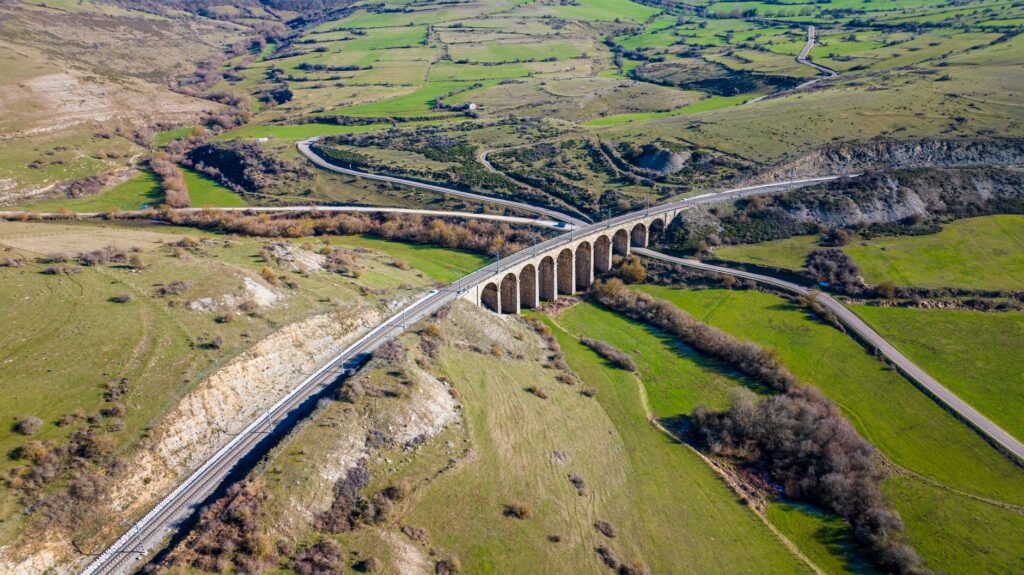
The structural system of the Belgrade-Bar line is a showcase of civil engineering from the socialist era in Eastern Europe. To overcome colossal elevation drops, engineers opted for a combination of metal lattice viaducts and massive reinforced concrete structures. The Mala Rijeka viaduct, situated some 20 kilometers north of Podgorica, is the ultimate exponent of this construction philosophy. Its main pillars rise nearly 200 meters above the valley floor, supporting a metal deck upon which convoys roll with millimetric precision.

Beyond the grand viaducts, the journey is distinguished by the dense network of tunnels piercing the Zlatibor and Zlatar mountains. The Sozina tunnel, over six kilometers long, and the Trebjesa tunnel exemplify how underground engineering had to cope with massive water infiltration, gas pockets, and unstable karstic formations that threatened to collapse excavations. Every kilometer of track posed a structural calculation challenge to guarantee stability against the frequent seismic movements of the Balkan region.
Logistics of Single-Track Operation and Alpine Maintenance
Operating a railway line of this nature in the twenty-first century entails monumental logistical challenges. Although a large portion of the route is electrified, the infrastructure operates predominantly on a single track, demanding millimetric coordination for convoy crossings at intermediate stations wedged into narrow gorges. Signaling systems, partially modernized in recent decades, coexist with traditional mechanical elements requiring constant supervision by specialized technical teams.
The infrastructure’s greatest enemy is extreme weather. During Balkan winters, heavy snowfall and blizzards in the high altitudes of Serbia and Montenegro routinely trigger snow avalanches and rockfalls that block the tracks. Special snowplow trains and emergency teams remain on permanent alert at strategic stations such as Užice or Kolašin to ensure the corridor is not severed for weeks, keeping this vital artery alive for trade and passenger transport.
The Economic Pulse Between Serbia and Montenegro
Historically, the Belgrade-Bar railway has functioned as the economic umbilical cord between Serbia and the port of Bar. During decades of industrial splendor, millions of tons of freight—ranging from steel products to agricultural raw materials—transited this route to connect Central European markets with Mediterranean maritime shipping lanes. Following the dissolution of Yugoslavia and subsequent political turbulence, cargo volumes sharply declined, forcing a rethinking of the corridor’s logistical role.

Today, investments focus on modernizing the most degraded sections to regain competitiveness against road transport. Governments and international organizations have allocated funds for the renewal of tracks, catenaries, and telecommunication systems, aiming to reduce travel times that, due to speed restrictions caused by infrastructure wear, have increased significantly compared to the historical records of the 1980s.
The Traveler’s Experience: Slowness, Awe, and Isolation
For the contemporary traveler, embarking on the Belgrade-Bar train is an experience that defies twenty-first-century haste. The full journey, which under optimal conditions should take around ten hours, frequently extends considerably due to maintenance work and speed limits in high-mountain stretches. Yet this apparent disadvantage becomes its greatest allure: the unhurried pace allows one to contemplate in detail a landscape transition unique in Europe.
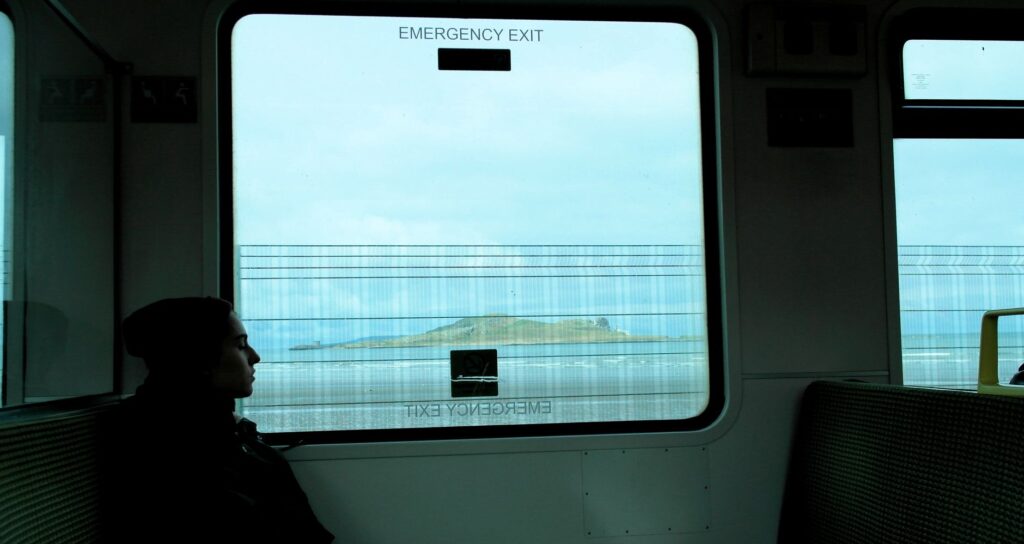
From the agricultural fields of the Pannonian plain in the north, the convoy ascends progressively toward the forested hills of Šumadija, enters the limestone moors of Zlatibor, crosses Bosnian territory for a brief stretch, and finally descends through the dizzying gorges of Montenegro until brushing against the intense blue of the Adriatic Sea. Each carriage window transforms into a cinema screen projecting impossible river gorges, villages clinging to steep slopes, and ghost stations that have stood silent for decades.

The Belgrade-Bar train is not a rapid mode of transport; it is a rolling archive of Balkan geography and history that compels the traveler to reconcile with slowness and the monumental scale of the landscape.
Practical guide
Planning a journey aboard the Belgrade-Bar railway requires patience, flexibility, and precise knowledge of the current operational conditions of the Balkan rail network.
- Route and main stations: The official journey starts at Belgrade Centar (Prokop) station and terminates at the maritime station of Bar, passing through key towns such as Užice, Bijelo Polje, Mojkovac, Kolašin, and Podgorica.
- Frequencies and schedules: Daytime and overnight trains typically operate. Night services generally include sleeper cars and couchettes, though availability may vary depending on the tourist season and track maintenance work.
- Tickets and reservations: Acquiring tickets online via centralized international platforms is not always possible. It is recommended to purchase tickets directly at station ticket counters in Belgrade or Bar several days in advance, especially during the summer months.
- Onboard logistics: Trains feature basic amenities, but boarding with sufficient food and water provisions is advisable, as dining cars are not always operational on every convoy.
- Connections and alternatives: If line disruptions occur due to rockfalls or major construction, state railway companies typically deploy alternative bus services to cover affected sections.
Emotional Epilogue in the Port of Bar
When the heavy railway convoy finally serpents through the final tunnels of the Montenegrin coast and leaves the shadows of the karstic gorges behind, the atmosphere changes radically. The dry mountain air immediately yields to the salty breeze of the Adriatic, and the gray limestone slopes merge with the deep blue of the sea. At that precise moment, the traveler comprehends the sheer magnitude of the human effort that made it possible to trace a line of steel across a labyrinth of unfathomable abysses. At the terminal station of Bar, beneath the metallic echo of wheels halting their motion after hours of mechanical tension, the landscape opens like a silent reward, reminding us that the most memorable journeys are not measured by the speed of the destination, but by the depth of the scar the road leaves upon the memory.