The Liquid Architecture of the Balkan Karst
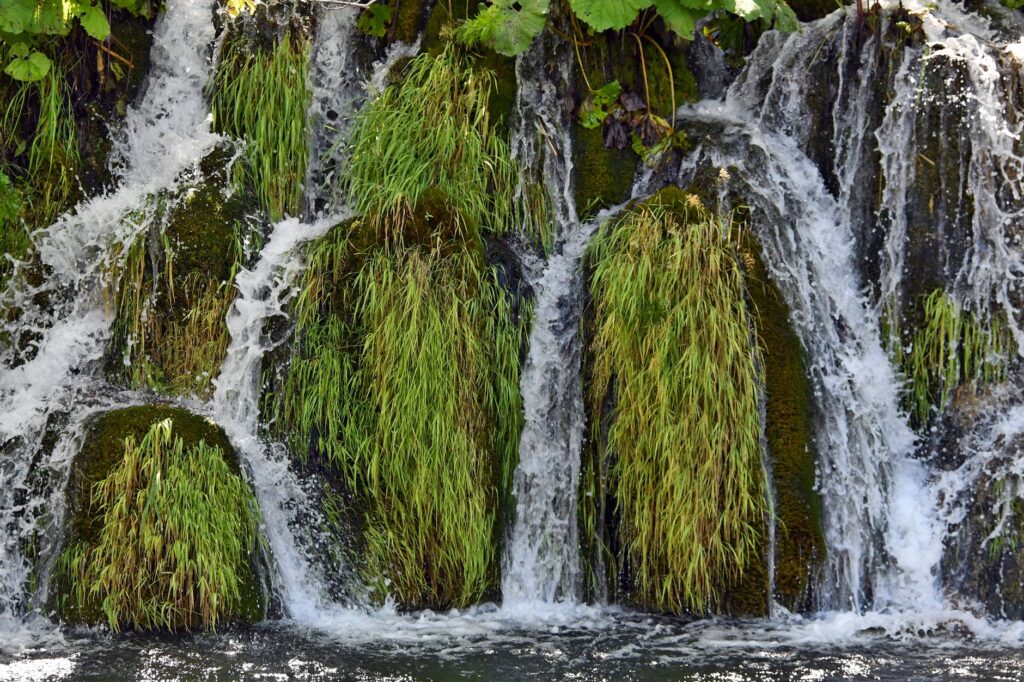
The territory of the Plitvice Lakes, inscribed as a UNESCO World Heritage Site in 1979, rises in the mountainous heart of Croatia as one of Europe’s most complex and fascinating hydrological systems. Far from constituting a mere geographical accident, this collection of sixteen terraced lakes interconnected by waterfalls and cascades is the result of an ancient biogeochemical process in constant transformation. Water rich in dissolved calcium carbonate interacts with mosses, algae, and aquatic bacteria to precipitate travertine, a porous sedimentary rock that forms the natural barriers retaining and structuring each lacustre basin.
Analyzing the Plitvice basin implies understanding that its morphology is not static. Travertine formations grow at an estimated rate of up to one centimeter per year, subtly yet incessantly modifying the park’s cartography. This dynamism demands rigorous scientific surveillance and an extremely respectful approach to human infrastructure design. Over decades, the management of the space has evolved from the unregulated access of the socialist era to the strict carrying capacity models applied today, where hydrological science and tourism planning work hand in hand to protect the fragile equilibrium of the beech and fir forests hugging the shores.
The Invisible Pulse of the Korana and Bijela Rijeka Rivers
The water cycle feeding Plitvice begins in the karst springs of the Bijela Rijeka (White River) and Crna Rijeka (Black River), whose subterranean waters emerge in a dense forest environment where sunlight barely penetrates the arboreal canopy. These streams converge to form Lake Prošćane, the highest in the upper system. From this point, the water begins a meandering descent along a drop exceeding one hundred and thirty meters, dividing the park into two distinct geological and landscape sectors.
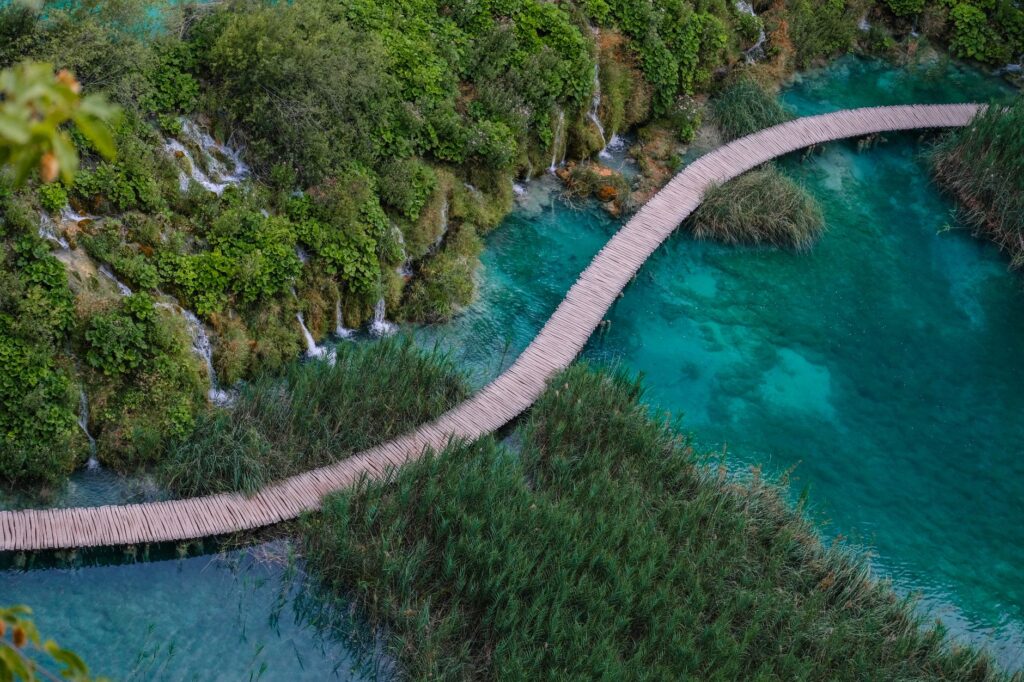
The upper lakes—Prošćane, Ciginovac, Okrugljak, Batinovac, Veliko Jezero, Malo Jezero, Vir, Galovac, Milin Jezero, Gradinski Jezero, and Burges—are characterized by their wide surfaces and gently sloping valleys excavated over beds of impermeable dolomite. In contrast, the lower lakes—Kaluđerovac, Gavanovac, Milanovac, and Novakovića Brod—run enclosed within a narrow limestone canyon of vertical walls, sculpted by millennia of erosion before the waters converge at the source of the Korana River. This geomorphological duality determines not only flow velocity but also the chromatic palette of the water, oscillating between deep emerald green and luminous turquoise depending on mineral concentration and solar incidence.
Timber Engineering and Vertical Respect
The experience of exploring Plitvice on foot is intrinsically linked to its network of floating boardwalks and suspended trails over the water. Originally constructed at the beginning of the twentieth century using locally sourced logs debarked by hand, these hardwood structures allow visitors to step into the heart of the lakes without disturbing the delicate travertine substrate. Today, the park’s carpentry teams maintain this artisanal tradition, periodically replacing oak and chestnut planks subjected to constant humidity and pedestrian traffic.
The conception of these elevated paths responds to a principle of minimal intervention. The boardwalks literally float on the lacustre surface through support systems that avoid deep anchoring into fragile living stone barriers. Walking upon them requires adopting a slow, almost reverential pace, where the crunch of wood beneath boots merges with the constant roar of falling water. This ephemeral architecture demonstrates that massive tourist accessibility can indeed be reconciled with the ecological integrity of a highly vulnerable natural environment.
The conservation of a karst landscape does not depend on prohibiting access, but on shaping the traveler’s gaze so they walk in silence, understanding that every wooden boardwalk is a fragile pact between man and water.
Hidden Biodiversity Beneath the Forest Canopy
Beyond its aquatic appeal, the nineteen thousand hectares comprising the Plitvice Lakes National Park harbor one of Central Europe’s best-preserved forest ecosystems. The woodland masses are dominated by European beech (*Fagus sylvatica*), silver fir (*Abies alba*), and Scots pine, forming in many areas authentic old-growth or mature forests where dead wood integrates into the soil’s life cycle, sheltering hundreds of species of fungi, saproxylic insects, and atmospheric purity-indicating lichens.

This dense and secluded habitat provides refuge to large ecological fauna, including stable populations of Eurasian brown bear (*Ursus arctos*), gray wolf (*Canis lupus*), and Eurasian lynx (*Lynx lynx*). Although spotting these large mammals during a daytime visit is exceptional due to their elusive and nocturnal habits, their invisible presence conditions territory management. Likewise, Plitvice’s skies are crossed by raptors like the golden eagle (*Aquila chrysaetos*) and Eurasian eagle-owl (*Bubo bubo*), while lake shores act as hunting grounds and nesting sites for the white-throated dipper and various endemic amphibian species.
Seasonal Impact and Landscape Metamorphosis
Understanding Plitvice requires acknowledging that there is no single landscape, but four completely distinct scenarios conditioned by the rigor of Balkan seasons. During spring, snowmelt originating from the Mala Kapela and Lička Plješivica mountains floods the channels with tumultuous volume. In this period, secondary waterfalls burst through thickets and water color acquires milky tones due to suspended mineral sediment, offering a spectacle of overflowing energy.
Summer brings the chromatic splendor of dense foliage and peak visitor influx, demanding meticulous management of tourist flows through entry quotas and signposted unidirectional circuits. With the arrival of autumn, beech forests undergo an explosion of ochres, reds, and yellows reflected on the crystalline lake surfaces like an impressionistic canvas. Finally, winter transforms the park into a territory of absolute silence where waterfalls frozen into icicle curtains form ephemeral glass cathedrals, accessible only to travelers willing to brave sub-zero temperatures.
Sustainability and the Challenge of Mass Tourism
The global success of the Plitvice Lakes has become its greatest structural threat. With the massive arrival of tour buses from the Dalmatian coast and Zagreb, the park has had to implement strict capacity control policies to prevent trail degradation and water pollution. From limiting daily visitors to relocating main parking lots outside the immediate perimeter of the lakes, administration seeks to discourage express tourism in favor of longer, more conscious stays.
This sustainable management model relies on fleets of electric traction buses and solar boats crossing Lake Kozjak without emitting noise or hydrocarbons. The scientific goal is to maintain water quality intact, historically cataloged as Class I, ensuring anthropogenic impact remains imperceptible in periodic chemical analyses. For contemporary travelers, accepting these restrictions is not an inconvenience, but the essential condition for enjoying an environment that refuses to turn into a natural theme park.
Practical guide
When to go: The months of May, June, September, and October offer the best balance between moderate temperatures, optimal water volume, and fewer crowds on the main boardwalks.

How to get there: Zagreb Airport lies about 140 kilometers to the north, while Zadar is 130 kilometers to the southwest. Renting a vehicle to travel along the D1 state highway crossing the park is highly recommended.
Tickets and reservations: Purchasing tickets in advance through the national park’s official web portal is mandatory. Daily quotas are limited to protect the ecosystem.
Recommended circuits: Several letter-designated visitation programs exist (from A to K). Circuits H and K are the most comprehensive, combining walking routes of 4 to 6 hours with electric boat rides and panoramic train tours.
Accommodation: The park features three historic hotels managed directly by the administration (Jezero, Plitvice, and Bellevue). For a more local experience, neighboring villages like Mukinje or Rastovača offer private rural rooms (*Sobe*).
Park regulations: Swimming in the lakes, straying from marked trails, camping, making fires, littering of any kind, or feeding wildlife is strictly prohibited.
Local gastronomy: In local restaurants, tasting Lika cheese (*Lički škripavac*), spit-roasted lamb (*janjetina*), and homemade plum brandy (*rakija*) is well worthwhile.
The Echo of Water in the Traveler’s Memory
Walking along the final stretch of the trail, as evening light begins to filter through centuries-old fir canopies, leaves a mark on the spirit that is difficult to fade. Plitvice is not a destination consumed with the urgency of a photographic postcard; it demands the intimate disposition of pausing before the relentless flow of stone and water, understanding that our presence in these landscapes is merely that of a temporary witness. Upon leaving the park, the distant murmur of the great waterfall (*Veliki Slap*) continues to resonate in thought, reminding us that Earth’s great natural sanctuaries still preserve a language of their own, an ancient heartbeat audible only to those willing to walk in silence.