
The Rhine is not merely a river; it is Europe’s circulatory system. From the peaks of the Swiss Alps to the North Sea delta in the Netherlands, this waterway has dictated the rhythm of trade, conflict, and culture at the heart of the continent for centuries. However, today the Rhine is facing its most ambitious transformation since the Industrial Revolution. The urgent need to decarbonize transport is turning its waters into a laboratory for hydrogen propulsion and its banks into the epicenter of a rail renaissance that seeks to replace short-haul flights with sleeper trains on long-distance routes.
This metamorphosis is not only technical but profoundly cultural. The contemporary traveler no longer seeks the frenetic pace of peripheral airports but an emotional connection with the landscape. Observing the slow passage of electric barges and the silent glide of new rail convoys under the moonlight reveals a new philosophy of mobility. It is a return to a human scale, where the journey is as valuable as the destination, and where sustainability is intertwined with the luxury of stillness and respect for the fluvial ecosystem that sustains millions of people.
Europe’s Backbone Turns Green
For decades, the Rhine was synonymous with heavy industry and carbon emissions. As the world’s busiest inland waterway, the environmental impact of thousands of cargo vessels and river cruises was a growing concern for the Central Commission for the Navigation of the Rhine (CCNR). The response has been a radical energy transition strategy aiming for zero-emission navigation by 2050. The first milestone in this race has been the launch of vessels powered by hydrogen fuel cells, a technology that allows for hundreds of kilometers of travel while emitting only water vapor.

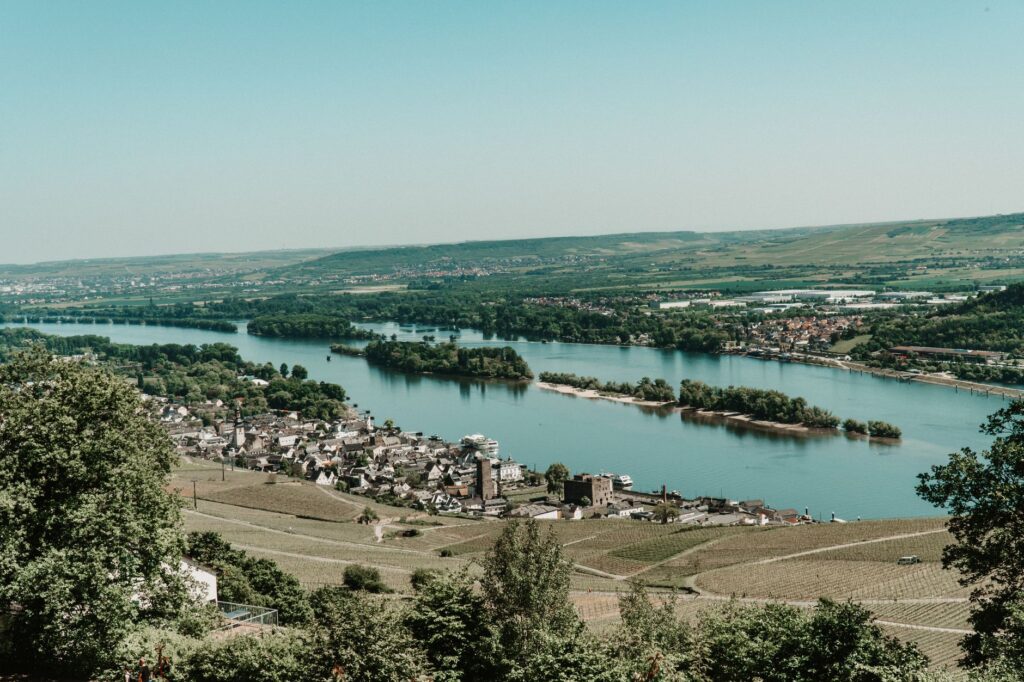
The H2 Barge project, already operating on the stretch between Rotterdam and Duisburg, is the most tangible example of this shift. These vessels not only reduce the carbon footprint but also eliminate the noise pollution that affects fish fauna and riverside populations. When sailing through the Middle Rhine Valley, a UNESCO World Heritage site, the absence of diesel engine noise allows the murmur of the water and the birdsong to reclaim center stage, transforming the river cruise experience into an exercise in absolute sensory immersion.
The Rhine is ceasing to be a fossil fuel highway to become an ecological corridor where advanced technology is put at the service of preserving the historic landscape.
This transition requires complex infrastructure. In ports like Cologne and Strasbourg, green hydrogen refueling stations—produced via wind and solar energy—are being installed. The logistics of this fuel present an engineering challenge, but its success ensures that European trade can continue to flow without compromising the climate goals of the Paris Agreement. For the tourist, this means that river cruises in the near future will be completely silent floating hotels, capable of docking in the heart of cities without disturbing the rest of their inhabitants.
The Triumphant Return of Berths: The Rhine Corridor Under the Stars
While the river cleans up its act, the tracks flanking it are undergoing their own revolution. The Nightjet phenomenon, driven by Austrian Railways (ÖBB) in collaboration with German and Swiss operators, has brought glamour and efficiency back to overnight travel. The route connecting Amsterdam to Zurich, following the course of the Rhine, has become one of the most in-demand in Europe. Traveling while you sleep is not just a time-saving measure; it is a statement of principles against the culture of low-cost air travel and its environmental externalities.
The new sleeper trains traveling the Rhine Valley have been redesigned for the 21st century. No longer a matter of cramped compartments, they feature ergonomically designed privacy capsules, private showers, and an attention to detail reminiscent of the golden age of rail. Waking up near Basel, after crossing the Black Forest and the Rhineland vineyards overnight, the traveler experiences a gentle geographical transition that a plane simply cannot offer. The carbon footprint of this journey is up to ten times lower than an equivalent flight, consolidating the train as the pillar of conscious mobility.
The success of these routes has prompted the reopening of historic stations and the improvement of regional connections. The night train acts as a catalyst for tourism in secondary cities that were previously ignored by major air routes. Now, destinations like Mainz or Koblenz become accessible to international travelers seeking authenticity and fewer crowds, integrating long-distance transport with soft mobility networks, such as cycle touring, which is highly popular on the routes following the riverbank.

Multimodality: From the Ship’s Deck to the Train Platform
The true magic of the new mobility on the Rhine lies in interconnectivity. Cities along the river have understood that the future does not belong to a single mode of transport but to the smart combination of all of them. In Basel, the river port connects directly with the electric tram network and the high-speed rail station. A traveler can disembark from a solar ferry and, in less than fifteen minutes, be seated on a train bound for the Alps or the Alsatian plain.
This multimodality is supported by digital platforms that unify ticketing for boats, trains, and bike-sharing systems. The goal is to eliminate the frictions of sustainable travel. In cities like Düsseldorf, urban design has prioritized riverfront promenades, removing car lanes and replacing them with infrastructure for pedestrians and personal mobility vehicles. The result is a city that breathes, where the river is once again the center of social life rather than an impassable industrial barrier.

Integration of systems is the key: it is not enough to have clean trains if accessing them is complex; the Rhine teaches us that water and steel can dance to the same rhythm.
The impact on urban architecture is notable. Former port warehouses are being transformed into cultural centers and designer hotels that respect industrial heritage while embracing energy efficiency. These spaces serve as meeting points where residents and travelers share a common vision of the city. Architecture no longer seeks to isolate itself from the river but to open up to it through glass facades and terraces that celebrate the recovery of water and air quality.
Regenerative Tourism: Beyond Sustainability
The concept of sustainability is giving way to regeneration. In the Rhine Valley, this translates into initiatives that seek not just to do no harm, but to improve the environment. Transport operators are funding wetland restoration projects in floodplain areas to offset remaining minimal emissions and increase biodiversity. The traveler who chooses these transport methods contributes directly to the health of the ecosystem they are visiting.
Tourist experiences are also changing. Wine tasting tours in the Rheingau region now include visits to vineyards practicing biodynamic agriculture, using animal traction or electric robots to avoid soil compaction. Gastronomy aboard hydrogen ships is based on zero-kilometer products, supplied by local farms that use the river itself as a low-emission distribution route. It is a virtuous circle where mobility is the engine of a more resilient and ethical local economy.

This approach attracts a younger, more conscious visitor profile, but also veteran travelers rediscovering Europe with fresh eyes. The narrative of the Rhine is no longer one of borders, but of union. The river that once divided nations now unites them through a shared power grid and a common vision of a continent that moves without leaving a trace, protecting its legacy for generations yet to be born.
Practical guide
- Rail transport: For night trains, it is recommended to book at least three months in advance via the official ÖBB Nightjet website or national apps (DB in Germany, SBB in Switzerland). Spaces in Single and Double compartments with showers are the first to sell out.
- River navigation: For the hydrogen experience, check the itineraries of pioneering companies like Future Proof Shipping. For passenger cruises, brands like Viking and AmaWaterways are incorporating shore power systems to eliminate emissions while docked.
- Best time to visit: Spring (May-June) and Autumn (September-October) offer the best balance between mild weather and spectacular landscapes, especially during the harvest in the Rhine hillsides.
- Connectivity: Use a Eurail or Interrail pass if you plan to combine multiple rail journeys. Many of these passes include discounts on selected river ferries in Germany and Switzerland.
- Luggage: Opt for sturdy wheeled suitcases or hiking backpacks, as historic Rhine stations often have cobblestone pavements in their vicinity.
- Documentation: Although the Schengen Area allows free movement, always carry your passport or ID, as random checks can occur on cross-border trains.
At the end of the day, when the sun sets behind the ruins of Rheinfels Castle and the first night train switches on its courtesy lights, a sense of profound peace remains. The Rhine teaches us that progress does not always mean going faster, but going better. In the reflection of its clean waters, we see the future of a Europe that has decided to heal its arteries to keep beating strongly. It is a journey that begins with a train ticket or a boat passage but ends with a renewed understanding of our responsibility toward the land we tread and the water that gives us life.