
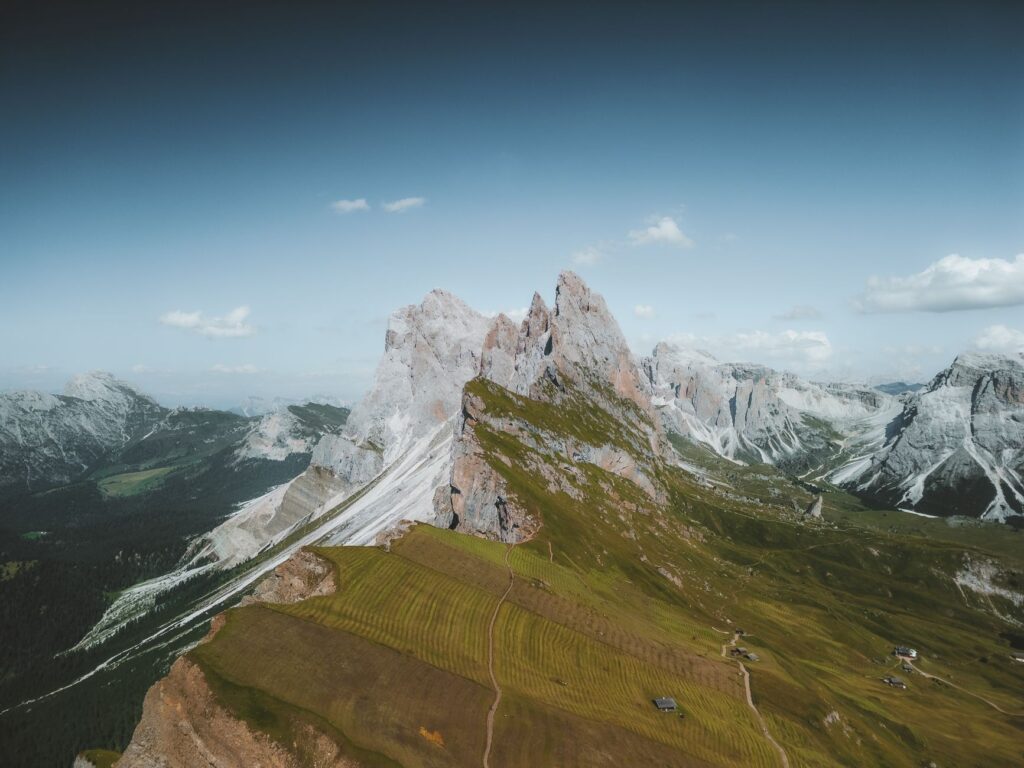
In northeastern Italy, where the Po Plain surrenders to the sheer verticality of the Alps, a geological phenomenon emerges that defies the conventional mountain color palette. The Dolomites are not merely a mountain range; they are the remains of an ancient tropical ocean that, through tectonic processes of incalculable violence, was thrust three thousand meters above sea level. This architecture of calcium carbonate and magnesium, which architect Le Corbusier famously called the most beautiful construction in the world, offers a narrative where stone is not an inert object but a historical record of floods, extinctions, and human endurance.
To walk today along the paths connecting the Val di Funes with the peaks of the Tre Cime di Lavaredo is to traverse a petrified seabed. Light behaves differently here. At sunset, the pale rock walls absorb solar rays only to release them in an explosion of orange and violet hues—a phenomenon known as enrosadira. This report breaks down the complexity of a territory that has successfully balanced its ecosystemic fragility with a high-mountain infrastructure that serves as a global benchmark for sustainability and cultural management.
Triassic Genesis: Atolls in the Sky
To understand the physiognomy of the Dolomites, one must travel back 250 million years. During that period, what is now South Tyrol and Veneto was a warm, shallow sea, similar to today’s Caribbean or Maldivian archipelagos. For millions of years, marine organisms, corals, and calcareous algae accumulated their skeletons on the seabed, creating immense reef structures. The accumulation of sediment and pressure transformed these deposits into limestone, but with a fundamental chemical twist: the partial replacement of calcium with magnesium.
This process, known as dolomitization, gave the rock unique resistance and texture. When the African tectonic plate began its collision with the European plate, these ancient reefs were fractured and pushed upward. Unlike other sectors of the Alps, where the rock folded plastically, the Dolomites broke into massive, vertical blocks. The result is a landscape of brutal contrasts: green alpine meadows ending abruptly in thousand-meter vertical drops—a stark reminder of the Earth’s crust’s fragility.
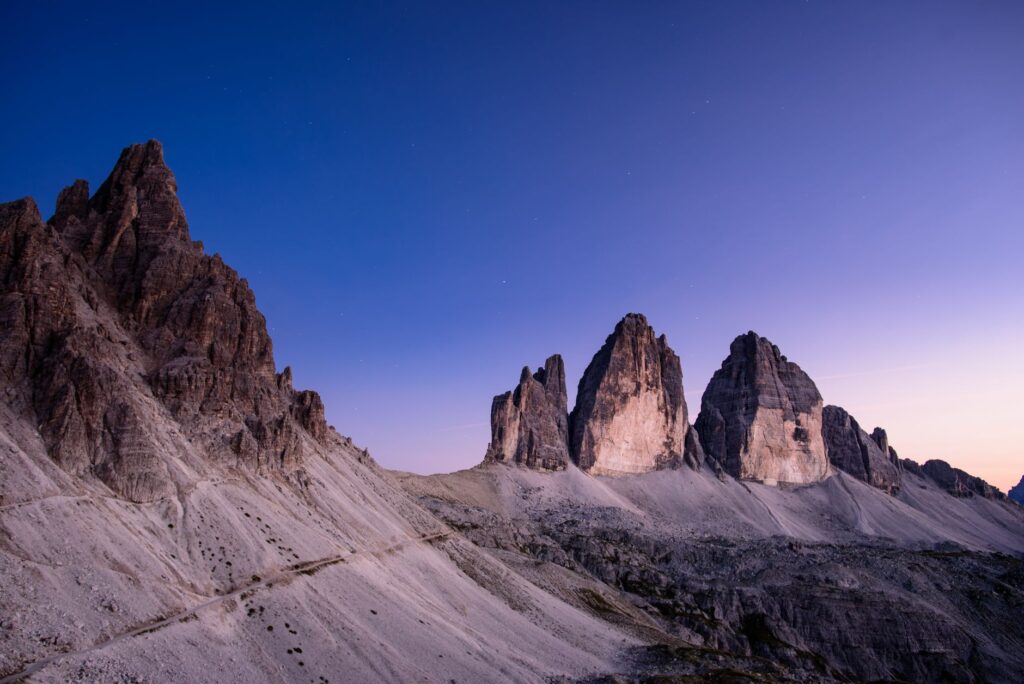
Subsequent erosion, driven by cycles of freezing and thawing, has sculpted the whimsical shapes we see today. The towers, pinnacles, and spires are but the remnants of those reefs that have best resisted the passage of time. Stratigraphy here is an open book; in a single glance from Passo Pordoi, a geologist can read millions of years of climatic history, identifying periods of marine transgression and eras of submarine volcanic activity that interspersed layers of lava within the carbonate.
“The Dolomites are not mountains of stone, but cathedrals of time holding within them the murmur of a vanished ocean.”
Déodat de Dolomieu and the Enigma of the Pale Rock
Until the late 18th century, these mountains were known simply as the Pale Mountains. It was the French geologist Déodat Gratet de Dolomieu who, during a trip through the region in 1789, observed that the rock of these summits did not react to acid in the same way as common limestone. After sending samples for analysis, a new mineral was identified: dolomite. In honor of its discoverer, the entire region and the type of rock were named after him, establishing an unbreakable link between science and the land.
The unique property of dolomite is its ability to reflect light. While granite or schist absorbs radiation opaquely, the crystalline structure of dolomite allows for internal refraction. This is what causes the enrosadira. For local inhabitants, before science explained the phenomenon, these lights were attributed to legends of invisible rose gardens that only manifested at twilight. Today, this phenomenon is one of the greatest draws for scientific and photographic tourism, though its presence strictly depends on atmospheric purity and the sun’s angle.
The significance of this discovery was not just mineralogical. It changed the perception of the region, which shifted from being a remote, impoverished area to a center of interest for the European intelligentsia. Early British explorers, such as Leslie Stephen, began mapping the routes, laying the groundwork for what we now know as modern mountaineering. However, the mountains held a much darker side that would be revealed a century later.
Iron Scars: The Great War Front
Between 1915 and 1918, the Dolomites became the stage for one of history’s most absurd and cruel wars: the White War. The front between the Kingdom of Italy and the Austro-Hungarian Empire ran across the highest peaks. Soldiers fought not only the enemy but also temperatures of 30 degrees below zero and avalanches that caused more casualties than bullets.
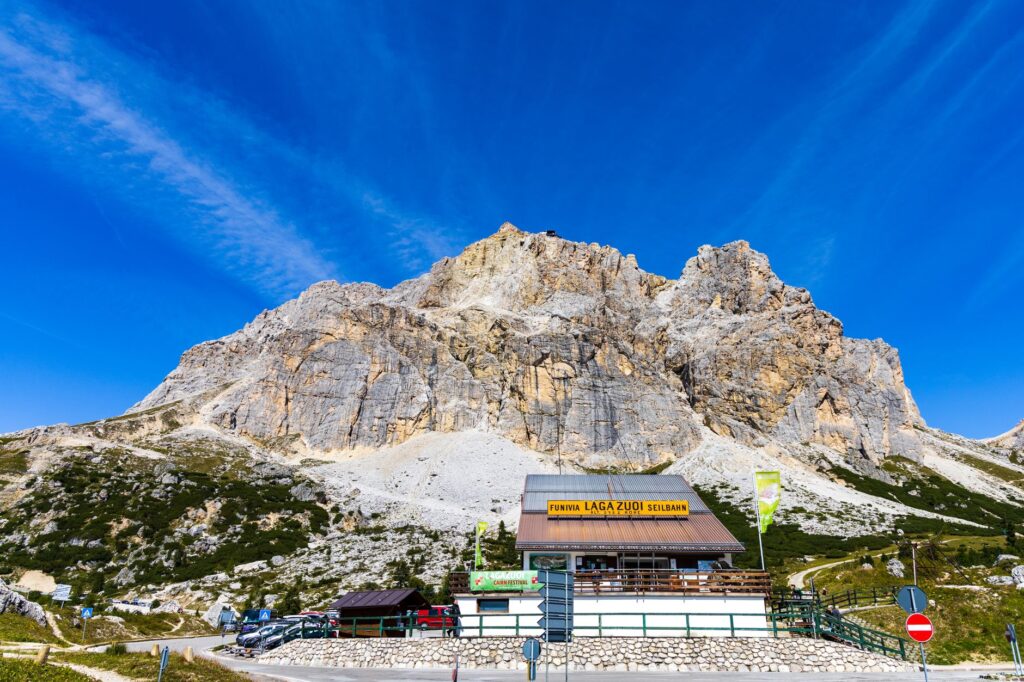
To survive and fight in this vertical environment, military engineers excavated kilometers of tunnels inside the mountains and strung steel cables to facilitate the ascent of supplies. This is the origin of the famous via ferratas. What is today a recreational activity for thousands of hikers began as a desperate logistical necessity. In the Lagazuoi massif, it is possible today to walk through the restored tunnel system, where rooms carved into the rock serve as a somber museum of human resilience.
The environmental impact of the war was severe, with entire peaks blown up by explosives to displace enemy positions (as happened at the Castelletto of Tofana di Rozes). However, peace brought a complex administrative integration. The territory, formerly Austrian, passed into Italian hands but preserved a trilingual cultural identity that is, today, one of its greatest social treasures.
The Language of the Valleys: The Ladin Legacy
In the heart of the Dolomites, in valleys like Val Badia or Val di Fassa, lives an ethnic minority that has preserved its language for over two thousand years: the Ladins. Their language is Rhaeto-Romance, a direct descendant of the vulgar Latin spoken by Roman soldiers who colonized the Alps, mixed with the languages of the original Rhaetic peoples.
- Linguistic Identity: Ladin is an official language alongside Italian and German in several provinces.
- Traditional Architecture: The «viles» are rural settlements made of wood and stone designed for energy efficiency and communal living.
- Subsistence Gastronomy: Dishes like canederli or schüttelbrot reflect a history of maximizing the limited resources of the high mountains.
Ladin culture is not a museum piece; it is a vibrant community that manages much of the tourism infrastructure. Their relationship with the land is one of strict guardianship. They have understood that preserving their landscape is the guarantee of their economic survival. The management of high pastures through the communal system has prevented the soil degradation seen in more industrialized alpine areas.
“The mountain teaches us that silence is the highest form of communication between man and nature.”
The Alta Via Network: Logistics of Verticality
For the traveler seeking total immersion, the Dolomites offer the Alta Via (High Route) system. These are multi-day itineraries that cross the main massifs, always staying above 2,000 meters. Alta Via 1, running from Lago di Braies to Belluno, is considered one of the most spectacular trekking routes in the world. What makes it unique is the network of rifugi (mountain huts).
Unlike the basic shelters of other ranges, Dolomitic huts are true cultural institutions. Many are family-owned and offer gastronomy that rivals valley restaurants, all while operating with advanced waste management and solar energy systems. This infrastructure allows for covering considerable distances with a light pack, democratizing access to high mountains without compromising safety or the environment.
However, this success has brought challenges. Overtourism at iconic spots like Lago di Braies or the Tre Cime has forced local authorities to implement pre-booking systems and mandatory public transport during summer months. The goal is clear: to protect the stillness that defines the alpine experience and prevent the accelerated erosion of the most traveled paths.
Biodiversity at the Biological Limit
Despite the sterile appearance of the vertical walls, the Dolomites house biodiversity adapted to extreme conditions. In the lower slopes, larch and Norway spruce forests dominate. The larch is particularly symbolic; it is one of the few conifers that loses its needles in winter, tinting the slopes an ethereal gold during October.
Above the tree line, flora becomes diminutive and resilient. Plants like Saxifraga burseriana or the famous Edelweiss (snow flower) have developed hairs to protect themselves from UV radiation and moisture loss. Regarding fauna, the chamois and marmot are the most visible inhabitants, but it is the recovery of the golden eagle and the bearded vulture that marks the success of conservation policies in natural parks like Fanes-Sennes-Prags.
The balance of these ecosystems depends critically on climate stability. The retreat of glaciers, though less dramatic than in the central Alps because the Dolomites have few large glaciers (with Marmolada being the main one), is a constant concern. Monitoring permafrost in rock walls is vital for predicting rockfalls that could affect hiking routes and valley ecosystems.
Practical Guide
Planning a trip to the Dolomites requires understanding that the region is primarily divided between the provinces of Bolzano (South Tyrol), Trento, and Belluno. Each offers a different atmosphere, from the Germanic rigor of the north to the Italian warmth of the south.

When to Go and How to Get Around
The hiking season runs from mid-June to early October. Before June, many high-altitude trails remain blocked by snow. Autumn is undoubtedly the most photogenic time due to the larch colors and greater atmospheric clarity for observing the enrosadira. For transport, taking the train to Bolzano or Fortezza is recommended, and from there, using the excellent local bus network (Südtirol Mobil), which connects even the most remote valleys, making a rental car unnecessary.
Strategic Points and Accommodation
- Val di Funes: Ideal for landscape photography and gentle hiking with views of the Odle peaks.
- Cortina d’Ampezzo: The perfect base for exploring the eastern Dolomites and Great War routes.
- Alta Badia: The hub of Ladin culture and high-altitude mountain gastronomy.
- Reservations: If you plan to sleep in rifugi during the summer, it is imperative to book 4 to 6 months in advance.
Gear and Safety
While trails are excellently marked, alpine weather should not be underestimated. Afternoon thunderstorms are common in July and August. It is essential to carry layers, mountain boots with Vibram soles or similar, and if planning to do via ferratas, certified equipment (helmet, harness, and lanyard) along with technical knowledge or hiring a certified mountain guide (UIAGM).
The Silence of the Stone
At the end of the day, when the last bus has departed and the day tourists retreat to valley hotels, the Dolomites regain their original scale. It is in that moment, from the terrace of a refuge at 2,500 meters, that the true magnitude of this place is understood. The pale stone, which was once submarine life, stands against a starry sky of breathtaking purity.
The lesson of the Dolomites is one of permanence versus the ephemeral. These mountains have seen empires fall, wars pass, and radical climate shifts, and they remain there, offering their verticality as a refuge for the human spirit. A journey to the Dolomites is not just a physical challenge or an aesthetic pursuit; it is an exercise in humility before geology, an invitation to walk slowly and listen to what the ancient reefs have to tell us about time and our own fragility.