
At five in the afternoon, as the tropical air over Penang begins to condense against the weathered masonry of colonial shophouses, the corner connecting Lebuh Chulia and Lorong Love transforms into a theatre of steam and sputtering oil. The rhythmic scrape of a iron spatula against the curved wall of a cast wok echoes like a mechanical pulse through the fading light. Here, fire is not merely a domestic heat source; it is a tool of surgical sculpting performed over mangrove charcoal, capable of turning rice noodles, bean sprouts, and lard into a piece of ephemeral art that lasts less than three minutes on a enamel plate.
George Town, the capital of the Malaysian state of Penang and designated a UNESCO World Heritage Site in 2008, shelters one of the densest and most complex ecosystems of street-level historical cooking in Asia. This culinary landscape did not emerge from royal courts, but from the grinding labor of maritime trade. Chinese immigrants arriving from Fujian, Guangdong, and Hainan provinces during the nineteenth century brought lightweight utensils, high-heat stir-fry techniques, and family recipes engineered to sustain dockworkers. Today, that survival cuisine has evolved into a living archive balancing global tourism demands with the unyielding preservation of artisanal mastery.
The Map of Smoke: Living Cartography of Penang’s Food Markets
Understanding the gastronomic geography of Penang requires learning to read wind currents and time cycles. Unlike Western capitals where restaurants occupy fixed commercial zones, food in George Town flows in temporal tides. Mornings belong to the kopitiams—traditional coffee shops born from Chinese and Nanyang heritage—where stainless steel counters assemble under shaded neoclassical arcades. There, the aroma of coffee beans roasted with butter and sugar merges with the spicy vapor of early-morning noodle broths.
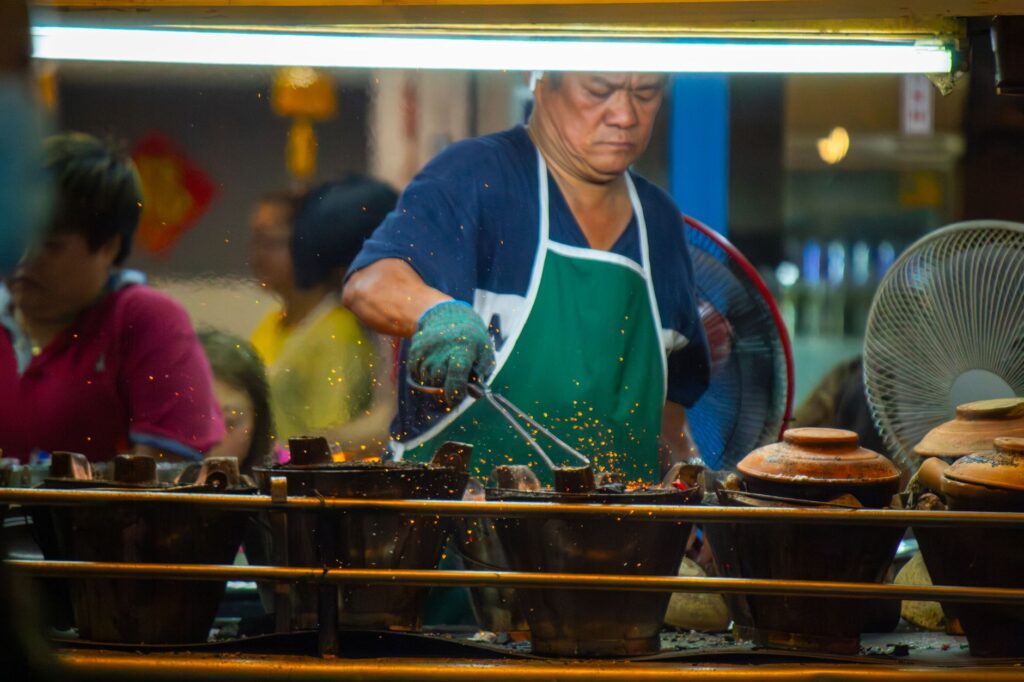
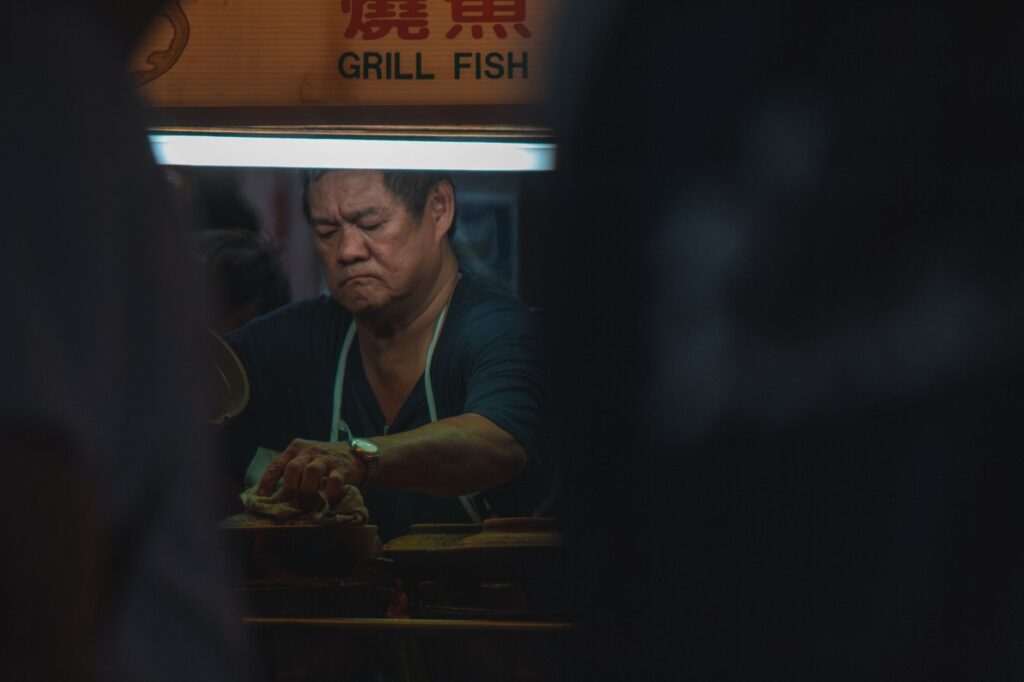
As night falls, the sidewalks along primary thoroughfares like Lebuh Kimberley or Lorong Selamat open to pushcarts locally known as hawker stalls. Each cart functions as a single-dish monopoly: a cook dedicates an entire lifetime to perfecting one precise preparation, repeating the same mechanical gestures thousands of times a week. This hyper-specialization has preserved uncorrupted flavor profiles across three or four generations, turning city streets into working archives of Chinese migration in Southeast Asia.
The Physics of Wok Hei: Temperature as Cultural Language
The organizing principle governing high-level street cooking in George Town is wok hei, a Cantonese expression translated as «the breath of the wok.» Far from an abstract poetic phrase, it represents a demanding physicochemical event. It requires the metal surface to exceed three hundred degrees Celsius to trigger the Maillard reaction in milliseconds, caramelizing surface sugars while atomizing micro-droplets of fat that re-incorporate into the ingredients as an unmistakable smoky glaze.
Executing this olfactory signature requires absolute muscular control and precise timing. The cook sways the heavy metal body with one arm while dropping ingredients in rapid mathematical sequences to prevent moisture from bean sprouts or seafood from dropping the interior temperature. A one-second delay transforms a crisp salte into a soggy, boiled dish.
«Wok hei is not a flavor you can bottle in a commercial sauce; it is the instantaneous micro-crystallization of fat and sugar over red-hot metal.»
Char Kway Teow: Science of Lard, Duck Egg, and Open Flame
If one dish defines the island’s identity, it is Char Kway Teow. This plate of flat rice noodles demands a minimal yet uncompromised technical setup. In the city’s most respected stalls, such as those along Presgrave Street or Siam Road, modern gas burners are systematically rejected in favor of vertical braziers fueled by dense mangrove charcoal. Charcoal provides an intense, dry radiant heat that introduces zero moisture to the pan.
The process begins with a ladle of rendered pork lard, followed by minced garlic and fresh Andaman Sea prawns. Flat rice noodles are immediately thrown in, alongside dark soy sauce aged in clay vats, ground fresh chili paste, estuary cockles, and short-stemmed bean sprouts. The distinct hallmark of the Penang technique lies in cracking a duck egg into the pan near the end: the higher lipid content in its yolk coats the noodles in a silky emulsion that contrasts with the charred edges of the rice strands.
Broth of Discord: The Botanical Acidity of Penang Assam Laksa
At the opposite end of the sensory spectrum sits Penang Assam Laksa, a thick rice noodle soup that marks the peak of Peranakan or Nyonya culture—the centuries-old synthesis between Chinese traders and local Malay populations. Unlike the rich coconut-cream laksas found in the southern peninsula, Penang’s benchmark version is a monument to botanical acidity and oceanic intensity.
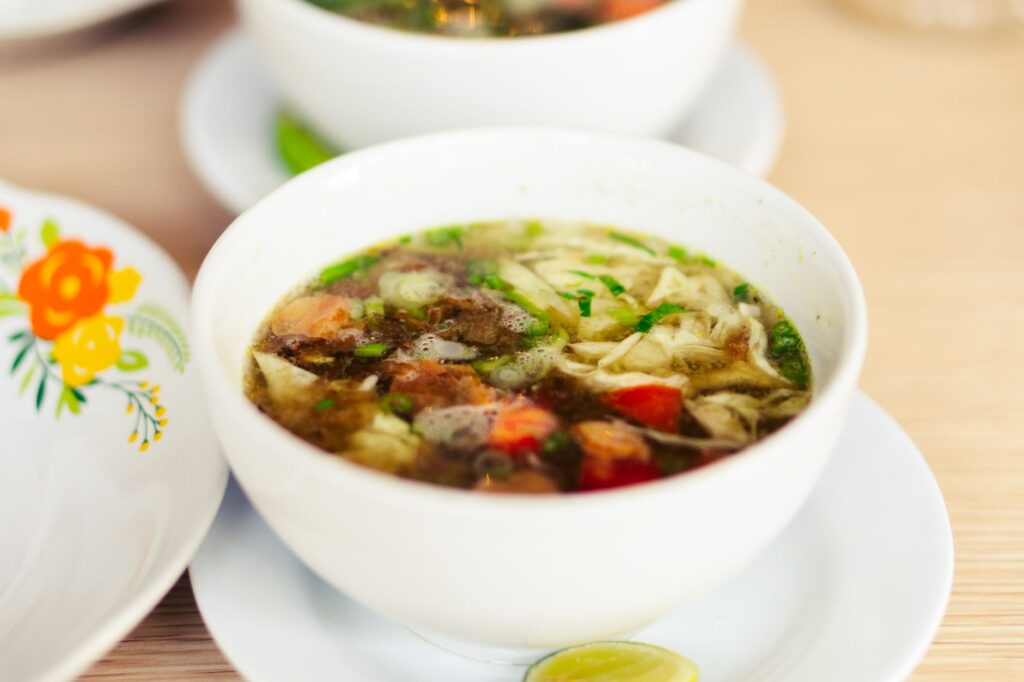
The broth base is crafted through a long reduction of flaked chub mackerel simmered with dried slices of asam gelugur (a wild sour fruit) and tamarind pulp. This dark stock is seasoned with a ground spice paste containing lemongrass, galangal, fresh turmeric, shallots, and red chilies. Service involves topping the steaming bowl with shredded torch ginger flower (bunga kantan), mint leaves, sour pineapple, purple onion, and a dark dollop of hae ko—a sweet fermented shrimp molasses paste.
Kopitiams: Social Living Rooms of Shophouse Architecture
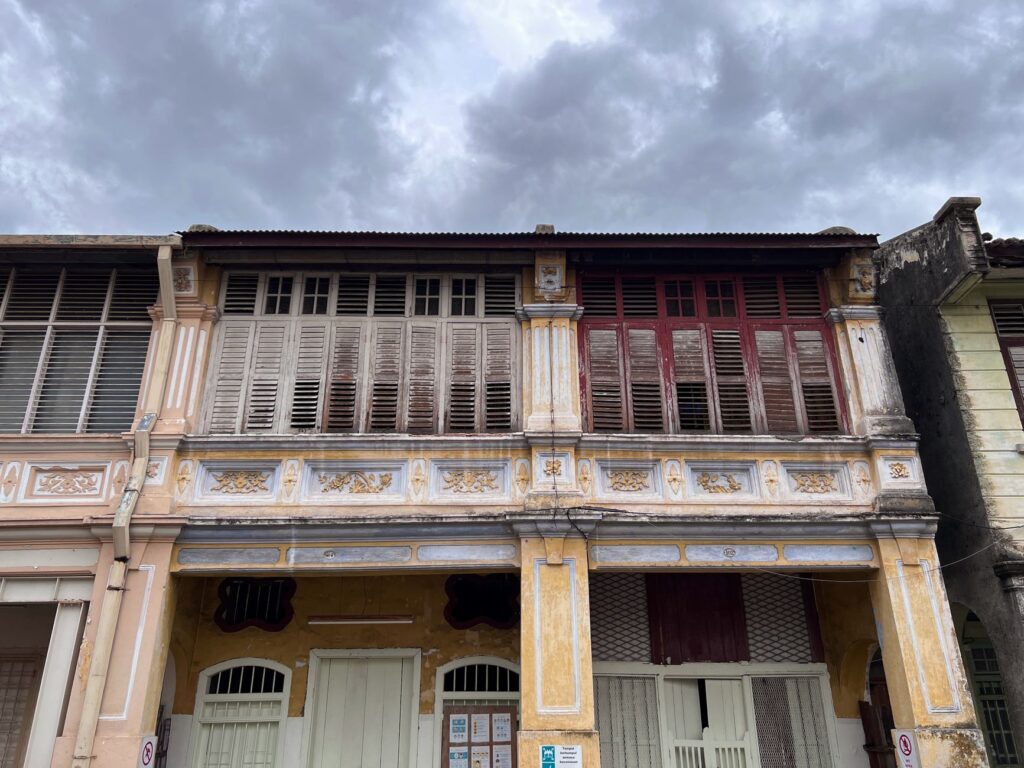
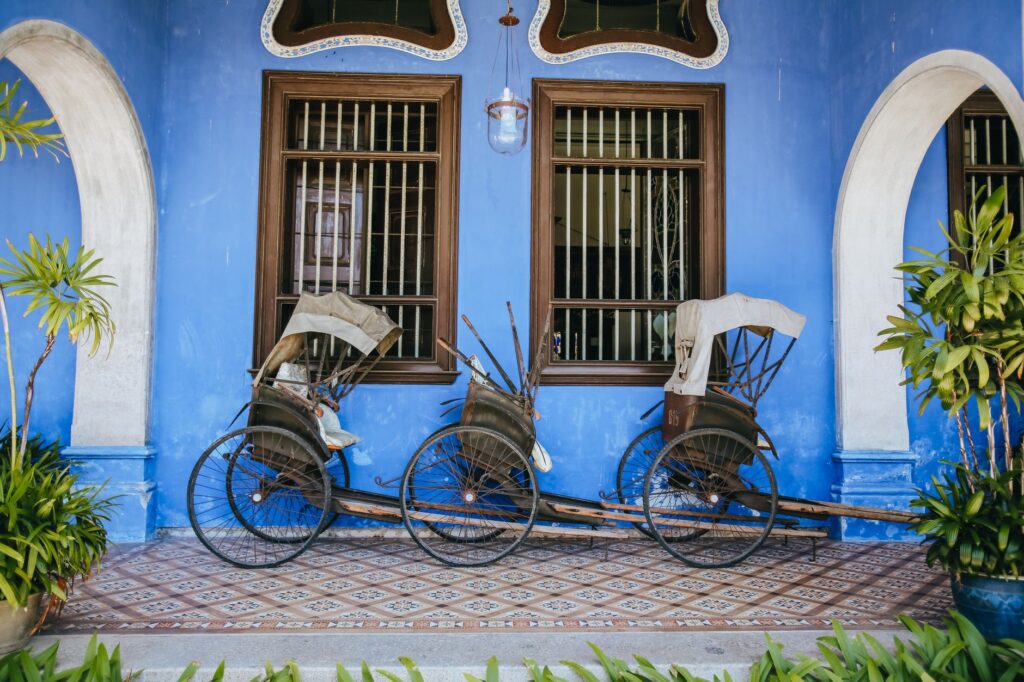
The culinary life of Penang cannot be separated from the domestic architecture that has housed it since the late nineteenth century. Historic shophouses feature narrow Chinese-European facades, clay-tiled roofs, internal lightwells, and a recessed ground floor forming a continuous covered walkway known as the five-foot way.
Inside these spaces sit the kopitiams, characterized by terrazzo tile floors and marble-topped round tables. Here, commercial operations follow a traditional unspoken system: the building owner manages the beverage counter—preparing Kopi-O, black coffee brewed through cloth filters—while leasing room along the walls to independent hawkers. This communal model enables families with limited capital to operate historic stalls while sharing utility and seating costs.
The Peranakan Footprint: Spices Bridging Peninsula and Sea
Penang’s kitchen is also a living record of the Straits Chinese community. Merchants from Fujian who settled in the British Straits Settlements intermingled with indigenous families, producing a home cooking style known as Nyonya cuisine. These dishes require labor-intensive prep work that often takes days of manual grinding and curing.
- Nasi Ulam: Room-temperature rice tossed with over a dozen finely sliced fresh wild herbs, including betel leaves, wild turmeric leaves, and lemongrass.
- Otak-Otak: A delicate fish cake blended with coconut milk, eggs, and an aromatic spice paste, wrapped in banana leaves and gently steamed over charcoal.
- Joo Hoo Char: A celebratory stir-fry of shredded jicama, bamboo shoots, and dried cuttlefish strands, illustrating the strategic use of sun-dried seafood to build deep umami layers.
The Generational Crossroads: Preserving Legacy Knowledge Against Global Tourism
Despite the bustling energy in city markets, Penang’s traditional street-food model faces a generational turning point. Cooking over intense charcoal fires in humid heat demands rigorous physical endurance. Younger generations, educated for digital careers, are often reluctant to take over businesses requiring fourteen-hour workdays. Simultaneously, rising property values across the UNESCO zone have displaced long-time residents and pushed up rental rates for historic shophouses.
«Preserving a recipe in George Town is not about writing down a list of weights; it is about teaching the ear to recognize the exact crackle of lard when the pan hits temperature.»
To prevent the loss of culinary authenticity, the Penang state government enacted heritage protection policies that prohibit foreign hire cooks from replacing master local chefs in preparing the ten most iconic local dishes. The policy aims to ensure that mechanical skill, precise timing, and oral culinary traditions remain anchored within native families who transmit the trade through direct apprenticeship.
Practical guide
Planning your itinerary
George Town is best navigated on foot or via traditional three-wheeled trishaws. For morning food markets, concentrate your exploration around Campbell Street Market and Lebuh Cintra. For night hawker concentrations with high historic value, visit Lebuh Kimberley, Presgrave Street, and Lorong Baru (New Lane).
Hours and operating rhythms
Food operations follow two main daily shifts. Morning soup stalls and traditional kopitiams run from 06:30 to 14:00. Nighttime wok stalls and charcoal hawkers operate between 16:30 and 23:00. Note that most family-run stalls observe a weekly rest day on a rolling schedule, typically Mondays or Tuesdays.
Kopitiam etiquette
When taking a seat inside a kopitiam, it is expected that every diner orders a drink from the house counter before purchasing food items from the peripheral hawker carts. Payment for food items is made in cash directly to the hawker upon dish delivery to your table.
Hygiene and food selection
High ingredient turnover at established Penang stalls guarantees fresh preparation. To ensure a safe experience, select stalls patronized by steady queues of neighborhood residents where food is cooked to order over high heat in full view.
When midnight finally douses the last charcoal embers along Kimberley Street and soft soot settles onto the concrete pavements, George Town retreats into a humid silence. Heavy cast-iron woks hang clean beneath timber eaves, waiting for the first sparks of dawn. On an island where time is measured by the steam rising from stockpots, every meal served remains an unyielding act of cultural memory.