The Architecture of the Breeze in Western Kyoto
At the western edge of Kyoto, where the urban basin yields to the wooded masses of the Arashiyama hills, the air acquires a different density. This is not merely a matter of humidity or the proximity of the Ōi River, which winds beneath the Togetsukyō Bridge with ancient patience, but rather an acoustic and luminous transformation operated by thousands of vertical stalks. Here, nature is not contemplated as a static landscape, but as a living mechanism of sensory modulation that Zen monks and poets of the imperial court learned to decode more than a thousand years ago. The Sagano bamboo grove is not an ornamental garden in the Western sense, but a vegetal structure designed to suspend time.
In the early morning hours, before the tour bus routes disgorge their tide of impatient visitors toward the Tenryu-ji temples, the forest operates under its own physical laws. The wind descending from Mount Atago does not blow freely; upon entering this labyrinth of giant timber bamboo stalks of the species Phyllostachys edulis, which reach heights of up to twenty-five meters, it fractures into thousands of micro-currents. The result is a continuous, metallic yet hollow whisper that Japan’s Ministry of Environment officially cataloged as one of the one hundred soundscapes to be preserved for future generations. This sound, described in Heian-period annals as the heartbeat of the green earth, constitutes the core of a wellness experience that transcends simple tourist evasion.
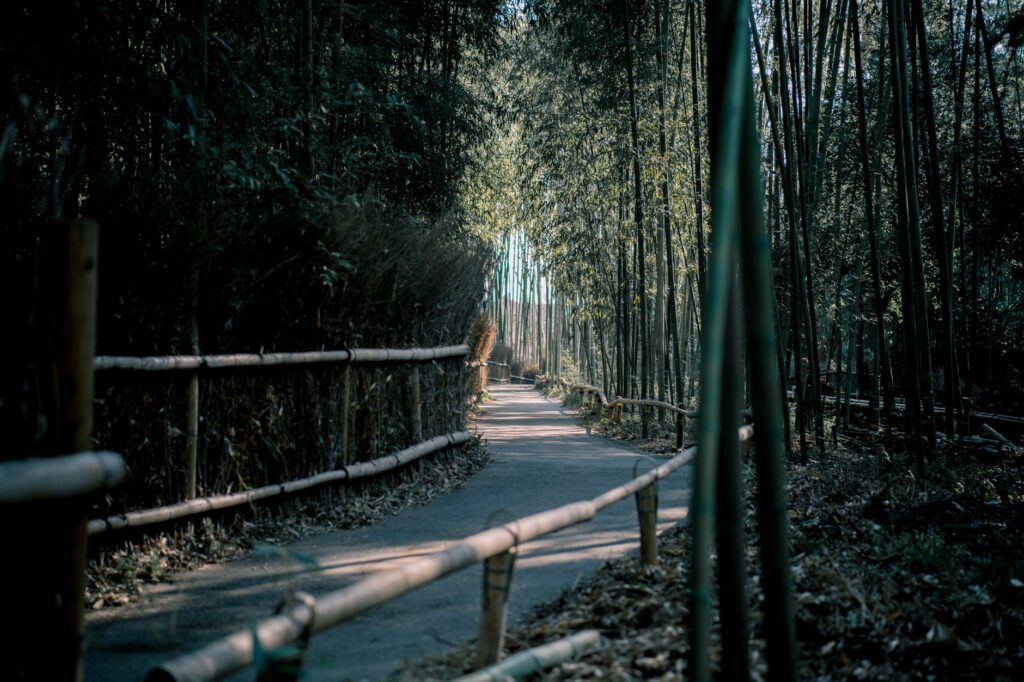
To comprehend the magnitude of this botanical sanctuary, one must abandon the notion of the forest as a scenic backdrop. Each bamboo culm is a dynamic organism that absorbs carbon dioxide at a rate three times higher than broadleaved trees, generating an atmosphere laden with negative ions and phytoncides—volatile organic compounds that plants secrete to defend themselves against microbes. As the traveler walks along the paved paths cutting through the grove, their nervous system undergoes an involuntary deceleration. Blood pressure drops, cortisol levels plummet, and the mind, accustomed to the tyranny of digital multitasking, finds an unshakeable physical anchor in the infinite verticality of the trunks.
The Science of Shinrin-yoku in the Imperial Groves
Although the term shinrin-yoku—commonly translated as «forest bathing»—was coined by the Forestry Agency of Japan in 1982 as a public health strategy to combat urban work-related stress, its philosophical roots sink deep into the Zen Buddhism and Shintoism that permeate Arashiyama. The surrounding temples, spearheaded by Tenryu-ji, were conceived not as places of passive prayer, but as centers of landscape integration. The famous garden of this temple, designed by master Musō Soseki in the fourteenth century, utilizes the technique of shakkei or «borrowed scenery,» integrating the bamboo-covered slopes of Mount Arashiyama into the visual composition of the central pond.
The forest is not a place one visits to rest, but an active mirror where consciousness regains its original form, free from the noise of haste and artifice.
The modern practice of forest bathing in this setting does not consist of an aerobic hike, but of a deliberate immersion of the five senses. Local certified guides instruct participants in the art of slowness: pausing to observe how morning sunlight pierces through the nodes of the stalks, creating geometric patterns on the moss; touching the striated, cool bark of mature bamboo; deeply inhaling the scent of damp resin and siliceous earth; listening to the rhythmic cracking produced by stalks brushing against one another when moderate gusts blow. This sensory protocol activates the parasympathetic nervous system, responsible for rest and digestion functions, counteracting the sympathetic hyperactivity induced by modern life.
Neuroscientific studies conducted by institutions such as the University of Tokyo have demonstrated that a single three-hour immersion session in dense bamboo and conifer forests significantly increases the activity of natural killer (NK) cells in the human immune system, an effect that can last for more than a week. In Arashiyama, this natural pharmacology is enhanced by visual isolation: the height of the stalks completely blocks the urban horizon, creating a spatial bubble where light and visual pollution vanish entirely, allowing the brain to recover its capacity for focused attention.
Traditional Engineering and the Management of the Sacred Grove
What at first glance appears to be a spontaneous work of nature is, in reality, the result of centuries of meticulous human management. Bamboo is not a tree, but a giant grass of extraordinarily rapid growth; some species can grow up to a meter in twenty-four hours during the spring season. However, an abandoned bamboo forest quickly turns into an impenetrable ecological trap, as the dense network of underground rhizomes suffocates all other plant life and completely blocks sunlight.
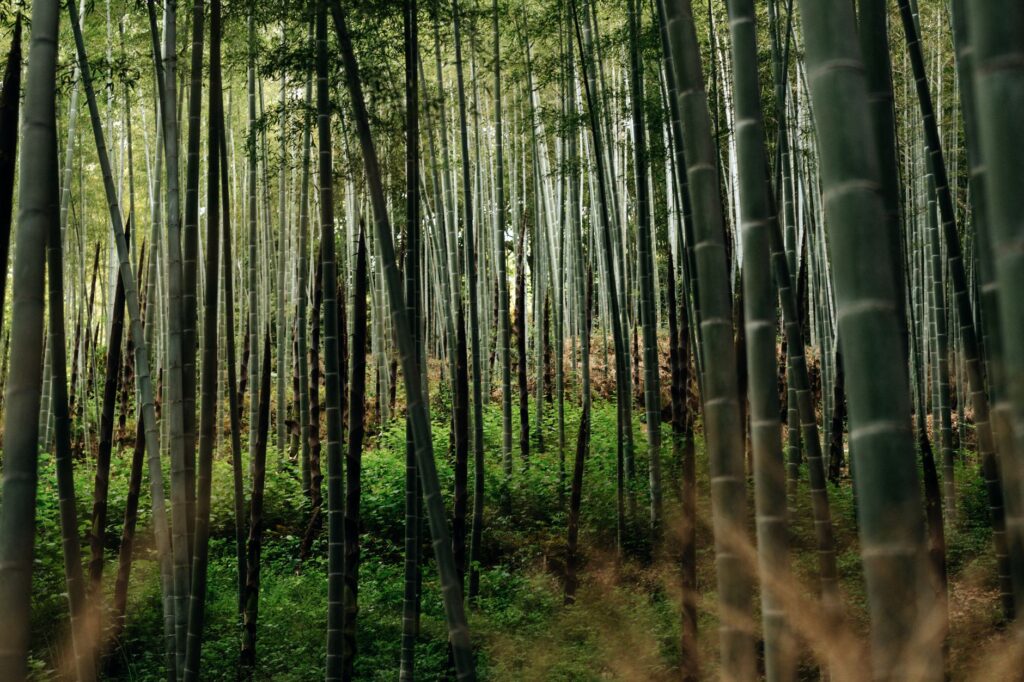
Kyoto’s forest artisans, known as takenoko-mori, apply ancestral techniques of earth-mounding and selective thinning that guarantee the health of the ecosystem. Every year, during the winter months, stalks that have exceeded five or six years of life are harvested, at which point their wood begins to lose flexibility and strength. This extracted wood is not discarded; it is masterfully reused in the construction of traditional fences called kengaki-gaki, in Zen garden aqueducts, and in crafting ceremonial utensils for green tea preparation in local tea houses.
The relationship between humanity and bamboo in this region is an exercise in economic and aesthetic symbiosis. The horizontal roots act as a natural anchoring lattice that prevents erosion on clay slopes during the typhoon and heavy rain season. At the same time, the constant twilight generated by the upper canopy prevents the proliferation of invasive weeds, keeping the ground naturally clean without the need for chemical herbicides or pesticides. This ancient equilibrium turns the forest into a pioneering model of ecological sustainability and landscape management that inspires urban planners worldwide.
The Artisan Pulse: From Raw Culm to Precision Craft
Beyond its landscape value, the territory of Arashiyama and its surrounding neighborhoods has been the historical epicenter of bamboo craftsmanship in Japan. Just meters away from the main paths of the grove, small family workshops continue to operate using methods that have hardly changed since the Edo period. Here, the artisan is not a mere carpenter, but a profound connoisseur of organic matter, capable of distinguishing the exact age, solar orientation, and moisture content of each stalk by merely listening to the sound it produces when gently tapped with knuckles.
The transformation process is fascinating for its technical rigor. Following harvest, the culms must undergo a degreasing process using heat—employing blowtorches or boiling water baths with wood ash—to eliminate residual sugars that would otherwise attract wood-boring insects. Subsequently, the pieces are straightened by hand using wooden presses and direct heat, an art that requires decades of apprenticeship to prevent the culm from fracturing. This material is used to create everything from delicate baskets used in traditional kaiseki haute cuisine to complex shakuhachi transverse flutes and oiled-paper parasols with flexible ribs.

True artisanal mastery lies in listening to what the material asks to be, accepting its knots and grain as necessary scars of its natural history.
This proximity economy gives the journey an inescapable ethical dimension. Purchasing an artisanal object in Arashiyama is not an act of superficial consumption, but a direct contribution to the survival of a craft facing extinction in the face of mass industrial production. Local workshops organize intimate demonstrations where travelers can witness the extreme precision with which bamboo sheets of less than a millimeter in thickness are cut to weave fans and small baskets. It is a tangible reminder that contemporary well-being and luxury do not reside in the accumulation of impersonal goods, but in connection with matter transformed by human hands with patience and respect.
The Architecture of Water and Stone Along the Ōi River Banks
The journey through the universe of Arashiyama would remain incomplete without attending to the element that balances the vertical dryness of the bamboo: river water. The Ōi River—which adopts the name Hozu in its upper stretch and Katsura at its mouth—acts as the liquid mirror reflecting the forested hills. Throughout the centuries, this riverbed has been tamed through hydraulic engineering works that now form part of the protected cultural heritage of the former capital, demonstrating that human intervention in nature can attain heights of extreme elegance.
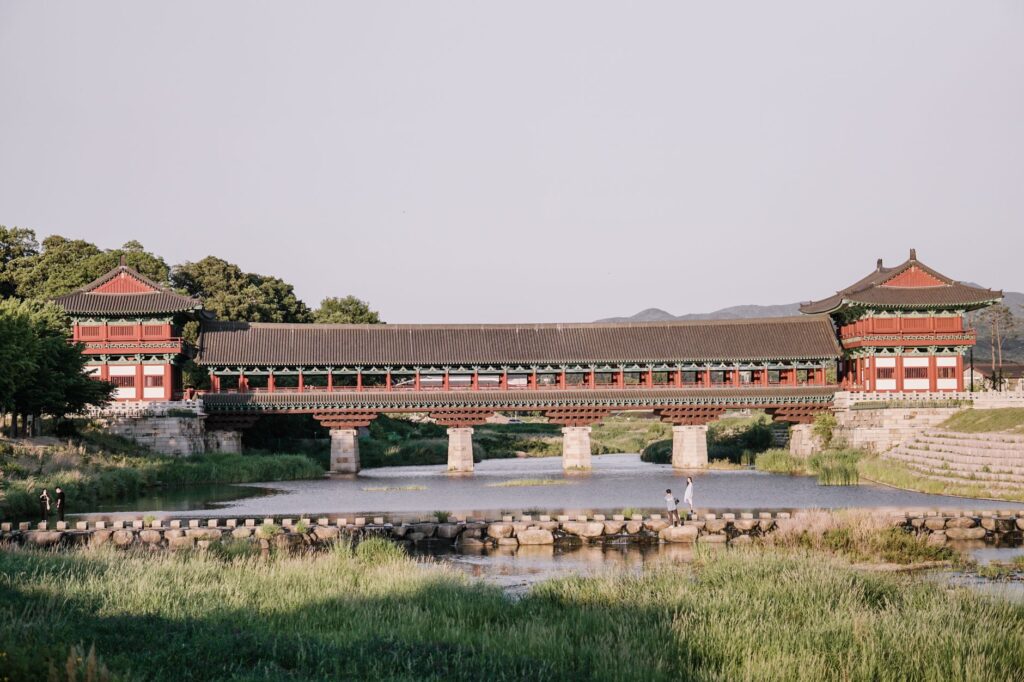
The Togetsukyō Bridge, whose current structure combines concrete foundations with noble wood railing to blend into the forest environment, marks the transition between the commercial activity of the village and the absolute quiet of the mountain temples. From this point depart traditional flat-bottomed boats propelled by long bamboo poles, originally used by the imperial aristocracy for poetic excursions and now available to travelers seeking a floating perspective of the landscape. Navigation up the Hozu Gorge reveals rock formations sculpted by the current over millennia, flanked by slopes where Japanese maples burst into reddish tones during autumn and cherry blossoms carpet spring in white.
On the riverbanks, the arrangement of volcanic rocks responds to the aesthetic principles of karesansui and naturalistic landscaping. Each stone has been placed to guide the walker’s gaze, creating visual pause points where the murmur of water over rounded pebbles completely masks the bustle of the outside world. This ancient dialogue between inert stone, fluid water, and vertical vegetation constitutes the culmination of Japanese landscape philosophy: a reminder that human beings are not the center of the cosmos, but privileged observers within a greater natural order.
Practical guide
How to Get There
Main access to Arashiyama from central Kyoto is via the JR San-in line (also known as the Sagano line) to Saga-Arashiyama station, a journey taking approximately fifteen minutes. Another highly recommended option is the historic Randen electric tram (Keifuku Arashiyama Line), connecting central Kyoto directly to the heart of the district in a twenty-five-minute scenic ride.
When to Go
Although the bamboo forest is accessible and beautiful year-round, transitional seasons offer the most memorable experiences. April stands out for cherry blossom viewing (sakura), while November offers the spectacle of maples at their chromatic peak (koyo). To avoid massive crowds, visiting at dawn (between 06:00 and 07:30 hours) is mandatory.

Conduct and Sustainability Rules
The bamboo forest is a protected public space and a place of spiritual respect. Touching or carving names into the trunks of the stalks is strictly prohibited, as any incision damages the plant’s protective layer and allows fungal entry. Visitors must maintain silence or speak in a very moderate tone, avoiding loud speakers or mobile devices without headphones.
Recommended Accommodation and Retreats
For complete immersion, staying at a traditional ryokan around Sagano is advised, such as the historic Suiran Luxury Collection Hotel, situated directly on the banks of the Hozu River, offering private mineral hot spring baths (onsen) and seasonal kaiseki gastronomy.
The Final Echo of Hollow Stalks in Memory
As afternoon wanes and the last horizontal sunrays manage to pierce Arashiyama’s thick canopy, casting elongated shadows over the leaf-carpeted ground, the forest adopts an almost liturgical solemnity. This is the moment when the bustle of daytime excursionists has completely dissipated and the territory reclaims its original vocation as a refuge and meditation ground. In that silence inhabited solely by the intermittent friction of stalks, the traveler realizes that the true journey did not consist of gathering photographs of a famous monument, but of tuning their internal rhythm to the immutable cadence of the earth.
The experience of this ancient grove leaves an imprint that endures far beyond the return to urban routine. Each time memory evokes the green twilight and the metallic murmur of wind through the heights, the nervous system reactivates that muscular memory of stillness. In a world obsessed with speed and constant performance, Kyoto’s bamboo forests stand as a beacon of aesthetic and spiritual resistance, a perennial reminder that the highest elegance and deepest rest are always born from essential simplicity and absolute respect for nature’s rhythms.