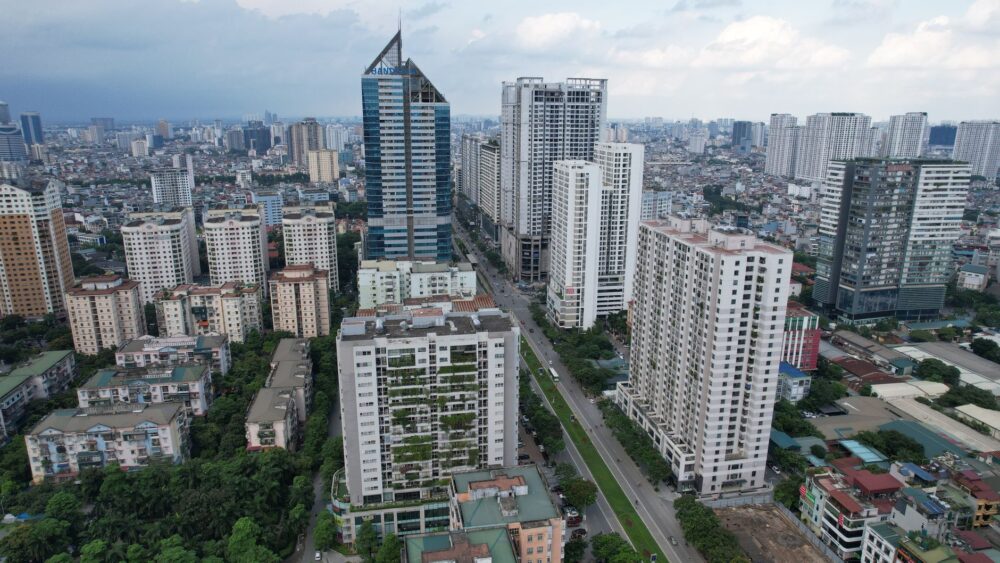
Arriving in Chongqing is akin to stepping inside an intricate three-dimensional maze that defies traditional cartography. In this sprawling southwestern Chinese megacity, built across rugged mountain ridges and wrapped by the confluence of the Yangtze and Jialing rivers, altitude is not merely a scenic feature; it is the fundamental governing axis of daily existence. Standard two-dimensional navigation apps quickly prove useless when the ground floor of an apartment complex opens directly onto the twentieth story of an adjacent thoroughfare, and public plazas float over complex webs of multi-layered highways.
Sensationalized across global social platforms as the ultimate cyberpunk metropolis, Chongqing has captured the imagination of international travelers drawn by viral footage of monorail trains slicing through residential tower blocks and glowing amber cliffside facades. Yet, behind the algorithmic allure lies a far more nuanced, demanding, and rewarding urban reality—one where solo exploration requires careful digital preparation, geographic resilience, and a deep appreciation for China’s rapidly evolving domestic landscape.
Deconstructing the Viral Illusion
Digital storytelling often distills the essence of Chongqing into a brief, hyper-saturated loop of iconic sights. Clips of the Liziba transit station or the dazzling illuminations of Hongyadong amass millions of views, constructing an image of an endless science-fiction theme park. However, experiencing the city at ground level reveals a bustling, organic metropolis of over thirty million residents, where hyper-modern engineering exists side-by-side with quiet, traditional neighborhood routines.
The radical verticality of Chongqing was born out of necessity rather than aesthetic ambition. Constrained by dramatic topography and severe land scarcity, city planners engineered bold solutions: skywalks suspended hundreds of feet above canyon-like streets, soaring bridges spanning wide river basins in dense fog, and networks of public elevators serving as vital transit arteries between distinct urban levels.

A Vertical Labyrinth: Where Geology Meets Architecture
Traversing the central Yuzhong District forces travelers to recalibrate their spatial awareness. It is entirely common to enter a building lobby at street level, take an elevator down ten floors, and exit onto another bustling avenue packed with vehicle traffic and street vendors. This constant layering creates a persistent sense of dislocation that is both the city’s most captivating quality and its greatest logistical challenge.
Connecting these elevated realms are the tikan—steep, historical stone stairways that predate modern mechanization. Along these vertical corridors, local porters carry bamboo baskets, delivery workers weave through crowds, and travelers pause to catch their breath. These pedestrian routes provide a intimate counterpoint to the towering concrete viaducts that crisscross the skyline above.
Chongqing’s vast urban geography defies Euclidean logic: the city is measured not by horizontal distances, but by sheer vertical ascent.
The Liziba Monorail and the Spatial Ingenuity of Chongqing
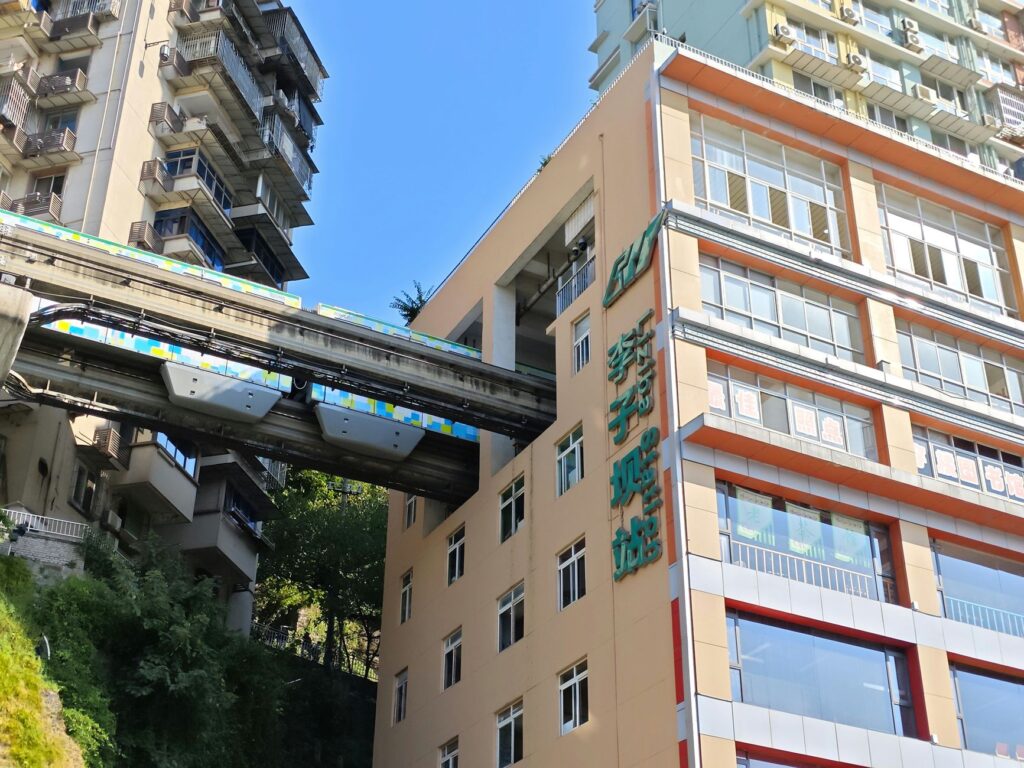
Among the city’s most famous sights is Chongqing Rail Transit Line 2 as it passes through Liziba Station. Custom-engineered into the sixth through eighth floors of a nineteen-story residential building, this infrastructural marvel draws steady crowds of onlookers. Every few minutes, silent, vibration-dampened trains glide smoothly through the core of the structure, disappearing into the building facade before the eyes of waiting photographers on the street below.

Beyond its novelty on camera, Liziba represents a pragmatic solution to urban density. Designed in the early 2000s to avoid structural demolition and land clearance, the project seamlessly integrated public transportation into residential architecture—a pioneering model of spatial efficiency that continues to fascinate urban design experts worldwide.
Hongyadong: Neon Heritage along the Jialing River
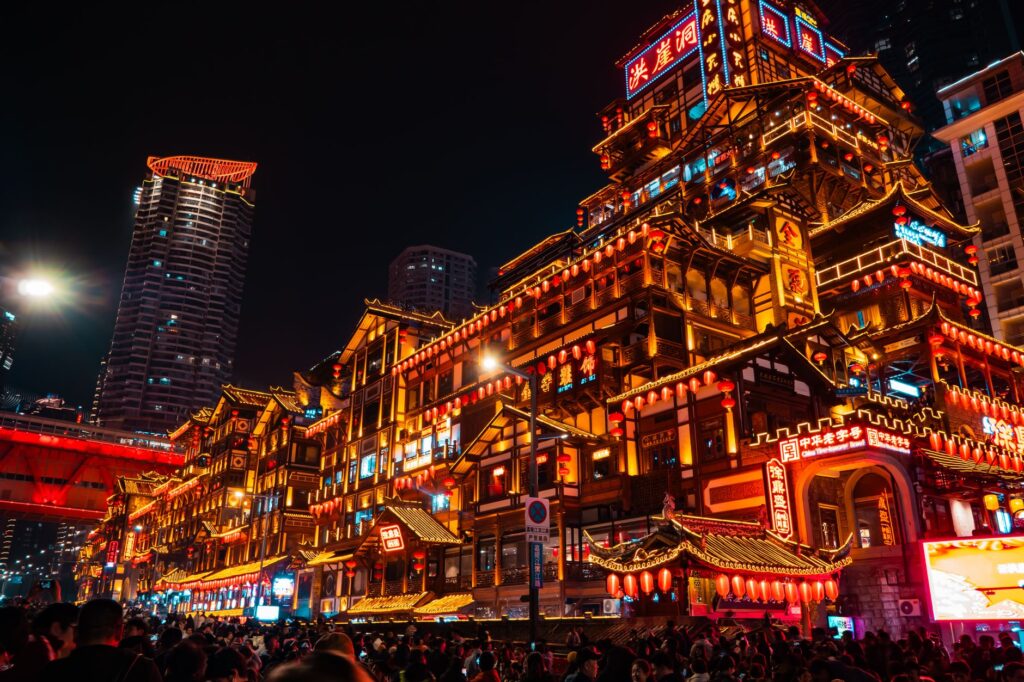
As evening descends, public life gravitates toward Hongyadong, an eleven-story architectural complex built against the sheer face of a riverfront cliff. Modeled after the classic diaojiaolou—traditional stilt houses historic to the regional Bayu culture—the complex features layered wooden balconies, tiered eaves, and warm lanterns that illuminate simultaneously at dusk, echoing scenes from iconic Asian animation.
While the interior houses busy souvenir stalls, tea houses, and dining halls, the most striking view is obtained from afar. Standing on the Qiansimen Bridge or viewing the complex from a riverboat offers an indelible vista: glowing traditional architecture juxtaposed against the soaring, neon-clad skyscrapers of the modern financial core across the water.
The Solo Traveler’s Reality: Digital Ecosystems and Linguistic Barriers
Navigating Chongqing independently is a masterclass in modern digital self-reliance. The domestic economy operates almost entirely cashless, making traditional credit cards and physical currency impractical for everyday transactions. Setting up digital payment platforms like Alipay and WeChat Pay prior to arrival is essential for everything from buying metro passes to purchasing snacks from local vendors.
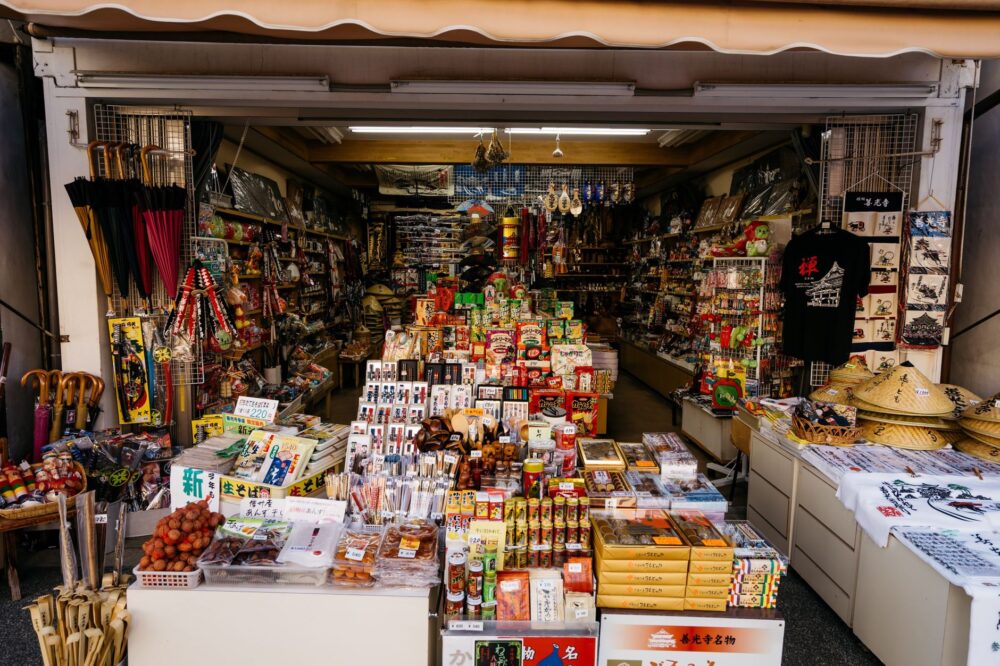
Linguistic barriers are significant, as English signage and English-speaking staff remain limited outside major international hotel chains. Navigating efficiently requires real-time translation tools with camera-assisted visual reading. Additionally, maintaining access to international services requires reliable mobile data solutions, such as international roaming eSIMs or properly configured network tools compliant with local regulations.
Exploring a Chinese megacity alone demands replacing traditional geographic intuition with digital fluency and patient observation.
Culinary Fire: The Ritual of Authentic Chongqing Hotpot
Understanding Chongqing’s local character is impossible without sampling its legendary cuisine, led by the fiery regional hotpot. Originating along the riverbanks as a cheap, hearty meal for dock porters, the dish revolves around a central basin of simmering broth seasoned with beef tallow, dried chili peppers, and numbing Sichuan peppercorns (huajiao).
Diners submerge raw ingredients ranging from thinly sliced meats to fresh bamboo shoots and specialty cuts into the boiling pot. Eating hotpot here is an intensely social, sensory ritual: crowded dining rooms fill with steam and loud conversation, balanced by cold herbal teas or local lagers to cool the palate. Solo travelers can readily find modern eateries offering individual mini-pots designed for single diners.
Beneath the Haze: Riverine History and Local Grit
Beneath the futuristic luster of social media media clips lies a city rich in historic endurance. Chongqing served as China’s provisional wartime capital during World War II, surviving years of heavy aerial bombardment that forged a notoriously resilient and pragmatic civic spirit. Many of the vast underground air-raid shelters carved into the sandstone mountains have since been repurposed into subterranean markets, cool cafes, wine cellars, and pedestrian walkways.
The local climate—characterized by heavy river humidity and a signature mist that frequently shrouds the upper stories of downtown skyscrapers—bestows a quiet, cinematic mood upon the city. Life remains tied to the Yangtze and Jialing rivers, where public ferries carry commuters between banks for nominal fares, offering a serene perspective on the towering urban waterfront.
Practical guide
Visas and entry requirements
Verify current visa exemption policies or transit visa-free allowances applicable to your passport prior to departure. Ensure your passport has at least six months of remaining validity from your date of entry.
Payments and digital tools
Install and verify Alipay and WeChat before traveling, linking international payment cards. For seamless navigation, download local map tools such as Baidu Maps or Gaode Maps, and secure an international data eSIM with active roaming capability.

Getting around
The Chongqing Rail Transit (CRT) monorail and subway system is clean, affordable, and features bilingual English-Chinese signage at stations. For ride-hailing services like Didi or street taxis, always carry your destination written in Chinese characters.
Optimal timing
Spring (March to May) and autumn (September to November) offer mild temperatures and manageable humidity levels. Summers are notoriously intense and humid, historically earning Chongqing a reputation as one of the Yangtze River’s famous three furnaces.
When twilight arrives and the river mist merges with steam rising from neighborhood kitchens, Chongqing reveals its true character. Far beyond its viral online persona, it remains a living, breathing testament to human ingenuity—a city carved directly into the mountains where ancient rock, river currents, and modern steel harmoniously coexist.
Source: Journalistic adaptation based on travel reporting by Solo Female Adventure Travel & Itineraries | My Life’s a Movie.