
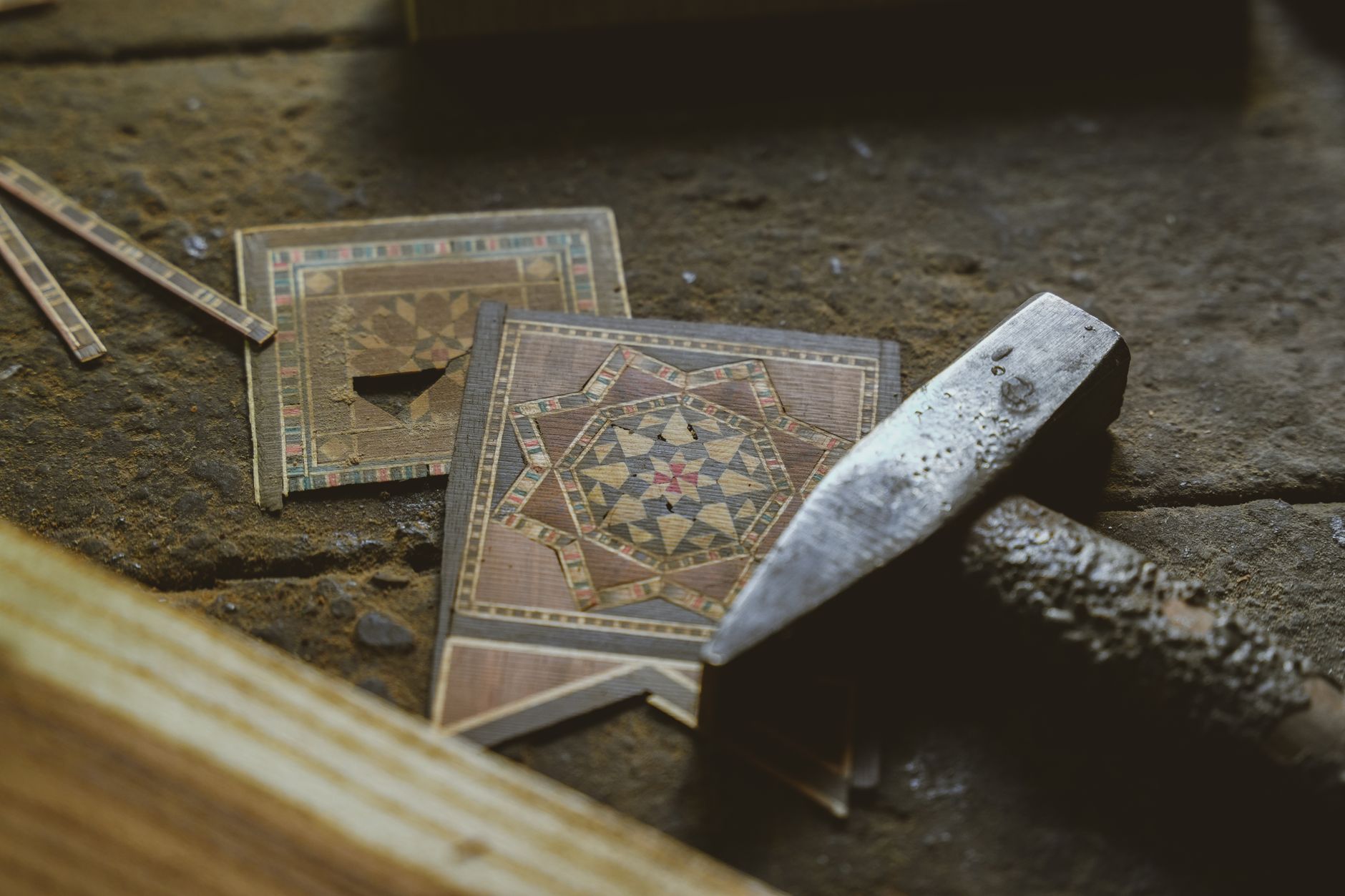

In the most secluded fabric of old Madrid, where cobblestone pavements still retain the echo of ancient guilds, wood ceases to be a mere structural support and transforms into a three-dimensional canvas. Far from the mass production dominating contemporary furniture, traditional workshops around the Rastro district and historic quarters preserve a craft on the verge of invisibility: fine marquetry. Here, patience is not an optional virtue, but an indispensable physical condition required to assemble millimeter-thick veneers that defy visual gravity through chromatic contrasts and natural textures.
This report delves into the daily pulse of these workshops where the gouge, the scalpel, and the wooden screw press still reign supreme over any industrial algorithm. Through conversations with veteran masters and young designers who have chosen to reclaim the technical heritage of the 18th and 19th centuries, we explore how artistic cabinetmaking survives the digital age by transforming into a form of sustainable auteur design deeply rooted in matter and time.
The Raw Material: When the Tree Dictates the Form
The marquetry process begins long before the artisan traces the first line onto the workbench; it starts with the meticulous selection of veneers. Inside wood warehouses along Toledo Street and its surroundings, the scent of dry resin, camphor, and walnut ages the air. Cabinetmakers examine each sheet searching for the whimsical knots of elm burl, the copper depth of Rio rosewood, or the almond-like veins of European boxwood. Each tree tells a geological story shaped by droughts, frosts, and soil minerals—information the artisan must decipher to anticipate how the wood will react when cut and polished.

Unlike conventional carpentry, marquetry works with thin sheets whose thickness rarely exceeds six-tenths of a millimeter. This demands absolute mastery over ambient humidity and the internal tensions of the material. If a burl walnut veneer dries out too much in the workshop, it will shatter upon contact with animal glue; if it retains too much moisture, it will contract over subsequent months, ruining the geometry of the final piece. It is a constant dialogue between the mathematical rigor of design and the capricious organic nature of wood.
The Hair-Saw Cut: Millimetric Geometry at the Workbench
The operational heart of any marquetry workshop is the fretsaw, popularly known as the hair-saw. Sitting before a small V-shaped notch in the carpenter’s bench, craftsmen lean their bodies at a precise angle to guide a metal blade as thin as a human hair. This technique, inherited from master cabinetmakers of European courts, allows for the French method or contrast cutting: multiple sheets of contrasting wood veneers are stacked vertically, the traced design is pinned on top, and all layers are cut simultaneously in a single pass.

The result of this extreme concentration is a set of interchangeable pieces where not a single millimeter of material is wasted. The dark piece fits millimetrically into the void left by the light piece, generating geometric motifs, floral compositions, or architectural landscapes with a precision that no industrial laser can replicate with the same tactile warmth. As one veteran dean of the Madrid guild with over forty years of experience notes: “The laser burns the fiber, seals it, and kills it; the hair-saw respects it, opens the pores, and allows the wood to keep breathing beneath the varnish”.
The Backstage of Hot Glue and Iron Presses
Once the puzzle of veneers is completed over the kraft paper holding them temporarily together, one of the most critical and physical phases of the process begins: edging and gluing onto the backing board. Traditional workshops continue to use animal glue—specifically bone and rabbit-skin glue prepared in a double boiler—for a purely technical reason: it is reversible. Unlike modern synthetic adhesives, hot glue allows any imperfection to be unglued and corrected by applying heat and moisture, while ensuring the wood does not suffer anomalous long-term stresses.
The board is quickly placed over the pine or fir base, covered with waxed paper to prevent sticking to the parallel metal spindle presses, and subjected to heavy pressure. Over the next twenty-four hours, the workshop maintains a nearly monastic silence, broken only by the subtle cracking of evaporating water and glue solidifying under pressure. It is the moment when physical material science seals the definitive marriage between decorative surface and structural support.
Polishing and Patina: The Soul Emerging into the Air
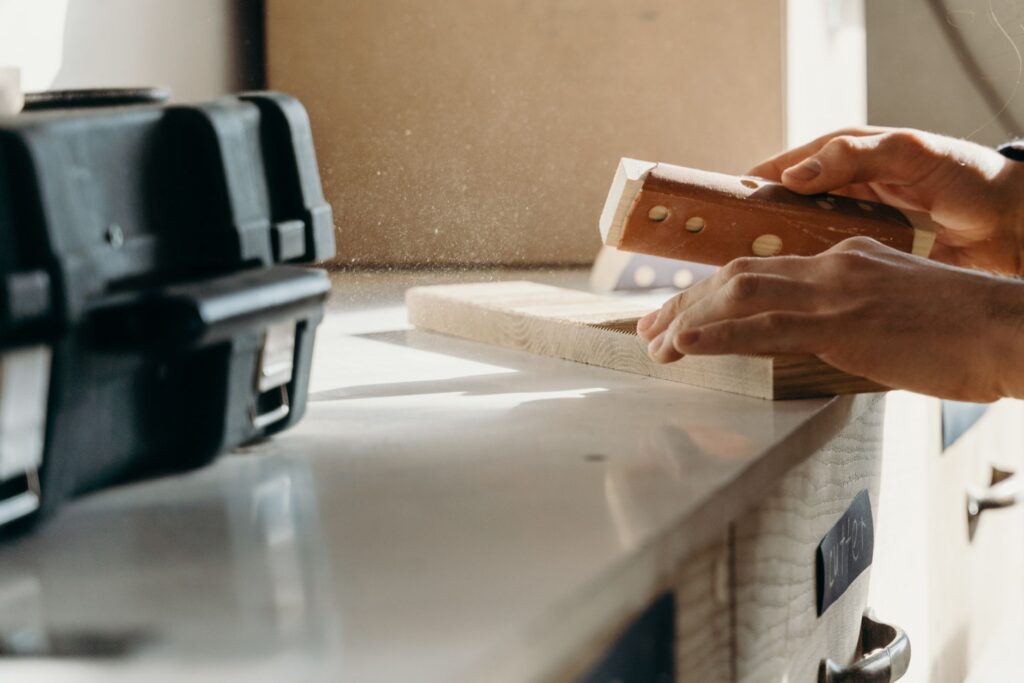
Dismantling the press and removing the protective paper reveals a rough, opaque, and seemingly dull surface. It is then that leveling and finishing begin—a task where the sense of touch far surpasses sight. Using perfectly sharpened cabinetmaker scrapers, fine files, and successive grades of sandpaper applied strictly along the grain, the artisan removes excess glue and smooths imperfections until the surface acquires the softness of silk.
To protect the marquetry and enhance its three-dimensionality, shellac dissolved in alcohol is traditionally applied using a cotton pad technique known as French polishing. This natural finish, composed of resinous secretions from the Asian lac bug, requires dozens of coats applied in circular, rhythmic motions. Each layer adds unmatched optical depth, allowing light to penetrate amber transparencies and return a warm, organic, and deeply human glow to the wood surface.
True luxury in contemporary cabinetmaking does not lie in material ostentation, but in the invisible hours of concentration that turn a forestry resource into an enduring tactile narrative.
Generational Handover: Contemporary Design and Roots
Faced with the extinction threat that loomed over these trades in the late 20th century, a new generation of creators is redefining the role of marquetry in interior design and ephemeral architecture. Young professionals trained in art and design schools have established shared studios in Madrid, reviving classical techniques while applying them to abstract geometries, modular furniture, and large-scale wall cladding that converse with modern minimalism.
This symbiosis between artisanal tradition and contemporary sensibility has captured the interest of interior architects and international collectors seeking unrepeatable pieces. The Rastro workshops no longer exclusively manufacture replicas of historical cabinets or restore Isabelino consoles; today they design acoustic wall panels clad in geometric veneers, coffee tables where reclaimed local woods converge, and technological supports integrated into high-end woodwork.
Practical guide

How to visit workshops and understand the universe of artisanal marquetry in Madrid:
- Workshop Locations: The highest concentration of historic workshops is located around Ribera de Curtidores, Mira el Río Baja street, and the La Latina neighborhood. While many are private workspaces, some open their doors during events such as the European Days of Arts and Crafts.
- Recommended Exhibition Spaces: The Museum of Decorative Arts (Calle de Montalbán, 12) houses one of Spain’s most significant collections of historic furniture, cabinets, and taracea, ideal for contextualizing the craft’s evolution.
- Acquisitions and Commissions: If you seek original pieces or wish to commission custom work, contact local artisan associations such as Oficios y Arte directly, as they certify the sustainable origin of woods and the authenticity of manual processes.
- Preventive Conservation: To care for marquetry furniture at home, avoid prolonged direct sunlight, maintain indoor relative humidity between 45% and 60%, and periodically nourish the wood with neutral natural waxes applied with a cotton cloth.
The future of this ancient art does not depend on museum nostalgia, but on its ability to continue moving people through touch. In a world saturated with cold screens and disposable objects, marquetry reminds us that true beauty lies in what has been carved with time, polished with patience, and handed over to the future as a testament of the human hand.


