


The Geometry of the Arctic Abyss
The Norwegian landscape is defined by its geological stubbornness. Along the western seaboard, where granite plateaus collide head-on with the North Sea, human mobility has historically depended on patience and meticulous technical calculation. The Flåm Railway, known in civil engineering manuals as the Flåmsbana, is far more than a leisure tourist route; it is a masterwork of civil engineering conceived to conquer one of the most aggressive vertical drops on the European continent. Over a mere twenty kilometers of track, the train plunges eight hundred and sixty-seven metres from the alpine station of Myrdal down to the docks of Flåm at sea level, operating on an average gradient of 5.5 percent across much of its run.
This topographical radicalism forced nineteenth-century engineers to devise an unprecedented traction system and tunnel layout. Out of the twenty kilometers making up the route, nearly six run through twenty tunnels hand-carved into the living rock during the early decades of construction. Each tunnel represents an exercise in millimeter calculation to prevent rockfalls and manage the constant infiltration of snowmelt water cascading down from the peaks. Work began in 1923 and concluded only in 1940, a monumental effort sustained by laborers working in conditions of extreme alpine isolation, using rudimentary tools and explosives on sheer vertical cliffs.
To understand the sheer magnitude of this rail corridor, one must examine the region’s hydrographic context. The Flåmsdalen valley acts as a natural drainage basin where glacial torrents from the Hardangervidda plateau converge. The railway crosses these turbulent waters multiple times via stone and steel bridges suspended over inaccessible gorges. The interplay between metallic infrastructure and the violent nature of rushing water creates a unique acoustic contrast, where the rhythmic clatter of wheels on steel rails merges with the roar of nearby waterfalls, such as the renowned Kjosfossen, whose hydraulic force today powers part of the line’s own electrical system.
The Architecture of Deceleration and the Traveler’s Pace
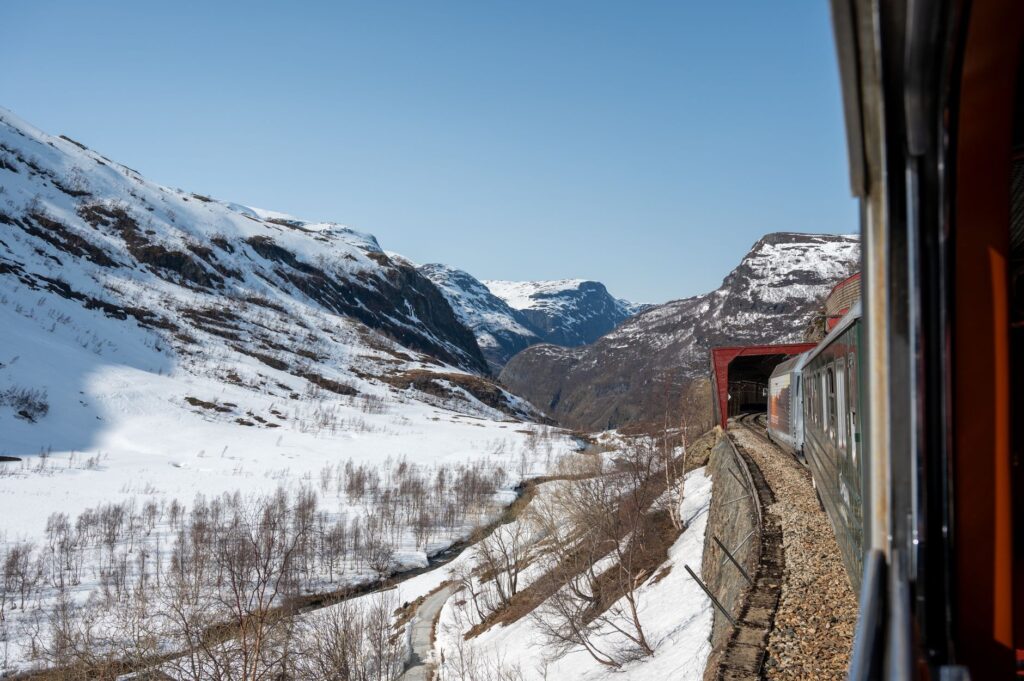
In the landscape of contemporary tourism, where speed is routinely prioritized over observation, the Flåm line operates as a philosophical and physical counterweight. Unlike high-speed trains that erase the landscape, this convoy travels at a maximum speed of forty kilometers per hour, dropping to twenty-eight in the steepest sections. This deliberate limitation is not merely a matter of technical safety; it constitutes a conscious invitation to contemplation and the restoration of the traveler’s biological rhythm in contrast to urban urgency.
The interior design of the carriages, clad in dark oak wood and equipped with large panoramic windows, prioritizes visual integration with the exterior. During the ascent or descent, passengers experience a radical climatic and ecological transition. Within minutes, the train moves from the treeless alpine tundra lashed by polar winds in Myrdal to boreal birch and conifer forests, ending in riparian meadows where marine influence softens the atmosphere. This accelerated shift in bioclimatic zones stimulates deep sensory attention, compelling travelers to abandon digital screens and tune into the tectonics of the landscape.
True exploration does not consist in seeking new landscapes, but in possessing new eyes to behold the relentless architecture of stone and water.
Maintaining this historic infrastructure requires a rigorous conservation protocol that combines traditional craftsmanship with advanced digital monitoring. Track maintenance crews daily inspect unstable rock slopes using laser sensors and on-foot patrols that check metal anchors installed in vertical walls. This artisanal care ensures the survival of an industrial heritage that, far from becoming a static museum piece, continues to function as a vital local transport artery, connecting residents of isolated hamlets with the main Bergen-to-Oslo railway network via the high-mountain junction at Myrdal.

The Logistics of Intermodal Integration in the Fjords
The efficient operation of the Flåm line depends on a complex logistical chain linking the railway with fjord navigation and mountain road networks. The terminal station at Flåm, located at the innermost tip of the Aurland Fjord—a secondary branch of the imposing Sognefjord—operates as an intermodal hub where heritage trains, electric passenger ferries, and regional buses converge. This precise synchronization prevents spatial congestion and optimizes the flow of visitors drawn by the glacial geography.
From an operational perspective, managing winter and summer timetables demands millimeter-level coordination. During the summer months, high train frequencies require an automated single-track signaling system with strategically placed passing loops at the intermediate stations of Berekvam and Blomheller. In winter, by contrast, absolute priority is given to snow clearance and avalanche prevention. Special locomotives equipped with front wedges and high-power snow blowers work before dawn to ensure the track remains free of frozen accumulations that could compromise mechanical safety.
This technical deployment contrasts with the apparent visual simplicity of the surroundings. Villages strung along the valley, such as Dalsbotn and Hareina, preserve vernacular timber architecture painted in the characteristic iron oxide red known locally as *furu*. Built upon dry-stone foundations to protect against dampness and seasonal river floods, these structures bear witness to a secular adaptation to a hostile environment. The coexistence of twentieth-century railway high technology with traditional agricultural practices forms a remarkable example of sustainable territorial development in zones of high ecological fragility.

The Science of Silence and Mental Well-Being
Beyond its value as an engineering feat or tourist asset, the journey along the Flåm railway offers an ideal case study on the acoustic and visual impact of environments on mental health. Recent research in environmental psychology indicates that continuous exposure to natural environments dominated by hydrogeological sounds—such as the steady flow of rivers and waterfalls—drastically reduces cortisol levels and blood pressure in urban travelers. The design of the line, running mostly through areas devoid of paved roads, isolates passengers from engine noise, generating a high-purity acoustic bubble.
The relative silence inside the train, especially on downhill sections where the electric motor decelerates to allow regenerative braking, induces a state of spontaneous mindfulness. Passengers silently observe the vertical walls of granite rock that seem to close in the sky, a spatial phenomenon known in environmental psychology as *sublime enclosure*. This experience contrasts sharply with the stress associated with driving on highways or navigating crowded airports, turning the train journey into a legitimate tool for preventive medicine and mental rest.
The sound of water striking bare rock acts as a natural metronome that dissolves the urgency of modern time and restores calm to thought.

Likewise, the absence of mobile phone coverage across wide stretches of the valley due to the mountain topography itself acts as a forced yet highly therapeutic digital disconnection. Far from causing anxiety, testimonies from frequent travelers indicate that this temporary loss of connectivity encourages unhurried conversation between strangers, quiet reading, and active contemplation of the changing landscape through the glass. The infrastructure thus transforms into a refuge against contemporary hyperconnectivity.
Practical guide
How to get there: The primary access to the Flåm line is via Myrdal station, located along the main Bergen railway line (*Bergensbanen*), which connects Oslo and Bergen. Direct car access to Flåm via the lower valley from the upper plateau is not possible without using the E16 road tunnel network, making the train the fundamental historical penetration route.
Ticketing planning: Tickets for the Flåmsbana must be booked well in advance, especially between June and August, due to high international demand and strict per-convoy seating limits to guarantee visual comfort. Combined tickets are available that integrate the train journey with electric fjord cruises through the Naerøyfjord.
Best time to travel: Although operational year-round, each season offers a radically different experience. From May to September, waterfall flow is at its peak and Arctic daylight is extended. From December to March, the snow-covered landscape transforms the valley into a white gorge, ideal for those seeking absolute winter silence.

Luggage and clothing: Layered warm clothing is strongly advised even in summer, as temperatures at the top of Myrdal and near waterfalls drop sharply. Footwear should be comfortable and slip-resistant for walking on damp stone platforms and viewpoint walkways.
The Echo of the Far North in Memory
The journey’s end at the Flåm dock returns the traveler to the open expanse of the fjord, where dark, calm waters reflect the stone walls like a mineral mirror. At this point of contact between solid earth and open water, the roar of the high mountains dissolves into the distant murmur of tides. Standing by the dock railing as the electric ferry prepares to cast off for Gudvangen is an exercise in synthesis: understanding that all human work, no matter how colossal its engineering, must submit with humility to the millennial rhythms of Arctic geology.
The afternoon’s lengthening shadows over the fjord water mark the close of a journey that transcends mere physical movement. The Flåm railway lingers in memory not only for the audacity of its tunnels or the extreme gradient of its tracks, but for its capacity to remind us that time, much like the water carving the valley, always finds its course when allowed to flow unhurried.


