Namibia unfolds before the traveler’s eyes as a land where geography seems to test its most extreme forms. From the blistering heat of red dunes tumbling directly into the Atlantic Ocean to the persistent fog wrapping rusting shipwrecks, this southern nation offers a monumental lesson on the persistence of life and the fragility of ecosystems. Far from mass tourism, navigating its routes requires understanding that time here is measured in geological eras and distances in hours of gravel track.
The primary challenge of this journey is not merely contemplating visual beauty, but understanding how local communities and scientists manage conservation in one of the most arid environments on the planet. The balance between regulated tourism development and the protection of unique biodiversity defines the current pulse of a nation looking toward the future from the immensity of its past.
The geography of emptiness and the chromatic palette of the Namib
The Namib Desert is not a homogeneous mass of sand, but a living archive of climatic transformations stretching back millions of years. Dune hues range from light ochre to intense red, acquiring violet shades at sunset due to the oxidation of iron accumulated in quartz grains. Every corner of this sand sea tells a story of millennial winds and cold ocean currents that prevent evaporation and generate perpetual drought.
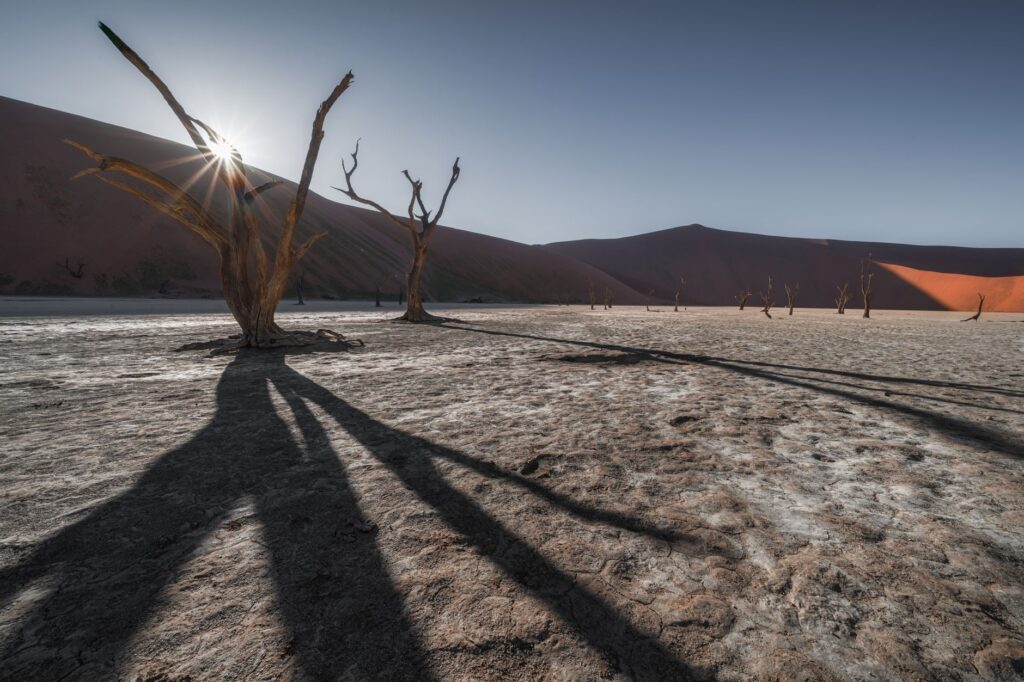
Sossusvlei and Deadvlei represent the iconic heart of this region. In the latter, an ancient desiccated clay pan, the black skeletons of camel thorn trees—dead for over half a century due to lack of water—stand out against the blinding whiteness of the clay and the vibrant red of surrounding dunes. There is no active vegetation or sound beyond the whisper of the wind; it is a landscape frozen in time that awes with its geometric severity.

Life on the margin: extreme biological adaptation
Surviving in the Namib requires fascinating evolutionary strategies that challenge known physiological limits. Darkling beetles, for example, have developed specialized anatomy allowing them to capture the dense morning fog rolling in from the Atlantic, tilting their bodies so condensation droplets slide straight into their mouths. This reliance on coastal mist demonstrates how nature finds pockets of abundance amid absolute aridity.
A few kilometers inland, large fauna has also had to adapt movement habits. Oryx, Hartmann’s mountain zebras, and desert-adapted elephants in Damaraland traverse vast distances following ancient underground riverbeds. The management of these ecological corridors is vital to prevent conflict between wildlife and pastoral communities, a challenge approached by Namibian authorities through communal conservancies.
The Skeleton Coast and the fury of the Atlantic
Where the desert meets the sea stands the infamous Skeleton Coast, named by Portuguese sailors who considered it the gates of hell due to treacherous currents, thick fog banks, and gale-force winds. The rotting wooden hulls and metal ribs of wrecks like the Eduard Bohlen or the Zeila protrude from sand and waves, recalling the implacable force of the South Atlantic over maritime history.
This coastal strip is not just a maritime cemetery, but a top-tier biological sanctuary. Colonies of thousands of South African fur seals populate sandy spits like Cape Cross, where their racket and pungent odor contrast with the stillness of the nearby desert. The presence of these mammals occasionally attracts brown hyenas and coastal lions specialized in marine hunting, a unique behavior baffling and fascinating biologists.
Swakopmund and Walvis Bay: colonial heritage and wetlands
Amid this inhospitable coastline, Swakopmund emerges as a mirage of 19th-century German alpine architecture. Wide streets, half-timbered houses, and bakeries serving Apfelstrudel contrast surreally with the dunes surrounding the city on three sides. This coastal enclave now functions as the adventure capital of the country, organizing kayak excursions among dolphins or scenic flights over the desert.
Further south, the Walvis Bay lagoon offers one of southern Africa’s richest ornithological spectacles. Plankton-rich waters attract monumental flocks of lesser and greater flamingos, pelicans, and migratory wading birds. This protected wetland is a critical link in the Atlantic migratory flyway, proving the Namib coast is not just arid, but a vital feeding ground for marine avifauna.
Damaraland: rock art and sculpted geology
Heading inland to the north, the landscape transforms into red sandstone plateaus and weathering-eroded basalt formations. Twyfelfontein, a UNESCO World Heritage site, concentrates one of Africa’s largest concentrations of petroglyphs and rock paintings. Hunter-gatherers carved representations of rhinoceroses, giraffes, and lions over six thousand years ago to map water routes and shamanic rituals.

The rock art of Twyfelfontein is not mere decoration, but a sacred survival map cartographing the ecological memory of a people attuned to scarcity.
Nearby, the landscape fractures into geological formations as unique as the Organ Pipe Pikes—basalt columns reminiscent of organ pipes—and the Burnt Mountain, whose volcanic strata display dark colors seemingly consumed by Earth’s internal fire.
Etosha: the great theater of wildlife
In the country’s north, Etosha National Park centers on a massive salt pan so vast it can be seen from space. During the dry season, this white salt desert becomes a magnet for wildlife, concentrating massively around scarce artificial and natural waterholes. Elephants, black rhinos, lions, and giraffes converge in a silent ballet of survival and hierarchy.

Staying overnight in camps like Okaukuejo, whose waterhole is artificially illuminated all night, reveals unusual scenes: elephant herds drinking under the stars while solitary rhinos await their turn at a prudent distance. Park management serves as a model of conservation based on tourism self-financing and strict environmental impact control.
Practical guide
How to get there: There are no direct flights from Spain or the US. Standard routing involves flying to Johannesburg, South Africa, and connecting to Hosea Kutako International Airport in Windhoek. Documentation: A passport valid for at least six months with blank pages is required. Most Western tourists do not need a visa for stays under 90 days. Health: Malaria prophylaxis is recommended when traveling to the north (Etosha and Damaraland) during the rainy season. Comprehensive travel insurance with medical evacuation coverage is essential. Transport: Main roads are paved, but the interior requires robust 4×4 vehicles with dual spare tires due to sharp gravel tracks. Currency: The Namibian dollar (NAD) is pegged one-to-one to the South African rand, which is also legal tender nationwide. Accommodation: Advance booking months ahead is mandatory for state-run Namibia Wildlife Resorts (NWR) camps inside national parks.
Namibia’s true engine lies in its social fabric and pioneering commitment to decentralized conservation. Through the national conservancy program, rural communities hold rights over wildlife management and tourism revenue on ancestral lands. This model has successfully revived populations of endangered species like the black rhino and cheetah, proving environmental policies succeed only when integrating local populations as legitimate stewards.

Conversing with local guides across northern plains or listening to traditional songs in Damara villages reveals that traveling through Namibia transcends simple aesthetic contemplation. It is an immersion in an ethics of scarcity where every resource is valued justly, reminding contemporary travelers of the urgency to rethink our relationship with the planet’s fragile balances.
Traveling through Namibia means accepting a truce with the noise of the modern world to listen to the ancient heartbeat of the earth under the relentless desert sun.
Leaving the country southward or eastward, travelers carry certainty of having walked through a space where nature retains absolute sovereignty. Dunes will continue shifting to eastern wind rhythms, shipwrecks will keep disintegrating under Atlantic salt, and fog will blanket the coast in an eternal cycle defying human transience.