At the northwestern edge of the British landmass, the railway network leaves behind the industrial order of the Scottish Central Belt to penetrate a territory where geology dictates its own laws. The West Highland Line was not conceived merely as a line of transport, but as a bold streak of steel carved across one of Europe’s most formidable and breathtaking topographies. Traversing this route means understanding humanity’s struggle to connect isolated fishing and farming communities across unfathomable peat bogs, extinct glaciers, and glens carved by ancient ice and water.
From Glasgow’s Queen Street Station to the fishing port of Mallaig, the iron track traces a 264-kilometer diagonal across layers of geological history and social transformation. As urban landscapes yield to the untamed wilderness of Loch Lomond and the desolate expanse of Rannoch Moor, the journey transforms into a masterclass in Victorian civil engineering and landscape adaptation, where every bridge, viaduct, and cutting represents a technical solution calculated to withstand the relentless Atlantic weather.
Victorian Genesis and the Topographical Challenge of Rannoch Moor
In the late 19th century, the need to support the west coast fishing industry and offer an alternative to the isolation of Gaelic-speaking communities spurred the creation of the West Highland Railway Company. Approved by Parliament after fierce debate over its financial viability, construction began in 1889 under the technical direction of engineering firm Formans & McCallum. The main obstacle facing the route was not the height of the mountain ridges, but the treacherous ground of Rannoch Moor—a 130-square-kilometer peat bog characterized by high altitude and absolute lack of structural bearing capacity.
Conventional excavation and foundation methods were impossible in soil made of decomposing organic matter and standing water sitting atop metamorphic bedrock. Sinking masonry piers down to solid rock would have required an astronomical budget and years of delays. Faced with this impasse, Victorian engineers devised a brilliant floating mattress solution: a submerged foundation grid made of tarred heather brushwood, local tree roots, compacted earth, and layers of crossed timber sleepers topped with heavy stone ballast.
«The tracks do not rest on solid rock, but on a flexible, floating mattress of heather and timber that has actively supported trains over Rannoch Moor since 1894.»
This floating trackbed has proven extraordinarily durable, absorbing the kinetic vibrations of heavy trains for well over a century without sinking into the bog’s waterlogged depths. The crossing of Rannoch Moor stands as a masterclass in native material usage and applied physics, turning a potentially destructive mire into the very foundation of trans-Highland transport.
Mass Concrete Architecture: The Technical Feat of Glenfinnan
The section of the line running from Fort William to Mallaig—opened in 1901 as a crucial extension to link Atlantic fisheries to mainland markets—demanded a radically different structural approach. The terrain of the Western Highlands, fractured by narrow sea lochs and deep glacial valleys, required numerous wide-span bridges. It was here that contractor Sir Robert McAlpine revolutionized bridge construction by pioneering the unreinforced mass concrete technique.
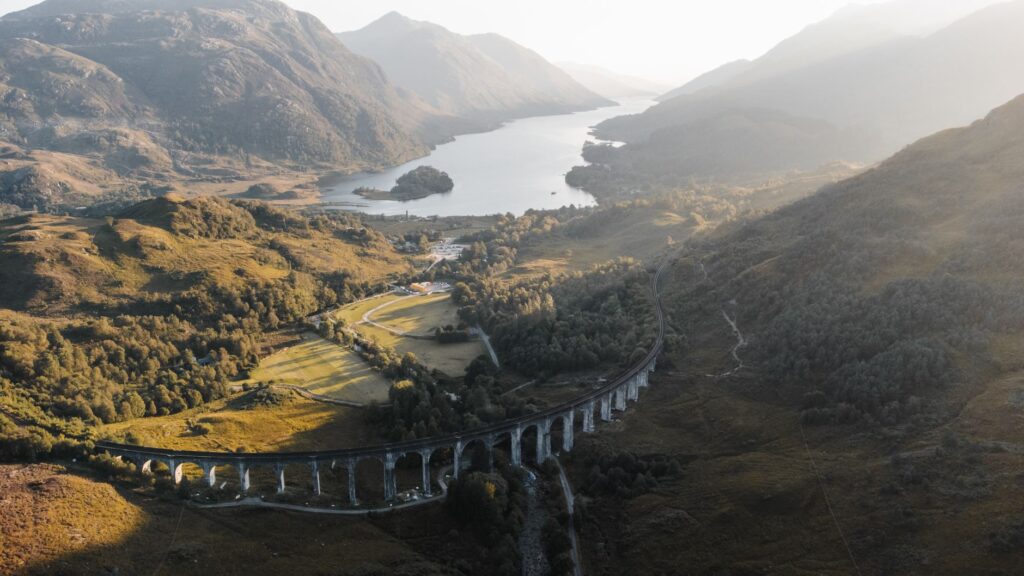
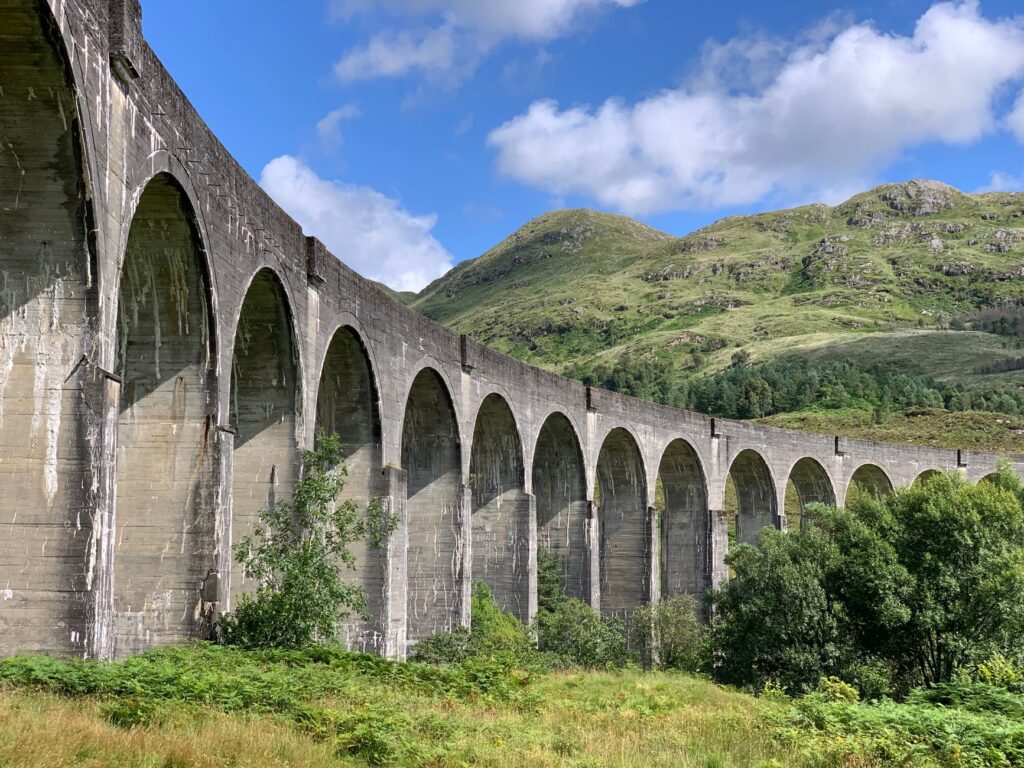
The Glenfinnan Viaduct, the crowning engineering achievement of the route, sweeps 380 meters across the Finnan valley at a maximum height of 30 meters, supported by 21 arches each spanning 15 meters. At a time when dressed stone and wrought iron dominated bridge building, McAlpine opted for Portland cement concrete poured in-situ, utilizing aggregate crushed directly from nearby glacial rock deposits.

- Total Structural Length: 380 continuous meters curved along a precise 241-meter radius.
- Primary Material: Mass unreinforced concrete, a pioneering innovation for a railway structure of this magnitude.
- Operational Gradient: Maintains a steady 1.8% climb to carry heavy locomotives smoothly over the valley divide.
- Environmental Integration: Color and texture match the surrounding schist and mica slate rock walls.
This technique drastically reduced material transport costs across roadless terrain and vastly accelerated construction timelines. Today, Glenfinnan Viaduct remains an intact monument to structural longevity, having endured continuous freight and passenger train passage under the harsh cycle of highland frost and heavy precipitation.
From Urban Fringe to Lochside Expanse: The Climb along Loch Lomond
Setting out from Glasgow’s urban heart, the train skirts the northern bank of the River Clyde before turning sharply northward. As urban density dissipates, the landscape undergoes a dramatic shift. The line clings to the steep eastern shore of Loch Long, a dark sea inlet, before crossing the narrow Tarbet isthmus to line up along the western precipices of Loch Lomond.
Here, the platform is carved directly into steep, heavily forested mountainsides high above the water’s surface. Cuttings blasted through hard schist bear witness to the manual labor of thousands of navvies working with dynamite and drills. The sweeping panoramas over Loch Lomond’s islands and the jagged Arrochar Alps illustrate how tightly the route aligns with the Highland Boundary Fault—the tectonic rift separating the Lowlands from the rugged wilderness of the north.
Human Geography in Isolation: Corrour and the Roadless Outposts
As the line climbs toward the interior plateau, human presence shrinks to stark outposts of resilience. High on the moor sits Corrour Station, perched at 411 meters (1,350 feet) above sea level, making it the highest and most remote main-line railway station in Great Britain with no public road access for miles around.

Life on the Edges of the Line
Corrour’s absolute isolation shaped a unique lifestyle for signalmen and railway families stationed there throughout the 20th century. With no connecting roads within a 15-kilometer radius, supplies of food, fuel, and mail depended entirely on passing trains. Severe winter blizzards frequently drifted deep into railway cuttings, requiring dedicated snowplow locomotives and track gangs working in freezing gales to keep the iron artery open.
Today, Corrour remains an essential dropping-off point for long-distance hikers and a symbol of the line’s untamed spirit. Free from light pollution and surrounded by endless open horizons, it holds a unique place on the map of European wilderness.
Operational Dynamics and Rolling Stock: Evolution of the Service
From the golden age of steam to modern diesel power, the rolling stock selected for the West Highland Line has been governed by steep gradients and unforgiving weather. During the steam era, heavy freight and passenger traffic relied on LNER K3 and V2 class locomotives, followed by British Railways Standard Class 5 engines, modified with enhanced sanding gear to maintain traction on wet, leaf-covered rails.
«The deep hum of diesel engines reverberates off rock cuttings, reminding travelers that machinery here is always working against the pull of gravity and nature.»
Today, scheduled passenger services are predominantly operated by Class 156 Super Sprinter diesel multiple units. Equipped with reinforced chassis and heavy-duty heating systems, these trains provide reliable year-round transit. Additionally, the iconic overnight Caledonian Sleeper connects London Euston directly to Fort William, allowing travelers to wake up at the foot of Ben Nevis after departing the metropolitan center the night before.
Maritime Geography of the Final Stretch: The Descent to Mallaig
Beyond Fort William and the sweep of Loch Eil, the railway enters its most dramatic coastal section. Leaving Glenfinnan behind, the tracks trace the shores of Loch Eilt before threading through ancient oak woodlands. Here, the Gulf Stream creates a mild microclimate, producing lush greenery that stands in stark contrast to the barren interior plateaus.
Reaching the Atlantic coast at Arisaig, the views open across the Sea of the Hebrides. Through the train windows, the sharp silhouettes of the Small Isles—Eigg, Rùm, and Muck—rise from the ocean. The train winds past white sand beaches and rocky outcrops before ending at the buffer stops of Mallaig harbor, where rail tracks meet ferry slipways serving the outer islands.

Practical guide
Route Planning and Timetables
ScotRail operates daily direct services connecting Glasgow Queen Street with Fort William and Mallaig. Advance seat reservations are highly recommended during peak spring and summer months to secure window seating on the most scenic sides of the carriage.
- Journey Times: Approximately 3 hours 45 minutes from Glasgow to Fort William; around 5 hours 15 minutes for the complete journey to Mallaig.
- Best Times to Travel: Late spring (May to June) offers long daylight hours and drier weather, while autumn (October) brings vibrant gold and purple hues to the bracken and heather slopes.
- Intermediate Stops: To alight at remote stations like Corrour or Rannoch, notify the conductor in advance, as several stops along the route operate strictly as request stops.
Conconnections and Essential Gear
Mallaig harbor provides direct ferry links to Armadale on the Isle of Skye, as well as regular sailings to the Small Isles. Travelers planning to hike into the backcountry from unstaffed stations should carry sturdy waterproof footwear, high-visibility layers, and reliable navigation tools.
Echoes of Steel over Loch Shiel
As the train slows for its final arrival into Mallaig, the Atlantic atmosphere takes full hold. Sea salt scents mix with the cool coastal air entering the carriage, replacing the earthy notes of peat and bracken that accompanied the journey across the mountains. In the harbor below, fishing boats sway in rhythm with the tide while gulls wheel over concrete breakwaters facing the distant hills of Skye.
It is here at the line’s end that the true achievement of the West Highland Line becomes clear. It is neither just a relic of Victorian engineering nor a simple scenic journey. It is a living, working artery that binds human history to an unyielding land—a ribbon of steel anchored in the wilderness, quietly testifying to human ingenuity against the vastness of the natural world.