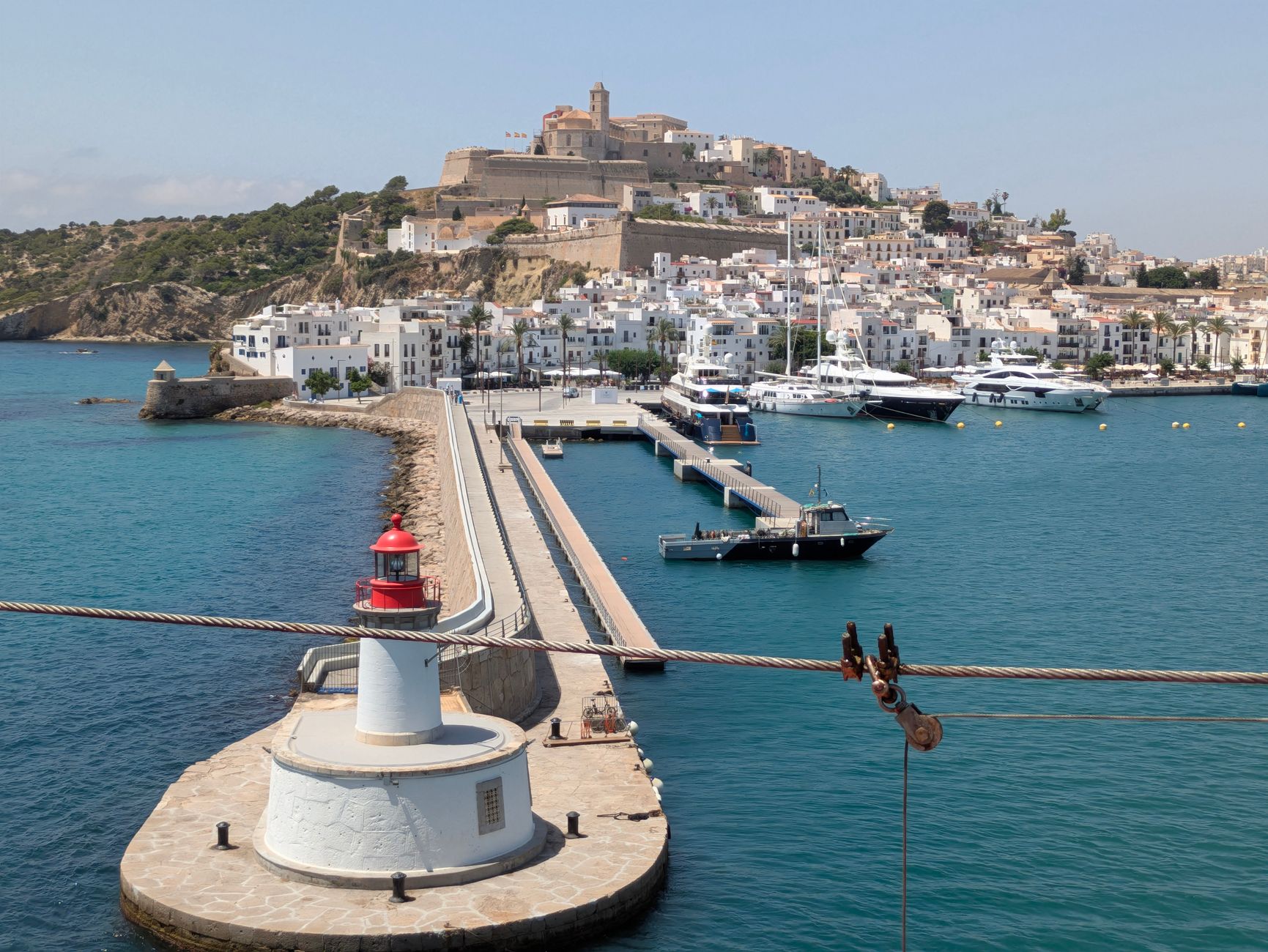

There are places in the Mediterranean where time does not flow in a straight line, but rather in waves of collective memory. Ibiza, beyond its geographical coordinates and the summer frenzy that dominates contemporary headlines, preserves an invisible yet tangible layer: that of the golden years when the island functioned as a refuge for radical freedom, artistic creation, and unpretentious hedonism. Out of this well-understood nostalgia arises a hospitality proposal that rejects impersonal luxury in favor of biographical storytelling. Hotel Mongibello is not merely a place to stay; it is a three-dimensional archive where every corner evokes the spirit of the dolce vita adapted to the island’s unique character.
The project stems from a premise as ambitious as it is delicate: translating the experiences, luminous excesses, and bohemian elegance of the mid-20th century into accommodations with distinct identities. Far from the minimalist uniformity that dominates much of today’s high-end hotel industry, this property has conceived 32 suites acting as time capsules. Each of them pays tribute to real individuals, cultural archetypes, or stellar moments that defined Ibiza’s personality before the advent of mass tourism. An exercise in emotional archaeology that turns interior design into an act of narrative journalism.
The myth of the dolce vita translated to the Balearic coast
To grasp the magnitude of this proposal, one must look back to the moment when Ibiza began to draw a diverse brotherhood of writers, painters, musicians, and adventurers seeking anonymity. The Pisan coast offered a blank canvas where the social conventions prevailing in continental Europe lost all validity. In this setting, traditional architecture of whitewashed walls and organic volumes merged with a carefree yet intensely aesthetic lifestyle. Porch sunsets, long afternoon meals washed down with local wine, and impromptu gatherings beneath the fig trees shaped an imaginary that now feels almost mythological.
Hotel Mongibello recovers this atmosphere through a careful selection of materials and visual references. The design does not seek a cardboard-historicist imitation, but rather a contemporary reinterpretation of those codes. Pastel tones, noble woods, artisanal terrazzo, and mid-century furniture coexist in a balance that immediately transmits a sense of belonging. Here, luxury lies not in ostentatious finishes, but in the space’s ability to evoke an era when time belonged to those who knew how to enjoy it.
Contemporary luxury in Ibiza no longer seeks absolute isolation, but rather a connection with a cultural memory that refuses to disappear beneath the asphalt of standardized tourism.
Architecture and design: when walls recover their voice
The core of this experience lies in its spatial distribution. The architectural complex dialogues fluidly with the marine environment, allowing natural light to act as another building block. The curved lines of the terraces recall the organic architecture of the sixties, while native vegetation—pine trees, agaves, and oleanders—acts as a visual filter ensuring privacy without breaking the connection with the coastal landscape. Every detail has been considered so guests experience a smooth transition between exterior bustle and the serenity of the private sanctuary.
Inside the buildings, corridors transform into spontaneous art galleries. Archival photographs, vintage posters, and objects found in local flea markets compose a scenography that invites pause. No two spaces are alike; heterogeneity is the norm and the most evident hallmark of the project. This formal diversity ensures that each room offers a unique perspective on the island’s cultural history, deliberately avoiding the monotony characteristic of large hotel complexes.
Thirty-two particular universes: the narrative of the suites
The heart of the proposal materializes in its 32 suites, each conceived as a specific tribute. Far from being numbered conventionally, many of these rooms bear the names of figures who left an indelible mark on the island, or evoke concepts and experiences from that golden era. From the sanctuary inspired by the aesthete seeking creative solitude to the festive space recalling legendary private parties in hidden coves, the spectrum of experiences is as broad as it is fascinating.
The interior design of these suites features iconic furniture pieces recovered and restored by local artisans, natural fiber textiles crafted in traditional workshops, and graphic art documenting the creative effervescence of Ibiza in the seventies. The color palette varies subtly from one room to another: while some lean toward solar corals and yellows, others prefer deep blues and off-whites that converse directly with the Mediterranean Sea. Sleeping here means inhabiting a small piece of aesthetic historiography.
Gastronomy as a bridge between tradition and hedonism
No recreation of the Ibizan dolce vita would be complete without a culinary proposal honoring the products of land and sea. The establishment’s gastronomic approach rejects avant-garde fine dining labels in favor of comforting honesty. Ingredients originate from local orchards and nearby fish markets, ensuring direct traceability translated into clean, direct, and deeply Mediterranean flavors.
Open-air dinners, illuminated by the warm light of paper lamps and accompanied by a musical selection moving between classic jazz and bossa nova, constitute one of the day’s high points. Traditional Pisan dishes—reinterpreted with impeccable technique yet retaining their rustic soul—are served on artisanal tableware recalling past summer gatherings. It is a tribute to unhurried dining, viewing the table as a primordial space for encounter and conversation.
The cultural pulse: art and music as insular DNA
Ibiza’s identity has never rested solely on its scenic beauty; it has primarily functioned as a magnet for creative minds drawn by freedom of expression. Mongibello embraces this legacy by integrating a cultural program including temporary exhibitions by resident artists, book presentations, and informal literary gatherings. Music occupies a central place, safely removed from the strident circuits of commercial electronic music.
Sunset vinyl sessions, curated by experts in the island’s musical history, recover the warm sounds of Balearic funk, psychedelic folk, and instrumental melodies that accompanied long summer days in the 1960s and 1970s. This attention to sonic detail rounds out an immersive atmosphere where all senses participate in recovering a past time that here feels strangely close.
Practical guide
How to get there: Ibiza Airport (IBZ) receives regular connections from major European and peninsular capitals. The journey by private vehicle or taxi to the hotel takes approximately thirty minutes by road.
Location: Situated in one of the island’s most privileged coastal areas, the property offers direct access to crystal-clear coves and lies within easy reach of cultural landmarks.
Rates: Suite rates vary according to season and room typology. Advance booking is strongly recommended due to high demand and the exclusive nature of the 32 units.
When to visit: The months of May, June, September, and October offer the perfect combination of mild weather, tranquility, and the opportunity to enjoy the island with lower tourist density.
Reservations and contact: All official information regarding availability, cultural events, and establishment policies is managed through the hotel’s direct communication channels.
The epilogue of light: when the day bids farewell to the Pisan coast
There is an exact hour on the coast of Ibiza when the landscape acquires an almost cinematic texture. As the sun descends, dyeing the horizon in copper and violet tones, the 32 suites of Hotel Mongibello seem to draw a new breath, as if the stories of the figures who inspired each space intertwined with contemporary travelers’ experiences. In that moment of shared silence, facing a sea that has witnessed civilizations, myths, and shipwrecks, one understands that true luxury lies not in excess, but in the ability to connect with the enduring beauty of things well made. The island continues to guard its secrets, but here they are generously surrendered to those who know how to listen.
Source: Condé Nast Traveler Spain (https://www.traveler.es/articulos/las-leyendas-detras-de-la-ibiza-dorada)