
The Catalan morning begins before dawn breaks
Barcelona is a city that wakes up through its markets. Long before traffic begins to clog the Ronda del Litoral or tourists stroll leisurely down the Passeig de Gràcia, the city’s port docks and centralized logistics hubs have already distributed the goods that will fuel the day. The Boqueria Market, officially known as the Mercat de Sant Josep, leads this daily pulse. Strategically located right next to the bustling Rambla, this venue is far more than a commercial supply point; it functions as a social thermometer, a living archive of Catalan culinary memory, and an ecosystem where deep-rooted tradition coexists with the pressures of global tourism.
Crossing the entrance arches at dawn reveals a silent yet relentless choreography. The restaurateurs from the bistros of the Gothic Quarter and the Born negotiate the day’s catch and harvest with the stallholders. Here, produce is never displayed at random: every piece of fish, every bunch of grapes, every cut of meat adheres to rigorous classification based on origin, season, and ripening. Professionals in the sector know that the excellence of a dish begins long before turning on the stoves; it is forged through the meticulous selection of raw materials in these centuries-old aisles.
From a secularized convent to a cathedral of produce
The history of the Boqueria is tied to Barcelona’s major urban and political shifts. The space now occupied by the market originally housed the convent of Sant Josep, belonging to the Discalced Carmelites order. Following the Mendizábal disentailment decrees and the anti-clerical fires and riots of the 1830s, the building was demolished. Initially, the plot was designated as a porticoed square to house the open-air market that had previously dispersed chaotically around the vicinity of the Rambla. It was not until 1840 that the foundation stone of the definitive market was laid, although its iconic metal roof—a true masterpiece of nineteenth-century engineering inspired by Europe’s grand railway stations—was not inaugurated until 1914.
This transition from the street to architectural shelter radically transformed how Barcelonians related to food. The market ceased to be an improvised souk and became an orderly, hygienic institution regulated by municipal authorities. Family stalls were passed down from generation to generation, accumulating encyclopedic expertise regarding the seasonality of mushrooms, native tomato varieties, and sustainable fishing arts practiced along the Catalan coast.
The backstage world of vendors: resilience and encyclopedic knowledge
Talking about the Boqueria today requires looking beyond the colorful stalls of tropical juices and cut-fruit skewers that welcome visitors at the main entrance. Moving inward toward the central and rear naves, the strident noise fades to reveal the true backstage reality of the market. There operate the veteran stallholders, guardians of a gastronomic heritage at risk of dilution. Families originating from the Maresme region or the Ebro Delta continue to bring local vegetable varieties that take only a few hours from harvest to display.
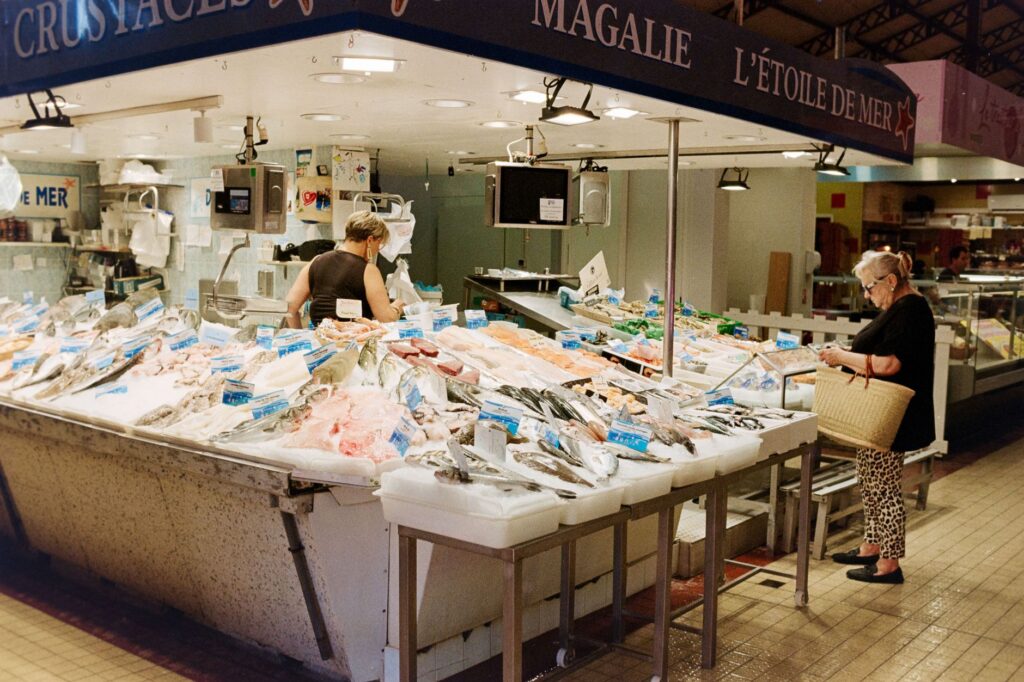
In the fishmonger sector, the offering is a masterclass in marine biodiversity. The stalls showcase red prawns from Palamós, langoustines from Sant Carles de la Ràpita, monkfish, hake, and small rock fish captured through artisanal inshore fishing. The vendors explain with didactic patience the differences between muddy-bottom fish and rock fish, advise on ideal cooking methods, and clean the fish with a surgical dexterity that impresses foreign observers.

The traditional market does not survive as a museum piece, but rather as a living organism that must negotiate daily between economic viability and the preservation of its identity.
However, real estate pressure and mass tourism have profoundly altered commercial dynamics. Many historic stalls have been tempted to convert into fast-tasting bars, transforming raw produce sales into a model of instant consumption for tapas and rations. This shift sparks ongoing debate between municipal managers and traditional merchants: should the market prioritize its neighborhood supply function, or yield to the massive demand of international visitors?
The invisible geography of mushrooms and Catalan orchards
One of the greatest attractions of the Barcelona market lies in its capacity to reflect the diverse landscape of Catalonia, a territory condensing sea, mountain, river valleys, and arid drylands within a few kilometers. During autumn months, mushroom stalls capture all eyes. The *rovelló* (saffron milk cap), the *camagroc*, the *cep* (porcini), and the *llenegua* arrive straight from the forests of Berguedà, Montseny, or the Pyrenees. Specialized vendors do not merely sell fungi; they act as botanical experts ensuring the traceability and safety of wild produce.

Similarly, the surrounding agricultural belt provides seasonal gems such as the Valls *calçot*—the undisputed star of winter *calçotades*—the Ganxet white bean with protected designation of origin, or hanging tomatoes from the Plana de Vic. These local varieties demand specific culinary knowledge that local chefs and experienced shoppers value above any industrial commercial standard.
Beyond the center: Barcelona’s neighborhood market network
Although the Boqueria captures international headlines, the true backbone of food supply in Barcelona lies in its network of more than forty municipal markets. Venues like the Santa Caterina Market, with its iconic undulating and colorful roof designed by Enric Miralles and Benedetta Tagliabue’s EMBT studio, or the Sant Antoni Market, a recently restored masterpiece of modernist ironwork, prove that the neighborhood market model remains vibrant and healthy.
These spaces fulfill an irreplaceable social function. They are covered public squares where locals not only buy meat, fish, and vegetables, but also practice urban sociability. The vendor knows their customers’ names, is aware of their dietary needs, understands what each family member prefers, and knows what recipes they will prepare for the weekend. This bond of mutual trust is the most effective antidote against the impersonality of large retail chains and mass e-commerce.

The alchemy of produce in market cuisine
The concept of market-driven cuisine—*cuina de mercat* in Catalan—constitutes the ideological core of high-end and mid-range dining in Barcelona. Renowned chefs and neighborhood tavern keepers share a single premise: the daily menu is not designed in an office, but in front of the morning display cases. If the fish market offers excellent red Almadraba tuna or if the farmer has brought an exceptional harvest of Maresme peas, the menu transforms immediately to honor that ephemeral ingredient.
This philosophy demands an attitude of absolute respect toward the raw material on the part of the cook. Preparations tend to be clean, devoid of unnecessary artifice that might mask the original flavor. Fresh fish requires little more than precise grilling and a trickle of extra virgin arbequina olive oil; seasonal vegetables shine with a brief cooking time that preserves their crunchy texture and natural sweetness. It is a cuisine that appears simple, yet rests upon rigorous technical foundations and an uncompromising selection at the source.
Practical information for the traveler and gastronome
For visitors wishing to explore the universe of Barcelona markets with discernment and respect, certain behavioral and planning guidelines are essential:

- Opening hours: Most municipal markets are open Monday through Saturday, generally from 7:30 or 8:00 in the morning until 2:30 or 3:00 in the afternoon. Some tasting stalls extend their activity into the afternoon, but the pure grocery market concentrates activity before noon.
- Respect for produce and space: Touching displayed goods with bare hands is prohibited in most stalls. Vendors are responsible for selecting and weighing requested items. Visitors should also avoid blocking main aisles with luggage or bulky photographic equipment.
- Payments and currency: While the vast majority of stalls accept credit cards and contactless payment systems, carrying some cash is recommended for small transactions at very traditional stalls or modest purchases.
- Getting there: Barcelona’s public transit network (Metro and TMB buses) connects directly to all municipal markets. The Liceu station (L3) places travelers practically at the gates of the Boqueria, while the Jaume I stop (L4) provides easy access to Santa Caterina.
Future challenges: sustainability and generational turnover
The future of fresh food markets in major European cities is not immune to structural threats. Beyond the aforementioned tourism pressure, the sector faces a severe generational turnover problem. Many children of current stallholders opt for professional paths outside retail commerce, discouraged by grueling early-morning hours and the physical demands of opening shutters before 6:00 AM for decades.
To counter this trend, merchant associations and city councils are driving specialized training programs, digitalization grants, and institutional campaigns highlighting the sustainability of local sourcing (*quilòmetre zero*). Reducing single-use plastics, encouraging bulk sales to minimize food waste, and certifying the organic origin of produce are indispensable steps to ensure these temples of taste remain vibrant through the coming century.
The unquenchable heartbeat of the city
Visiting a market like the Boqueria or any of its neighborhood sister markets in Barcelona is, ultimately, an act of profound cultural immersion. Behind every marble counter, beneath every canvas awning, and amidst the steady murmur of daily transactions lies the true identity of a people who understand food not merely as an act of subsistence, but as a ritual of affection, culture, and shared memory. As long as stalls continue to open at dawn and vendors patiently advise on the precise ripening point of a cheese or the freshness of a fish, Barcelona’s heart will continue to beat with an unquenchable strength.