Introduction to a Masterpiece of Global Railway Engineering
The railway journey connecting the Swiss town of Chur with the Italian locality of Tirano via the Bernina Pass is not merely an alpine transport link; it represents one of the pinnacles of twentieth-century civil engineering and an immersive travel experience where technical design exists in perfect harmony with Europe’s most demanding geography. Managed by the Rhaetian Railway (Rhätische Bahn) company, this rail corridor winds through glacial valleys, crosses multi-arched stone bridges, and climbs up to 2,253 meters above sea level at the Bernina Hospice without resorting to rack-and-pinion systems—a technical milestone that continues to captivate engineers, historians, and international travelers alike.
Spanning over 120 kilometers of meter-gauge track, the train tackles gradients of up to 70 per mil, proving that human ingenuity is capable of carving stable pathways across precipices, through spiral tunnels, and beneath the watchful gaze of snow-capped peaks such as the Bernina massif. This report provides an in-depth analysis of the historical, technical, and practical aspects necessary to understand, plan, and rigorously enjoy one of the planet’s premier rail routes.
Historical Origins and the Challenge of Uniting Grisons with Lombardy
The genesis of the Bernina line dates back to the late nineteenth and early twentieth centuries, a period when the Swiss canton of Grisons desperately needed to break its geographical isolation and connect its alpine valleys with the commercial networks of neighboring Italy and northern Europe. Up to that point, the transport of goods and passengers depended on slow, hazardous stagecoaches vulnerable to harsh winter weather in the Alps.

In 1904, the Bernina-Bahnbahn company was formally established with the initial purpose of constructing and operating an electric narrow-gauge railway capable of year-round operation. Engineers faced a fragmented, unstable terrain subject to extreme meteorological conditions. The complete inauguration of the route between St. Moritz and Tirano took place in 1910, subsequently integrating into the Rhaetian Railway network in 1943. In 2008, UNESCO recognized the outstanding universal value of the Albula and Bernina lines, inscribing them on the World Heritage list for their exemplary landscape integration and technological innovation.
Mechanical Ingenuity: Conquering Relief Without Rack-and-Pinion
One of the most remarkable and studied aspects of the Bernina railway is its ability to overcome colossal elevation changes using exclusively the natural adhesion between steel wheels and rails, dispensing with rack systems that slow down progress and limit speeds. This feat is achieved through powerful electric locomotives and motorized railcars specifically engineered to distribute traction across multiple axles.
The electrification of the line was executed from the outset using single-phase alternating current, tailored to high-power demands on steep inclines. The regenerative braking system furthermore allows energy to be fed back into the electrical grid during prolonged descents from the mountain pass toward Tirano—a pioneering example of energy sustainability applied to mountain rail transport over a century ago.
The Architectural Masterpiece: The Brusio Circular Viaduct
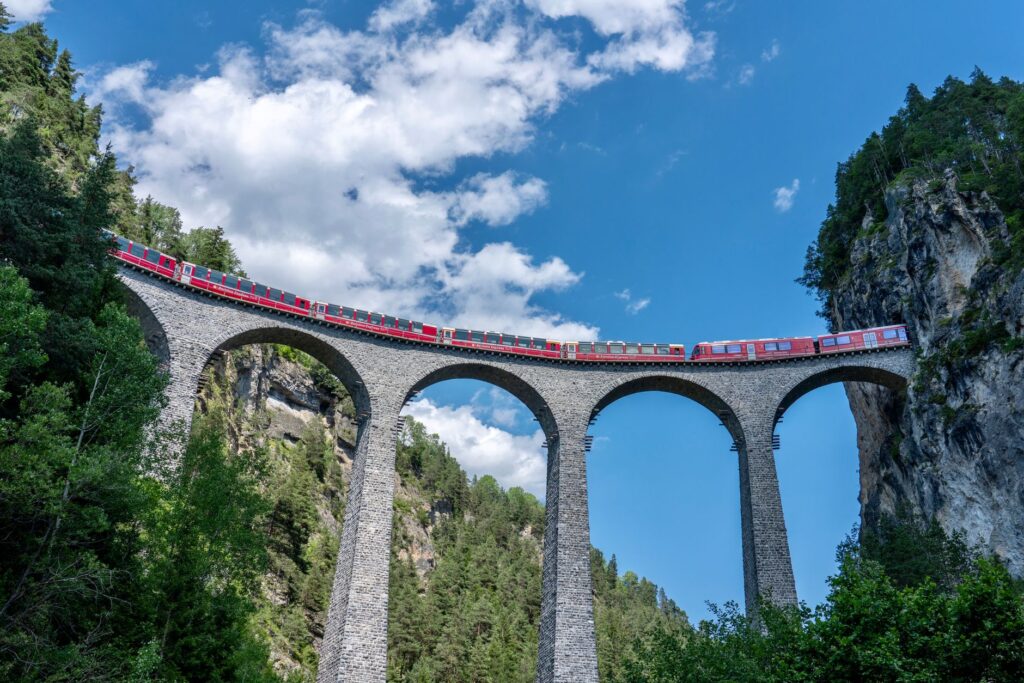
Among the various monumental elements punctuating the journey, the Brusio helical viaduct holds a prominent position in the history of civil architecture. Located along the final stretch of the southern slope, shortly before reaching Tirano, this curved bridge was designed to resolve a critical spatial problem: overcoming an excessively steep gradient within a very confined horizontal space.
Rather than tunneling extensively or building an impractical inclined plane, engineers projected a complete 360-degree loop with a radius of curvature of barely 70 meters. The train describes a perfect circle over limestone masonry arches, elevating or descending upon itself and allowing passengers to observe the railway composition as it snakes past from an unusual perspective. This technical solution is not only functional but has become the undisputed visual icon of the route.
The Brusio viaduct demonstrates how topographic limitation can be transformed into an architectural work of art that engages in dialogue with the agricultural landscape of the Poschiavo valley.
From High Mountain to Palm Tree: Climatic Diversity in Hours
One of the most unique appeals of the journey lies in the dizzying climatic and landscape transition experienced by the traveler within a mere four-hour ride. The train departs from severe alpine environments where glaciers such as Morteratsch dominate the horizon, and vegetation is sparse, limited to high-altitude meadows and conifers resilient to extreme cold.
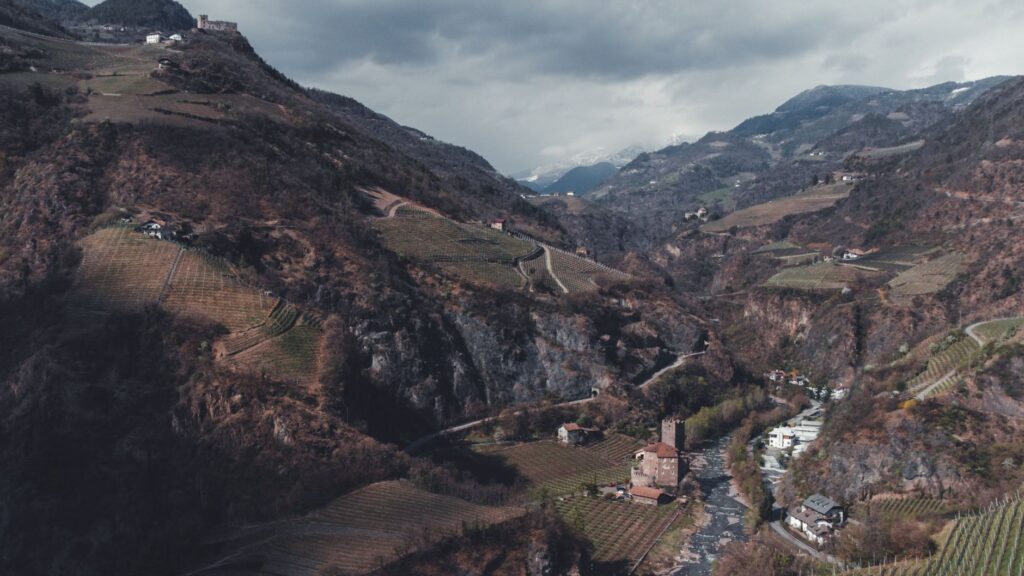
As the convoy crosses the threshold of the Bernina Pass and descends through the Poschiavo valley toward the Italian Valtelina, the scenery transforms radically. Firs give way to chestnut woods, glacial lakes are replaced by terraced orchards and vineyards, and the cold mountain air yields to the temperate atmosphere of the southern Alps. Upon arriving in Tirano, situated just over 400 meters above sea level, the presence of Mediterranean vegetation, palm trees, and Lombard-influenced architecture completes a geographical contrast difficult to match on any other European route.
Logistics and Planning: How to Organize the Journey
Planning a trip along the Bernina line requires understanding the operational difference between regular regional trains and the commercial panoramic service globally known as the Bernina Express. Both traverse the exact same tracks and share identical exceptional landscapes, but their onboard experience and reservation structures differ significantly.
Regional trains operate on an hourly or bi-hourly frequency, featuring traditional carriages with drop-down windows—ideal for photography enthusiasts wishing to capture images without glass reflections—and require no prior seat reservations. Conversely, the Bernina Express features air-conditioned panoramic cars equipped with large curved windows extending into the roof, offering overhead views of the peaks, though windows cannot be opened and a specific mandatory seat reservation surcharge must be paid on top of the base ticket fare.
Key Connections, Airports, and International Access
Access to the Rhaetian Railway network is primarily achieved through rail hubs well integrated with the European transport system. Chur, the northern starting point for many services, is reachable via direct trains from Zurich and its international airport, the primary entry gateway to Switzerland for travelers arriving on intercontinental flights.
Meanwhile, Tirano, the southern terminal in the province of Sondrio, features direct rail connections operated by Trenord to Milan and its metropolitan area, enabling the design of circular itineraries combining northern Italy and Switzerland. Milan’s airports (Malpensa, Linate, and Bergamo) are situated approximately two and a half to three hours away by train or road from Tirano, facilitating international getaways.
Fares, Tickets, and the Swiss Transport System
The tariff system of the Bernina line is integrated into Switzerland’s general public transport network, simplifying the purchase of tickets for foreign visitors. The Swiss Travel Pass offers full coverage for the base journey on regional trains, although passengers opting for the Bernina Express remain obligated to pay the mandatory seat reservation surcharge, which varies according to the tourist season.
It is strongly recommended to secure seat reservations weeks or even months in advance during peak travel periods, which coincide with the summer months (July and August) and the height of the winter ski and snow landscape season (December to February). For budget-conscious travelers or those preferring flexibility, utilizing regular regional trains without surcharges guarantees the exact same panorama alongside the added advantage of opening windows for sharper photography.

Traveling on standard regional trains not only saves on tourist surcharges but also enables direct interaction with local residents who rely on this infrastructure for their daily commutes.
Practical Information for the Traveler: Luggage, Accessibility, and Seasonality
When packing for the trip, it is crucial to consider the drastic thermal variations experienced in a single day. Even in the dead of summer, stops at high mountain passes such as Ospizio Bernina can feature temperatures near freezing and biting winds, while the final destination in Italy may record summer heat. Layered clothing and appropriate footwear are recommended for travelers planning short walks near the stations.
Regarding accessibility, Rhaetian Railway has made notable investments to adapt its stations and rolling stock. Modern regional trains and Bernina Express carriages feature designated wheelchair spaces and boarding ramps, though travelers should notify the company of specific needs at least 48 hours in advance to ensure assistance at smaller or high-altitude stations where platforms may require special deployment.
Visual Conclusion and Historical Persistence in the Twenty-First Century
The Bernina Railway represents much more than an alpine transport solution; it stands as an enduring testament to human capacity in transforming geographical adversity into a channel of communication and cultural understanding between northern and southern Europe. In an era dominated by the impersonal speed of commercial aviation and high-capacity highways, this historic rail line reaffirms the value of meditative slowness, respect for the natural environment, and the technical elegance of a mechanism that, powered by electricity, continues to defy the elements across the peaks of the world.