
Introduction to the Alpine Rail Legend
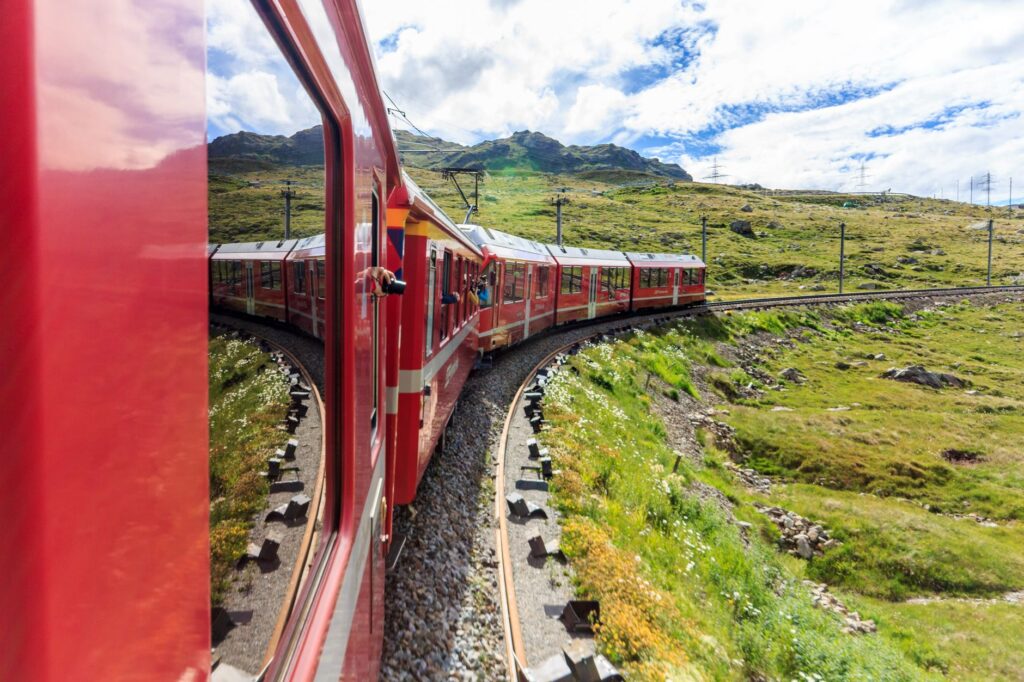
Travel across the European Alps has undergone a profound conceptual transformation in the 21st century, shifting from mere tourist transit toward a revaluation of slowness, sustainable engineering, and landscape contemplation. Within this ecosystem of alpine mobility, the Bernina Express stands out not only as a technical feat of international railway transport but as a vital artery connecting cultures, microclimates, and diametrically opposed geographies between Switzerland and Italy. Far from the hermetic speed of modern high-speed trains, this panoramic convoy champions the human scale of travel, allowing the modern voyager to comprehend the scale of the territory at an average speed of 35 kilometers per hour.
Operated jointly by the Rhaetian Railway (Rhätische Bahn) and historically linked to the mountain pass of the same name, this route stands as a living monument to human audacity. Its contemporary relevance lies in its capacity to offer a fully integrated, functional, and environmentally friendly public transport alternative within a fragile mountain ecosystem. This report analyzes the complex infrastructure enabling the route, its history, the ecological and scenic transitions experienced by travelers, and a rigorous practical guide to plan the journey safely.
Historical Genesis and Territorial Vision
The history of the Bernina Railway cannot be understood without recognizing the necessity of breaking the secular isolation of eastern Swiss alpine valleys in the late 19th and early 20th centuries. While major base tunnels prioritized freight transport and rapid north-south European connections at low elevations, Rhaetian Railway engineers chose the opposite philosophy: scaling the mountains in the open air to democratize access to the territory and boost local economies through pioneering alpine tourism.
The section between St. Moritz and Tirano was fully inaugurated in 1910, following the overcoming of colossal challenges that included obtaining international permits between the Swiss government and the Kingdom of Italy. From its inception, the route was designed for year-round operation, an extraordinary milestone given the severity of winters at the Bernina pass, situated over two thousand meters above sea level. The original vision of the engineers was not merely to create a shortcut, but a scenic and commercial corridor that today maintains its operational integrity, transporting international travelers and local residents alike.
Rackless Engineering and Extreme Gradients
One of the most fascinating aspects of the Bernina Express from a civil engineering standpoint is its ability to overcome extreme elevation differences using exclusively conventional adhesion, meaning without resorting to the rack-and-pinion system common in high-mountain railways. The route reaches a maximum gradient of 70 per mille (7%), setting a world record for a narrow-gauge railway operating solely by frictional traction.
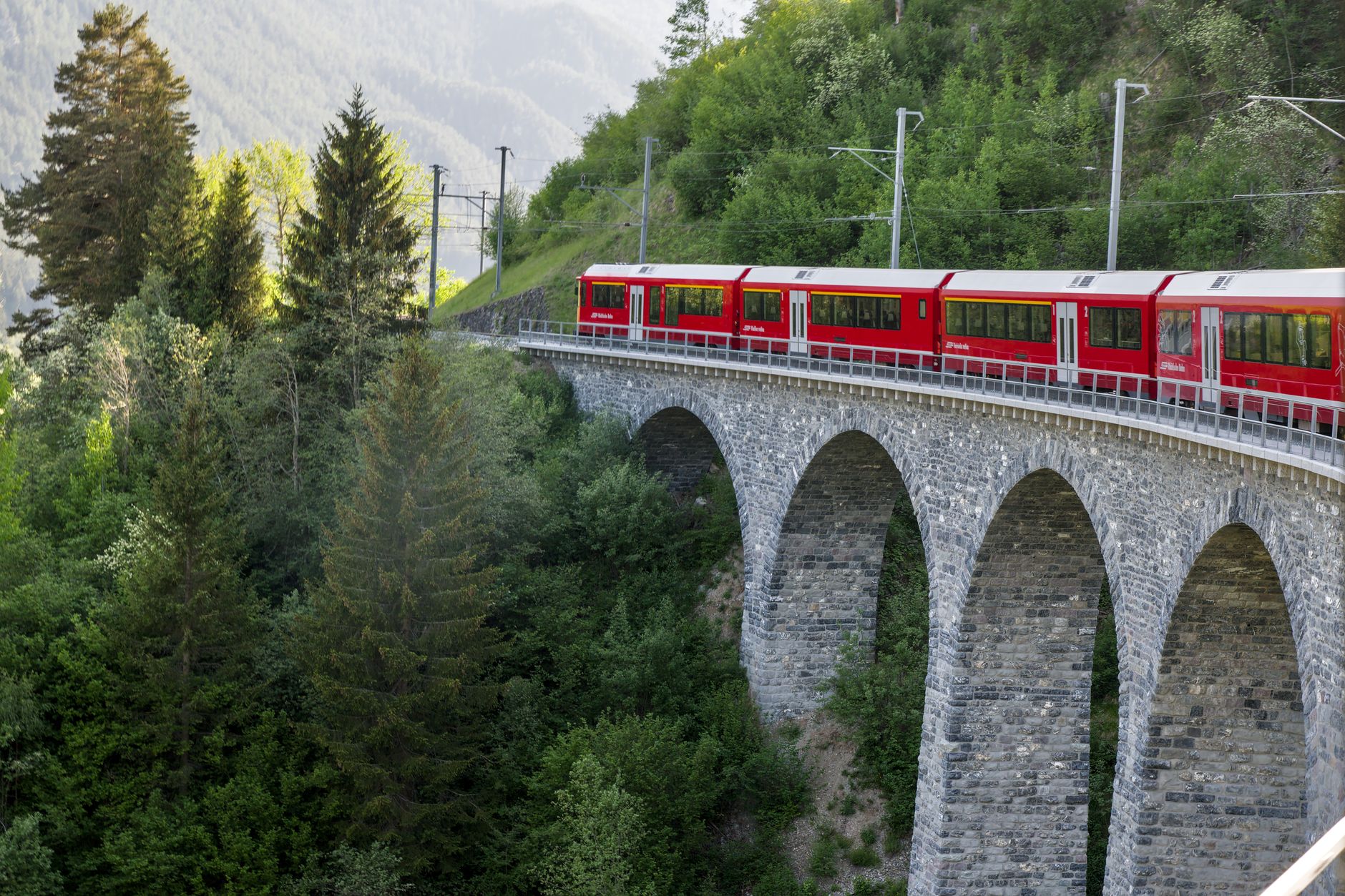
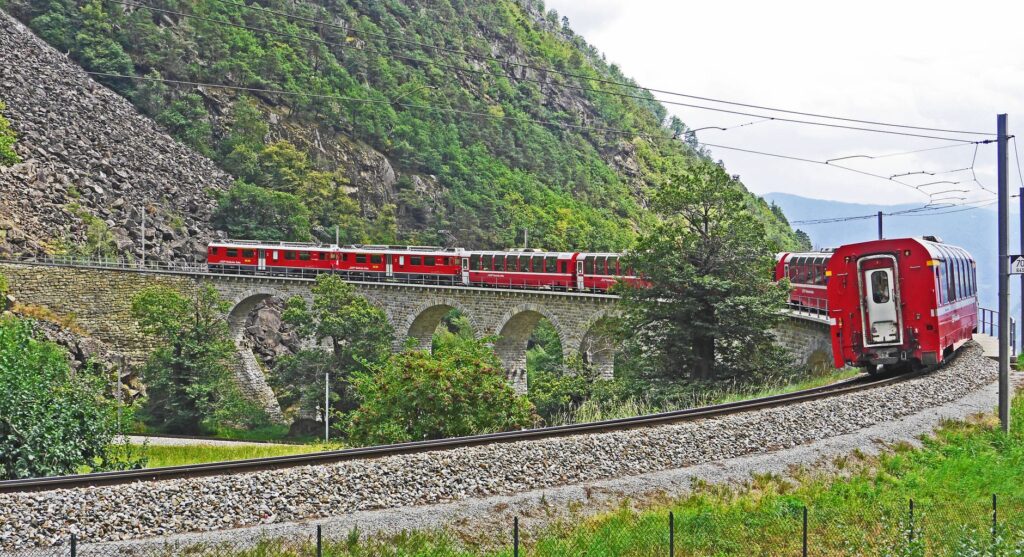
To achieve this feat, engineers designed a winding route featuring numerous monumental structures. The most iconic element of this engineering is the Brusio circular viaduct, a closed-loop structure that allows the train to gain or lose height within a very tight radius, dissipating the gradient gradually while completing a full circle in the open air. This solution not only resolved a severe topographical problem but became a universal visual icon of Swiss railway engineering.
From Eternal Ice to the Mediterranean Basin
The geographic experience of the Bernina Express is defined by the brutality and swiftness of its climatic and landscape transitions. In barely a four-hour journey, the convoy traverses 55 tunnels and crosses 196 bridges, transporting passengers from the perpetual glaciers of the Upper Engadine to the lush Mediterranean vegetation of the Valtellina valley in the Italian province of Sondrio.
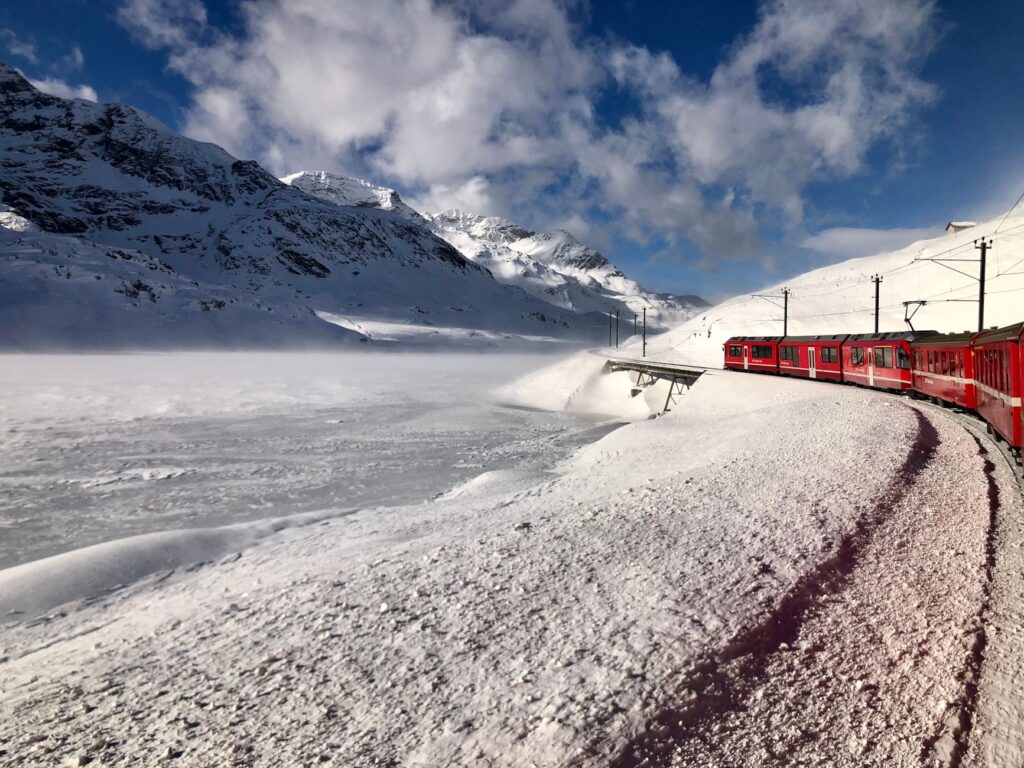
The culminating point of the route is located at the Ospizio Bernina station, 2,253 meters above sea level. In this subarctic environment, dominated by glacial lakes frozen for much of the year such as Lago Bianco and Lej Nair, tree vegetation disappears entirely. Yet just a few kilometers further south, after descending steeply through the Poschiavo valley, the landscape transforms radically. Conifers give way to chestnut trees, vineyards, and ultimately the Italian-influenced architecture of the terminal in Tirano, where palm trees grow mere meters from the railway tracks.
Architecture, Culture, and Local Communities
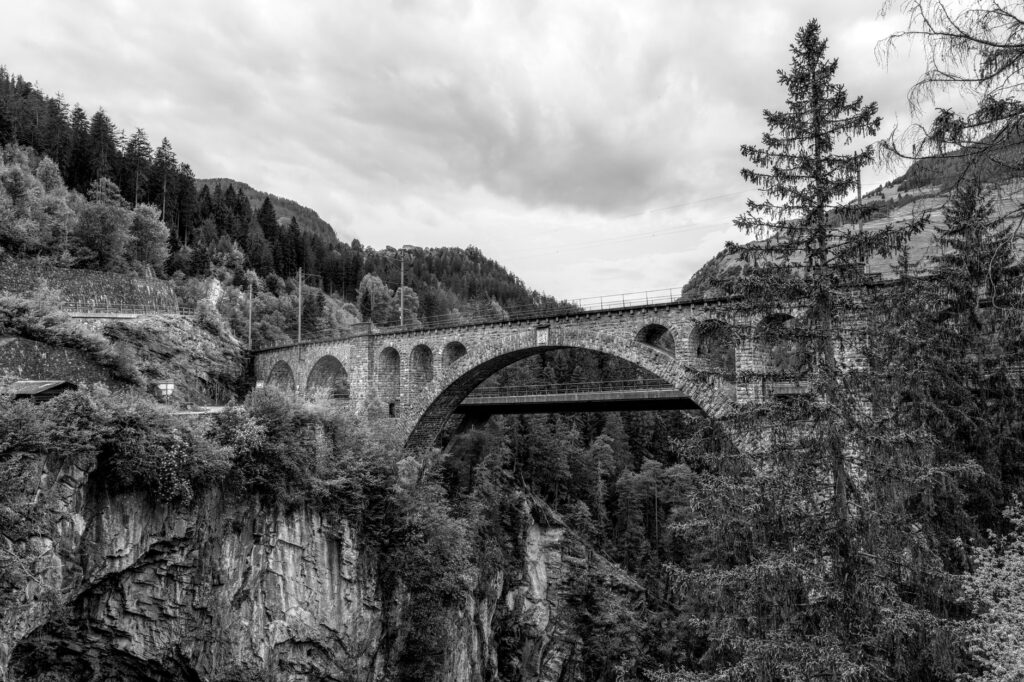
The Bernina crossing is not only a journey through pristine nature but also a tour of a unique cultural mosaic where Romansh, German, and Italian coexist. The communities situated along the line have adapted their architecture and way of life to the constant presence of the railway, which historically served as an indispensable umbilical cord for the supply of fuel, food, and mail during winter months.
The alpine railway is not a barrier dividing the mountain, but the invisible thread weaving human continuity between valleys that would otherwise remain isolated beneath the snow.
Villages such as Pontresina, Poschiavo, and Le Prese preserve historical centers of high heritage value, featuring Engadine houses decorated with sgraffito techniques and porticoed squares of clear Lombard influence. The arrival of the train to these settlements provided an economic revival that prevented rural depopulation, allowing local craftsmanship, high-altitude agriculture, and traditional gastronomy to find a stable market in international cultural tourism.
Sustainability and Alpine Corridor Management
In the context of the 21st century, the Bernina line has established itself as a global benchmark for sustainable mobility. The entire Rhaetian Railway system operates on 100% renewable electricity, generated primarily by local hydroelectric plants in the Graubünden region. This enables a high-mountain route of this scale to maintain a carbon-neutral footprint, a decisive factor for its preservation under strict UNESCO environmental criteria.
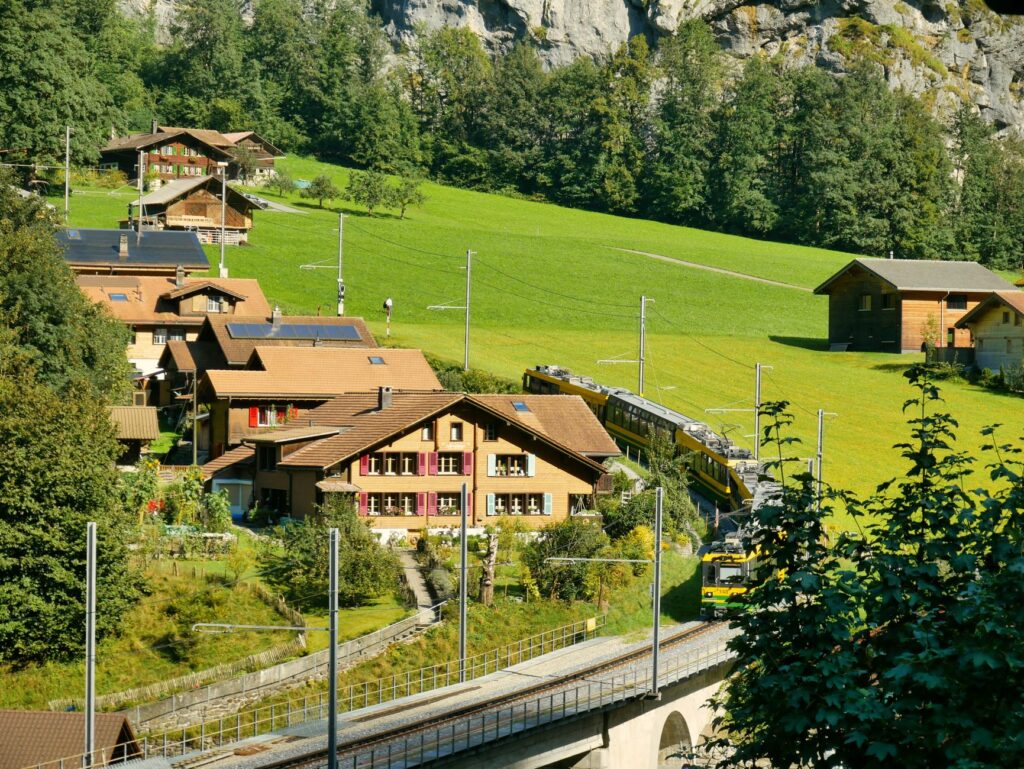
Traffic management combines scheduled precision between tourist panoramic trains and regular regional commuter trains utilized by local residents, students, and workers. This coexistence ensures that the infrastructure does not become an exclusive theme park for foreign visitors, but retains its essential public utility. Winter maintenance protocols, featuring powerful historic and modern rotary snowplows, guarantee line operability even during severe blizzards.
Practical Information for Planning the Journey
Planning a trip on the Bernina Express requires understanding the operational difference between official panoramic trains with mandatory seat reservations and regular regional trains running the exact same scenic route. The former feature large curved windows extending into the ceiling, while the latter have traditional drop-down windows, ideal for photography enthusiasts seeking to avoid glass reflections.
- Main Route: The complete journey connects Chur or St. Moritz with Tirano (Italy).
- Duration: Approximately 4 hours and 15 minutes from St. Moritz to Tirano; around 6 and a half hours when starting from Chur.
- Seat Reservation: Mandatory and subject to an additional fee in the Bernina Express panoramic cars, managed via the official Rhätische Bahn website.
- Tickets: International transport passes like the Swiss Travel Pass are accepted, though the reservation fee remains compulsory.
- Recommended Season: Operates year-round; May to October offers the green and glacier contrast, while December to March guarantees deep winter landscapes.
Conclusions and Visual Coda
The Bernina Express transcends the category of a simple tourist attraction to establish itself as a masterpiece of territorial integration and sustainable civil engineering. Its ability to connect opposing climatic worlds without harming the fragile balance of the alpine landscape demonstrates that public transport can simultaneously be a top-tier aesthetic experience and a tool for social cohesion.
Traveling across the centurylong viaducts of the Bernina is rediscovering time through the calculated slowness of the mountain, where every curve reveals a new lesson in respect for nature.
For the contemporary traveler, this journey offers a necessary pause in the accelerated pace of mass tourism, reminding us that the journey, when conceived with technical rigor and landscape sensitivity, can be infinitely more valuable than the final destination.