The journey begins at the precise point where the air smells of damp pine and the morning mist licks the slate roofs of Chur, Switzerland’s oldest city. Here, in the canton of Graubünden, the railway tracks do not merely connect two geographical points; they weave an invisible thread between two completely contrasting climatic, linguistic, and cultural worlds. The Bernina Express, operated by the historic Rhaetian Railway (Rhätische Bahn), is not a high-speed train designed to swallow miles in a hurry. It is a moving observatory, a masterpiece of 20th-century engineering that ascends from the temperate valleys of the northern Alps to the eternal glaciers of the high peaks, before plunging elegantly down to the Mediterranean warmth of Tirano, just across the Italian border. To complete this route is to understand the true scale of alpine topography and to admire a civil work so respectful of its environment that UNESCO declared it a World Heritage Site in 2008.
The Historical Context: Boldness Against Rock and Slope
In the late 19th century, the idea of connecting the northern and southern Alps via a narrow-gauge railway without using a cogwheel system seemed like a fantasy of utopian visionaries. However, Swiss engineers took on the challenge with an unshakeable premise: the route had to adapt to the mountain, not the mountain to the route. Opened in sections between 1908 and 1910, the Bernina line was designed to overcome astonishing gradients relying solely on the adhesion of steel wheels on steel rails. The Bernina line overcomes gradients of up to 7% without a cogwheel system, a figure that remains among the steepest in the world for conventional adhesion railways. This technical achievement required not only exceptionally powerful locomotives for the era but also unprecedented architectural audacity, realized in 55 tunnels and 196 bridges and viaducts that dot the 122-kilometer journey from Chur to Tirano.
The Bernina Express is not merely a means of transport, but a moving observatory that defies gravity to connect two contrasting climatic worlds.
The Point of Departure: The Understated Elegance of Chur
Chur welcomes the traveler with the serenity of a city that has watched the centuries pass since Roman times. Surrounded by vineyards and guarded by towering peaks, its car-free historic center is the perfect prelude to the journey. Upon boarding the panoramic carriages of the Bernina Express, the interior design immediately catches the eye: huge glass windows curve upward toward the roof, allowing almost complete visibility of the treetops and the peaks that will soon rise on either side of the tracks. The initial rumble is smooth, almost imperceptible, as the train leaves the station and heads into the Hinterrhein valley, passing ruined medieval castles guarding the mountain passes from their rocky promontories.
The Landwasser Viaduct: Where the Train Defies the Void
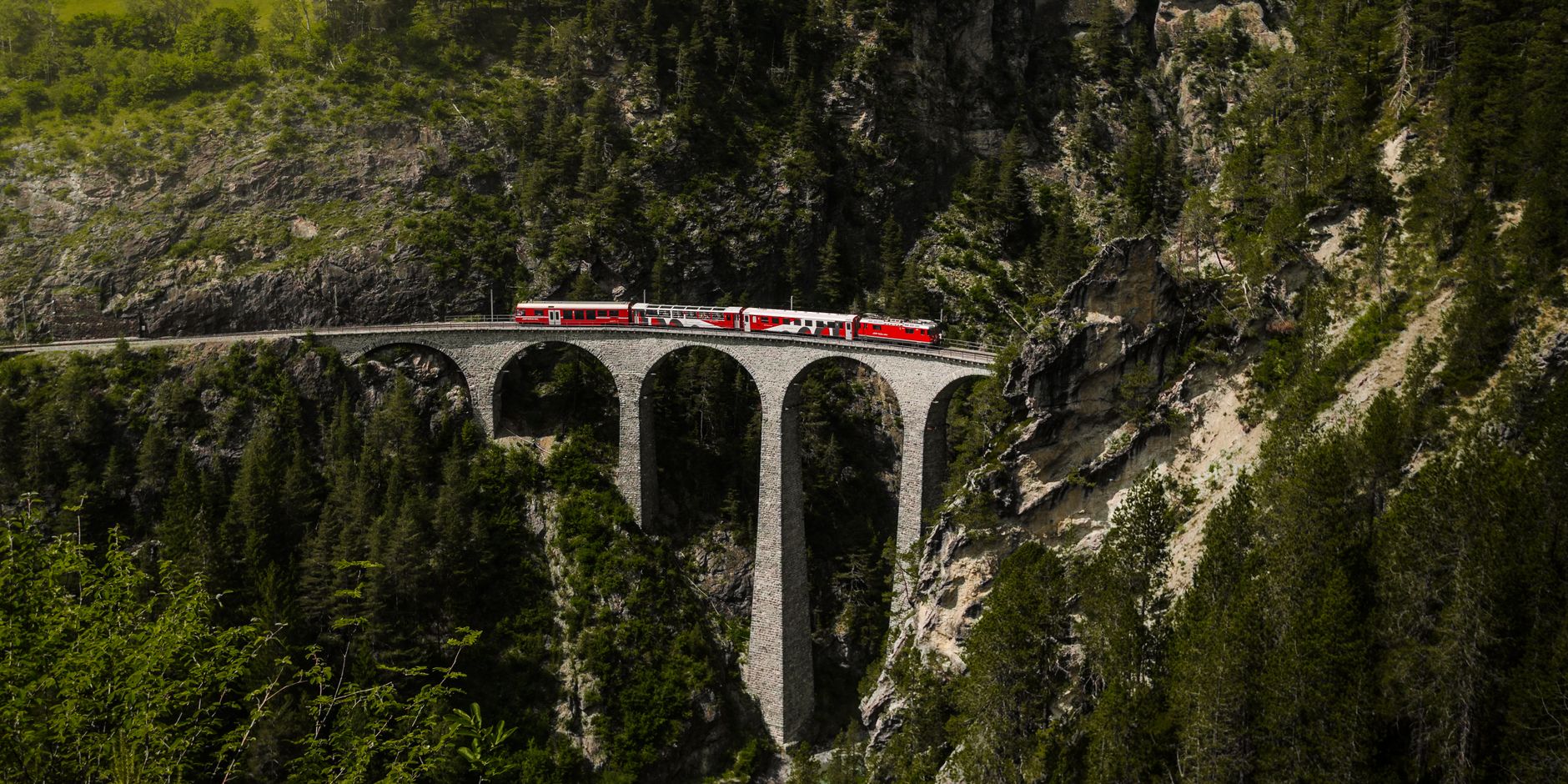
As the train gains altitude, the landscape becomes more dramatic. The first major milestone of the journey is announced by a subtle change in the sound of the wheels on the rails. We are approaching the Landwasser Viaduct, a monumental structure of dark limestone rising 65 meters above the floor of the canyon of the same name. Built in 1901 without scaffolding, using only two wooden gantry cranes, the viaduct describes a perfect curve with a 100-meter radius. The experience from inside the panoramic car is breathtaking: looking out the window, you can watch the red locomotive curve through mid-air before immediately disappearing into the rock face. The Landwasser Viaduct leads the train directly into a tunnel carved into the sheer rock face, creating one of the most spectacular and photographed visual transitions in the railway world. The abyss on one side and the solidity of the stone on the other perfectly capture the philosophy of the entire route.

The Engadin Valley: Alpine Meadows and Traditional Architecture
Having crossed the viaduct, the train enters the Engadin Valley, a high-altitude alluvial plain where the air becomes noticeably colder and clearer. Here, the landscape softens temporarily to reveal picture-postcard villages like Samedan and Pontresina. The Engadin houses, with their thick stone walls decorated with traditional sgraffito etching and deeply recessed windows designed to protect against harsh winters, seem to grow out of the earth itself. Along this stretch, Romansh, Switzerland’s fourth official language, is heard over the train’s loudspeakers, reminding passengers of the profound cultural fragmentation that the geography of the Alps has preserved over the centuries. Larch trees, which turn a fiery gold in autumn and are covered in thick powder snow in winter, line the tracks in a steady climb toward the heart of the Bernina massif.
The High Mountains: The White Silence of Ospizio Bernina
The geographical climax of the journey is reached as the train rises above the tree line. Vegetation disappears, giving way to a high-altitude desert of rock, ice, and freezing water. The train skirts the Lago Bianco, a reservoir whose waters display a milky green hue due to the suspended «glacial flour» washing down from the adjacent peaks. Here, the landscape turns into a breathtaking study in minimalism, especially during the winter months when the lake freezes completely, blending seamlessly into the snowy horizon. Ospizio Bernina, at 2,253 meters above sea level, marks the highest point of the journey and serves as the highest station on the entire Rhaetian Railway network. There are no trees or meadows here; only the vastness of the Cambrena glaciers and the imposing silhouette of Piz Bernina, the four-thousand-meter giant guarding the pass. The train pauses for a few moments, allowing travelers to contemplate the desolate beauty of an environment where humans are merely passing visitors.
Alp Grüm: A Pause Suspended Between Ice and Valley
Shortly after beginning the descent down the southern slope, the Bernina Express makes a technical stop at Alp Grüm, an isolated station accessible only by train or on foot. Perched at 2,091 meters, its terrace offers one of the most comprehensive panoramas of the route. From this natural balcony, the view plunges down toward the Palü Glacier, whose tongues of ice seem to spill into a turquoise lagoon, while looking south reveals the deep green of the Poschiavo Valley thousands of meters below. The station restaurant, built of rustic local stone, invites travelers to enjoy a slice of traditional Engadin walnut cake (Bündner Nusstorte) while gazing into the abyss. It is the last bastion of the harsh alpine climate before the journey shifts gears entirely.
The Steep Descent to the Poschiavo Valley
The descent from Alp Grüm is a masterclass in applied physics and driving skill. In just a few miles, the train must drop more than a thousand meters in altitude. To achieve this without relying on endless spiral tunnels, the tracks trace a series of tight horseshoe curves along the mountainside. Passengers experience a noticeable change in the outside temperature and vegetation: stone pines give way to firs, then to chestnut trees, and finally to fruit orchards. Arriving in Poschiavo, the capital of the Italian-speaking valley, the architecture changes dramatically. Churches with sharp Gothic spires are replaced by Lombard-style Baroque bell towers, and house facades are painted in pastel shades of yellow and pink, signaling the imminent proximity of Italian territory.

The Brusio Spiral Viaduct: The Perfect Curve
Before crossing the border, Rhaetian engineering saves its last and most famous surprise. Near the town of Brusio, the space available at the valley floor is so narrow that it is impossible to lay a direct slope that the train can safely manage. The solution adopted by engineers in 1908 was as simple as it was brilliant: to build a nine-arch stone spiral viaduct that allows the train to loop completely over itself in mid-air to lose height gradually. The Brusio spiral viaduct resolves a twenty-meter drop within a radius of just one hundred meters, offering a perfect visual choreography where the rear of the train passes beneath the locomotive as it descends. Watching the red train glide gracefully along this grey masonry structure, integrated among meadows and apple orchards, is to witness the triumph of harmony between human technique and the traditional agricultural landscape.
The Final Destination: The Scent of Coffee and Sunshine in Tirano
The final stretch of the journey crosses the invisible border between Switzerland and Italy in the most natural way possible: the train runs right down the middle of the main street in the border town of Campocologno, sharing the asphalt with cars and pedestrians like an urban tramway. A few minutes later, the Bernina Express pulls into Tirano station in the Italian region of Lombardy, situated at just 429 meters above sea level. The contrast with the starting point is absolute. In just four hours, the traveler has descended from eternal glaciers to a valley where fig trees, grapevines, and palms flourish. The cold mountain air is replaced by a warm breeze and the smell of freshly brewed espresso wafting from the cafes in Piazza Basilica. Tirano invites you to stroll leisurely through its Renaissance palaces and enjoy a plate of *pizzoccheri*, the buckwheat pasta typical of the Valtellina, before beginning the return journey.
Practical Guide for the Independent Traveler
To make the most of this unique alpine experience, it is essential to plan certain logistical details in advance, distinguishing between the different travel options offered by the railway line.
Bernina Express vs. Regional Train?
This is the most important planning decision a traveler must make:
- The Official Bernina Express: Features panoramic carriages with large windows extending to the ceiling. Requires a mandatory seat reservation with a supplement on top of the ticket price. It is ideal for those seeking absolute comfort, onboard audio guides, and a direct journey without transfers. However, the windows in these cars do not open, which can create annoying reflections when taking photos.
- Rhaetian Railway Regional Trains: Run on the exact same tracks and with the same frequency (approximately once every hour). They do not require seat reservations or supplements, and are fully covered by passes like the Swiss Travel Pass or Eurail. Their windows can be pulled down at the top, allowing you to feel the fresh mountain air on your face and take clean, reflection-free photographs. They are the preferred choice for photographers and travelers seeking flexibility.
Planning and Fares
The Bernina line operates year-round, offering two completely different spectacles depending on the season. In winter, the landscape is a pristine white canvas of frozen lakes and snow-draped forests; in summer and autumn, the color contrasts between green meadows, golden forests, and glacial ice are dazzlingly beautiful. A standard Rhätische Bahn ticket allows passengers to disembark at any intermediate station to hike, dine at Alp Grüm, or explore Poschiavo, and resume the journey on a later train with the same ticket, provided it is done within the same day. It is highly recommended to purchase tickets or reserve seats on the panoramic train at least two months in advance if traveling during peak seasons (July-August and January-February).