A Peaceful Scar Across the Strait
The Öresund Strait, the saltwater channel separating the Danish island of Zealand from the Scandinavian Peninsula in Sweden, has historically functioned both as a natural barrier and a defensive moat. For centuries, armies crossed the water in wooden barges, and trade depended entirely on the whims of Baltic winds. Today, that liquid separation has been conquered by one of the most ambitious civil engineering works on the European continent: the Öresund Link.
Inaugurated in the summer of 2000 by King Carl XVI Gustaf of Sweden and Queen Margrethe II of Denmark, this integrated transport system is not merely a rapid transit route; it is the physical and economic cement of a transnational macro-region known as the Öresund Region. By connecting Copenhagen, the Danish capital, with Malmö, Sweden’s third-largest city, the project radically transformed the mobility of millions of citizens, integrating two labor markets and two distinct cultures into a single continuous metropolitan corridor.
The technical complexity of the project lay in the need to cross a busy international shipping lane without disrupting the flight paths of the neighboring Copenhagen-Kastrup Airport. The solution adopted by Scandinavian engineers combined three distinct structural typologies over a total distance of just over fifteen kilometers: an underwater tunnel, an artificial transition island, and a dual-level cable-stayed bridge.
The Political Genesis of a Scandinavian Dream
The idea of uniting Denmark and Sweden via a fixed link did not emerge on twentieth-century drawing boards; precedents date back to the era when steam power began to revolutionize land transport. As early as the late nineteenth century, proposals for railway bridges were drafted, but wars, economic crises, and prohibitive technological costs shelved the initiative decade after decade.
The definitive momentum arrived following the end of the Cold War and the consolidation of European integration. The governments in Stockholm and Copenhagen understood that the northern periphery needed an economic counterbalance to the central axis of the European Union. In 1991, the parliaments of both countries signed an intergovernmental treaty to construct and operate the infrastructure under a unique financing model: the project would not be funded by direct citizen taxes, but through a state-owned consortium whose commercial loans would be amortized exclusively via user toll collection.
This financial approach demanded extreme budgetary rigor during the construction phase, which officially began in 1995. Despite logistical challenges posed by harsh Baltic and North Sea weather conditions, the project was completed ahead of schedule, becoming an international case study in public infrastructure project management.
The Drogden Tunnel: Beneath Maritime Routes
The first leg of the journey, departing from the Danish coast, takes place beneath the sea surface. The Drogden Tunnel, spanning just over three and a half kilometers, was designed to allow large cruise ships, container vessels, and cargo freighters transiting the strait to continue doing so without height restrictions.
To construct this submerged conduit, engineers employed the technique of prefabricating reinforced concrete elements. In a dry dock specially built near the port of Copenhagen, gigantic concrete caissons weighing tens of thousands of tons each were cast. These hollow blocks were sealed at both ends, towed by fleets of tugboats to their exact positions in the dredged seabed, and finally fitted together with millimeter precision using satellite-guided positioning systems.
Inside, the Drogden Tunnel houses four independent tubes: two dedicated to double-track railway traffic and two reserved for the four-lane motorway. This subterranean layout ensures that, even during severe storms or dense fog on the surface, rail and road traffic maintain optimal safety and flow standards.
Peberholm Artificial Island: The Ecological Hinge
Emerging from the Drogden Tunnel, vehicles and trains briefly traverse an artificial island constructed from scratch in the middle of the strait. Named Peberholm—a playful complement to the neighboring natural island of Saltholm («Salt Island»), translating to «Pepper Island»—this land-reclaimed platform serves a crucial technical function and an unforeseen biological experiment.
Peberholm measures approximately four kilometers in length and was formed by depositing millions of cubic meters of rock and sediment excavated during seabed dredging and tunnel construction. Its primary purpose is to act as a physical transition between the underwater tunnel section and the elevated cable-stayed bridge section.
The artificial island of Peberholm has become an inadvertent natural laboratory, where local flora and fauna have colonized the protected territory without direct human intervention.
Far from remaining a concrete wasteland, Peberholm was deliberately left to its own devices from an ecological standpoint. Marine and terrestrial biologists prohibited artificial vegetation planting, allowing wind-borne seeds and migratory seabirds to germinate spontaneously. Today, the island is a protected sanctuary inhabited by dozens of rare bird species, colonies of green-toad populations, and a rich variety of wildflowers thriving in an environment completely isolated from road traffic and urban human activity.
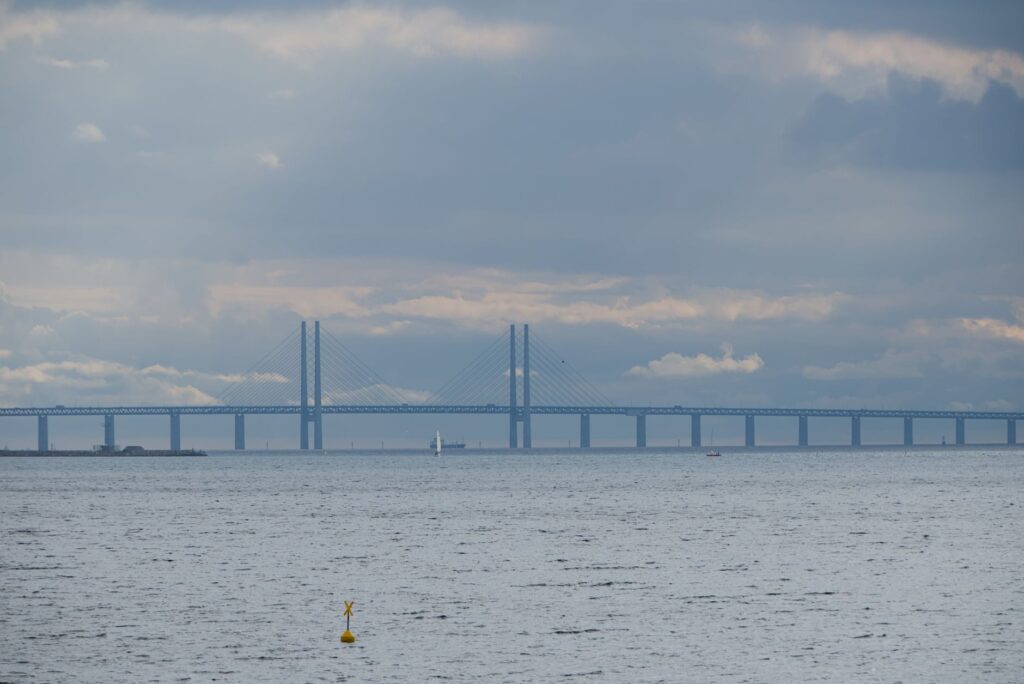
The most spectacular and visible segment of the Öresund Link is the high-level bridge, an almost eight-kilometer structure connecting Peberholm to the Swedish coast of Limhamn, on the outskirts of Malmö. Its design combines the robustness of a steel box girder with the visual slenderness of a cable system supporting the central deck.

The two main bridge towers rise over two hundred meters above sea level, serving as recognized architectural landmarks visible from both countries’ shores. From these towers spring high-strength steel stays supporting the central span, a nearly five-hundred-meter section leaving a vertical clearance of over fifty meters for auxiliary maritime traffic.
The dual-level structural design clearly separates transport modes: the upper deck is reserved exclusively for bidirectional car and truck traffic, while the lower deck houses the double railway tracks. This arrangement guarantees high transport capacity and minimizes operational interference between private motoring and mass public transit.
The Railway Revolution: Bridging Disparate Networks
For railway operators and daily commuters, the Öresund Bridge represented an unprecedented technical challenge in interoperability. Denmark and Sweden operate under different railway regulations: while Danish trains run on the left and use distinct electrical voltage and signaling systems, the Swedish network operates on the right with different technical specifications.
To resolve this historical incompatibility, engineers and rolling stock manufacturers developed special dual-system trains, popularly known as Øresundstag units. These electric multiple units are capable of switching driving lanes, adjusting voltage systems on the fly, and processing cross-border signaling without passengers experiencing journey interruptions.
The impact on daily mobility was immediate. Before the bridge opened, a train journey between Copenhagen and Malmö required complex transfers via weather-dependent ferry boats. Today, a regional train crosses the strait in under thirty minutes, directly connecting Copenhagen Central Station with Malmö C and frequently extending onward to Copenhagen-Kastrup International Airport, which acts as the major aviation hub for all of southern Scandinavia.

Economic and Metropolitan Regional Integration
The success of the Öresund Link transcends mere transport engineering; it is measured in terms of socioeconomic cohesion. The creation of the so-called «Öresund Region» fostered an integrated labor market where tens of thousands of people cross the border daily to work, study, or reside in one country while laboring in the other.
Many Danish citizens, facing a highly pressured housing market in Copenhagen, chose to purchase single-family homes in southern Sweden, where the cost of living and land prices were historically more accessible. Simultaneously, skilled Swedish professionals found career opportunities within the thriving biotechnology, financial, and cultural sectors of the Danish capital.
The cross-border infrastructure demonstrated that removing physical barriers between neighboring countries can accelerate regional productivity and foster a shared European identity grounded in daily mobility.
However, the model has also faced tensions and regulatory challenges. The temporary reintroduction of border controls and identity checks by Sweden and Denmark during European migration crises and health pandemics underscored the vulnerability of integrated regions to unilateral national sovereignty decisions, serving as a reminder that physical borders may vanish, but administrative ones require constant political coordination.

Environmental Sustainability and Future Challenges
More than two decades after its inauguration, the bridge operator (Öresundsbron) and both governments face new debates concerning environmental sustainability and carbon neutrality. Although the railway has shifted millions of trips away from private cars, the volume of freight trucks hauling goods across the motorway remains substantial.
Current strategies focus on the complete electrification of the freight logistics chain, the optimization of traffic flows via artificial intelligence, and full ticketing integration among public transport operators on both shores. Additionally, supplementary projects are being studied to divert heavy freight traffic onto dedicated rail routes, easing pressure on the bridge’s upper deck.
Maintaining an infrastructure exposed to the constant assault of the Baltic Sea—with its strong currents, gale-force winds, and marine corrosion episodes—demands a permanent inspection program. Specialized diving teams, autonomous drones, and fiber-optic sensors embedded within the steel stays monitor every centimeter of the structure twenty-four hours a day.
Practical Guide for Travelers and Transport Professionals
For those interested in experiencing the Öresund Link from a technical or tourism perspective, journey planning requires keeping several essential operational factors in mind:
- Cross by train: Øresundstag regional trains operate twenty-four hours a day with a twenty-minute frequency during peak hours. They connect Copenhagen Central Station (Københavns Hovedbanegård) with Malmö C in precisely twenty-five minutes.
- Tickets and fares: Integrated tickets can be purchased via the mobile apps of DSB (the Danish rail company) or SJ (the Swedish counterpart). Seat reservations are not required in advance for regional trains.
- Automotive transit: Private vehicles and long-distance buses use the E20 motorway. Tolls are collected at the station located on the Swedish side (Brofästet) and can be paid by card or via compatible electronic toll tags.
- Documentation: Although both countries belong to the Schengen free-movement zone, carrying a valid passport or national identity card is mandatory, as random police checks at arrival stations are common.
- Best photographic viewpoint: To contemplate the bridge’s scale from dry land, the best observation spots are located at the Ribersborgs kallbadhus waterfront park in Malmö or from aircraft during the landing approach at Copenhagen-Kastrup Airport.
Epilogue on European Connectivity
The Öresund Bridge and Tunnel remains an eloquent testament to what civil engineering and European political will can achieve when combined with a long-term vision. By fusing two sovereign shores into a single metropolitan heartbeat, the infrastructure has redefined the concept of distance in northern Europe, proving that marine straits are no longer moats that separate, but bridges that unite civilizations.