
Origins of a Rail System in the Pacific Mists
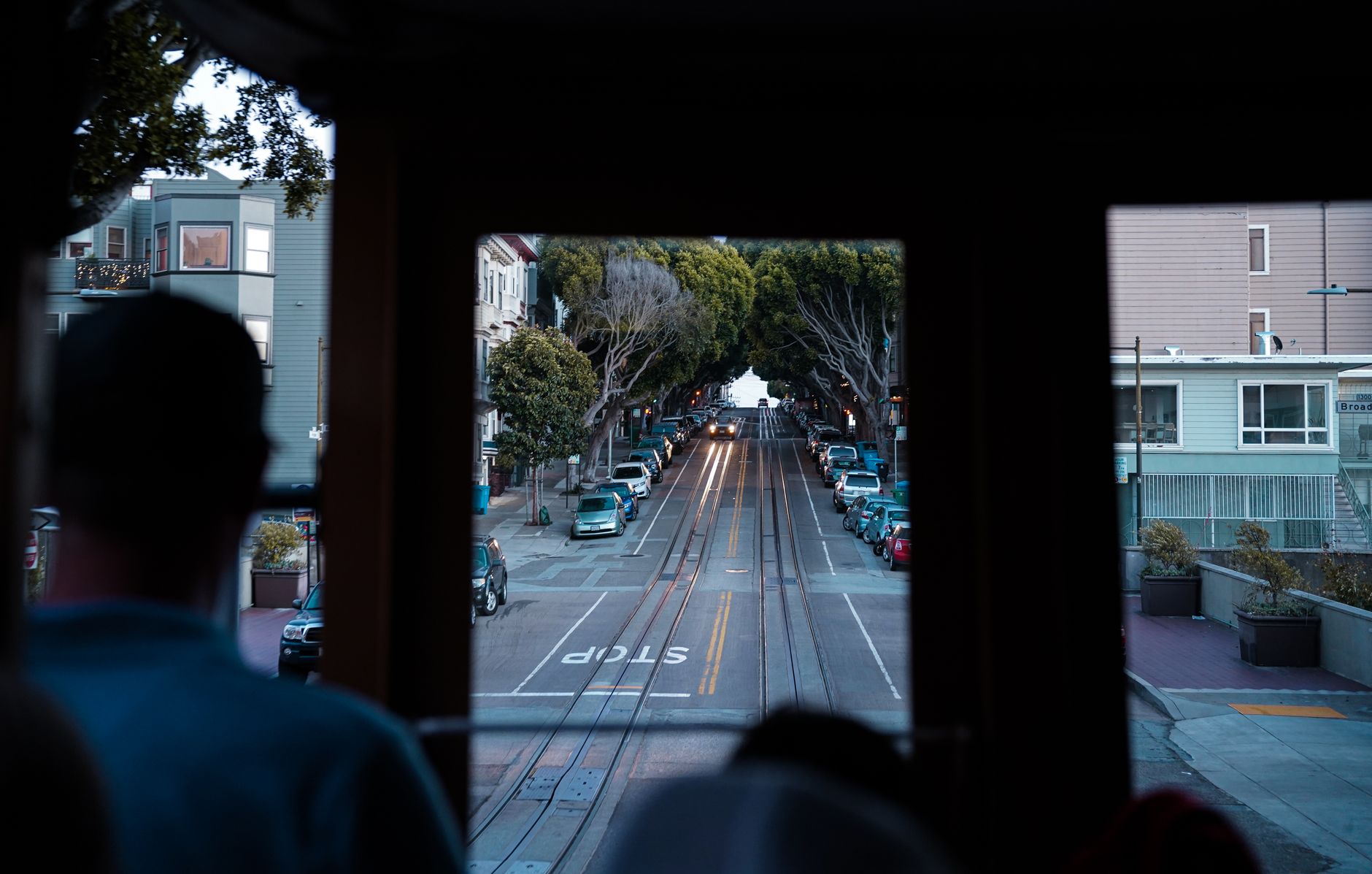
San Francisco’s rugged geography has dictated a symbiotic relationship between its residents and rail-based mobility since the nineteenth century. In a city defined by impossible slopes and persistent fog, public transport has never been a mere utilitarian resource, but rather the skeleton sustaining civic identity. The hills cascading down toward the bay demanded bold mechanical solutions, giving rise to a network of trams and cable cars that survive today not as static museum pieces, but as functional arteries of daily displacement. This historic commitment to rail traction now faces an inescapable contemporary challenge: reconciling the heritage value of centennial vehicles with the imperative demands of energy sustainability and urban decarbonization.
Over recent decades, the transformation of mobility on the US West Coast has been dominated by the urgency of reducing greenhouse gas emissions. However, in San Francisco, transport authorities and neighborhood associations have championed a unique thesis: the most genuine sustainability often lies in the preservation and intelligent modernization of existing infrastructure. Faced with mass replacement by conventional diesel bus fleets or generic electric designs, the city chose to restore and optimize its fleet of historic trams. This strategy not only minimizes the carbon footprint associated with manufacturing new vehicles, but also keeps alive a high-energy-efficiency transport model per passenger.
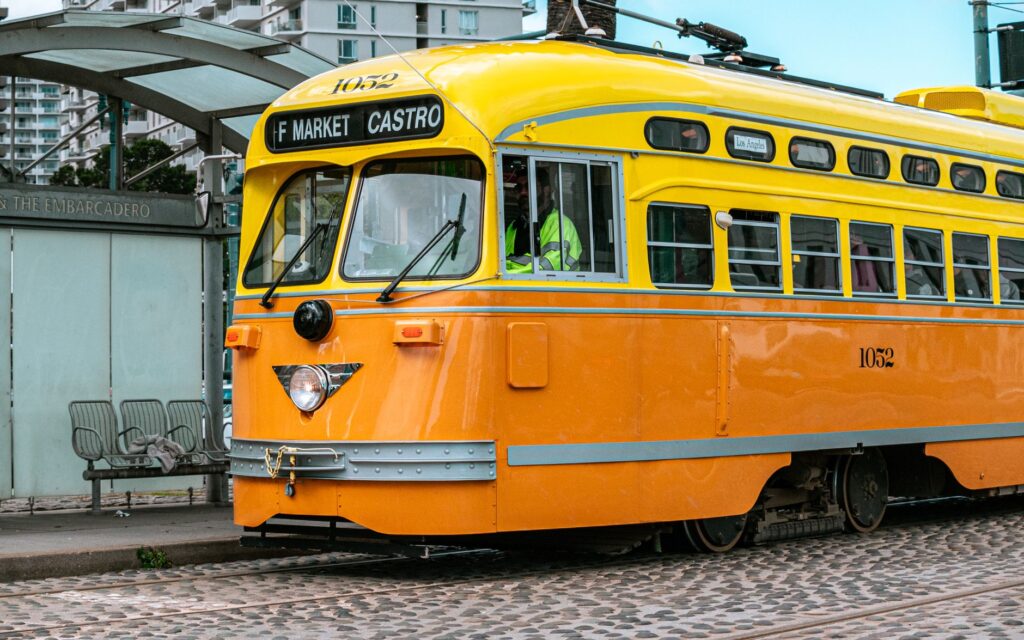
The heart of this network is concentrated in the F Market & Wharves line corridor, a route connecting the bustling financial district with the historic docks of Fisherman’s Wharf using exclusively classic railcars from various cities around the world. Far from being an aesthetic whim for visitors, this line operates as a mass transit service fully integrated into the San Francisco Municipal Transportation Agency (SFMTA). During peak hours, these noble-wood trams, with their brass fittings and handcrafted bells, carry thousands of local workers shoulder-to-shoulder with curious travelers, proving that technical heritage can respond robustly to the demands of a modern metropolis.
Invisible Engineering: Hidden Modernization Beneath the Noble Wood
To an uninitiated observer, boarding one of San Francisco’s historic trams is an exercise in temporal nostalgia. The varnished wooden slat seats, leather straps, and enameled signs suggest technology frozen in time. Yet beneath that centennial bodywork beats a deeply contemporary engineering heart. In the underground SFMTA workshops, a specialized team of carpenters, turners, and electronics technicians performs meticulous surgical maintenance. Oak and ash structures are treated and reinforced, while braking systems, traction motors, and electrical wiring are upgraded with high-energy-efficiency components.
The key to sustainability in this system lies in extreme durability and local repair capability. Unlike modern buses, whose useful life rarely exceeds a decade and whose proprietary electronic components demand costly wholesale replacements, wooden trams are designed to be repaired almost infinitely. Wooden parts are replaced using timber sourced from certified origins or recycled from local demolitions, and original electric motors have been rewound and optimized to reduce energy consumption on the steep slopes of streets like Market or California. This circular approach to maintenance drastically cuts down raw material extraction and industrial waste generation.
Likewise, the integration of the historic network with the city’s intelligent traffic management systems has notably improved its energy performance. Traffic lights prioritize the passage of trams to avoid unnecessary stops on inclines, reducing the energy consumption spikes associated with uphill starts. Energy generated through regenerative braking on descents is partially returned to the grid or controlledly dissipated, optimizing the overall energy balance of the system. This balance between artisanal tradition and cutting-edge technology redefines what we understand by innovation in today’s urban transport.
Community Impact and Resistance Against Gentrification
The pulse of a city is also measured by the accessibility of its public spaces and equity in its mobility. In San Francisco, the F line and cable cars do not merely serve as tourist links; they act as a social equalizer in neighborhoods suffering from the onslaught of real estate speculation and tech gentrification. By maintaining unified fares integrated with the rest of the public transit network, these vehicles ensure that residents of working-class communities retain fast, dignified, and low-emission access to employment centers and essential services.
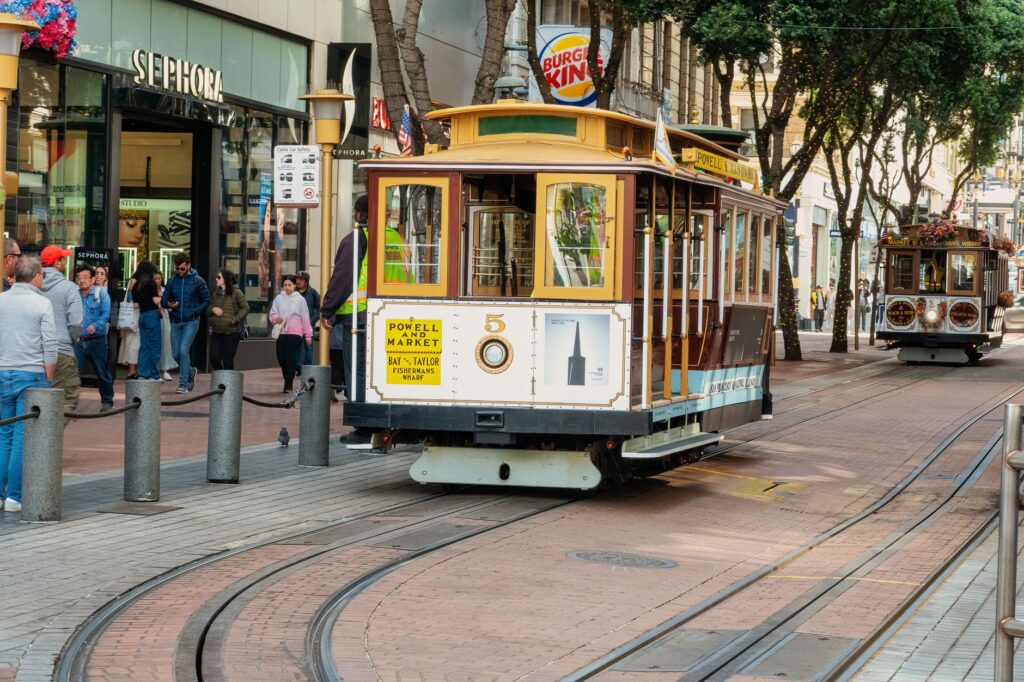
Community associations have played a fundamental role in defending this model against pressures to prioritize sheer speed through buses or soulless exclusive lanes. Groups like Market Street Railway work closely with the municipality to document the history of each car, ensuring users recognize the cultural value of the journey. This sense of belonging fosters a collective care for public space rarely observed in standardized transport systems. Passengers tend to respect interior furnishings, converse with conductors, and value the ride as a shared civic experience.
However, the balance is fragile. The constant influx of international visitors poses a risk of overcrowding, forcing authorities to manage frequencies with millimeter precision. To prevent heritage transport from becoming an exclusive theme park for outsiders, the SFMTA implements capacity reinforcement policies during school and rush hours, explicitly prioritizing the needs of the local population. In this way, sustainable mobility in San Francisco is consolidated not only as an environmental solution, but as an intergenerational social pact.
Multimodal Integration: Connecting Tram with Bicycle and Ferry
No sustainable transport system survives in isolation. The success of mobility in San Francisco lies in its capacity to weave a fluid multimodal network where the historic tram acts as the backbone feeding and nourishing other low-emission transit modes. Upon arriving at the Ferry Building terminal, passengers can step directly off the wooden tram to connect with electric and hybrid ferries crossing the bay toward Oakland or Sausalito, or board a shared bicycle to navigate the extensive network of protected bike lanes bordering the Embarcadero waterfront.
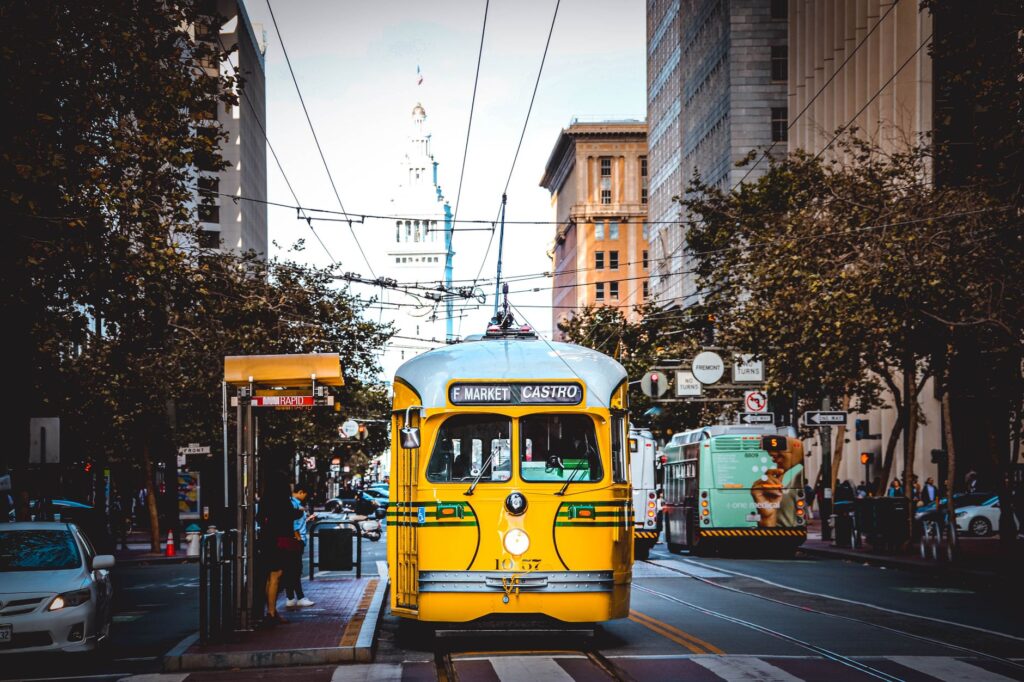
This intermodal connectivity has been designed under strict universal accessibility criteria. Stops along the F line have been adapted with raised platforms and discreet ramps enabling step-free access for wheelchair users or people with reduced mobility, proving that respect for historical aesthetics need not contradict civil rights and inclusion. Furthermore, digital signage integrated into shelters provides real-time information on incoming convoys and connection status with the underground metro (MUNI Metro) and electric trolleybuses.
Surrounding urban design has also evolved to prioritize pedestrians and soft mobility. The gradual removal of lanes for private automobiles in key corridors has freed space for wider sidewalks, urban trees, and rest areas, reducing noise pollution and improving air quality along historical corridors. For the conscious traveler, this integrated network offers a masterclass in how a major city can redesign its mobility without demolishing its past, betting on intermodality as the shortest path to comprehensive urban sustainability.
True urban sustainability does not consist of erasing the past to build an artificial future, but of equipping our collective heritage with the technical intelligence needed to keep transporting us justly and efficiently.
Climate Challenges and Resilience Against Sea-Level Rise
The geography that makes San Francisco unique—its narrow peninsula wedged between the Pacific Ocean and the bay—also places it in a position of extreme vulnerability to global climate change. Sea-level rise and the increased frequency of extreme weather events pose a direct threat to transport infrastructure located in coastal zones, especially along critical stretches like the Embarcadero and historic car barns where the wooden tram fleet is housed and repaired. Urban resilience has consequently become the new guiding axis of municipal planning.

Engineers and urban planners are working against the clock on soft engineering projects and coastal defenses to protect railway tracks from king tide flooding and winter storms. At the same time, the electrical substations powering the tram network are being relocated and elevated to guarantee service continuity during adverse weather episodes. Far from being isolated measures, these interventions form part of a master adaptation plan seeking to safeguard public transit infrastructure against the worst climate scenarios projected for coming decades.
This adaptation effort highlights a fascinating paradox: the city’s oldest vehicles now operate as standards for twenty-first-century infrastructure. The capacity of trams to operate independently of fossil fuels turns them into strategic emergency assets during prolonged power outages or natural disasters, when conventional gasoline- or diesel-powered vehicles are immobilized by supply shortages. Thus, San Francisco’s rail memory is not merely a reminder of what we were, but an indispensable tool to guarantee community survival and mobility in times to come.
Practical guide
Planning a sustainable tour of San Francisco’s historic transit system requires understanding schedules, usage rules, and key connections to minimize carbon footprints while maximizing the urban experience.
How to Use the Historic Network Efficiently
The F Market & Wharves line operates daily from early morning past midnight, with frequencies ranging from six to ten minutes during peak hours. To board the trams, using the rechargeable Clipper municipal card or the official SFMTA mobile app is recommended to streamline boarding and avoid cash. Contactless smartphone payments are also fully compatible across all turnstiles and onboard validators.
Recommended Multimodal Connections
- Ferry Building: The major interchange hub connecting the F line with commuter ferries toward Marin County and the East Bay.
- Transbay Terminal (Salesforce Transit Center): Connection point with zero-emission regional buses and intercity networks.
- Embarcadero Station: Direct underground connection with the MUNI Metro heavy rail system and BART lines toward international airport (SFO).
- Cycling Corridors: The waterfront features segregated bike lanes connected with pedal-assist public bike-share systems.
Accessibility Rules and Etiquette
Historic trams feature designated wheelchair zones on adapted fleet vehicles. Passengers are requested to yield front seating to seniors, expectant mothers, or individuals with reduced mobility. Consuming food and beverages onboard is prohibited, and bicycles are permitted on front racks of auxiliary convoys, though utilizing parallel bike infrastructure for longer trips is prioritized.
The Rolling Legacy in the Evening Mist
As the sun begins to dip below the Pacific horizon, San Francisco’s signature fog—known locally as Karl—slips silently across the Golden Gate Bridge and envelopes the city’s hills. In that crepuscular moment, the silhouette of the wooden trams winding along the waterfront assumes an almost cinematic dimension. The warm glow of interior lamps illuminates the faces of passengers: tired workers returning home, students with books tucked under arms, and attentive travelers watching the rhythmic sway of copper and wood mechanisms. In this daily ritual there are no strident notes or empty commercial promises; only the steady heartbeat of a community that has found in its own history the mechanical impulse to advance toward a more human and sustainable future.
Preserving this rolling heritage is not an exercise in sterile nostalgia, but a statement of principles regarding the scale of our cities. It reminds us that true modernity does not always demand demolishing the past to erect impersonal structures, but caring for, adapting, and honoring the accumulated intelligence of those who preceded us. As long as steel rails continue guiding these wooden veterans through the mist, San Francisco will continue showing the world that elegance, memory, and sustainability can travel perfectly together in the very same seat.