
In the northeastern corner of Paris, where the city loses height and gains horizon, Ourcq station occupies a discreet but decisive place. It belongs to the 19th arrondissement of Buttes-Chaumont, in France, a territory that for more than a century was synonymous with quarries, slaughterhouses and workshops, and that today combines social housing, artists’ studios and one of the capital’s largest urban transformations. The station is not a monument: it is infrastructure that works. Every day, thousands of residents pass through it to reach the centre, work, school or the market, and that routine gives it a value no tourist brochure can capture.
This report looks at the 19th arrondissement through its urban railway: not as a relic of the industrial past, but as a living tool that explains how life is organised in one of the most diverse neighbourhoods in Paris. The question is simple and difficult at once: what does a metro station do for a community when it stops being just a point of passage?
A district that grew facing the tracks
The 19th arrondissement stretches over uneven terrain, with hills, former gypsum quarries and an urban density that changes from block to block. Metro Line 5, which crosses the neighbourhood from north to south, reached this area in the early decades of the 20th century, when Paris was still digesting its own industrial expansion. The stations of Porte de Pantin, Ourcq, Laumière, Jaurès and Stalingrad now form a backbone connecting the northeastern edge with the heart of the city.
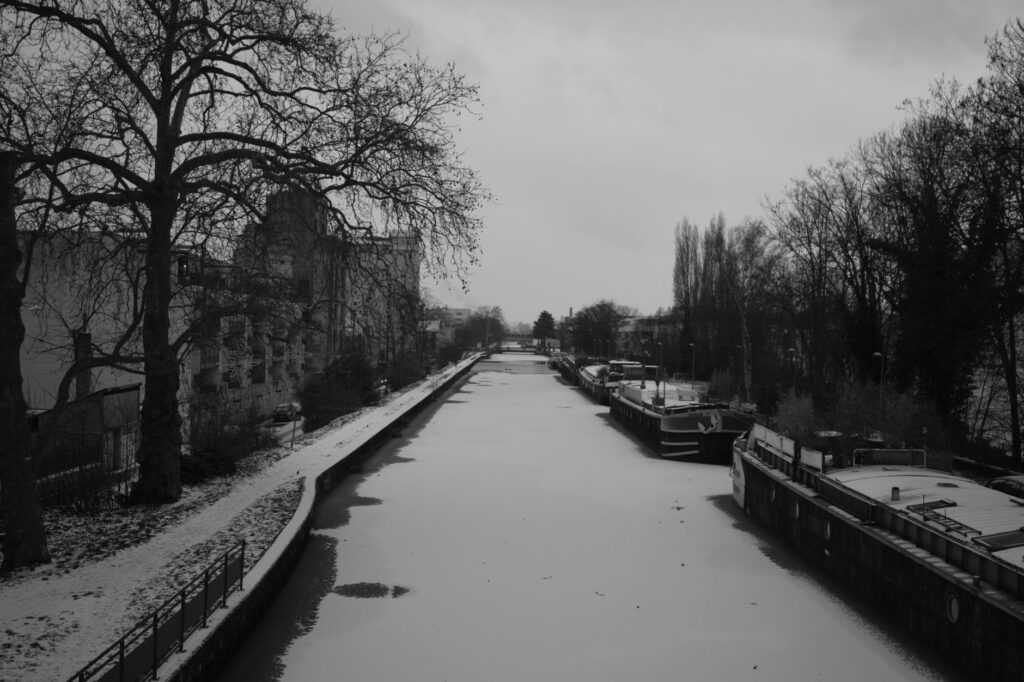
Ourcq station, located near the Canal de l’Ourcq and the Buttes-Chaumont park, is a good example of that logic. It lacks the monumentality of other Parisian stations, but its position makes it a real node: it connects residential neighbourhoods, cultural facilities and a bus network that extends its reach. For many residents, it is the gateway to and from their working day.
A neighbourhood station is not measured by its architecture, but by the number of lives it organises every morning.
Line 5 and the invisible map of the northeast
Line 5 was born in the early 20th century and grew in stages until it linked Gare du Nord with Place d’Italie, crossing eastern Paris. Its route is no accident: it follows old industrial and commercial axes, and its passage through the 19th arrondissement reflects the way the city planned workers’ mobility for decades. Today, that same line carries a far more heterogeneous population: students, families, professionals commuting to the centre and residents who never leave the neighbourhood.
The stretch between Jaurès and Porte de Pantin, with stops such as Ourcq, shows how urban rail has shaped local commerce. Around the metro exits, bakeries, pharmacies, call shops, hairdressers and small restaurants have grown, all depending on the constant flow of passengers. These are not tourist businesses: they are local services that exist because the station exists.
Buttes-Chaumont: the park that changed the neighbourhood
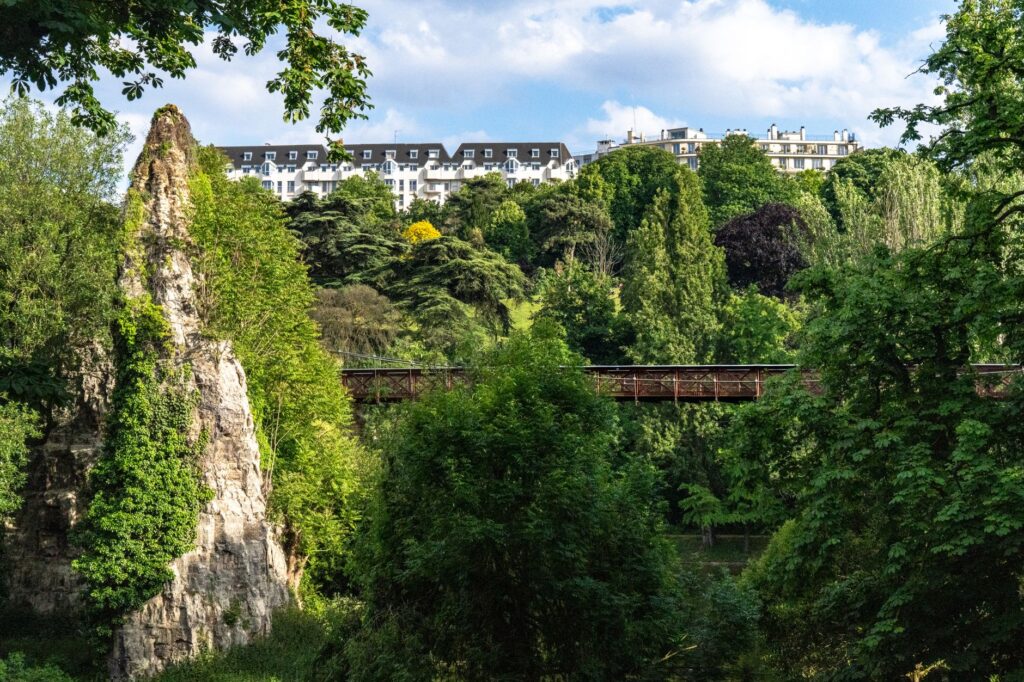
Buttes-Chaumont park, opened in 1867, occupies a former quarry and rubbish dump transformed by engineer Jean-Charles Alphand during the Paris renovation works driven by Baron Haussmann. Its artificial hills, lake and romantic temple are now one of the capital’s green lungs, but also an economic engine for the 19th arrondissement.
The relationship between the park and the railway is everyday: many families take the metro to Buttes-Chaumont or Botzaris for Sunday outings, and at weekends Ourcq station records a different flow, slower and more family-oriented. That alternation between the working week and the recreational weekend gives the neighbourhood a recognisable, almost domestic rhythm.
Quarries, workshops and working-class memory
Before becoming a residential neighbourhood, the 19th arrondissement was a territory of extraction. The gypsum quarries of Buttes-Chaumont fed the construction of Paris for generations, and the workshops and factories that settled later left a mark still visible in the architecture: converted warehouses, inner courtyards, narrow streets and brick buildings.
Ourcq station preserves no great traces of that past, but its surroundings do. Walking from the metro exit towards the Canal de l’Ourcq allows that history to be read in layers: social housing, former industrial premises now occupied by associations, and a mix of populations reflecting Paris’s migration history.
The Canal de l’Ourcq and the new geography of leisure
The Canal de l’Ourcq, which crosses the 19th arrondissement from north to south, has moved from being a freight route to becoming a space for walking, sport and culture. Its banks, rehabilitated in recent decades, now host bars, cultural centres and meeting points that attract residents from across the city.
Ourcq station is a few minutes’ walk from this axis. That proximity has reinforced its role as an access point to an area combining industrial heritage and new forms of leisure. For travellers who want to understand contemporary Paris beyond the grand boulevards, this stretch offers a useful and little-visited reading.
The canal is not a backdrop: it is proof that a neighbourhood can change its function without losing its memory.
What the traveller arriving by metro sees
First-time arrivals at Ourcq are often surprised by the absence of monumentality. There are no grand avenues or spectacular facades. What exists is a neighbourhood that works: markets, schools, local shops and a social mix that is increasingly rare in Paris. That ordinariness is, precisely, its interest.
Travellers can use the station as a base to explore Buttes-Chaumont park, the Canal de l’Ourcq, the La Villette neighbourhood and the Cité des Sciences. They can also simply sit on a terrace and watch how the neighbourhood changes pace throughout the day. The station, in that sense, is not the destination: it is the key.
The station as a public service
Beyond tourism, Ourcq station fulfils a social function worth underlining. For older people, early-shift workers and students, the metro is the infrastructure guaranteeing access to employment, education and healthcare. Its reliability matters more than its aesthetics.
At a time when many cities are debating how to fund public transport, the case of Ourcq reminds us that a station is not an expense: it is a condition for a neighbourhood to function. The 19th arrondissement, with its mix of populations and industrial history, depends on that network to avoid becoming isolated.
Practical guide
- Getting there: Ourcq station is on Paris metro Line 5, in the 19th arrondissement, close to the Canal de l’Ourcq and Buttes-Chaumont park.
- When to go: weekday mornings show the station’s most intense use; at weekends the pace is quieter and more family-oriented.
- What to see nearby: Buttes-Chaumont park, the banks of the Canal de l’Ourcq, the La Villette neighbourhood and the Cité des Sciences et de l’Industrie.
- Mobility tip: check official metro network maps and updated timetables before travelling; Line 5 connects with other lines at Jaurès, Stalingrad and Gare du Nord.
- For residents: the station works as a connection point with urban buses and as fast access to central Paris.
A neighbourhood explained from the platform
At the end of the day, when light falls on the tracks and passengers head home, Ourcq station becomes again what it always was: a necessary place of passage. There is no epic in it, but there is a form of everyday civility that sustains the life of an entire neighbourhood. Understanding the 19th arrondissement of Paris, in France, means understanding that small machine: the station that every morning sets in motion a neighbourhood that wakes early.