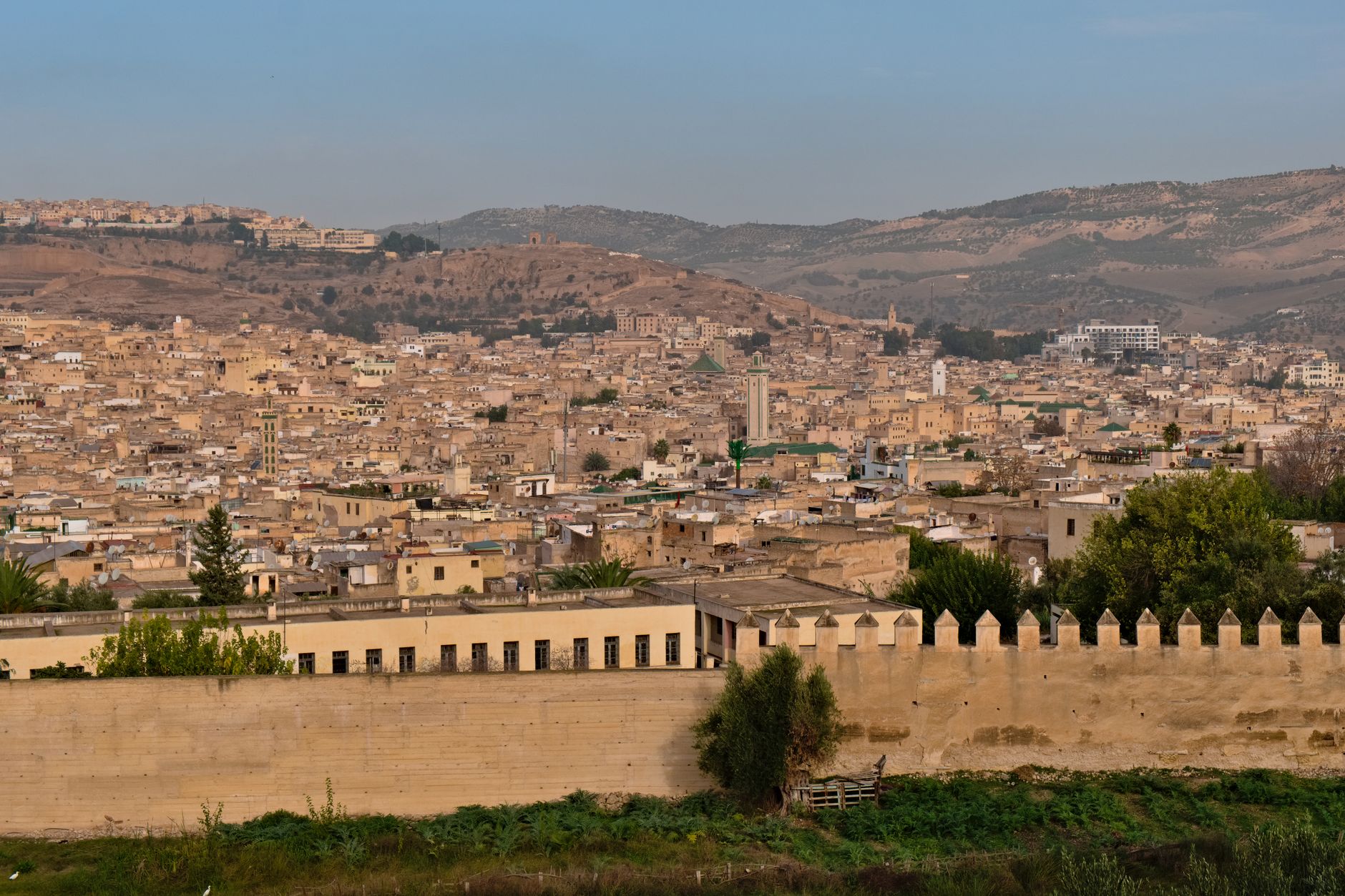

The medina of Fez, Morocco, is one of the best-preserved historic cities in the Arab-Muslim world. Founded in the 9th century and inscribed as a UNESCO World Heritage site in 1981, its urban fabric retains madrasas, fondouks, palaces, mosques, and fountains dating mainly from the 13th and 14th centuries, when the Marinid dynasty made Fez the capital of the kingdom. Although the political capital moved to Rabat in 1912, the city kept its status as the country’s cultural and spiritual centre.
That historical continuity is not just about monuments. In the workshops of the medina, trades such as tanning, weaving, carpentry, and pottery are still practised with techniques passed down from generation to generation. This report explores how these crafts structure daily life, what challenges they face, and why their survival is inseparable from the conservation of the historic site.
A city that works with its hands
The medina of Fez is not an open-air museum. It is a living space where artisanal activity fills streets, squares, and courtyards. According to UNESCO documentation, the medina’s urban fabric retains most of its original functions and transmits a lifestyle, skills, and culture that persist and are renewed. Traditional trades are part of that fabric: they are not a tourist add-on but an economic and social infrastructure that gives the city meaning.
The international body itself notes that the survival of traditional architectural know-how, particularly in building and decoration trades, is a major advantage for maintaining the site’s values. In other words, heritage conservation depends directly on these crafts continuing to exist.
The medina of Fez retains most of its original functions and transmits a lifestyle, skills, and culture that persist and are renewed.
Tanning: hides, vats, and time
The tanneries of Fez are among the most visible trades in the medina. In terraced courtyards, artisans work hides using methods that combine lime, pigeon droppings, salt, and vegetable tannins. The process is slow and demands patience: hides are soaked, scraped, dyed, and dried in the sun. Each stage has its own space and its own rhythm.

Tanning is not just a productive activity. It is a trade that defines entire neighbourhoods and has shaped the architecture of the terraces where it takes place. Hides tanned in Fez feed a chain that runs from local shoemakers to international markets. However, tanners face environmental and economic pressures: the use of chemicals, industrial competition, and the need to adapt to stricter regulations.
A skill learned over years
Master tanners usually start as apprentices in their teens. They learn to read the state of a hide, calculate soaking times, and recognise the exact point of tanning. That knowledge is not written in manuals: it is passed on in the courtyard, through hands and observation. UNESCO considers the survival of these skills a key factor in maintaining the site’s authenticity.
Weaving: threads that cross generations
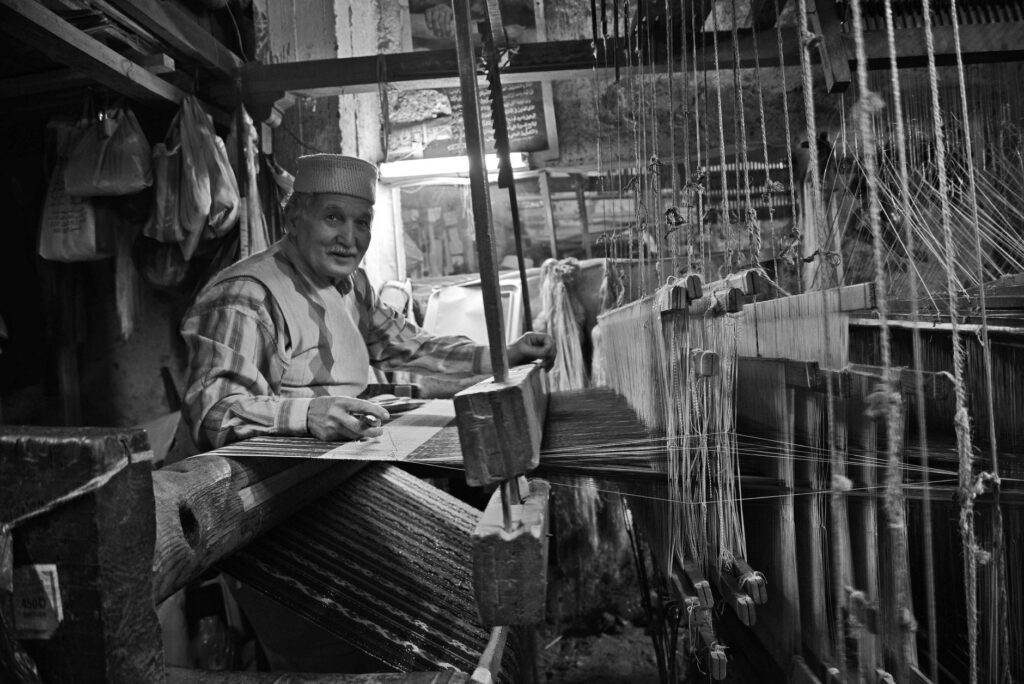
Weaving is another trade that sustains the medina’s economy. In narrow workshops, handlooms produce wool, cotton, and silk fabrics. Designs vary by family tradition and region of origin. Some workshops specialise in traditional garments such as djellabas and kaftans; others work fabrics for the home.
The weaver’s work is quiet and repetitive, but it demands constant attention. A mistake in the weft can ruin hours of work. Artisans often work in small family teams, where children learn the trade from an early age. Competition from industrial textiles has reduced demand, but artisanal weaving retains a niche market among those who value quality and provenance.
The fondouk as a workspace
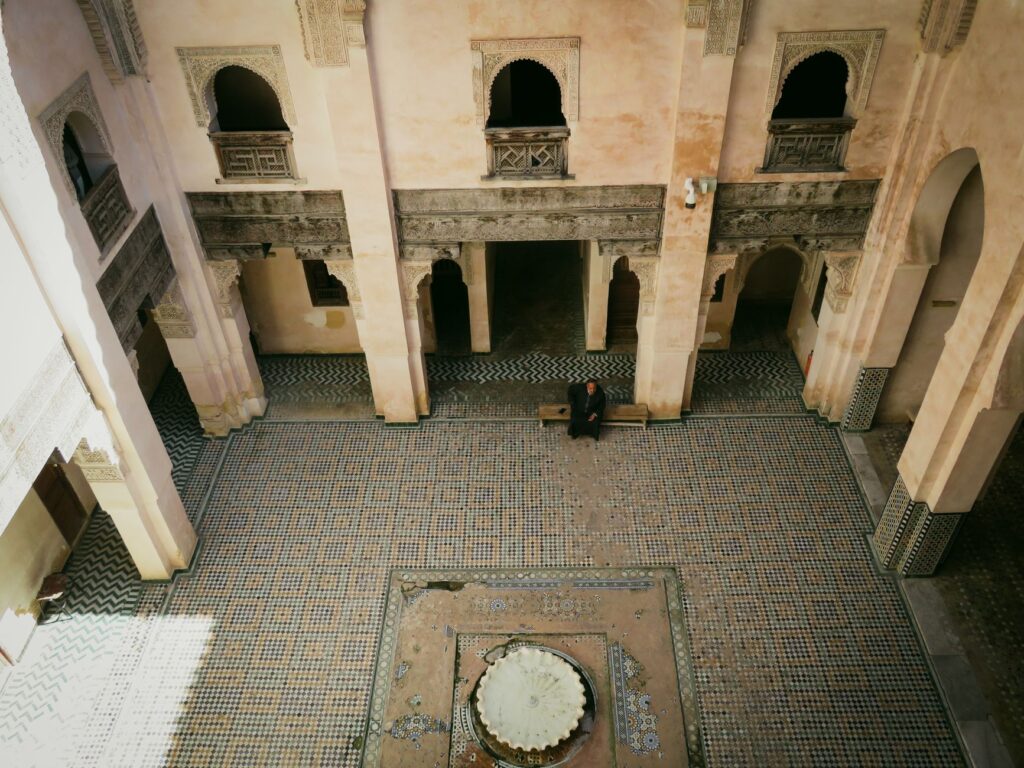
Many of these workshops are located in fondouks, former merchant inns that now serve as workshops and storerooms. These buildings, documented by UNESCO as part of the medina’s monumental heritage, have central courtyards surrounded by galleries. The fondouk is not only a workplace: it is a social space where artisans share tools, clients, and information.
Wood, plaster, and metal: the building trades
The conservation of the medina depends on specialised traditional construction trades. Carpenters, plasterers, masons, and blacksmiths work with techniques dating back to the Marinid era. UNESCO highlights that Fez’s architecture is characterised by construction and decorative techniques developed over more than ten centuries, where local knowledge interweaves with Andalusian, Eastern, and African influences.
Carpenters produce carved doors, wooden ceilings, and furniture. Plasterers work the carved plaster that decorates walls and fountains. Blacksmiths forge grilles, nails, and tools. Each trade has its own neighbourhood and its own internal hierarchy. Master artisans supervise apprentices and control the quality of the work.
Fez’s architecture is characterised by construction and decorative techniques developed over more than ten centuries, where local knowledge interweaves with Andalusian, Eastern, and African influences.
The challenge of restoring without betraying
Restoring monuments and homes in the medina requires traditional materials and techniques. The use of cement or industrial materials can damage historic structures. That is why the building trades are essential for any rehabilitation project. The Agency for the De-densification and Rehabilitation of the Medina of Fez coordinates many of these interventions, but specialised labour remains limited.
Pottery and ceramics: clay, kiln, and colour
Fez ceramics are known for their blue glazes and geometric motifs. Potters work local clay, shape it on manual wheels, and decorate it with fine brushes before firing it in traditional kilns. The full process can take several days and requires precise coordination between the potter, the decorator, and the kiln operator.
Like other trades, ceramics faces competition from cheaper industrial products. However, demand for handmade tiles and tableware persists among those seeking authenticity. Some workshops have diversified into contemporary design, combining traditional techniques with modern forms.
A trade with its own name
Fez ceramics have a specific designation: Fez blue. That colour is not just an aesthetic choice; it is the result of a glazing technique perfected over centuries. Artisans closely guard the glaze recipes, which are passed down orally within families.
The souk as economic infrastructure
The medina’s trades do not operate in isolation. They are integrated into a network of souks specialised by activity: the tanners’ souk, the weavers’ souk, the blacksmiths’ souk. That spatial organisation is not accidental. It responds to a logic of efficiency and control of odours, noise, and waste. UNESCO describes the medina as an outstanding example of a medieval town created during the first centuries of Morocco’s Islamisation, with an original type of human settlement and traditional occupation of the land.
The souk is also a space of social regulation. Artisan guilds set prices, resolve disputes, and control access to the trade. Although their power has diminished with modernisation, they remain a reference for the organisation of work.
Pressures and adaptations
Fez’s traditional trades face several pressures. The first is demographic: the medina is densely populated and many homes are dilapidated. The second is economic: industrial products are cheaper and reach the market faster. The third is cultural: young people may prefer jobs in the service sector or migrate to other cities.
Despite this, there are signs of adaptation. Some artisans have created cooperatives to share costs and access international markets. Others have incorporated modern tools without abandoning basic techniques. UNESCO notes that the Ministry of Culture endeavours, not without difficulty, to ensure that different actors respect the site’s authenticity.
Training and generational succession
Generational succession is one of the biggest challenges. Learning a trade such as tanning or weaving takes years and does not guarantee stable income. Some families have chosen to send their children to school and seek work outside the medina. Others maintain the tradition, but with fewer apprentices than before. Arts and crafts schools, both public and private, try to fill that gap, although practical training still depends largely on family workshops.
Practical guide
For those who wish to discover the trades of the medina of Fez, it is advisable to plan the visit with respect and patience. The medina is an inhabited space, not a theme park. Here are some general guidelines:
- Best time to visit: mornings are quieter and allow you to observe work in the workshops. On Fridays, the day of prayer, many shops remain closed.
- Clothing: comfortable, modest clothing covering shoulders and knees is recommended. Footwear should be suitable for uneven streets and stairs.
- Orientation: the medina is a maze of alleys. Hiring an accredited local guide or using offline maps is useful. Getting lost is part of the experience, but carry water and allow time.
- Photography: before photographing an artisan, ask permission. Some workshops charge a small fee for access or photos.
- Shopping: if you buy a piece, ask about its origin and process. The price of artisanal products reflects hours of work and is not always negotiable.
- Respect: tanners, weavers, and potters work in demanding conditions. Avoid comments about odours or noise and do not interfere with tasks.
- Accessibility: the medina is not adapted for wheelchairs or strollers. The streets are narrow and uneven.
- Language: Arabic and French are the most useful languages. English is spoken in many tourist-oriented workshops, but not all.
Visiting Fez’s trades does not require a rigid itinerary. Simply walking, observing, and asking respectfully is enough. The artisans who maintain these trades are the true guardians of the medina.
A heritage sustained by hands
The medina of Fez is an exceptional example of a historic city that still functions as one. Its trades are not relics of the past but activities that structure daily life and sustain the conservation of the site. UNESCO inscribed the site in 1981 under criteria highlighting its influence on architecture, monumental arts, and town planning, as well as its character as an outstanding example of a medieval town.
That dual condition, heritage and active life, is also its greatest fragility. If the trades disappear, the medina loses part of its authenticity. If tourism or real estate pressure displaces them, the social fabric breaks. The survival of Fez’s trades depends not only on conservation policies but on new generations finding a viable future in them.
At the end of the day, when workshops close and streets empty, the medina becomes what it has always been: a place where manual work sets the rhythm of life. That continuity, fragile and tenacious, is what makes Fez more than a monument.