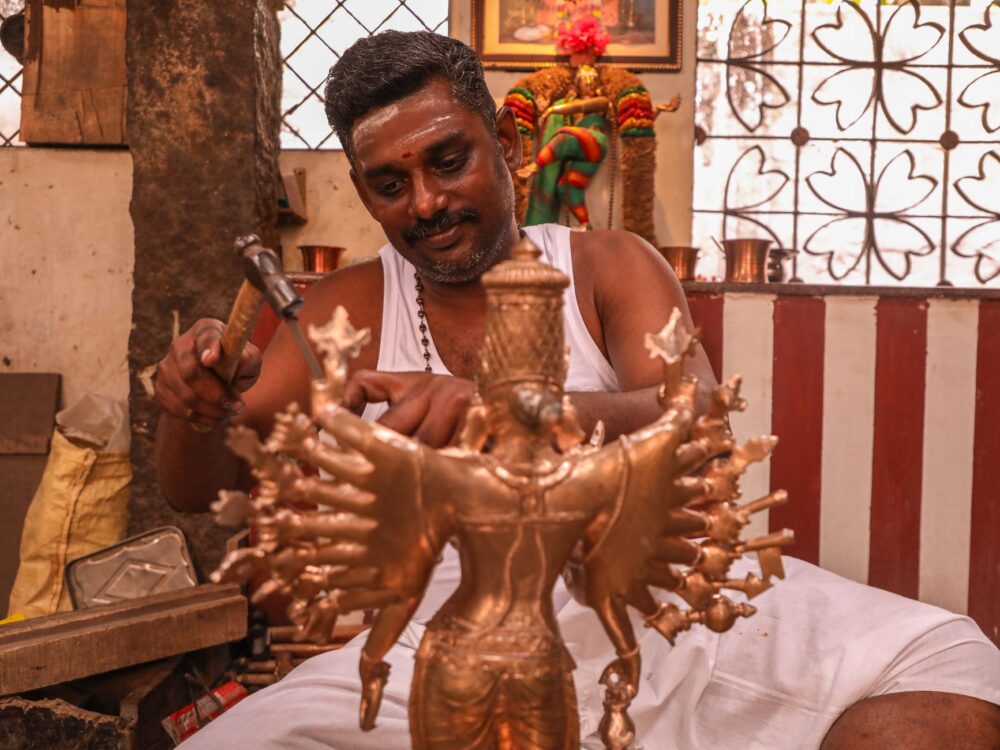

In the Puri district of India’s eastern state of Odisha, daily life is still written with a stylus on palm leaves. This is not a metaphor: it is a craft that has survived for centuries, passed down from generation to generation, and now faces its greatest challenge. The palm-leaf scribes—known locally as pothi—continue to hand-engrave religious texts, genealogies, and family chronicles onto strips of dried palm leaf, a material that outlasts paper.
This report explores how this ancient art survives in Odisha, what it means for the communities that practice it, and why its continuity is at risk. Through the observation of workshops, the review of archives, and an analysis of its cultural context, we reconstruct a documentary profile of a tradition that endures on the margins of modernity.
A craft born of forest and ritual
Palm-leaf writing in Odisha is not a simple recording method. It is deeply tied to the state’s agricultural cycle and ritual life. The leaves come from the talipot palm (Corypha umbraculifera), a species that flowers only once in its lifetime and then dies. Its slow reproduction makes each leaf a precious resource, and its harvesting follows a traditional calendar that respects the plant’s cycles.
In the workshops of Puri, the process begins with cutting and drying the leaves, which are then smoothed and cut into rectangular strips. The scribe uses an iron stylus to incise the letters, then applies a mixture of charcoal and oil to make the text legible. The result is an object that can last for centuries if properly stored.
«The palm leaf is not a neutral medium: it imposes its rhythm, its texture, and its fragility. Writing on it means negotiating with time,» notes a researcher at the Odisha State Archives.
Family memory engraved on palm strips
One of the most persistent functions of this craft is genealogy. Many families in Odisha keep their family trees on palm leaves that go back several generations. These documents record not only names and dates but also stories of migration, land disputes, and marriage alliances. In a state where oral tradition is strong, the palm leaf acts as a material anchor.
In villages near Bhubaneswar, the state capital, some scribes still receive commissions to update these records. The work is slow and meticulous: every letter must be engraved with precision, and any mistake forces the leaf to be discarded. Clients are often elderly families who value the permanence of the medium over the volatility of digital archives.
The Jagannath Temple and sacred writing
The connection between palm leaves and religion is inseparable in Odisha. The Jagannath Temple in Puri is one of India’s most important spiritual centers and has been a hub of manuscript production for centuries. Ritual texts, hymns, and temple chronicles were copied onto palm leaves for preservation.

Today, although printing and digital media have replaced much of that function, some scribes still work for the temple and for devotional communities. Writing is not just a technical act: it is an offering. Each engraved leaf becomes an object of veneration, and its production is surrounded by rules of purity and respect.
The last workshops of Puri
In the Puri district, few workshops remain dedicated exclusively to palm-leaf writing. Most artisans combine this activity with other crafts, such as wood carving or traditional painting. Demand has fallen, and young people rarely see this work as an economically viable path.
However, some masters have begun teaching the craft to small groups, often in collaboration with museums and universities. The goal is not only to preserve the technique but also to document the texts still held in family and temple archives. Digitization is presented as a complementary tool, not a substitute.
A heritage at risk of silence
UNESCO has recognized the importance of Odisha’s palm-leaf manuscripts, but recognition does not guarantee the craft’s survival. The factors threatening its continuity are multiple: scarcity of raw material, lack of generational replacement, and competition from cheaper, faster media.

Moreover, climate change affects the talipot palms, whose flowering cycle is becoming increasingly irregular. Scribes depend on a fragile ecosystem, and any alteration in their environment has direct consequences for their work. The relationship between landscape and daily life becomes evident here: without palms, there are no leaves; without leaves, there is no writing.
The human dimension of the craft
Behind every engraved leaf is a person who has spent years perfecting their technique. Odisha’s scribes typically begin their apprenticeship in adolescence and take decades to master the stylus. Their work is solitary and requires extreme concentration. It is not uncommon for a scribe to spend weeks engraving a single text.
The life stories of these artisans reflect a mix of pride and resignation. They know their craft is unique, but also that the world that sustained it is crumbling. Some have found in teaching a way to prolong their legacy; others simply continue because they cannot conceive of another life.

«I don’t write for the future. I write because it’s what I know how to do, and because while I do it, I feel that something of my ancestors is still alive,» confesses a scribe from a village near Puri.
Between tradition and innovation
Some artisans have begun experimenting with new formats: palm-leaf notebooks for tourists, bookmarks, or even contemporary artworks incorporating the traditional technique. These initiatives seek to generate income without betraying the essence of the craft, though they are not without criticism.
Purists argue that the palm leaf should not become a souvenir, and that its value lies precisely in its ritual and documentary function. Innovators respond that the only way for the craft to survive is to adapt to a market that no longer needs sacred manuscripts. The debate is open.
The landscape as a living archive
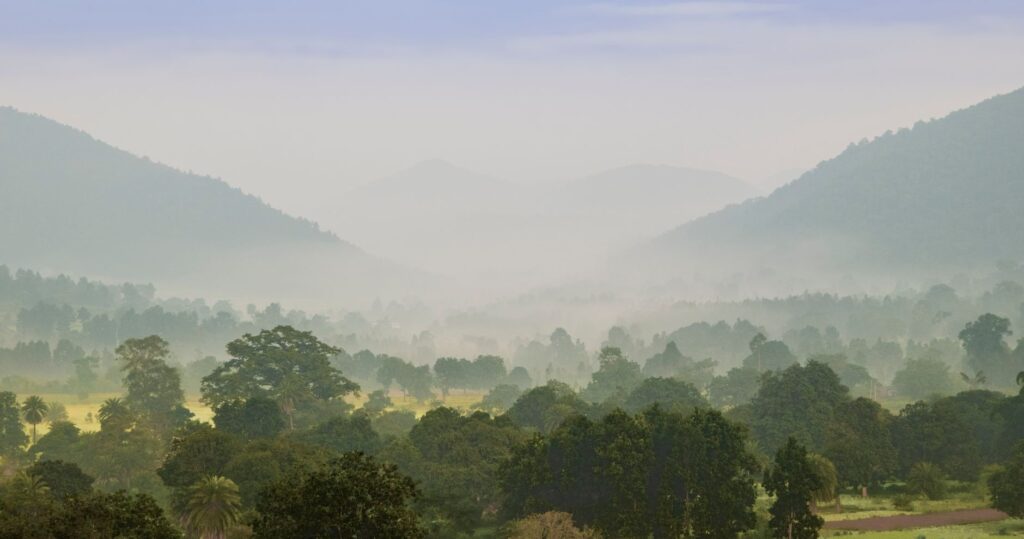
In Odisha, the landscape is not a mere backdrop. The talipot palm forests, the stone temples, and the canals crossing the Mahanadi delta are part of a cultural system that sustains writing. Every element of the environment has meaning and function within the tradition.
Scribes know the palm’s cycles, the winds that dry the leaves, and the seasons favorable for work. Their knowledge is both technical and ecological, and its loss would affect not only a craft but also a way of understanding the relationship between humans and their environment.

Practical guide
If you wish to learn about the palm-leaf writing tradition in Odisha, consider the following points:
- Where to go: The Puri district, especially villages near the city of Puri and the Bhubaneswar area, concentrates most active workshops. The Odisha State Museum in Bhubaneswar holds an important collection of manuscripts.
- When to travel: The dry season, from November to February, is the most suitable time to visit the region. Avoid the monsoon months, when rains make travel difficult.
- How to respect: If you visit a workshop, ask permission before photographing. Palm-leaf writing is a ritual craft for many families, and discretion is appreciated.
- What to read: The Jagannath Temple archives and publications from the Odisha Department of Culture offer historical context. There are no updated official figures on the number of active scribes, so any data should be treated with caution.
- What to avoid: Do not buy old palm leaves without guarantees of legal provenance. The manuscript trade can contribute to heritage looting.
Palm-leaf writing in Odisha is much more than an artisanal technique. It is a testament to how communities have found ways to record their memory on materials that time respects. Its continuity depends on human decisions, but also on the health of a landscape that has been, for centuries, its most silent ally.