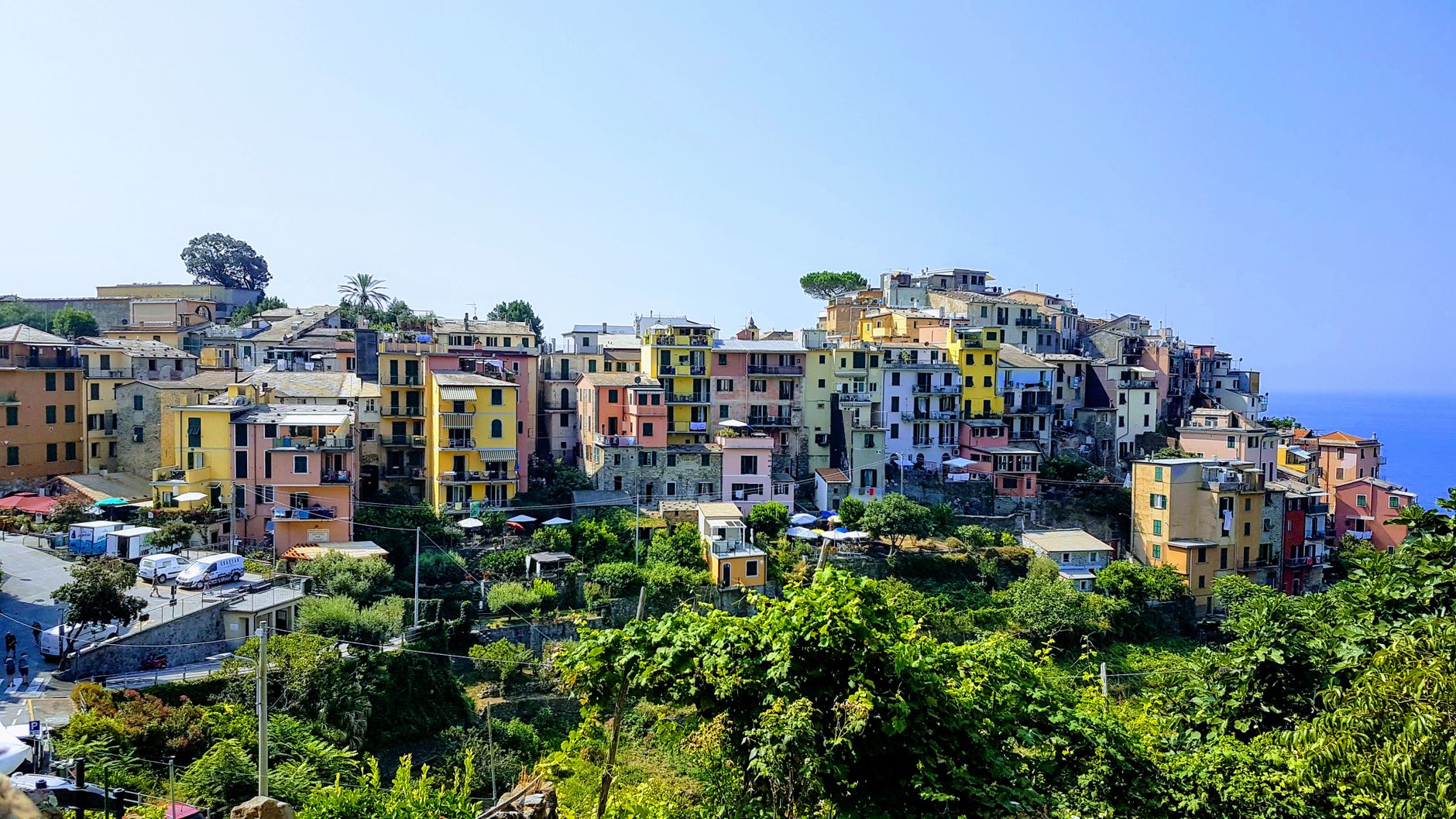

On the eastern coast of Liguria, between the sea and a slope that plunges toward it, five tiny villages cling to the rock. Monterosso, Vernazza, Corniglia, Manarola and Riomaggiore make up the Cinque Terre, a cultural landscape recognized by UNESCO together with Portovenere and the islands of Palmaria, Tino and Tinetto. It is not merely a spectacular backdrop: it is the result of a thousand years of human labour on terrain that, without that effort, would revert to dense scrub.
The question running through this story is not how to visit the Cinque Terre, but how they are sustained. Behind every viewpoint lie dry-stone walls, hand-repaired paths and families farming near-vertical slopes. Understanding that mechanism is understanding why this place still stands.
A landscape built, not found
The coastal strip stretching from Levanto to La Spezia runs for about fifteen kilometres of jagged cliffs. For centuries it was almost inaccessible by land; until the Genoa–La Spezia railway arrived in the 1870s, the sea was the main route. That isolation explains the density of its terraces: inhabitants turned steep slopes into cultivable plots, held up by sandstone walls fitted together without mortar.
UNESCO describes the site as a cultural landscape of great scenic and cultural value, where the layout of the villages and the shaping of the surroundings encapsulate the continuous history of human settlement in the region over the past millennium. The terraces, in some stretches up to two kilometres long, climb from a few metres above sea level to around four hundred, the limit where cultivation ceases to be viable.
The Cinque Terre landscape is not a natural stage set: it is a collective work that demands constant maintenance to avoid disappearing.
Dry stone as infrastructure
The walls supporting the terraces were mostly built in the 12th century, when Saracen raids from the sea came to an end, according to the site’s documentation. They are made of irregular sandstone blocks bonded with small stones removed from the ground. No cement is used; their stability depends on fit and drainage.
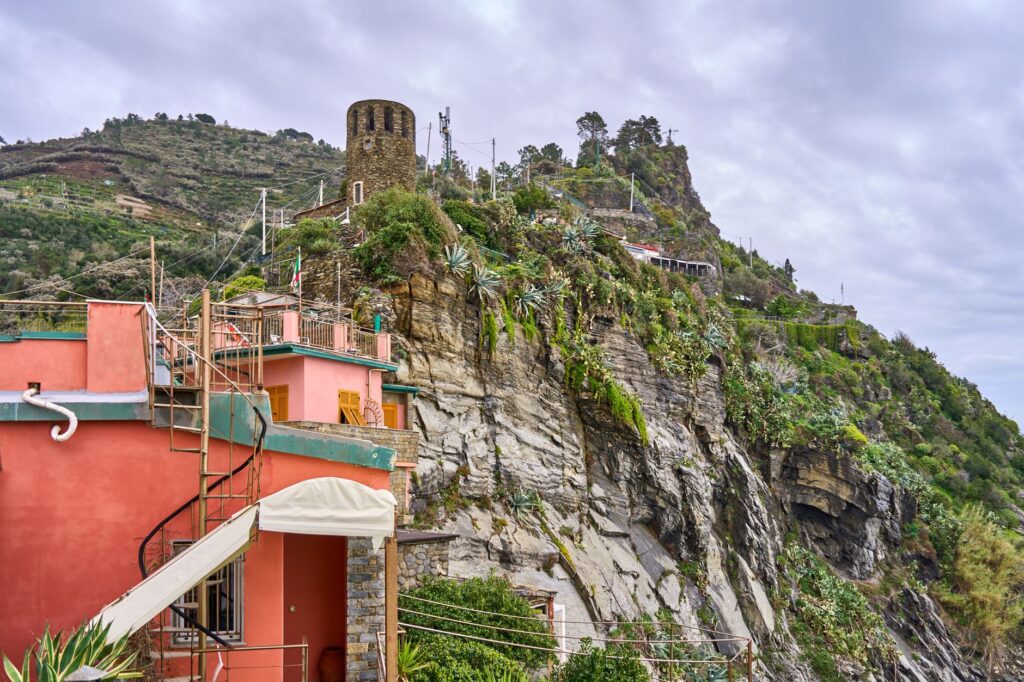
That technique turns each terrace into a small piece of hydraulic engineering. Rainwater filters between the stones, preventing waterlogging and reducing the risk of landslides. When a wall collapses and no one repairs it, water begins to undermine the slope and the damage spreads downhill.
UNESCO warns that the terraced agricultural system, including wall maintenance and water management, remains highly vulnerable. At the time of inscription, urgent reconstruction was estimated for about 130 metres of wall per hectare of vineyard and between 30 and 300 metres per hectare of olive grove.
Five villages, five ways of living on the edge
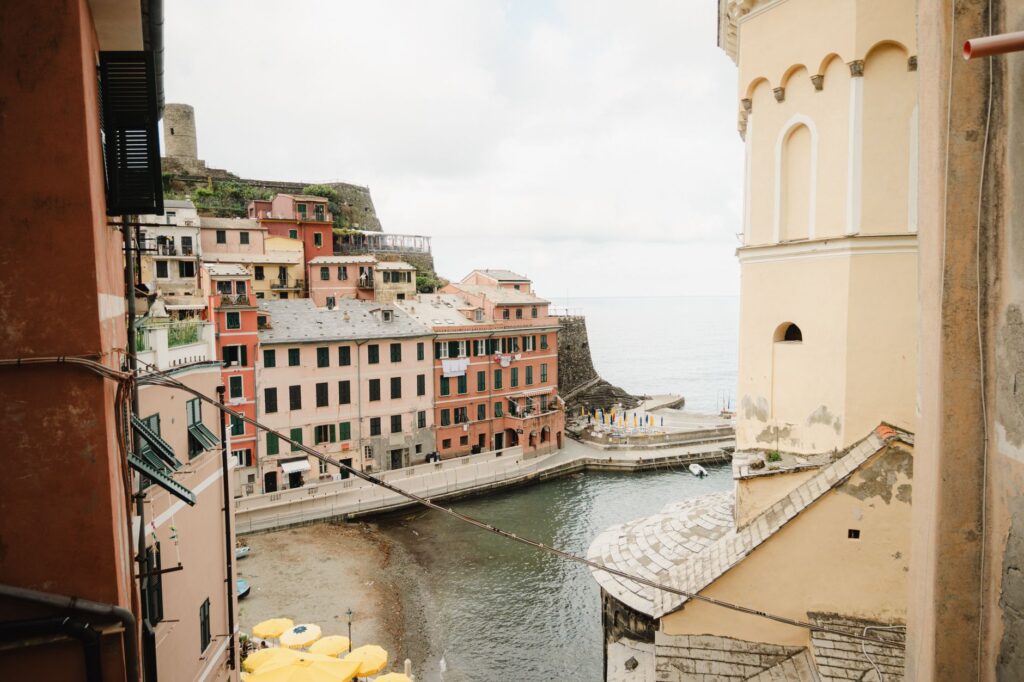
Each village solved the same problem — living between the sea and the slope — differently. Monterosso al Mare, the northwesternmost, spreads across two short valleys and has one of the few beaches in the area. Vernazza is organized around the Vernazzola stream, sheltered by a rocky spur that protects it from the sea.
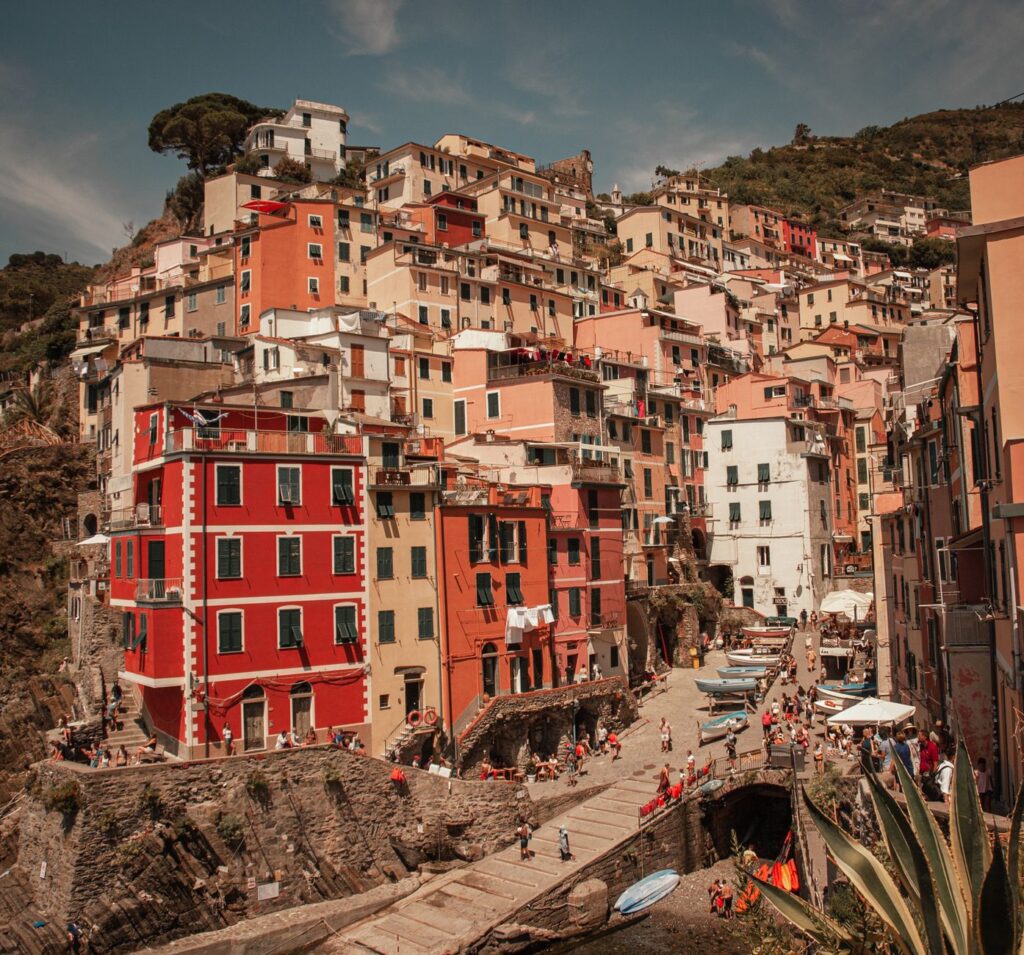
Corniglia is the exception: it does not face the water directly but stands on a high promontory. Manarola distributes its houses between a rocky spur and the Grappa stream. Riomaggiore, the easternmost and southernmost, lines the narrow valley of the Rio Maggiore, now covered and used as the main street.
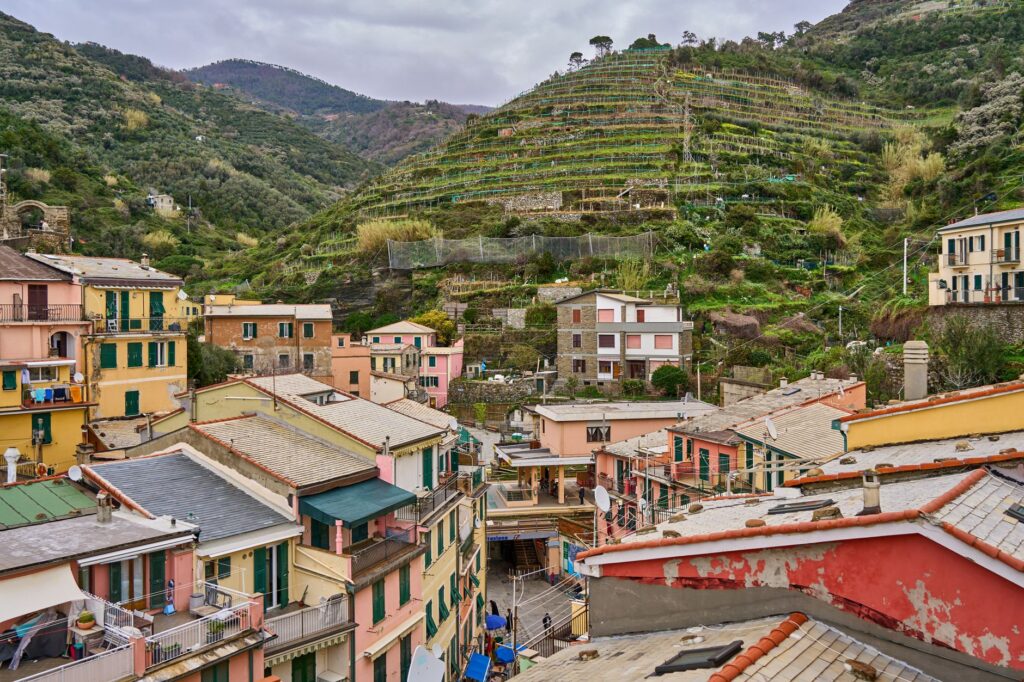
The widespread use of natural stone for roofing gives the settlements a distinctive appearance, and buildings tend to cluster around churches or medieval castles. Scattered across the slopes are small stone huts, isolated or grouped, once used for temporary shelter during the harvest.
Community as a conservation system
The maintenance of terraces and the cultivation of vines and olive trees reflect, according to UNESCO, a communal approach to farming and a collaboration without which such cultivation would not have been possible. It is not a sum of individual efforts but a collective logic: paths, walls and water are managed as shared assets.
That social dimension is what sustains the site’s outstanding value. UNESCO recognizes this explicitly, noting that the landscape illustrates a traditional way of life that has existed for a thousand years and continues to play an important socio-economic role in the life of the community.
Today that continuity coexists with tourism pressure. The 1997 World Heritage inscription was accompanied by the creation of a marine protected area and the transformation of the regional park into a national park in 1999. Specific plans and regulations exist for the Cinque Terre and Portovenere parks, with strict limits on tourist facilities.
The authenticity of the place depends on farmers still finding economic and social meaning in tending the terraces.
Wine, oil and the value of difficulty
Slope viticulture is costly. Every operation — pruning, harvesting, repairing a wall — is done on foot, with no room for mechanization. That difficulty is also why the landscape survives: as long as grapes and olives justify the effort, someone will maintain the walls.
UNESCO stresses that the site’s authenticity is tied to sustaining traditional farming and wine-growing systems and their integrated settlements. It also notes that support is needed so farmers can add value to their produce and sustain their livelihoods and the landscape.
Cinque Terre wine, produced on near-vertical terraces, is the most direct expression of that economy. It does not compete on volume; it competes on origin. Each bottle summarizes work that cannot be industrialized without destroying what makes it possible.
Risks that are not abstract
The vulnerability of the place is concrete. UNESCO notes that some abandoned terraces are now highly prone to landslides and need to be mapped and recorded. Spontaneous reforestation also threatens the terraces, because uncontrolled vegetation breaks the structure of the walls.
Floods have affected some villages and the watercourses descending the terraced slopes. Although damage has been limited to specific areas, not all have been fully restored, and mitigation measures must be assessed for their impact on the site’s outstanding universal value before being carried out.
That warning matters: not every intervention is beneficial. A poorly designed project can solve a local problem while degrading the whole. Managing the site involves coordinating municipalities, provinces, the region, parks and heritage offices, with a coordination committee and a permanent technical group.
What such a place can teach
The Cinque Terre are not a case of passive conservation. They are an example of a landscape that exists only while it is worked. That is an uncomfortable lesson in a world that tends to separate nature and culture, or to protect heritage by freezing it.
Here, real protection is use: cultivation, repair, the transmission of crafts. UNESCO frames it as a harmonious interaction between people and nature producing a landscape of exceptional scenic quality. But that harmony is not spontaneous; it is the result of decisions and continuous work.
For travellers, understanding this changes the experience. The viewpoints remain beautiful, but they stop being a mere backdrop. They become the visible surface of a system that requires hands, agreements and time.
Practical guide
The most sensible way to explore the Cinque Terre is on foot and by train. The railway connects the five villages and avoids reliance on cars, whose circulation and parking are heavily restricted. Trails require proper footwear: there are sections with steps, gradients and uneven surfaces.
Check trail conditions before setting out, as some paths may close for maintenance or geological risk. The Cinque Terre National Park and the Portovenere Regional Park manage the area, and specific landscape and heritage protection rules apply.
- Travelling outside peak months reduces pressure on the villages and improves the experience.
- Respect the crops: terraces are working spaces, not just viewpoints.
- Choosing local products, such as wine or oil, directly supports landscape maintenance.
- Carry water and sun protection: some stretches offer little shade and limited services.
- Consult official park and UNESCO site sources for up-to-date schedules, routes and restrictions.
Portovenere, with its Doria Castle and the islands of Palmaria, Tino and Tinetto, completes the visit. Tino and Tinetto preserve remains of early monastic settlements, and the whole is testimony to an intense relationship between communities, sea and territory.
A landscape cared for by hand
At sunset, when the light grazes the stone walls and houses glow above the water, the Cinque Terre seem suspended. But what holds that image together is not the light: it is the walls, the paths and the people who keep walking up and down them.
The greatness of this corner of Italy lies not only in what is seen but in what is done every day to keep it alive. A cultural landscape is, in the end, a renewed promise: that someone will be willing to repair the next stone that falls.