Western Granada unfolds as an invisible and fascinating frontier, a mid-mountain territory where water, limestone, and medieval history have woven a landscape far removed from mass tourism circuits. Far from the hustle and bustle of the Alhambra and the peaks of the Sierra Nevada, this western sector of the province preserves a geological and monumental heritage that demands time, patience, and a careful gaze. Driving through the region allows visitors to understand the complexity of a land that for centuries functioned as the defensive border of the Nasrid Kingdom, a fortified limes dotted with watchtowers, gorges, and fertile vegas where time seems to slow down.
This two-day journey through the western part of Granada does not pursue the rush of major highways, but rather the slow pulse of secondary roads. From the cold trout waters of Riofrío to the vertiginous cliffs of Alhama de Granada, the trip proposes a constant dialogue between archaeological heritage, defensive architecture, and astronomical observation under some of the clearest skies in the southern Iberian Peninsula. A rigorous itinerary that reveals the most authentic, silent, and profound face of the Andalusian interior.
The Springs of Riofrío and the Gateway to Loja
The journey begins in Riofrío, a village in the municipality of Loja famous throughout the peninsula for its fish farms and the excellence of its organic caviar production. Here, the Genil River and its tributaries emerge directly from the karstic depths of the Sierra de Loja, generating a constant flow of crystalline, cold waters that sustain a rich gastronomic tradition linked to trout. The purity of these springs has turned the small settlement into an obligatory stop to understand how the traditional use of water has shaped the local economy for decades.
A few kilometers away stands Loja, the historic city that Arab chroniclers called the key to the kingdom. Its urban fabric, stepped along the foothills of the mountain range, retains notable traces of its Andalusian and Christian past. The Alcazaba and the remains of its walls recall the harshness of the sieges and the strategic importance of its geographical position in the Genil Valley. Strolling through its steep streets reveals Mudejar churches and noble mansions that bear witness to the commercial and administrative splendor the town achieved after the Castilian conquest in the late 15th century.
Montefrío and Monumentality Above the Gorge
The route continues north toward Montefrío, a town whose urban silhouette has been cataloged by international publications among the most beautiful and unique in the world. The white village spreads across the slope of a deep gorge crowned by the singular Church of the Villa, a Renaissance temple built upon the foundations of the ancient Nasrid fortress. The perspective from the scenic viewpoints offers an imposing panoramic view that contrasts with the apparent fragility of the houses suspended over the limestone abyss.
Beyond its obvious photographic appeal, Montefrío holds a first-rate archaeological treasure: the prehistoric settlement of Villavieja. This Neolithic and Bronze Age site documents the earliest forms of sedentarism and social organization in the highlands of Granada. Scientific excavations have brought to light residential structures and burial goods that demonstrate the strategic importance of this enclave millennia before the arrival of Iberian and Roman cultures.
Moclín and the Historic Orchards of the Border
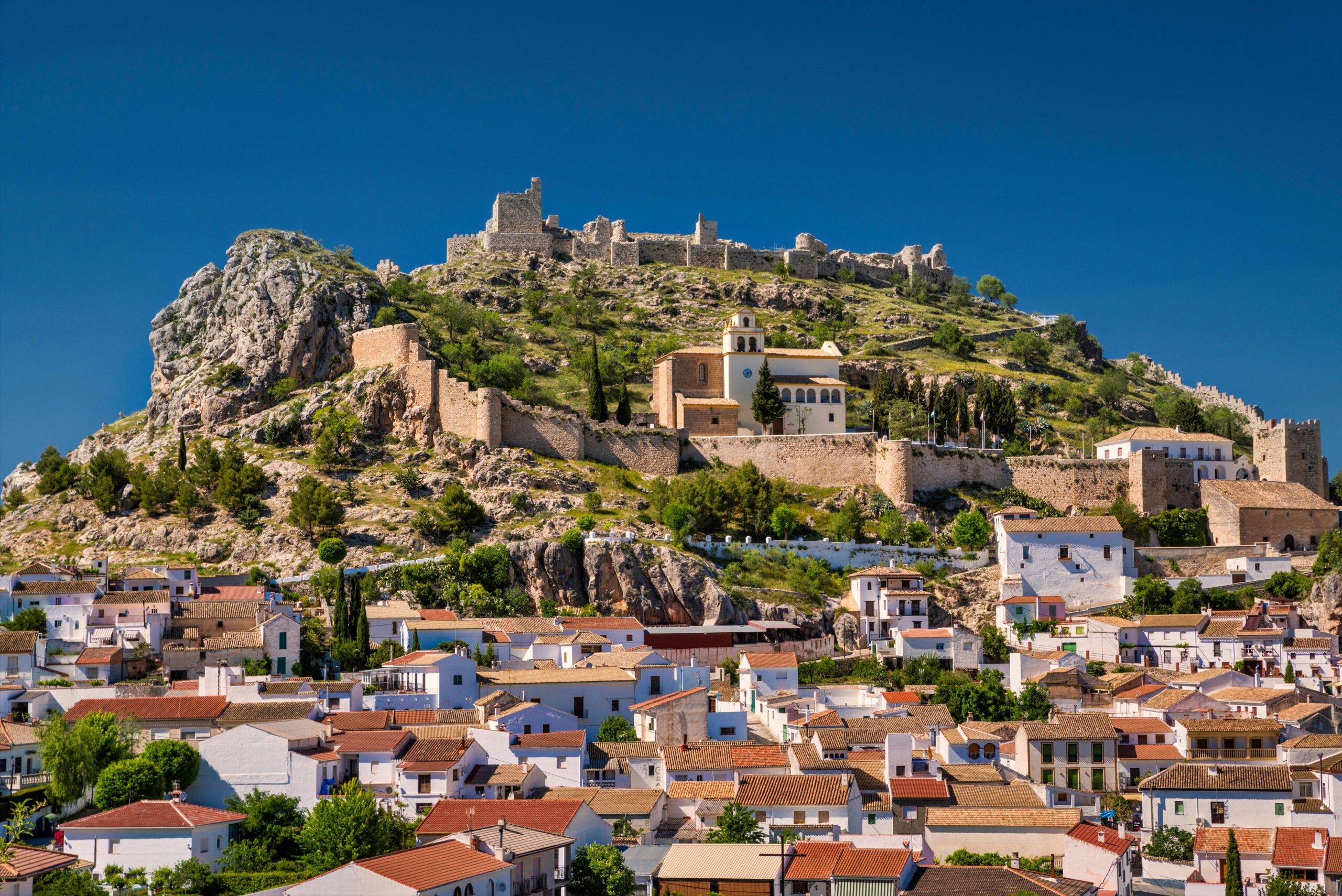
Following the line of ancient fortifications, the road winds toward Moclín, perched almost impregnably on a hill dominating the approaches to the Vega de Granada. The medieval castle, flanked by an intricate system of walls and natural cliffs, formed part of the Nasrid kingdom’s defensive system to contain the Christian advance. The visit to the walled enclosure reveals the scale of a fortification designed to house permanent garrisons and ensure control of the era’s commercial and military passes.
At the foothills of the municipality, the landscape changes radically to give way to traditional orchards and paths descending toward the Hoya del Moro and the Cimbarra cliffs. These natural spots, alongside their botanical and landscape value, preserve rock shelters with schematic cave paintings testifying to uninterrupted human presence since prehistory. Respect for the rural environment is the only way to understand the delicate symbiosis that has existed for millennia between these mountain dwellers and their natural resources.
A Window to the Cosmos at Sky Andaluz Observatory
As evening falls, the journey moves away from strictly historical tracks to delve into science and the contemplation of the night sky. Located in one of the areas with the lowest light pollution in the province, the Sky Andaluz observatory offers cutting-edge infrastructure for astronomical outreach. The professional telescopes installed in the complex allow visitors to explore nebulae, star clusters, and planets with an unusual level of detail in publicly accessible facilities.
The nocturnal experience is completed with informative talks given by professional astronomers who explain the importance of protecting dark skies against urban light pollution. The atmospheric clarity of Granada’s mountains makes this enclave an international reference for sustainable astrotourism, demonstrating that the heritage of this region extends far beyond the earth’s surface into the celestial vault.
Alhama de Granada and the Roar of the Clefts
The second day of the itinerary culminates in Alhama de Granada, a monumental city famous both for its stunning location atop the Marchán River gorges and for its historic thermal springs. The canyon, carved by fluvial erosion over millennia, literally cuts through the plateau upon which the urban center sits, generating a landscape of great visual force and dramatic beauty. The historic bridges spanning the abyss connect the old neighborhoods with the Renaissance convents and hospitals dotting the urban fabric.
Alhama’s sulfurous waters, harnessed since Roman times and extensively developed during the Andalusian period, still emerge hot in the baths located at the bottom of the gorge. This hydrothermal heritage keeps alive a tradition of health and rest that has defined the locality’s identity over the centuries, offering travelers a space of introspection after the intense journey through the western roads.
Western Granada does not surrender to the impatient traveler; it demands contemplation, respect for the silences of stone, and the capacity to listen to the stories held within its ravines.
Practical guide
To undertake this journey through Western Granada, having a personal vehicle is recommended, preferably an agile car that allows comfortable transit along secondary mountain roads connecting the different municipalities.
How to get there
The natural starting point is the city of Granada or Málaga, both connected by the A-92 highway, which crosses the region from east to west, facilitating direct access to Riofrío and Loja in under 45 minutes.
When to visit
Spring and autumn are the optimal seasons due to mild temperatures and the lush state of vegetation in the vegas and riverbeds, avoiding the extreme heat of the summer months.
Where to stay
The region features a growing network of restored rural accommodations, small charming hotels in former mills, and manor houses in towns like Montefrío, Loja, and Alhama de Granada.
Gastronomy and recommendations
Tasting Riofrío trout, local organic caviar, extra virgin olive oil, and traditional spoon dishes from the mountain cuisine of Granada is essential.
The final stretch of the journey toward the deep south of Western Granada ventures onto dirt tracks bordering the ravines of Alhama as the sun begins to melt behind distant peaks. At that precise moment, when golden light bathes the limestone walls and the countryside’s silence reclaims its hegemony, the traveler understands that the true luxury of this route lies in the territory’s capacity to keep its geological and human memory intact. The traces of past civilizations are not exhibited here as mere museum relics, but as a living, breathable element permeating every corner of the landscape, inviting a reflective pause before returning to the fast pace of the contemporary world.
Source: El País (https://elpais.com/elviajero/escapadas/espana/2026-09-25/de-riofrio-a-alhama-road-trip-por-el-poniente-de-granada.html)